
Regional Sustainability ›› 2026, Vol. 7 ›› Issue (1): 100300.doi: 10.1016/j.regsus.2026.100300
• Full Length Article • Previous Articles
Nasrulloev FARHODa,b, CHEN Yaninga,*( ), Sheralizoda NAZRIALOb, Gulahmadov NEKRUZa, Shobairi SEYED OMID REZAa, Murodov MURODKHUJAa,b
Received:2025-06-19
Revised:2025-11-21
Accepted:2026-01-04
Published:2026-02-28
Online:2026-01-21
Contact:
CHEN Yaning
E-mail:chenyn@ms.xjb.ac.cn
Nasrulloev FARHOD, CHEN Yaning, Sheralizoda NAZRIALO, Gulahmadov NEKRUZ, Shobairi SEYED OMID REZA, Murodov MURODKHUJA. Hydrological change trends of the Surkhob and Khingov river basins in the Vakhsh River of Tajikistan under climate change[J]. Regional Sustainability, 2026, 7(1): 100300.
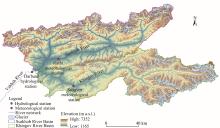
Fig. 1.
Overview of the study area."
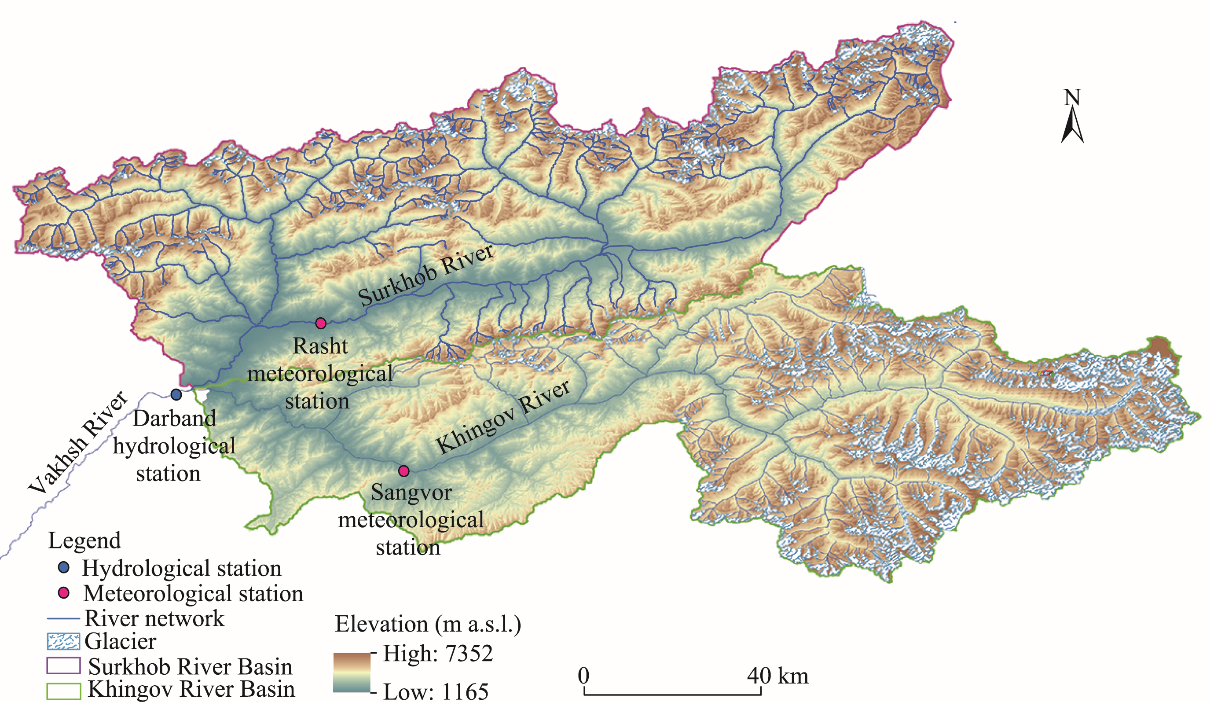
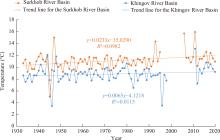
Fig. 2.
Annual mean temperature change trend in the Surkhob and Khingov river basins using the data from the Rasht and Sangvor meteorological stations during 1933-2020. The Rasht meteorological station was not operational during 1999-2010 and the Sangvor meteorological station was not operational during 1996-2005."
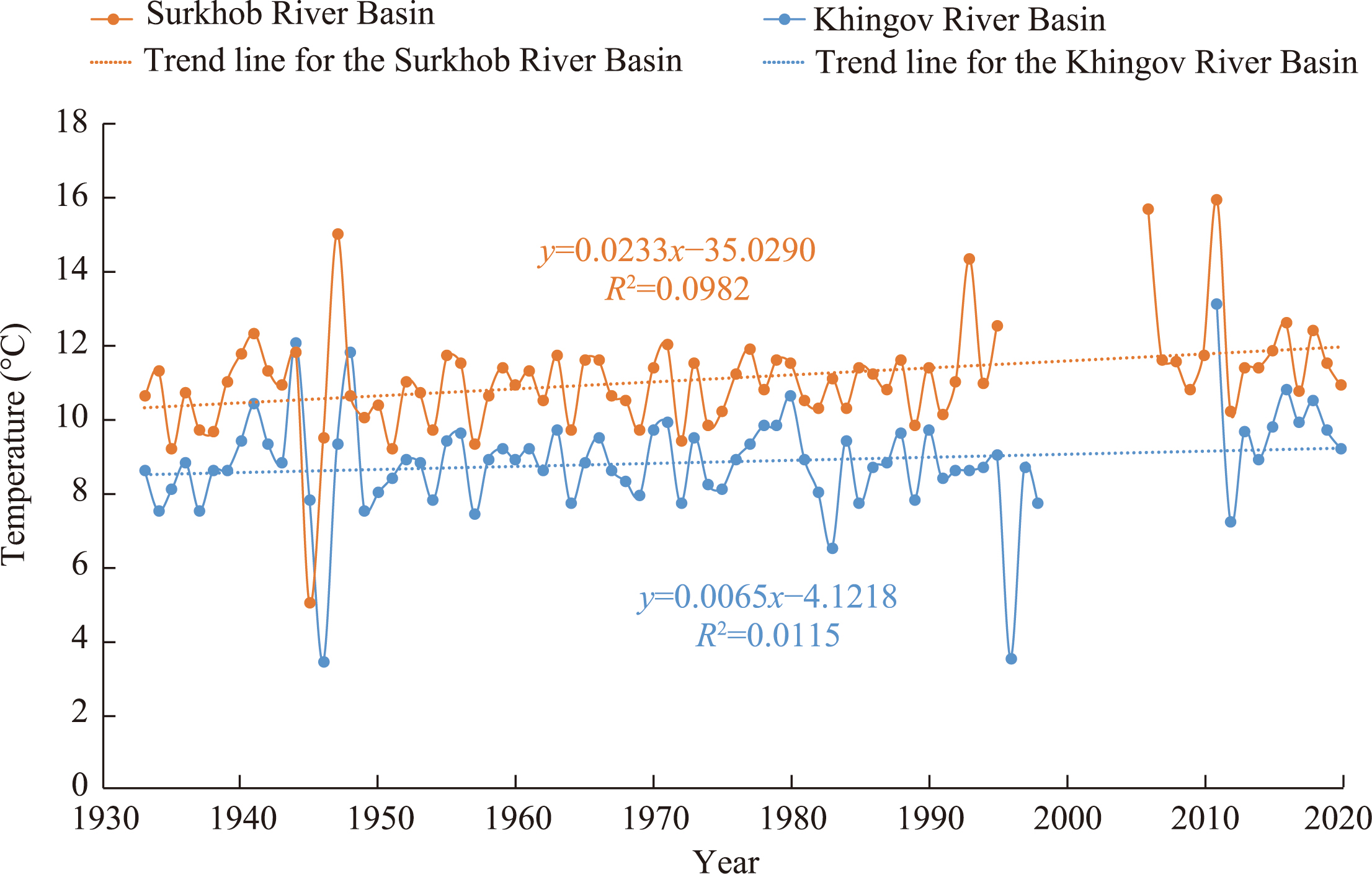
Table 1
Annual mean temperature at the Rasht and Sangvor meteorological stations and its change trend during 1933-2020."
| Period | Sangvor meteorological station (°C) | Rasht meteorological station (°C) | Change trend |
|---|---|---|---|
| 1933-1960 | 8.72 | 10.73 | Baseline level |
| 1960-1990 | 8.81 | 11.13 | Moderate warming |
| 1990-2020 | 9.51 | 11.92 | Accelerated warming |
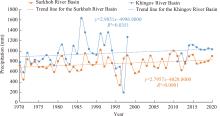
Fig. 3.
Annual mean precipitation change trend in Surkhob and Khingov river basins using the data from the Rasht and Sangvor meteorological stations during 1970-2020. The Sangvor meteorological station was not operational during 1999-2010."

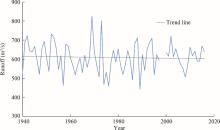
Fig. 4.
Annual mean runoff variation of the Vakhsh River using the data from the Darband Hydrological station during 1940-2018. Darband Hydrological station was not operational during 1998-1999."
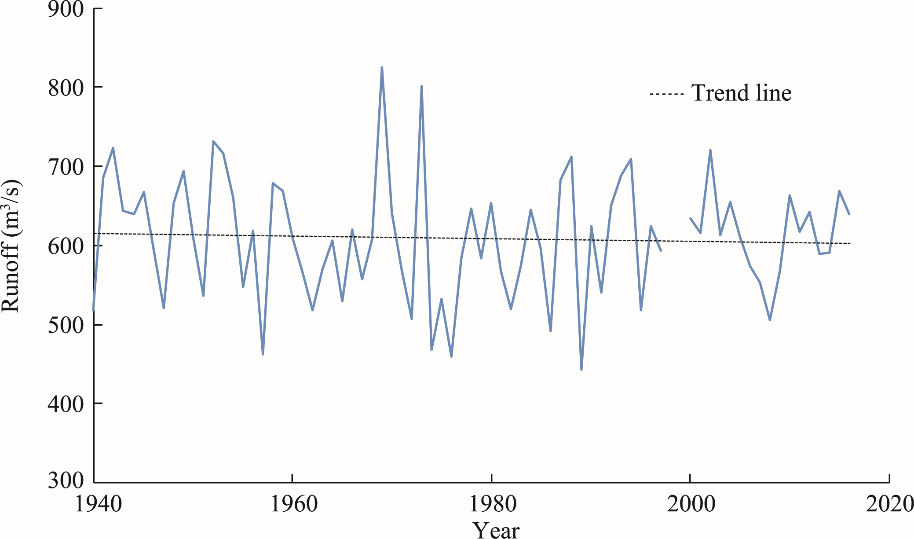
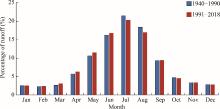
Fig. 5.
Percentage of monthly runoff in the Vakhsh River during 1940-1990 and 1991-2018."
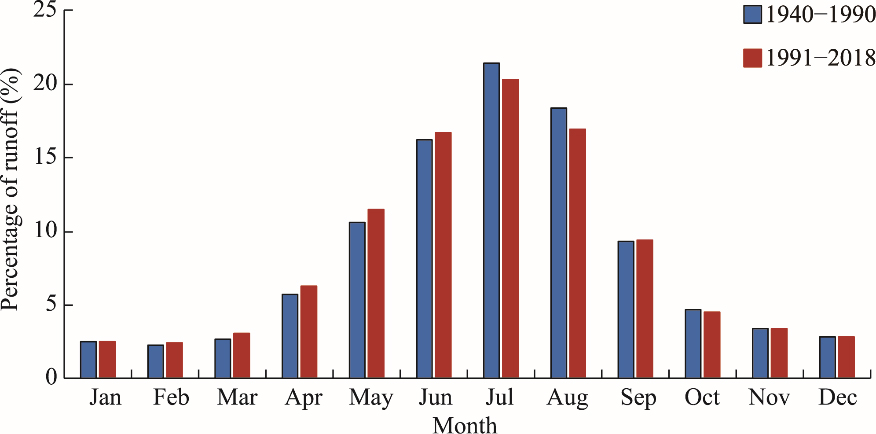
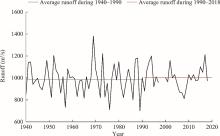
Fig. 6.
Runoff change trend in the Vakhsh River Basin during 1940-2018."
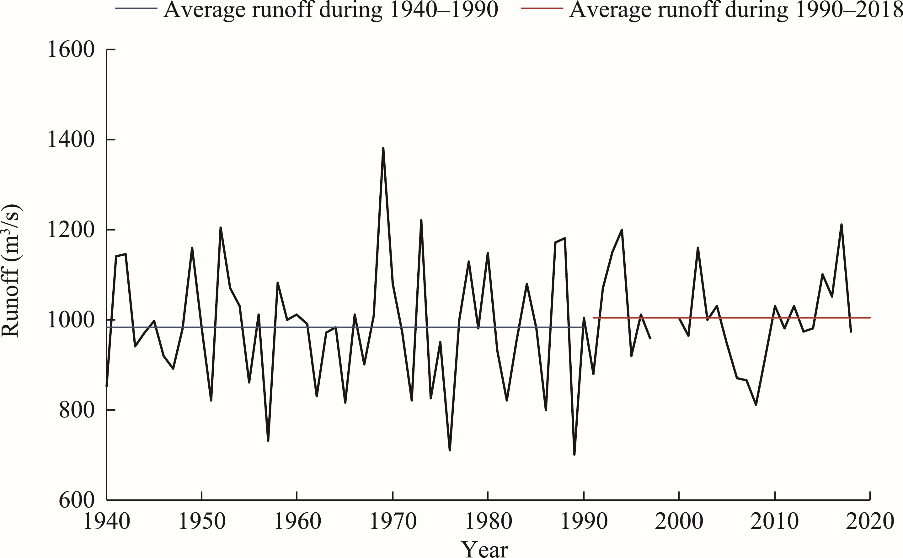
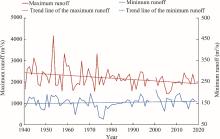
Fig. 7.
Long-term change trend of the annual maximum and minimum runoff in the Vakhsh River during 1940-2018."
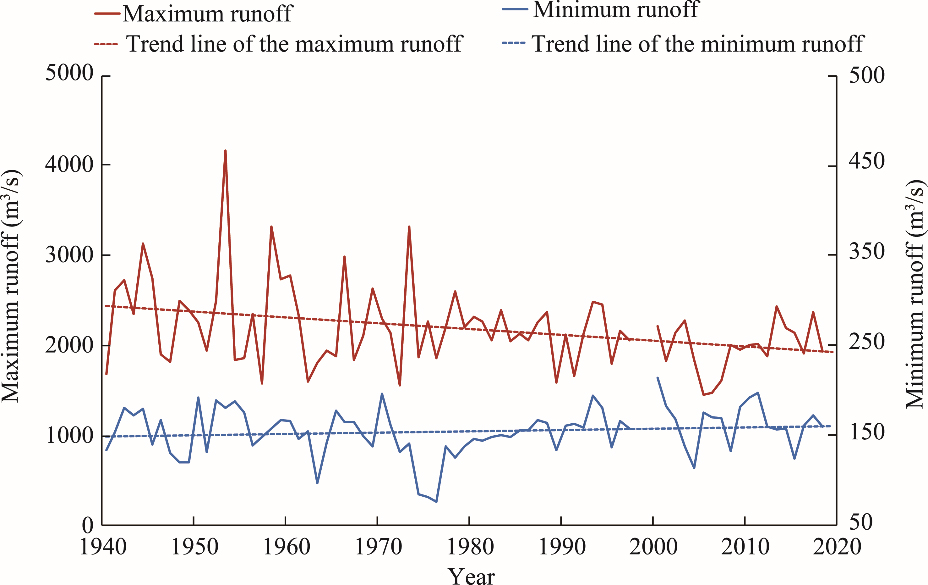
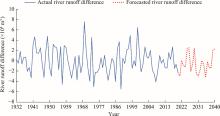
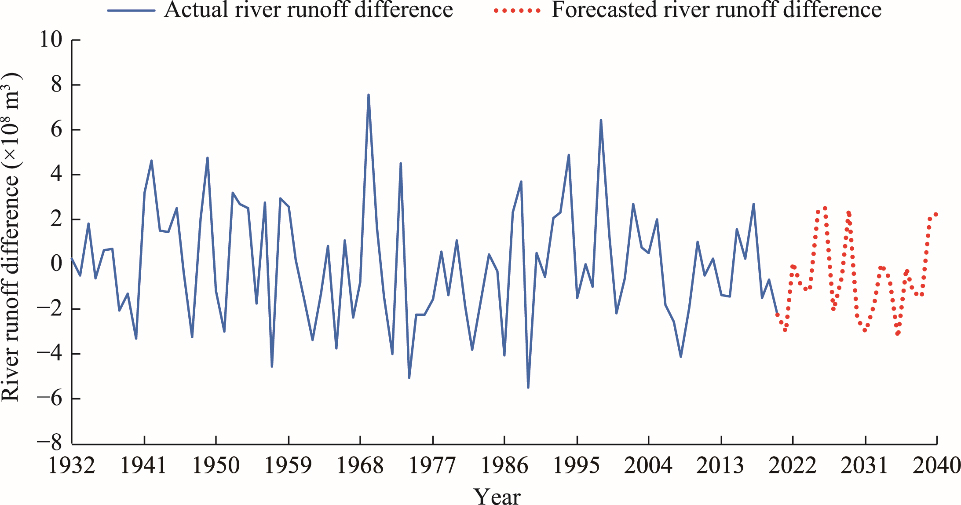
Fig. 8.
Actual and forecasted river runoff differences in the Vakhsh River during 1932-2040."
| [1] |
Ahmed K., Shahid S., Chung E.S., et al., 2017. Spatial distribution of secular trends in annual and seasonal precipitation over Pakistan. Climate Research. 74(2), 95-107.
doi: 10.3354/cr01489 |
| [2] |
Aizen V.B., Aizen E.M., Melack J.M., 1995. Climate, snow cover, glaciers, and runoff in the Tien Shan, Central Asia. JAWRA Journal of the American Water Resources Association. 31(6), 1113-1129.
doi: 10.1111/jawr.1995.31.issue-6 |
| [3] | Barandun M., Pohl E., Naegeli K., et al., 2021. Hot spots of glacier mass balance variability in Central Asia. Geophysical Research Letter. 48(11), e2020GL092084, doi: 10.1029/2020GL092084. |
| [4] |
Barandun M., Pohl E., 2023. Central Asia’s spatiotemporal glacier response ambiguity due to data inconsistencies and regional simplifications. The Cryosphere. 17, 1343-1371.
doi: 10.5194/tc-17-1343-2023 |
| [5] |
Chen Y.N., Li W.H., Fang G.H., et al., 2017. Review article: Hydrological modeling in glacierized catchments of Central Asia—status and challenges. Hydrology and Earth System Sciences. 21, 669-684.
doi: 10.5194/hess-21-669-2017 |
| [6] | Cui Y.J., Chen L.J., Li M.M., et al., 2018. The study of watershed topography characteristics in Vakhsh River based on ZY3-DSM. The International Archives of the Photogrammetry, Remote Sensing and Spatial Information Sciences. 3, 245-252. |
| [7] |
Eyring V., Bony S., Meehl G.A., et al., 2016. Overview of the Coupled Model Intercomparison Project Phase 6 (CMIP6) experimental design and organization. Geoscientific Model Development. 9, 1937-1958.
doi: 10.5194/gmd-9-1937-2016 |
| [8] | Gulakhmadov A., Chen X., Gulahmadov N., et al., 2020. Simulation of the potential impacts of projected climate change on streamflow in the Vakhsh River Basin in Central Asia under CMIP5 RCP scenarios. Water. 12(5), 1426, doi: 10.3390/w12051426. |
| [9] | Gulakhmadov A.A., 2022. Variations of the temperature and precipitation in the Vakhsh River Basin. News of the National Academy of Sciences of Tajikistan. 3(188), 152-164 (in Russian). |
| [10] | Hoelzle M., Barandun M., Bolch T., et al., 2019. The status and role of the alpine cryosphere in Central Asia. In: The Aral Sea Basin:Water for Sustainable Development in Central Asia. London: Routledge, 100-121. |
| [11] |
Huss M., Hock R., 2018. Global-scale hydrological response to future glacier mass loss. Nature Climate Change. 8(2), 135-140.
doi: 10.1038/s41558-017-0049-x |
| [12] | ICG(International Crisis Group), 2002. Central Asia:Water and conflict (Report No.34). Osh/Brussels: International Crisis Group. [2025-04-30].https://www.files.ethz.ch/isn/28347/034_central_asia_water_conflict.pdfImmerzeel. |
| [13] |
Immerzeel W.W., Lutz A.F., Andrade M., et al., 2020. Importance and vulnerability of the world’s water towers. Nature. 577(7790), 364-369.
doi: 10.1038/s41586-019-1822-y |
| [14] | IPCC (Intergovernmental Panel on Climate Change), 2022. Climate Change 2022: Impacts, Adaptation and Vulnerability. Contribution of Working Group II to the Sixth Assessment Report of the Intergovernmental Panel on Climate Change. Cambridge: Cambridge University Press. |
| [15] | Kayumov A.K., Arifov K.O., 2021. Prospects for the development of hydropower engineering under climatic change and glacier degradation. Tajikistan Economy. 1, 117-121 (in Russian). |
| [16] | Kayumov A.K., Shomahmadov A., Safarov M., 2022. Studying the relationship of meteorological parameters and snow cover in the main river basins of Tajikistan for the winter period and the beginning of spring 2017-2022. Cryosphere. 1(5), 8-39 (in Russian). |
| [17] |
Konovalov V.G., Shchetinnicov A.S., 1991. Evolution of glaciation in the Pamiro-Alai mountains and its effect on river run-off. Journal of Glaciology. 40(134), 149-157.
doi: 10.3189/S0022143000003920 |
| [18] |
Kotlyakov V.M., Osipova G.B., Tsvetkov D.G., 2008. Monitoring surging glaciers of the Pamirs, Central Asia, from space. Annals of Glaciology. 48, 125-134.
doi: 10.3189/172756408784700608 |
| [19] |
Kure S., Jang S., Ohara N., et al., 2013. Hydrologic impact of regional climate change for the snowfed and glacierfed river basins in the Republic of Tajikistan: Hydrological response of flow to climate change. Hydrological Processes. 27(26), 4057-4070.
doi: 10.1002/hyp.v27.26 |
| [20] | Liang W.T., Chen Y.N., Fang G.H., et al., 2023. Machine learning method as an alternative for hydrological modeling in alpine catchments of the Tianshan region, Central Asia. Journal of Hydrology: Regional Studies. 49, 101492, doi: 10.1016/j.ejrh.2023.101492. |
| [21] |
Normatov I.S., Goncharuk V.V., Kurbonali K., et al., 2024. Influence of natural water hydrochemistry in the Vakhsh River Basin on the water-salt regime of the irrigated agricultural land. Journal of Water Chemistry and Technology. 46(2), 93-99.
doi: 10.3103/S1063455X24010065 |
| [22] | Normatov P., 2022. The Impact of Climate Change on Hydrology and Glaciation of the Zeravshan, Vakhsh and Pyanj River Basin. In: IAHS-AISH Scientific Assembly 2022. Montpellier, France |
| [23] | Osipova G.B., Tsvetkov D.G., Shchetinnikov A.S., et al., 1998. Catalog of Surging Glaciers of the Pamir. Moscow: Glaciological Association (in Russian). |
| [24] | Petrov G.N., 2007. Long-term forecast of the water flow of the Vakhsh River. News of the Academy of Sciences of the Republic of Tajikistan. 50(6), 539-545 (in Russian). |
| [25] |
Qin J., Yang K., Liang S.L., et al., 2009. The altitudinal dependence of recent rapid warming over the Tibetan Plateau. Climatic Change. 97(1-2), 321-327.
doi: 10.1007/s10584-009-9733-9 |
| [26] | Saks T., Pohl E., Machguth H., et al., 2022. Glacier runoff variation since 1981 in the upper Naryn River catchments, Central Tien Shan. Frontiers in Environmental Science. 9, 780466, doi: 10.3389/fenvs.2021.780466. |
| [27] | Schaffer N., Gascoin S., MacDonell S., et al., 2025. Editorial: Water and hazards in mountainous regions in a changing climate. Frontiers in Water. 7, 1637903, doi: 10.3389/frwa.2025.1637903. |
| [28] |
Siegfried T., Bernauer T., Guiennet R., et al., 2012. Will climate change exacerbate water stress in Central Asia? Climatic Change. 112(3-4), 881-899.
doi: 10.1007/s10584-011-0253-z |
| [29] | Union of Soviet Socialist Republics Glacier Inventory, 1971. Catalog of Glaciers of the USSR.Leningrad: Gidrometeoizdat (in Russian). |
| [30] | Union of Soviet Socialist Republics Glacier Inventory, 1978. Catalog of Glaciers of the USSR.Leningrad: Gidrometeoizdat (in Russian). |
| [31] | Viviroli D., Dürr H.H., Messerli B., et al., 2007. Mountains of the world, water towers for humanity: Typology, mapping, and global significance. Water Resources Research. 43(7), W07447, doi: 10.1029/2006WR005653. |
| [32] | Water Resources of Tajikistan, 2003. Dedicated to the International Year of Freshwater.Dushanbe: Academy of Sciences of Tajikistan (in Russian) |
| [33] |
Xenarios S., Gafurov A., Schmidt-Vogt D., et al., 2019. Climate change and adaptation of mountain societies in Central Asia: Uncertainties, knowledge gaps, and data constraints. Regional Environmental Change. 19(5), 1339-1352.
doi: 10.1007/s10113-018-1384-9 |
| [1] | CHEN Yaning, FANG Gonghuan, LI Zhi, ZHANG Xueqi, LI Weihong, Nekruz GULAHMADOV, Farhod NASRULLOEV, Aminjon GULAKHMADOV. Water resources and sustainable management in Tajikistan under global change [J]. Regional Sustainability, 2026, 7(1): 100291-. |
| [2] | Kobiljon Khushvakht KHUSHVAKHTZODA, Ilkhom Burkhonovich MAKHSUMOV, Muzaffar Boynazarovich KHOLNAZAROV, Irina Mikhailovna KIRPICHNIKOVA. Impact of green energy development on climate change mitigation [J]. Regional Sustainability, 2026, 7(1): 100292-. |
| [3] | Hikmat HISORIEV, LI Yaoming, HUANG Wenjun, FAN Lianlian, Mekhrovar OKHONNIYOZOV, MA Xuexi. Grassland ecosystems of Tajikistan: Plant species diversity, ecological restoration, and sustainable management [J]. Regional Sustainability, 2026, 7(1): 100293-. |
| [4] | Ranna HAZIHAN, DU Hongru, HE Chuanchuan, Kobiljon Khushvakht KHUSHVAKHTZODA, Bobozoda KOMIL. Coupling dynamics of SDGs in Tajikistan from 2001 to 2023 [J]. Regional Sustainability, 2026, 7(1): 100295-. |
| [5] | XU Chunhai, LI Zhongqin, HE Zhonghua, WANG Feiteng, MU Jianxin, CHEN Yaning, Sheralizoda NAZRIALO, Farhod NASRULLOEV, Aminjon GULAHMADZODA. Current status and recent changes of glaciers in Tajikistan [J]. Regional Sustainability, 2026, 7(1): 100296-. |
| [6] | LI Chunlan, YU Yang, SUN Lingxiao, HE Jing, LU Yuanbo, GUO Zengkun, FANG Gonghuan, Alexandr ULMAN, Vitaliy SALNIKOV, Ireneusz MALIK, Małgorzata WISTUBA. Spatiotemporal heterogeneity of runoff in Tajikistan and its driving mechanisms under climate change [J]. Regional Sustainability, 2026, 7(1): 100297-. |
| [7] | LI Yupeng, CHEN Yaning, WANG Fei, ZHANG Xiang, ZHANG Qifei, SUN Fan, FANG Gonghuan, Safarkhon SHAROFIDDINOV, Jafar NIYAZOV. Risks of snow drought and impacts on streamflow in Tajikistan [J]. Regional Sustainability, 2026, 7(1): 100298-. |
| [8] | JIA Wenjun, CHEN Ningsheng, XUE Yang, WANG Zhihan, WEN Tao, GUO Ru, Safaralizoda NOSIR, Aminjon GULAKHMADOV. Spatial differentiation and risk zonation of debris flow hazards in Tajikistan [J]. Regional Sustainability, 2026, 7(1): 100299-. |
| [9] | Mahalingam Santhosh KUMAR, Narasimabhrathi Venkatesa PALANICHAMY, K. M. SHIVAKUMAR, Mani CHANDRAKUMAR, Muthuswamy KALPANA, Dhandapani MURUGANANTHI. Impact of climate change on global economy: A comprehensive review [J]. Regional Sustainability, 2025, 6(6): 100274-. |
| [10] | Yadeta BEDASA, Adeba GEMECHU, Amsalu BEDEMO. Combined adoption decisions of climate-smart agriculture and their impacts on maize yield in western Ethiopia [J]. Regional Sustainability, 2025, 6(6): 100280-. |
| [11] | Md Tauhid Ur RAHMAN, Adnan KHAIRULLAH. Integrating farmers’ perceptions and empirical climate data to assess agricultural productivity and food security in coastal Bangladesh [J]. Regional Sustainability, 2025, 6(5): 100259-. |
| [12] | Piyali KUMAR. Examining the effects of climatic and non-climatic factors on sectoral growth: Evidence from different country income groups [J]. Regional Sustainability, 2025, 6(5): 100261-. |
| [13] | Saira SHAFIQ, Muhammad ZIA UL HAQ, Syed Abbas RAZA NAQVI, Wardha SARFARAZ, Hina ALI, Muhammad Majid ISLAM, Gul Zaib HASSAN, Muhammad NAWAZ, Tasawer ABBAS. Integrating neglected and underutilized crops (NUCs) in South Asian cropping systems and diets: Challenges and prospects [J]. Regional Sustainability, 2025, 6(4): 100242-. |
| [14] | Md Maruf BILLAH, Mohammad Mahmudur RAHMAN, Santiago MAHIMAIRAJA, Alvin LAL, Asadi SRINIVASULU, Ravi NAIDU. Enhancing climate-smart coastal farming system through agriculture extension and advisory services towards the avenues of farm sustainability [J]. Regional Sustainability, 2025, 6(4): 100243-. |
| [15] | Syed Masiur RAHMAN, Asif RAIHAN, Md Shafiul ALAM, Shakhawat CHOWDHURY. Greenhouse gas emission dynamics and climate change mitigation efforts toward sustainability in the Middle East and North Africa (MENA) region [J]. Regional Sustainability, 2025, 6(4): 100246-. |
| Viewed | ||||||
|
Full text |
|
|||||
|
Abstract |
|
|||||
 REGSUS Wechat
 新公网安备 65010402001202号