
Regional Sustainability ›› 2026, Vol. 7 ›› Issue (1): 100293.doi: 10.1016/j.regsus.2026.100293
• Review Article • Previous Articles Next Articles
Hikmat HISORIEVa,b, LI Yaomingb,c,*( ), HUANG Wenjunb,c, FAN Lianlianb,c, Mekhrovar OKHONNIYOZOVa,d,e, MA Xuexib,c
Received:2025-09-08
Revised:2025-11-12
Accepted:2026-01-03
Published:2026-02-28
Online:2026-01-21
Contact:
LI Yaoming
E-mail:lym@ms.xjb.ac.cn
Hikmat HISORIEV, LI Yaoming, HUANG Wenjun, FAN Lianlian, Mekhrovar OKHONNIYOZOV, MA Xuexi. Grassland ecosystems of Tajikistan: Plant species diversity, ecological restoration, and sustainable management[J]. Regional Sustainability, 2026, 7(1): 100293.
Table 1
Main forage plant species of grassland ecosystems in Tajikistan."
| Family | Genus | Species |
|---|---|---|
| Amaryllidaceae | Allium | Allium atrosanguineum, Allium barsczewski, Allium coeruleum, Allium fedtschenkoanum, Allium odorum, Allium oschaninii, Allium rosenbachianum, Allium rosenorum, and Allium winkleranum |
| Poaceae | Alopecurus | Alopecurus mucronatus, Alopecurus ventricosus, and Alopecurus zeravshanicus |
| Asteraceae | Artemisia | Artemisia absinthum, Artemisia glaucina, Artemisia lehmaniana, Artemisia macrocephala, Artemisia tenuisecta, and Artemisia turanica |
| Fabaceae | Astragalus | Astragalus alpinus, Astragalus aksuenisis, Astragalus bornmulleranus, Astragalus breviscapus, Astragalus campylorrhynchus, Astragalus campylotrinchus, Astragalus commixtus, Astragalus corydalinus, Astragalus dignus, Astragalus dolychopodus, Astragalus filicaulis, Astragalus flexus, Astragalus harpilobus, Astragalus heterodontus, Astragalus hissaricus, Astragalus korovinianus, Astragalus lasiosemius, Astragalus macrotropis, Astragalus macroptera, Astragalus melanostachys, Astragalus opiocarpus, Astragalus pauper, Astragalus rytilobus, Astragalus sesamoides, Astragalus severzovii, Astragalus skorniakovii, Astragalus subcaposus, Astragalus tecti-mundi, Astragalus tibetanus, Astragalus tribuloides, and Astragalus turkestanicus |
| Campanulaceae | Asyneuma | Asyneuma trautvetter |
| Poaceae | Bromus | Bromus severtzovii |
| Cyperaceae | Carex | Carex pachystilis, Carex pseudofoedita, and Carex stenophylloides |
| Ranunculaceae | Ceratocephalus | Ceratocephalus testiculatus |
| Plumbaginaceae | Cephalorrhiza | Cephalorrhiza oopodum |
| Brassicaceae | Chorispora | Chorispora macropoda |
| Asteraceae | Cousinia | Cousinia francheti and Cousinia splendida |
| Thymelaeaceae | Diarthron | Diarthron vesiculosum |
| Geraniaceae | Erodium | Erodium oxyrrhynchus |
| Asteraceae | Erigeron | Erigeron cabulicus |
| Euphorbiaceae | Euphorbia | Euphorbia canescens |
| Poaceae | Festuca | Festuca alaica, Festuca protensis, Festuca rubra, Festuca squamulosa, and Festuca sulcata |
| Apiaceae | Gaga | Gaga graminifoli, Gaga hissarica, and Gaga Olga |
| Caryophyllaceae | Gastrolychnis | Gastrolychnis longicarpophora |
| Gentianaceae | Gentiana | Gentiana olivieri |
| Geraniaceae | Geranium | Geranium collinum and Geranium regelii |
| Poaceae | Hordeum | Hordeum bogdanii, Hordeum leporinum, Hordeum spontaneum, and Hordeum turkestanicum |
| Asteraceae | Inula | Inula rhizosephalis |
| Fabaceae | Lathyrus | Lathyrus annuus, Lathyrus aphaca, Lathyrus hirsutus, Lathyrus inconspicuus, Lathyrus mulkak, Lathyrus protensis, and Lathyrus tuberosus |
| Fabaceae | Lens | Lens culinaris and Lens orientalis |
| Brassicaceae | Leptaleum | Leptaleum filifolium |
| Asteraceae | Ligularia | Ligularia thomsonii |
| Lindelophia | Lindelofia | Lindelofia olgae |
| Fabaceae | Lotus | Lotus corniculatus |
| Malva | Malva | Malva neglecta |
| Fabaceae | Medicago | Medicago denticulata, Medicago sativa, Medicago lupulina, Medicago minima, Medicago orbicularis, and Medicago rigidula |
| Fabaceae | Melilotus | Melilotus albus, Melilotus derntatus, Melilotus indicus, and Melilotus officinalis |
| Cistaceae | Melisitus | Melisitus adsendens, Melisitus lipskyi, Melisitus pamirica, Melisitus popovii, and Melisitus zaorjagaevii |
| Boraginaceae | Myosotis | Myosotis alpestri |
| Lamiaceae | Nepeta | Nepeta podostachus |
| Asteraceae | Omalotheca | Omalotheca supina |
| Fabaceae | Oxytropis | Oxytropis baldshuanica, Oxytropis bella, Oxytropis gorbunovii, Oxytropis hirsutiuscula, Oxytropis limmersa, Oxytropis ovczinnikovii, Oxytropis pamiroalaicum, Oxytropis savellanica, and Oxytropis trichosphaera |
| Papaveraceae | Papaver | Papaver pavonium |
| Poaceae | Piptatherum | Piptatherum alpestre |
| Poaceae | Poa | Poa angustifolia, Poa bactriana, Poa bucharica, Poa bulbosa, Poa calliopsis, Poa lipskyi, Poa pratensis, Poa supina, Poa ursulens, and Poa versicolor |
| Polygonaceae | Polygonum | Polygonum biaristatum and Polygonum coriarium |
| Poaceae | Psilurus | Psilurus aristatus |
| Pucciniaceae | Puccinella | Puccinella subspicata |
| Apiaceae | Semenovia | Semenovia dasycarpa |
| Asteraceae | Serratula | Serratula algida |
| Sewerzowia | Sewerzowia | Sewerzowia vicaria |
| Stipa | Stipa | Stipa longiplumosa |
| Brassicaceae | Strigosella | Strigosella africana, Strigosella hispida, Strigosella grandiflora, Strigosella latifolia, and Striugosella turkestanica |
| Fabaceae | Trifolium | Trifolium fragiliferum, Trifolium karatavicum, Trifolium lapaceum, Trifolium negligum, Trifolium repens, Trifolium pratense, and Trifolium seravschanicum |
| Fabaceae | Trigonella | Trigonella arcuata, Tigonella noeanna, Trigonella foenum-graecum, and Trigonella geminiflora |
Table 2
Rare, endemic, and endangered plant species of grassland ecosystems in southern and central Tajikistan."
| Conservation status | Number of species | Species name |
|---|---|---|
| Extinct | 1 | Ranunculus chodzhamastonicus |
| Critically endangered | 28 | Allium ferganicum, Allium inсrustatum, Allium lipskyanum, Allium taeniopetalum, Korshinskya bupleuroides, Cousinia agelocephala, Jurinea tadshikistanica, Stephanocaryum olgae, Cryptocodon monocephalus, Anthochlamys tianschanica, Salsola pulvinata, Astragalus darwasicus, Astragalus subspongocarpus, Chesneya tadshikistanica, Hedysarum korshinskyanum, Hedysarum mogianicum, Onobrychis gontscharovii, Oxytropis kuramensis, Oxytropis mumynabadensis, Iris tadshikorum (syn. Juno tadshikorum), Iris zaprjagajevii (syn. Juno zaprjagajevii), Scutellaria juzepczukii, Gagea holochiton, Tulipa fosteriana, Cephalanthera longifolia, Bromus alaicus, Stipa gracilis, and Stipa regeliana |
| Highly endangered | 45 | Allium confragosum, Allium elegans, Allium flavellum, Allium gracillimum, Allium gypsodictyum, Allium hexaceras, Allium ophiophyllum, Ungernia victoris, Ferula decurrens, Ferula koso-poljanskyi, Ferula sumbul, Cousinia darwasica, Jurinea impressinervis, Jurinea pteroclada, Saussurea tadshikorum, Dielsiocharis bactriana, Draba yunussovii, Spryginia pilosa, Stroganowia tolmaczovii, Cleome lipskyi, Gypsophila vedeneevae, Polycnemum perenne, Astragalus junussovii, Astragalus leptophysus, Astragalus mogoltavicus, Astragalus saratagius, Astragalus taschkutanus, Chesneya neplii, Cicer chorassanicum, Eversmannia sogdiana, Oxytropis astragaloides, Oxytropis siomensis, Iris baldshuanica (syn. Juno baldshuanica), Iris leptorrhiza (syn. Juno leptorrhiza), Iris linifolia (syn. Juno linifolia), Nepeta gontscharovii, Nepeta maussarifi, Scilla raevskiana, Tulipa affinis, Tulipa ingens, Acantholimon varivtzevae, Cephalorhizum popovii, Delphinium decoloratum, Valerianella kulabensis, and Erianthera rhomboidea |
| Vulnerable | 31 | Allium bucharicum, Allium giganteum, Allium rosenbachianum, Allium trautvetterianum, Cousinia leptocampyla, Iskandera hissarica, Capparis rosanoviana, Gypsophila tadzhikistanica, Halocharis gossypina, Carex bucharica, Crocus korolkowii, Iris darwasica, Iris hoogiana, Iris lineata, Dracocephalum formosum, Kudrjaschevia korshinskyi, Nepeta odorifera, Salvia komarovii, Scutellaria picta, Fritillaria regelii, Gagea villosula, Tulipa bifloriformis, Tulipa linifolia, Stipa kuhitangi, Polygonum ovczinnikovii, Rheum hissaricum, Dionysia involucrata, Anemone bucharica, Aquilegia darwazi, Pulsatilla kostyczewii, and Fragaria bucharica |
| Total | 105 |
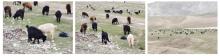
Fig. 1
Herding small cattle to poor winter pastures (Tabakchi pasture in the Vakhsh Valley of the Khatlon region on 11 January 2024)."
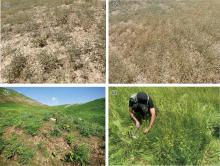
Fig. 2.
Degraded grassland vegetation versus restored vegetation. (a), degraded vegetation in Tabakchi pasture; (b), restored vegetation in Tabakchi pasture; (c), degraded vegetation in Ziddi pasture; (d), restored vegetation in Ziddi pasture."

| [1] | Agency on Statistics under the President of the Republic of Tajikistan, 2018. Agriculture of the Republic of Tajikistan: Statistical Digest. Dushanbe: Agency on Statistics under the President of the Republic of Tajikistan, 81-85 (in Russian). |
| [2] | Ahmadov H.M., 2012. Influence of over-grazing on biodiversity and productivity of the pasture on high mountain zone Tajikistan. Journal of Academy of Soil Science. 2(1), 33-42 (in Russian). |
| [3] | Aknazarov K.A., Kasach A.E., Yusufbekov K.Y., 1993. Wild Dorage Plants in the Western Pamirs. Dushanbe: Donish, 1-132 (in Russian). |
| [4] | Cabar A., 2024. Farmers in Southern Tajikistan Sound the Alarm over Locust Infestation. [2025-07-30]. https://asiaplustj.info/ru/news/tajikistan/security/20240530/farmers-yuga-tajikistan-bespokoit-napadenie-saranchi (in Russian). |
| [5] | Fan L.L., Okhonniyozov M., Li Y.M., et al., 2021. Effect of nutrient addition on the productivity and species richness of grassland along with an elevational gradient in Tajikistan. Frontiers in Plant Science. 12, 765077, doi: 10.3389/fpls.2021.765077. |
| [6] | Geng Y.X., Hikmat H., Wang G.Y., et al., 2025. Time-lag of effects of extreme climate events on grassland vegetation dynamics across an altitudinal gradient in Tajikistan. Plants. 14(8), 1266, doi: 10.3390/plants14081266. |
| [7] |
Giam X., Bradshaw C.J.A., Tan H.T.W., et al., 2010. Future habitat loss and the conservation of plant biodiversity. Biological Conservation. 143(7), 1594-1602.
doi: 10.1016/j.biocon.2010.04.019 |
| [8] | GIZ(Gesellschaft für Internationale Zusammenarbeit) 2016. Germany Program for Sustainable and Climate Sensitive Land Use for Economic Development in Central Asia. [2025-07-01]. . |
| [9] | Government of the Republic of Tajikistan, 2022. Pasture Development Program in the Republic of Tajikistan for 2023-2027. [2025-06-29]. https://mmk.tj/ru/documents/10/583/ (in Tajik). |
| [10] | Hao L.N., Ye H.P., He S., et al., 2025. Estimation of aboveground biomass in Tajikistan based on upscaling extrapolation of UAV and Sentinel-2 multi-source data synergy. Science of Remote Sensing. 12, 100259, doi: 10.1016/j.srs.2025.100259. |
| [11] | Hisoriev H.H., 2022. Plant diversity and steppe conservation in the Pamir-Alai Range (Tajikistan) . In: Global Steppe Symposium Proceedings. Denver: Denver Botanic Gardens Press, 33-42 (in Russian). |
| [12] | Hisoriev H.H., Ashurov A.A., Kudratov I., et al., 2011. Rare and endangered species of wild flora for inclusion in the second edition of the Red Book of the Republic of Tajikistan. Academy of Sciences of the Republic of Tajikistan. 4(177), 7-18 (in Russian). |
| [13] | Irgashev T.A., Khandzharov A., Irgashev S.T., 2022. Creation of winter cultural pastures using black saxaul in the arid zone of Tajikistan. Bulletin of the Orenburg State Agrarian University. 6(98), 98-103 (in Russian). |
| [14] | Karaev S., 2023. Seven Somoni per Hectare: Will Tajikistan Be Able to Improve Its Pastures for Such Money? [2025-07-13]. https://asiaplustj.info/ru/news/tajikistan/economic/20230113/po-sem-somoni-na-gektar-sumeet-li-tadzhikistan-za-takie-dengi-uluchshit-svoi-pastbitsha (in Russian). |
| [15] | Karaev S., 2024a. Silent Death of Pastures in Tajikistan. [2025-07-01]. https://asiaplustj.info/ru/news/tajikistan/economic/20240701/bezmolvnaya-gibel-pastbitsh-tadzhikistana (in Russian). |
| [16] | Karaev S., 2024b. Pistachio, Juniper and Black Forest: What You Need to Know about the Forests of Tajikistan? [2025-07-22]. https://asiaplustj.info/ru/news/tajikistan/20240922/fistashka-archa-i-chernolese-chto-nuzhno-znat-o-lesah-tadzhikistana (in Russian). |
| [17] | Karimov H.H., 1996. Reserve of Phytomass of Plant Communities of the Western Pamir-Alai. Dushanbe: Donish, 1-23 (in Russian). |
| [18] | Khisoriev H.H., 2024. The Red Book of the Republic of Tajikistan. Dushanbe: Ganch Nashreti, 1-696 (in Tajik). |
| [19] | Khisoriev H.K., 2015. The Red Book of the Republic of Tajikistan. Dushanbe: Ganch Nashreti, 1-536 (in Tajik). |
| [20] | Li Y.M., Madaminov A.A., Li K.H., et al., 2018. Productivity of tall-grass semi-savannahs pastures of Tajikistan. Journal of the Academy of Sciences of Tajikistan. 61(9-10), 800-804 (in Russian). |
| [21] | Madaminov A.A., Shub S.S., Maysupov M., 1981. On the biology of wild birds of southern Tajikistan. Izvestiya of the Academy of Sciences of the Tajik SSR. 1(110), 43-49 (in Russian). |
| [22] | Madaminov A.A., Amanova N.M., 1988. Effect of fertilizers on the mineral composition of plants in pastures and hayfields of Tajikistan. In: All-Russia Scientific and Technical Information Center. No. 6836-V88. Moscow, Russia (in Russian). |
| [23] | Madaminov A.A., Budtueva T.I., 1988. Dynamics and productivity of the ephemeral-bearded association. In: All-Russia Scientific and Technical Information Center. No. 785-B85. Moscow, Russia (in Russian). |
| [24] | Madaminov A.A., 1992. Productivity of mountain pastures and hayfields of Tajikistan. In: All-Russia Scientific and Technical Information Center. No. 2711-B92. Moscow, Russia (in Russian). |
| [25] | Madaminov A.A., Sanginova M.Y., 1993. Productivity and chemical composition of phytomass of meadow communities of the Gissar Range. In: Institute of Plant Physiology and Genetics of the National Academy Republic of Tajikistan. No. 48(837)-TA93. Dushanbe, Tajikistan (in Russian). |
| [26] | Madaminov A.A., 2000. Study of fodder plants of the Pamirs in the works of M.I. Ibadov. In: KhasanovO.K., SanginovS.R., (eds.). Contribution of Scientists to the Development of Animal Husbandry in Tajikistan. Dushanbe: Maorif, 138-143 (in Russian). |
| [27] | Mi W.T., Tang S.M., Qi L., et al., 2023. Grazing reduces plant sexual reproduction but increases asexual reproduction: A global meta-analysis. Science of the Total Environment. 879, 162850, doi: 10.1016/j.scitotenv.2023.162850. |
| [28] | Mirzokhonova S.O., 2022. Climate of Tajikistan in Connection with Global Warming. [2025-07-14]. https://physical.tnu.tj/ru/klimat-tadzhikistana-v-svjazi-s-globalnym-potepleniem/ (in Russian). |
| [29] | Musoev A., 2022. Geography of the Vakhsh Valley and the uniqueness of its nature. Tajik State Pedagogical University (TSPU) named after Sadriddin Aini. 3(3), 264-269 (in Russian). |
| [30] | Narzikulova K., 2024. New Breeds of Beef and Dairy Cows Began to Be Bred in Tajikistan. [2025-06-26]. https://mir24.tv/news/16591563/novye-porody-myasnyh-i-molochnyh-korov-nachali-razvodit-v-tadzhikistane (in Russian). |
| [31] | Nazarova S., 2024. Interview with the Head of the Pasture and Land Reclamation Trust of the Ministry of Agriculture of Tajikistan. [2025-07-11].https://old.asiaplustj.info/ru/news/tajikistan/economic/20221213/v-tadzhikistane-prinyata-programma-razvitiya-pastbitsh-na-2023-2027-godi (in Russian). |
| [32] |
Nowak A., Nowak S., Nobis M., 2011. Distribution patterns, ecological characteristic and conservation status of endemic plants of Tadzhikistan—A global hotspot of diversity. Journal for Nature Conservation. 19(5), 296-305.
doi: 10.1016/j.jnc.2011.05.003 |
| [33] | Nowak A., Nobis M., 2020. Illustrated Flora of Tajikistan and Adjacent Areas. Warsaw: Botanical Garden Center for Biological Diversity Conservation, 1-770. |
| [34] | Nowak A., Świerszcz S., Nowak S., et al., 2021. Red List of vascular plants of Tajikistan—the core area of the Mountains of Central Asia global biodiversity hotspot. Scientific Reports. 10, 6235, doi: 10.1038/s41598-020-63333-9. |
| [35] | Nowak A., Nobis M., Nowak S., et al., 2025. Vegetation of Middle Asia with a Special Reference to Tajikistan. Wroclaw: Polish Botanical Society, 1-632. |
| [36] | OrexCA(Oriental Express Caucasus & Asia),2024.Pamir Mountains: Mountains of Tajikistan. Passes and Mountains of Tajikistan Regions. [2025-07-15]. https://www.orexca.com/tajikistan/nature/mountains/pamir.htm. |
| [37] | Ovchinnikov P.N., 1957. Flora of the Tajik SSR (vol. 1). Pteridophytes - Gramineae. Moscow & Leningrad: Publishing House of the USSR Academy of Sciences, 1-547 (in Russian). |
| [38] | Ovchinnikov P.N., Sidorenko G.T., Kaletkina N.G., 1973. Vegetation of the Pamirs. Dushanbe: Donish, 1-28 (in Russian). |
| [39] | Ovchinnikov P.N., Sidorenko G.T., 1977. Pastures and Hayfields of Tajikistan. Dushanbe: Donish, 1-304 (in Russian). |
| [40] | Safarov N.M., 1993. State of biological resources in 1990-1991. In: National Center for Biodiversity and Biosafety of the Republic of Tajikistan. NCBB National Report. Dushanbe, Tajikistan (in Russian). |
| [41] | Safarov N.M., Novikova T., Shermatov H., 2014. Fifth National Report of the Republic of Tajikistan on Biodiversity. Dushanbe: Global Environment Facility & United Nations Environment Programme, 1-152 (in Russian). |
| [42] | Safarov N.M., 2015. Flora and Vegetation of the Southern Pamir-Alay. Dushanbe: Donish, 1-384 (in Russian). |
| [43] | Safarov T., 2017. Restoration of Pasture Lands Through Perennial Shrub Seeds in Tajikistan. In: World Bank. Bokat Database Technical Report T_TAj368ru. Dangara, Tajikistan (in Russian). |
| [44] | Shamsutdinov Z.S., 1975. Creation of Long-Term Pastures in the Arid Zone of Central Asia. Tashkent: Fan, 1-174 (in Russian). |
| [45] | Shamsutdinov Z.S., Ibragimov I.O., 1983. Long-Term Pasture Agrophytocenoses in the Arid Zone of Uzbekistan. Tashkent: Fan, 1-176 (in Russian). |
| [46] | Shamsutdinov Z.S., Shamsutdinov N.Z., 2002. Methods of Ecological Restoration of Arid Ecosystems in Areas of Pasture Livestock. Novosibirsk: Novosibirsk University Press, 21-27 (in Russian). |
| [47] |
Shamsutdinov Z.S., Shamsutdinov N.Z., 2012. Biogeocenotic principles and methods of ecological restoration of desert pasture ecosystems in Central Asia. Arid Ecosystems. 2(3), 139-149.
doi: 10.1134/S2079096112030146 |
| [48] | Shamsutdinova E.Z., Shamsutdinov Z.S., 2011. Phytoresources of halophytes and prospects for their use in the system of arid forage production. Fodder Production. 1(1), 5-8 (in Russian). |
| [49] | Sinkovsky L.I., Madaminov A.A., 1989. Pastures of Low-Grass Semi-Savannas of Central Asia. Dushanbe: Donish, 1-268 (in Russian). |
| [50] | Sinkovsky L.P., Savchenko I.V., 1976. Productivity of natural hayfields and pastures in the mixed forest zone.In: Larin, I.V., (ed.). Natural Forage Resources of the Soviet Union and Prospects for their Rational Use. Moscow: Kolos, 258-282 (in Russian). |
| [51] | Stanyukovich K.V., 1973. Vegetation of the Mountains of the USSR (Botanical and Geographical Essay). Dushanbe: Donish, 1-411 (in Russian). |
| [52] | Umarov H., 2019. Livestock sector in Tajikistan:Problems of sustainable and balanced development. In: Leibniz Institute of Agricultural Development in Transition Economies. IAMO Discussion Paper N190. Halle, Germany (in Russian). |
| [53] | Umuhoza J., Jiapaer G., Yin H.M., et al., 2021. The analysis of grassland carrying capacity and its impact factors in typical mountain areas in Central Asia—A case of Kyrgyzstan and Tajikistan. Ecological Indicators. 131, 108129, doi: 10.1016/j.ecolind.2021.108129. |
| [54] | United Nations Convention to Combat Desertification, 2024. ‘Silent Demise’ of Vast Rangelands Threatens Climate, Food, Well-being of Billions: UNCCD. [2025-05-21]. https://www.unccd.int/news-stories/press-releases/silent-demise-vast-rangelands-threatens-climate-food-wellbeing-billions. |
| [55] |
Wang R.Z., 2000. Effect of grazing on reproduction in Leymus chinensis population. Chinese Journal of Applied Ecology. 11(3), 399-402 (in Chinese).
pmid: 11767641 |
| [56] | Wang Z.J., Chen M., Song Z.B., et al., 2025. Effects of different grazing intensities on the plant reproductive traits and heterogeneous distributions of soil properties. CATENA. 250, 108785, doi: 10.1016/j.catena.2025.108785. |
| [57] | World Bank Group, 2024. Tajikistan Country Climate and Development Report. [2025-05-11]. https://www.preventionweb.net/publication/tajikistan-country-climate-and-development-report-0. |
| [58] | Yusufbekov H.Y., 1968. Improvement of Pastures and Hayfields of the Pamirs and the Alai Valley. Dushanbe: Donish, 1-320 (in Russian). |
| [59] | Zozulin G.M., 1977. Scientific and Practical Aspects of Landscapes Used as A Natural Standards. Rostov: Rostov University, 1-336 (in Russian). |
| [1] | CHEN Yaning, FANG Gonghuan, LI Zhi, ZHANG Xueqi, LI Weihong, Nekruz GULAHMADOV, Farhod NASRULLOEV, Aminjon GULAKHMADOV. Water resources and sustainable management in Tajikistan under global change [J]. Regional Sustainability, 2026, 7(1): 100291-. |
| [2] | Kobiljon Khushvakht KHUSHVAKHTZODA, Ilkhom Burkhonovich MAKHSUMOV, Muzaffar Boynazarovich KHOLNAZAROV, Irina Mikhailovna KIRPICHNIKOVA. Impact of green energy development on climate change mitigation [J]. Regional Sustainability, 2026, 7(1): 100292-. |
| [3] | ZHOU Yixin, MA Suliya, LI Wenjun, Parvina KURBONOVA, Mariyo BOBOEV, LI Yufan, Hikmat HISORIEV, MA Keping, YANG Weikang, ZHANG Yuanming. Vascular plant diversity and distribution pattern in Tajikistan: A global hotspot of diversity [J]. Regional Sustainability, 2026, 7(1): 100294-. |
| [4] | Ranna HAZIHAN, DU Hongru, HE Chuanchuan, Kobiljon Khushvakht KHUSHVAKHTZODA, Bobozoda KOMIL. Coupling dynamics of SDGs in Tajikistan from 2001 to 2023 [J]. Regional Sustainability, 2026, 7(1): 100295-. |
| [5] | XU Chunhai, LI Zhongqin, HE Zhonghua, WANG Feiteng, MU Jianxin, CHEN Yaning, Sheralizoda NAZRIALO, Farhod NASRULLOEV, Aminjon GULAHMADZODA. Current status and recent changes of glaciers in Tajikistan [J]. Regional Sustainability, 2026, 7(1): 100296-. |
| [6] | LI Chunlan, YU Yang, SUN Lingxiao, HE Jing, LU Yuanbo, GUO Zengkun, FANG Gonghuan, Alexandr ULMAN, Vitaliy SALNIKOV, Ireneusz MALIK, Małgorzata WISTUBA. Spatiotemporal heterogeneity of runoff in Tajikistan and its driving mechanisms under climate change [J]. Regional Sustainability, 2026, 7(1): 100297-. |
| [7] | LI Yupeng, CHEN Yaning, WANG Fei, ZHANG Xiang, ZHANG Qifei, SUN Fan, FANG Gonghuan, Safarkhon SHAROFIDDINOV, Jafar NIYAZOV. Risks of snow drought and impacts on streamflow in Tajikistan [J]. Regional Sustainability, 2026, 7(1): 100298-. |
| [8] | Nasrulloev FARHOD, CHEN Yaning, Sheralizoda NAZRIALO, Gulahmadov NEKRUZ, Shobairi SEYED OMID REZA, Murodov MURODKHUJA. Hydrological change trends of the Surkhob and Khingov river basins in the Vakhsh River of Tajikistan under climate change [J]. Regional Sustainability, 2026, 7(1): 100300-. |
| [9] | Mahalingam Santhosh KUMAR, Narasimabhrathi Venkatesa PALANICHAMY, K. M. SHIVAKUMAR, Mani CHANDRAKUMAR, Muthuswamy KALPANA, Dhandapani MURUGANANTHI. Impact of climate change on global economy: A comprehensive review [J]. Regional Sustainability, 2025, 6(6): 100274-. |
| [10] | Yadeta BEDASA, Adeba GEMECHU, Amsalu BEDEMO. Combined adoption decisions of climate-smart agriculture and their impacts on maize yield in western Ethiopia [J]. Regional Sustainability, 2025, 6(6): 100280-. |
| [11] | Md Tauhid Ur RAHMAN, Adnan KHAIRULLAH. Integrating farmers’ perceptions and empirical climate data to assess agricultural productivity and food security in coastal Bangladesh [J]. Regional Sustainability, 2025, 6(5): 100259-. |
| [12] | Piyali KUMAR. Examining the effects of climatic and non-climatic factors on sectoral growth: Evidence from different country income groups [J]. Regional Sustainability, 2025, 6(5): 100261-. |
| [13] | Saira SHAFIQ, Muhammad ZIA UL HAQ, Syed Abbas RAZA NAQVI, Wardha SARFARAZ, Hina ALI, Muhammad Majid ISLAM, Gul Zaib HASSAN, Muhammad NAWAZ, Tasawer ABBAS. Integrating neglected and underutilized crops (NUCs) in South Asian cropping systems and diets: Challenges and prospects [J]. Regional Sustainability, 2025, 6(4): 100242-. |
| [14] | Md Maruf BILLAH, Mohammad Mahmudur RAHMAN, Santiago MAHIMAIRAJA, Alvin LAL, Asadi SRINIVASULU, Ravi NAIDU. Enhancing climate-smart coastal farming system through agriculture extension and advisory services towards the avenues of farm sustainability [J]. Regional Sustainability, 2025, 6(4): 100243-. |
| [15] | Syed Masiur RAHMAN, Asif RAIHAN, Md Shafiul ALAM, Shakhawat CHOWDHURY. Greenhouse gas emission dynamics and climate change mitigation efforts toward sustainability in the Middle East and North Africa (MENA) region [J]. Regional Sustainability, 2025, 6(4): 100246-. |
| Viewed | ||||||
|
Full text |
|
|||||
|
Abstract |
|
|||||
 REGSUS Wechat
 新公网安备 65010402001202号