
Regional Sustainability ›› 2026, Vol. 7 ›› Issue (1): 100294.doi: 10.1016/j.regsus.2026.100294
• Full Length Article • Previous Articles Next Articles
ZHOU Yixina,b,c, MA Suliyad, LI Wenjuna,b,c,*( ), Parvina KURBONOVAe, Mariyo BOBOEVf, LI Yufang, Hikmat HISORIEVh, MA Kepingb, YANG Weikanga,b,c, ZHANG Yuanminga,b,c
Received:2025-08-31
Revised:2025-12-08
Accepted:2026-01-05
Published:2026-02-28
Online:2026-01-21
Contact:
LI Wenjun
E-mail:liwenjunao@ms.xjb.ac.cn
About author:First author contact:The first and second authors contributed equally to this work
ZHOU Yixin, MA Suliya, LI Wenjun, Parvina KURBONOVA, Mariyo BOBOEV, LI Yufan, Hikmat HISORIEV, MA Keping, YANG Weikang, ZHANG Yuanming. Vascular plant diversity and distribution pattern in Tajikistan: A global hotspot of diversity[J]. Regional Sustainability, 2026, 7(1): 100294.
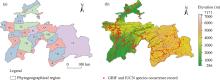
Fig. 1.
Spatial distribution of phytogeographic regions (a) and quality-controlled vascular plant occurrence records (b). 1, Kuraminian; 2, Mogoltausian; 3, Prisyrdarian; 4A, Turkestanian A; 4B, Turkestanian B; 5A, Zeravshanian A; 5B, Zeravshanian B; 5C, Zeravshanian C; 6A, Gissar-Darvasian A; 6B, Gissar-Darvasian B; 6C, Gissar-Darvasian C; 6D, Gissar-Darvasian D; 6E, Gissar-Darvasian E; 6F, Gissar-Darvasian F; 7A, South Tadzhikistanian A; 7B, South Tadzhikistanian B; 7C, South Tadzhikistanian C; 7D, South Tadzhikistanian D; 8A, East Tadzhikistanian A; 8B, East Tadzhikistanian B; 8C, East Tadzhikistanian C; 9A, West Pamirian A; 9B, West Pamirian B; 9C, West Pamirian C; 10, East Pamirian; 11, Alajian. These regions were defined following the classification system established by Goncharov in the Flora Tadzhikskoi SSR (Ovchinnikov, 1957-1991). GBIF, Global Biodiversity Information Facility; IUCN, International Union for Conservation of Nature. Abbreviations are defined in the figure and are consistent in subsequent figures. Note that the figure is based on the standard map (GS(2025)1508) of the Map World (https://map.tianditu.gov.cn) marked by the National Platform for Common GeoSpatial Information Services, and the boundary of the standard map has not been modified."
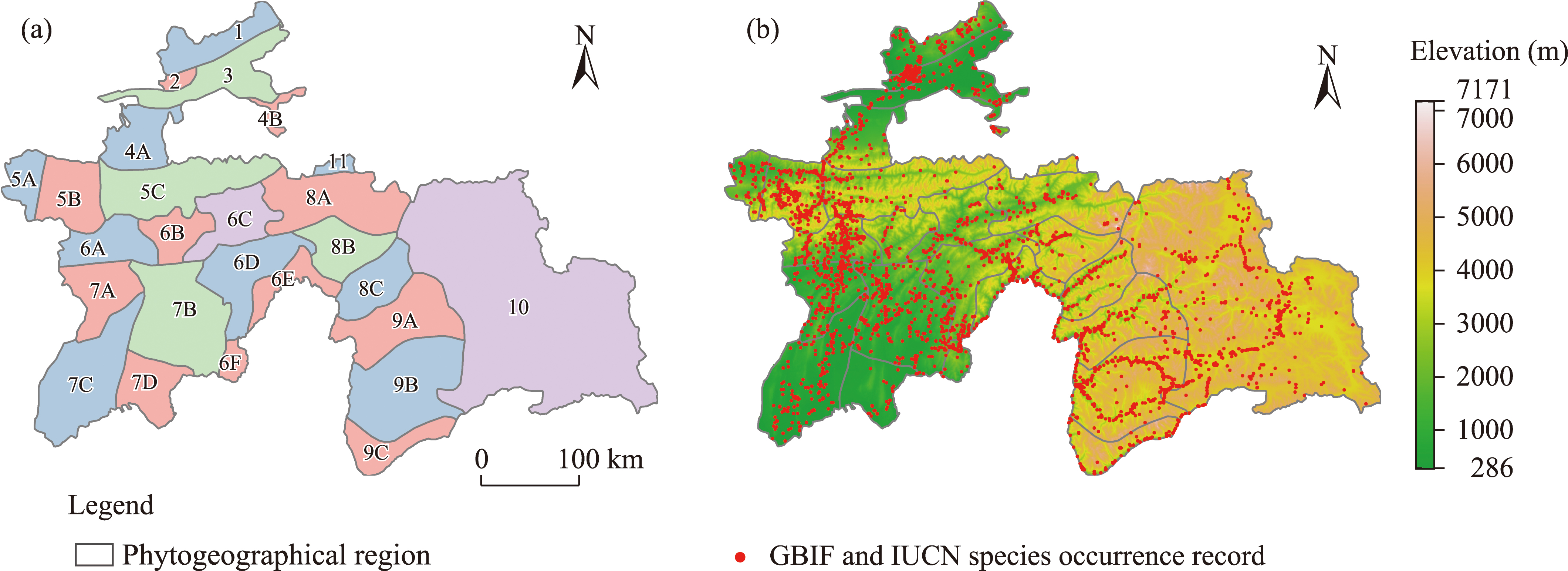
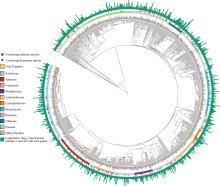
Fig. 2.
Genus-level phylogenetic tree of vascular plants in Tajikistan. Genera highlighted in yellow color represent the top 20 genera with the most species richness (SR). Blue circles indicate genera containing endemic species, while brown-red stars denote genera containing threatened species. The colored sectors in the inner ring represent the top 10 families with the greatest SR. The outermost ring displays the logarithmic (log10) transformed the number of species within each genus."

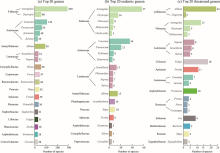
Fig. 3.
Top 20 genera (a), top 20 endemic genera (b), and top 20 threatened genera (c) with the most number of species in Tajikistan. Each bar is color-coded by family, demonstrating the taxonomic distribution of diversity across different plant lineages. Genera are ranked in descending order of species number within each category."
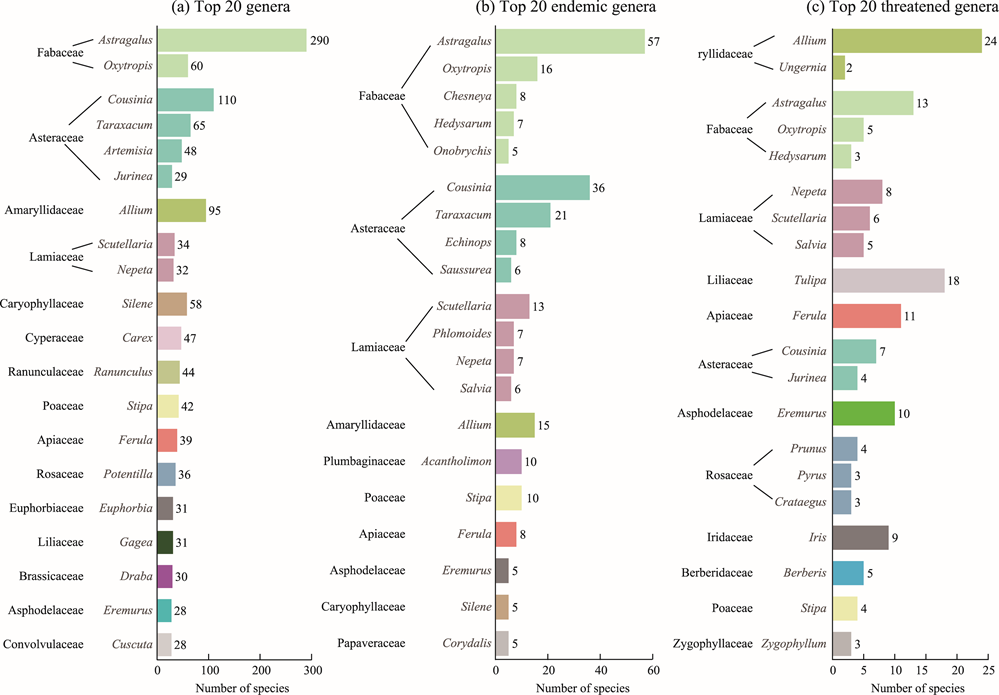
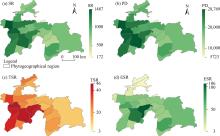
Fig. 4.
Geographic distribution patterns of SR (a), PD (b), TSR (c), and ESR (d) in Tajikistan. SR, species richness; PD, phylogenetic diversity; TSR, threatened species richness; ESR, endemic species richness."

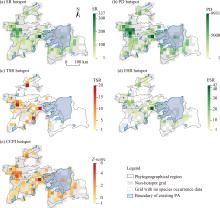
Fig. 5.
Geographic distribution patterns of SR hotspot (a), PD hotspot (b), TSR hotspot (c), ESR hotspot (d), and composite conservation priority index (CCPI) hotspot (e) in Tajikistan. PA, protected area."

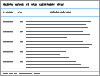
Table 1
Conservation gap analysis for biodiversity hotspots of vascular plants in Tajikistan."
| Diversity index | Total hotspot grids | Protected hotspot grids | Unprotected hotspot grids | Percentage of protection area (%) | Percentage of conservation gap area (%) |
|---|---|---|---|---|---|
| SR | 72 | 26 | 46 | 36.10 | 63.90 |
| ESR | 53 | 20 | 33 | 37.70 | 62.30 |
| TSR | 42 | 16 | 26 | 38.10 | 61.90 |
| PD | 67 | 21 | 46 | 31.30 | 68.70 |
| CCPI | 71 | 25 | 46 | 35.20 | 64.80 |
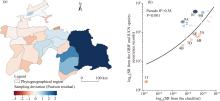
Fig. 6.
Spatial distribution of sampling deviation of GBIF and IUCN species occurrence records (a) and fitted negative binomial regression curve between SR from the GBIF and IUCN species occurrence records and SR from the checklist (b) for vascular plants in Tajikistan. In Figure 6a, red region indicates under-sampled region (negative residual) where SR from the GBIF and IUCN species the occurrence record is significantly lower than SR from the checklist, while blue zone shows relatively well-sampled region (positive residual)."

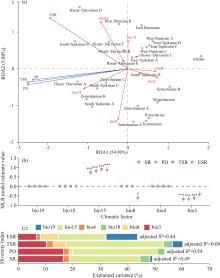
Fig. 7.
Relationships among diversity index, climatic factor, and phytogeographic region for vascular plants in Tajikistan. (a), relationship among diversity index, climatic factor, and phytogeographic regions based on redundancy analysis (RDA); (b), best-fit multiple linear regression (MLR) model of diversity indices and climatic factors; (c), contribution of climatic factors to each diversity index. bio3, isothermality; bio4, temperature seasonality; bio8, mean temperature of the wettest quarter; bio15, precipitation seasonality; bio18, precipitation of the warmest quarter; bio19, precipitation of the coldest quarter. In Figure 7a, arrow length and direction indicate the strength and direction of correlations with ordination axes, respectively. Percentage in parentheses represents the proportion of the total variation explained by each axis. In Figure 7b, point represents coefficient values. Error bar indicates ±1 standard error. The vertical dashed line denotes the zero-reference line. *, P≤0.050; ***, P≤0.001. Bar length represents the percentage of independently explained variation, with different colors corresponding to different climatic factors."

| [1] | Akhmadov K.M., Breckle S.W., Breckle U., 2006. Effects of grazing on biodiversity, productivity, and soil erosion of alpine pastures in Tajik mountains. In: SpehnE.M., LibermanM., KörnerC., (eds.). Land Use Change and Mountain Biodiversity. Boca Raton: CRC Press, 239-248. |
| [2] | Ball A., Daru B.H., Lughadha E.M., et al., 2025. What ‘unexplored’ means: Mapping regions with digitized natural history records to look for ‘biodiversity blindspots’. PeerJ. 13, e18511, doi: 10.7717/peerj.18511. |
| [3] | Bartoń K., 2025. MuMIn: Multi-Model Inference. R Package Version 1.48.11. [2025-07-11]. https://CRAN.R-project.org/package=MuMIn. |
| [4] |
Borsch T., Berendsohn W., Dalcin E., et al., 2020. World Flora Online: Placing taxonomists at the heart of a definitive and comprehensive global resource on the world’s plants. Taxon. 69(6), 1311-1341.
doi: 10.1002/tax.v69.6 |
| [5] |
Boyle B., Hopkins N., Lu Z., et al., 2013. The taxonomic name resolution service: An online tool for automated standardization of plant names. BMC Bioinformatics. 14, 16, doi: 10.1186/1471-2105-14-16.
pmid: 23324024 |
| [6] |
Brown M.J., Walker B.E., Black N., et al., 2023. rWCVP: A companion R package for the World Checklist of vascular plants. New Phytologist. 240, 1355-1365.
doi: 10.1111/nph.18919 pmid: 37289204 |
| [7] | Chen Y.N., Li W.H., Deng H.J., et al., 2016. Changes in Central Asia’s water tower: Past, present and future. Scientific Reports. 6, 35458, doi: 10.1038/srep35458. |
| [8] |
Coelho M.T.P., Barreto E., Rangel T.F., et al., 2023. The geography of climate and the global patterns of species diversity. Nature. 622(7983), 537-544.
doi: 10.1038/s41586-023-06577-5 |
| [9] |
Fallah B., Didovets I., Rostami M., et al., 2024. Climate change impacts on Central Asia: Trends, extremes and future projections. International Journal of Climatology. 44(10), 3191-3213.
doi: 10.1002/joc.v44.10 |
| [10] | Fattorini S., 2017. Endemism in historical biogeography and conservation biology: Concepts and implications. Biodiversity and Evolution. 32(1), 47-75. |
| [11] |
Govaerts R., Nic Lughadha E., Black N., et al., 2021. The World Checklist of Vascular Plants, a continuously updated resource for exploring global plant diversity. Scientific Data. 8, 215, doi: 10.1038/s41597-021-00997-6.
pmid: 34389730 |
| [12] |
Hawkins B.A., Field R., Cornell H.V., et al., 2003. Energy, water, and broad-scale geographic patterns of species richness. Ecology. 84(11), 3105-3117.
doi: 10.1890/03-8006 |
| [13] | Hernangómez D., 2023. Using the tidyverse with terra objects: The tidyterra package. Journal of Open Source Software. 8(91), 5751, doi: 10.21105/joss.05751. |
| [14] |
Hewitt G., 2000. The genetic legacy of the Quaternary ice ages. Nature. 405(6789), 907-913.
doi: 10.1038/35016000 |
| [15] | Hijmans R.J., 2025. terra: Spatial Data Analysis. R Package Version 1. [2025-07-11]. https://CRAN.R-project.org/package=terra. |
| [16] |
Jin Y., Qian H., 2022. V.PhyloMaker2: An updated and enlarged R package that can generate very large phylogenies for vascular plants. Plant Diversity. 44(5), 335-339.
doi: 10.1016/j.pld.2022.05.005 |
| [17] | Kass J.M., Guénard B., Dudley K.L., et al., 2022. The global distribution of known and undiscovered ant biodiversity. Science Advances. 8(34), eabp9908, doi: 10.1126/sciadv.abp9908. |
| [18] | Knoche M., Merz R., Lindner M., et al., 2017. Bridging glaciological and hydrological trends in the Pamir Mountains, Central Asia. Water. 9(6), 422, doi: 10.3390/w9060422. |
| [19] | Kumar P., Sharma K., 2023. Snowfall shift and precipitation variability over Sikkim Himalaya attributed to elevation-dependent warming. Journal of Atmospheric Science Research. 6(4), 5854, doi: 10.30564/jasr.v6i4.5854. |
| [20] | Kusumoto B., Chao A., Eiserhardt W.L., et al., 2023. Occurrence-based diversity estimation reveals macroecological and conservation knowledge gaps for global woody plants. Science Advances. 9, eadh9719, doi: 10.1126/sciadv.adh9719. |
| [21] |
Lai J.S., 2022. Generalizing hierarchical and variation partitioning in multiple regression and canonical analysis using the rdacca.hp R package. Methods in Ecology and Evolution. 13(4), 782-788.
doi: 10.1111/mee3.v13.4 |
| [22] |
Leão T.C.C., Lughadha E.N., Reich P.B., 2020. Evolutionary patterns in the geographic range size of Atlantic Forest plants. Ecography. 43(10), 1510-1520.
doi: 10.1111/ecog.2020.v43.i10 |
| [23] | Letunic I., Bork P., 2024. Interactive Tree of Life (iTOL) v6: recent updates to the phylogenetic tree display and annotation tool. Nucleic Acids Research. 52(W1), W78-W82. |
| [24] | Li W.J., Tojibaev K.S., Hisoriev H., et al., 2020. Mapping Asia Plants: Current status of floristic information for Central Asian flora. Global Ecology and Conservation. 24, e01220, doi: 10.1016/j.gecco.2020.e01220. |
| [25] |
Li Y.F., Li W.J., Ma S.L.Y., et al., 2025. Diversity and conservation gaps of threatened vascular plant species in Tajikistan. Arid Land Geography. 48(1), 43-52 (in Chinese).
doi: 10.12118/j.issn.1000-6060.2024.067 |
| [26] |
Liu J.Q., Li J.L., Lai Y.J., 2021. Plant diversity and ecology on the Qinghai-Tibet Plateau. Journal of Systematics and Evolution. 59(6), 1139-1141.
doi: 10.1111/jse.v59.6 |
| [27] | Ma S.L.Y., Li W.J., Tojibaev K.S., et al., 2024. Regionwide and nationwide floristic richness reveal vascular plant diversity in Central Asia. Plants. 13(16), 2275, doi: 10.3390/plants13162275. |
| [28] |
Marchese C., 2015. Biodiversity hotspots: A shortcut for a more complicated concept. Global Ecology and Conservation. 3, 297-309.
doi: 10.1016/j.gecco.2014.12.008 |
| [29] | Molina-Venegas R., Ramos-Gutiérrez I., Moreno-Saiz J.C., 2020. Phylogenetic patterns of extinction risk in the endemic flora of a Mediterranean hotspot as a guiding tool for preemptive conservation actions. Frontiers in Ecology and Evolution. 8, 571587, doi: 10.3389/fevo.2020.571587. |
| [30] |
Naimi B., Hamm N.A.S., Groen T.A., et al., 2014. Where is positional uncertainty a problem for species distribution modelling. Ecography. 37(2), 191-203.
doi: 10.1111/ecog.2014.37.issue-2 |
| [31] | National Academy of Sciences of Tajikistan, 2024. The Red Book of the Republic of Tajikistan (3rd edition). Dushanbe: National Academy of Sciences of Tajikistan. |
| [32] |
Noroozi J., Khalvati S., Nafisi H., et al., 2021. Endemics determine bioregionalization in the alpine zone of the Irano-Anatolian biodiversity hotspot (South-West Asia). Alpine Botany. 131(2), 177-186.
doi: 10.1007/s00035-021-00266-7 pmid: 34721248 |
| [33] |
Noroozi J., Minaei M., Khalvati S., et al., 2023. Hotspots of (sub)alpine plants in the Irano‐Anatolian global biodiversity hotspot are insufficiently protected. Diversity and Distributions. 29(2), 244-253.
doi: 10.1111/ddi.v29.2 |
| [34] |
Nowak A., Nobis M., 2010. Tentative list of endemic vascular plants of the Zeravshan Mts in Tajikistan: Distribution, habitat preferences and conservation status of species. Biodiversity: Research and Conservation. 19, 65-80.
doi: 10.2478/v10119-010-0011-5 |
| [35] | Nowak A., Nowak S., Nobis M., 2020a. The Pamir-Alai Mountains (Middle Asia:Tajikistan). In: Noroozi, J., (ed.). Plant Biogeography and Vegetation of High Mountains of Central and South-West Asia. Cham: Springer International Publishing, 1-42. |
| [36] | Nowak A., Świerszcz S., Nowak S., et al., 2020b. Red List of vascular plants of Tajikistan—the core area of the Mountains of Central Asia global biodiversity hotspot. Scientific Reports. 10, 6235, doi: 10.1038/s41598-020-63333-9. |
| [37] | Ohdo T., Takahashi K., 2020. Plant species richness and community assembly along gradients of elevation and soil nitrogen availability. AoB Plants. 12(3), plaa014, doi: 10.1093/aobpla/plaa014. |
| [38] | Oksanen J., Simpson G.L., Blanchet F.G., et al., 2025. vegan: Community Ecology Package R Package Version 2.7-2. [2025-06-11]. https://CRAN.R-project.org/package=vegan. |
| [39] |
Ondo I., Dhanjal-Adams K.L., Pironon S., et al., 2024. Plant diversity darkspots for global collection priorities. New Phytologist. 244(2), 719-733.
doi: 10.1111/nph.v244.2 |
| [40] | Ovchinnikov P.N., 1957-1991. Flora Tadzhikskoi SSR. Moscow & Leningrad: Izdatel’stvo Akademii Nauk SSSR (in Russian). |
| [41] | Pebesma E., Bivand R., 2023. Spatial Data Science:With Applications in R (1st edition). New York: Chapman and Hall/CRC Press. |
| [42] | Qian H., Kessler M., Qian S., et al., 2024. Patterns and drivers of taxonomic and phylogenetic endemism in regional fern floras across the world. Biological Conservation. 291, 110506, doi: 10.1016/j.biocon.2024.110506. |
| [43] |
Raduła M., Świerszcz S., Nobis M., et al., 2021. Palaeoclimate has a major effect on the diversity of endemic species in the hotspot of mountain biodiversity in Tajikistan. Scientific Reports. 11, 18684, doi: 10.1038/s41598-021-98027-3.
pmid: 34548515 |
| [44] | Rahmonov O., Majgier L., Andrejczuk W., et al., 2013. Landscape diversity and biodiversity of Fann Mountains (Tajikistan). Ekológia. 32(4), 388-395. |
| [45] | Song S.L., Chen X., Zan C., et al., 2025. Integrated spatial priority assessment in Central Asia: Bridging biodiversity, ecosystem services, and human activities. Geography and Sustainability. 6, 100231, doi: 10.1016/j.geosus.2024.08.010. |
| [46] | Spengler R.N., 2019. Origins of the apple: The role of megafaunal mutualism in the domestication of Malus and rosaceous trees. Frontiers in Plant Science. 10, 617, doi: 10.3389/fpls.2019.00617. |
| [47] | Squires V.R., Safarov N., 2013. High-altitude ecosystems and biodiversity of Tajikistan:Conservation and management. In: Akhmadov, K.M., Khamidov, J.K., Razykov, M.R., (eds.). Rational Use of Natural Resources and Sustainable Development of the Pamir Mountain Region. Dushanbe: Donish, 15-21. |
| [48] | Squires V.R., Dengler J., Hua L., et al., 2018. Grasslands of the World:Diversity, Management and Conservation (1st edition). Boca Raton: CRC Press. |
| [49] | Sun L., Luo J., Qian L.L., et al., 2020. The relationship between elevation and seed-plant species richness in the Mt. Namjagbarwa region (Eastern Himalayas) and its underlying determinants. Global Ecology and Conservation. 23, e01053, doi: 10.1016/j.gecco.2020.e01053. |
| [50] | Thakur S., Dhyani R., Negi V.S., et al., 2022. Water-energy, climate, and habitat heterogeneity mutually drive spatial pattern of tree species richness in the Indian Western Himalaya. Frontiers in Forests and Global Change. 5, 1022082, doi: 10.3389/ffgc.2022.1022082. |
| [51] |
Tucker C.M., Cadotte M.W., Carvalho S.B., et al., 2017. A guide to phylogenetic metrics for conservation, community ecology and macroecology. Biological Reviews. 92(2), 698-715.
doi: 10.1111/brv.2017.92.issue-2 |
| [52] | Venables W.N., Ripley B.D., 2002. Modern Applied Statistics with S (4th edition). New York: Springer. |
| [53] |
Volkova P.A., Ivanova M.O., Boboev M.T., et al., 2024. Are aquatic plants really endangered in Tajikistan (core area of the Mountains of Central Asia global biodiversity hotspot)? Journal of Asia-Pacific Biodiversity. 17(4), 769-779.
doi: 10.1016/j.japb.2024.04.009 |
| [54] | Wickham H., 2016. ggplot2: Elegant Graphics for Data Analysis (2nd edition). New York: Springer-Verlag. |
| [55] |
Wilson B., Dolotbakov A., Burgess B.J., et al., 2021. Central Asian wild tulip conservation requires a regional approach, especially in the face of climate change. Biodiversity and Conservation. 30(6), 1705-1730.
doi: 10.1007/s10531-021-02165-z |
| [56] | Wu Y.L., Shen J.Q., Deane D.C., et al., 2025. Future extreme climate events threaten alpine and subalpine woody plants in China. Earth’s Future. 13(6), e2024EF005147, doi: 10.1029/2024EF005147. |
| [57] |
Wyse Jackson P., Kennedy K., 2009. The global strategy for plant conservation: A challenge and opportunity for the international community. Trends in Plant Science. 14(11), 578-580.
doi: 10.1016/j.tplants.2009.08.011 pmid: 19781974 |
| [58] | Yao S.T., Akram M.A., Hu W.D., et al., 2021. Effects of water and energy on plant diversity along the aridity gradient across dryland in China. Plants. 10(4), 636, doi: 10.3390/plants10040636. |
| [59] |
Zhang Y.M., Zhang D.Y., Li W.J., et al., 2020. Characteristics and utilization of plant diversity and resources in Central Asia. Regional Sustainability. 1(1), 1-10.
doi: 10.1016/j.regsus.2020.08.001 |
| [1] | LI Yupeng, CHEN Yaning, WANG Fei, ZHANG Xiang, ZHANG Qifei, SUN Fan, FANG Gonghuan, Safarkhon SHAROFIDDINOV, Jafar NIYAZOV. Risks of snow drought and impacts on streamflow in Tajikistan [J]. Regional Sustainability, 2026, 7(1): 100298-. |
| [2] | LI Chunlan, YU Yang, SUN Lingxiao, HE Jing, LU Yuanbo, GUO Zengkun, FANG Gonghuan, Alexandr ULMAN, Vitaliy SALNIKOV, Ireneusz MALIK, Małgorzata WISTUBA. Spatiotemporal heterogeneity of runoff in Tajikistan and its driving mechanisms under climate change [J]. Regional Sustainability, 2026, 7(1): 100297-. |
| [3] | XU Chunhai, LI Zhongqin, HE Zhonghua, WANG Feiteng, MU Jianxin, CHEN Yaning, Sheralizoda NAZRIALO, Farhod NASRULLOEV, Aminjon GULAHMADZODA. Current status and recent changes of glaciers in Tajikistan [J]. Regional Sustainability, 2026, 7(1): 100296-. |
| [4] | Ranna HAZIHAN, DU Hongru, HE Chuanchuan, Kobiljon Khushvakht KHUSHVAKHTZODA, Bobozoda KOMIL. Coupling dynamics of SDGs in Tajikistan from 2001 to 2023 [J]. Regional Sustainability, 2026, 7(1): 100295-. |
| [5] | Hikmat HISORIEV, LI Yaoming, HUANG Wenjun, FAN Lianlian, Mekhrovar OKHONNIYOZOV, MA Xuexi. Grassland ecosystems of Tajikistan: Plant species diversity, ecological restoration, and sustainable management [J]. Regional Sustainability, 2026, 7(1): 100293-. |
| [6] | CHEN Yaning, FANG Gonghuan, LI Zhi, ZHANG Xueqi, LI Weihong, Nekruz GULAHMADOV, Farhod NASRULLOEV, Aminjon GULAKHMADOV. Water resources and sustainable management in Tajikistan under global change [J]. Regional Sustainability, 2026, 7(1): 100291-. |
| [7] | Muhammadjon Kobuliev, Tie Liu, Zainalobudin Kobuliev, Xi Chen, Aminjon Gulakhmadov, Anming Bao. Effect of future climate change on the water footprint of major crops in southern Tajikistan [J]. Regional Sustainability, 2021, 2(1): 60-72. |
| Viewed | ||||||
|
Full text |
|
|||||
|
Abstract |
|
|||||
 REGSUS Wechat
 新公网安备 65010402001202号