
Regional Sustainability ›› 2025, Vol. 6 ›› Issue (2): 100212.doi: 10.1016/j.regsus.2025.100212cstr: 32279.14.REGSUS.2025011
• Research article • Previous Articles Next Articles
ZHANG Tianyang, LI Linna*( )
)
Received:2024-08-06
Revised:2025-02-21
Accepted:2025-05-06
Published:2025-04-30
Online:2025-05-21
Contact:
*E-mail address: lilinna@bnu.edu.cn (LI Linna).
ZHANG Tianyang, LI Linna. Exploring the transformation mechanism of modern agricultural villages in the loess hilly and gully regions using actor-network theory[J]. Regional Sustainability, 2025, 6(2): 100212.
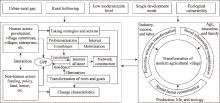
Fig. 1.
Framework of the transformation of modern agricultural village based on actor-network theory (ANT). OPP, obligatory passage point."
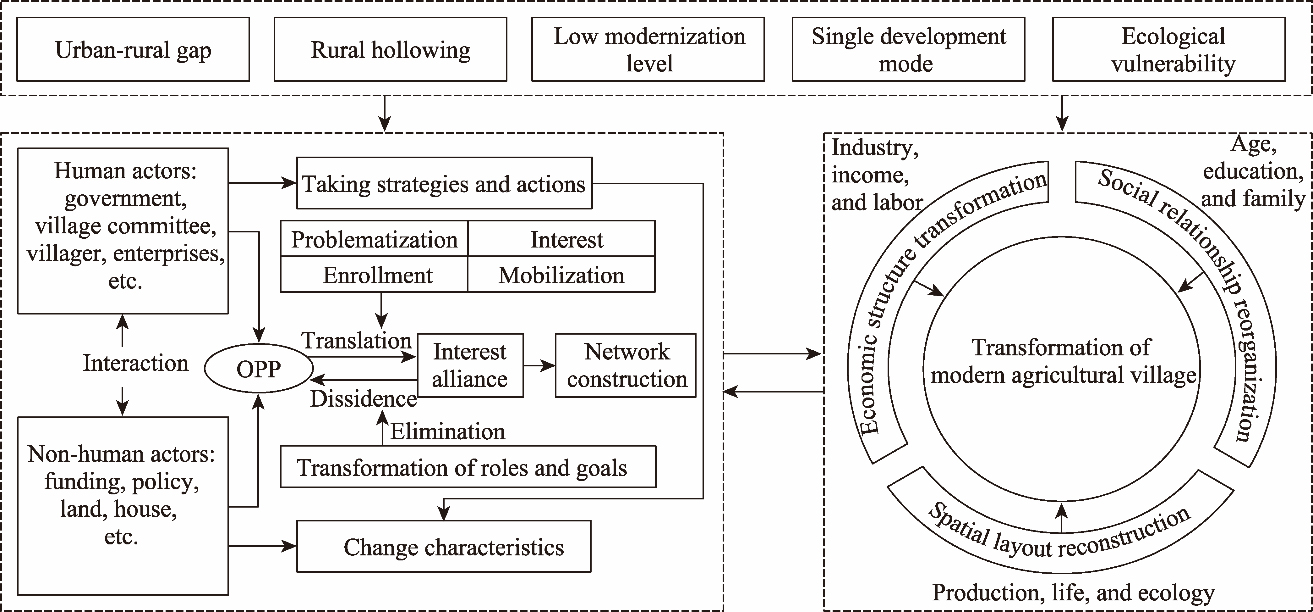
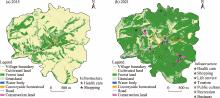
Fig. 2.
Characteristics of spatial layout reconstruction in Zhaojiawa Village from 2015 (a) to 2021 (b)."

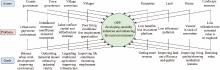
Fig. 3.
Actors, problems, goals, and OPP in the construction stage of modern agricultural village."

Table 1
Main recruitment methods used by the Suide County government in the construction stage of modern agricultural village."
| Mode of recruitment | Primary recruitment actor | Main method |
|---|---|---|
| Administrative recruitment | Town government and committee | Project implementation and fund allocation by relevant departments and town government. |
| Environmental recruitment | Committee | Implementation of livable environment projects, including house refurbishment, road improvement, sewage treatment, and power system upgrades. |
| Land recruitment | Committee, cooperative, and enterprise | Reform of property rights, land transfer to cooperatives, and establishment of apple orchards. |
| Talent recruitment | Specialist and talent | Hiring of experts for lectures and training in agronomy and agricultural services. |
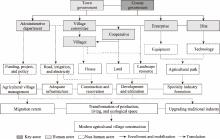
Fig. 4.
Actor network in the construction stage of modern agricultural village."
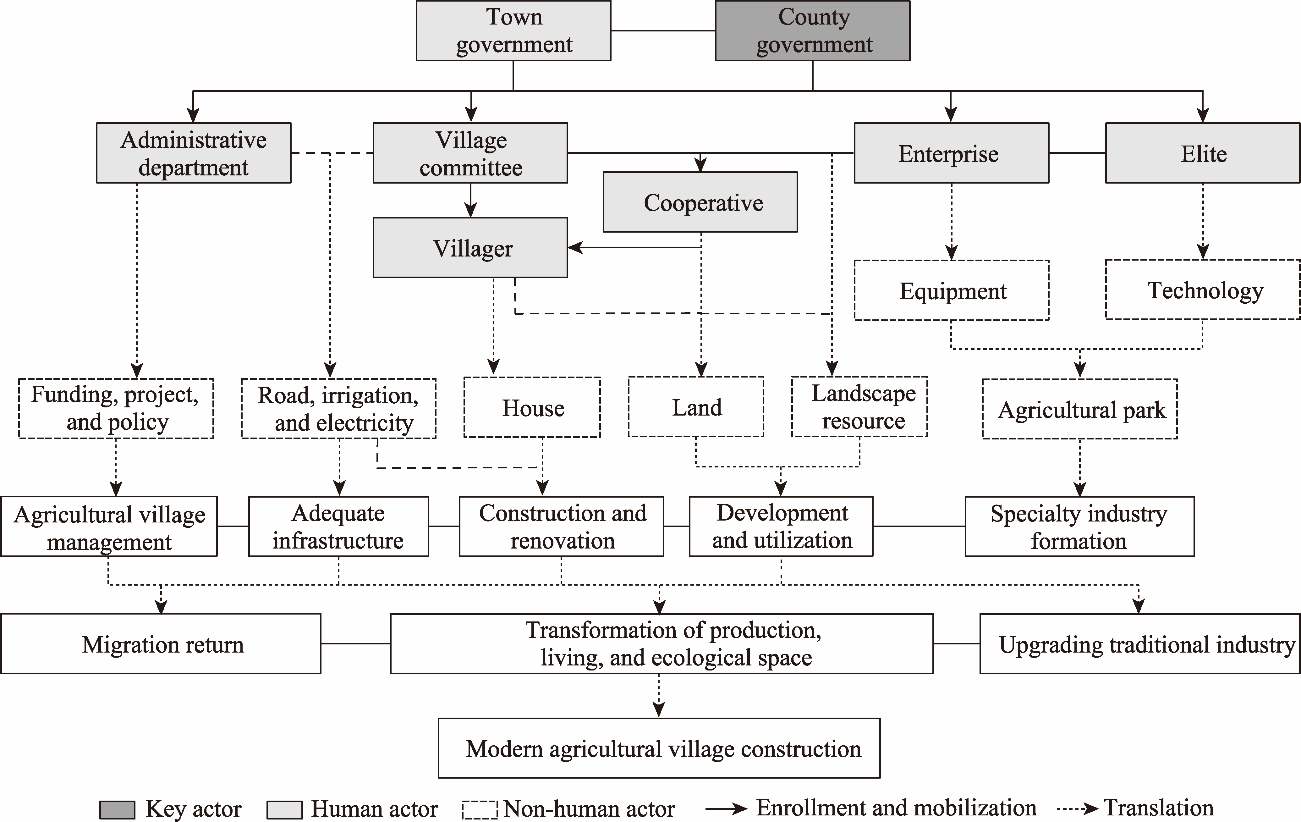
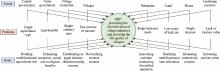
Fig. 5.
Actors, problems, goals, and OPP in the development stage of modern agricultural village."
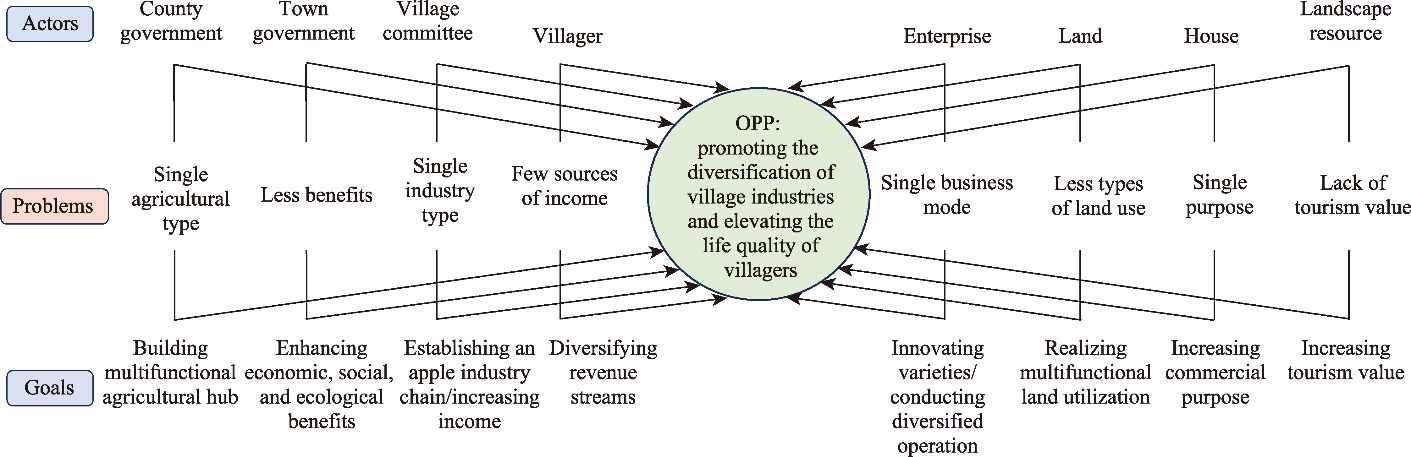
Table 2
Main recruitment methods used by the Zhaojiawa Village committee in the development stage of modern agricultural village."
| Mode of recruitment | Primary recruitment actor | Main method |
|---|---|---|
| Market recruitment | Enterprise and villager | Collaboration with enterprises to develop apple farming, aquaculture, solar power, and tourism. |
| Employment recruitment | Villager | Establishment of companies for apple planting, greenhouse management, and agricultural product marketing. |
| Talent recruitment | Talent | Recruitment of talent for apple variety experiments and promotion of new agricultural models. |
| Publicity recruitment | County and township government | Promotion and standardization of policies for the village’s new development model. |
Fig. 6.
Actor network in the development stage of modern agricultural village."
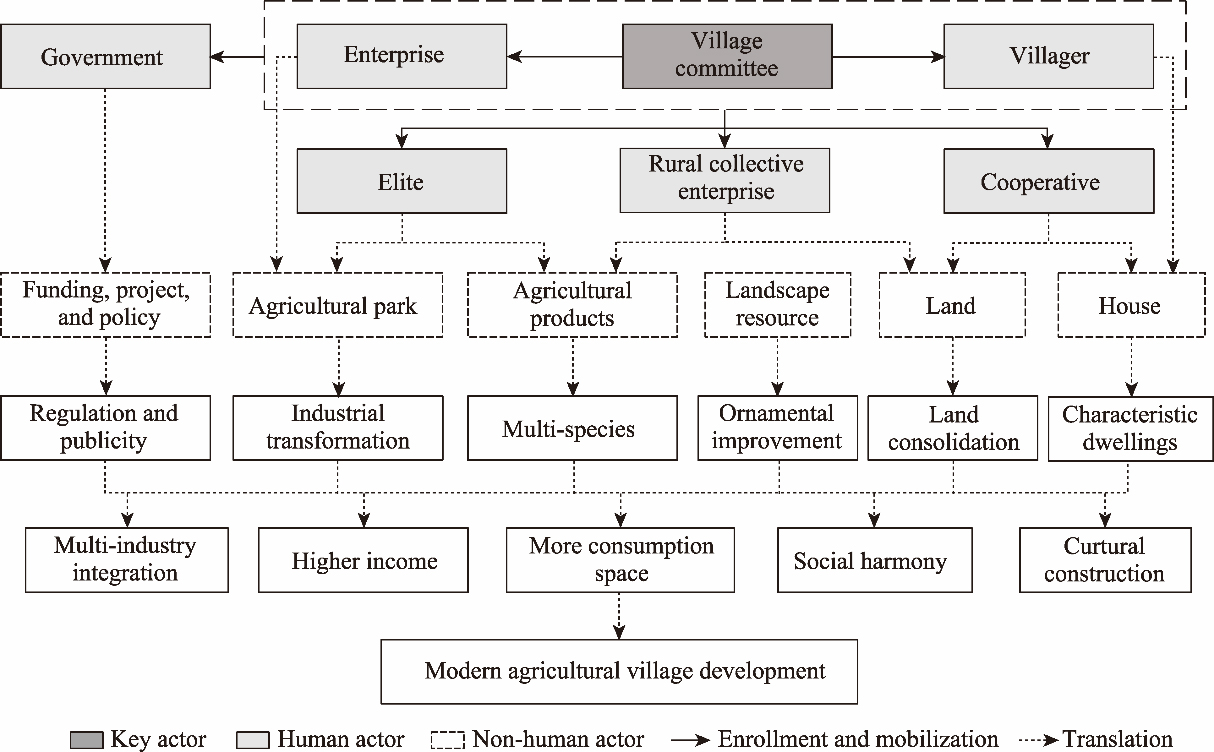
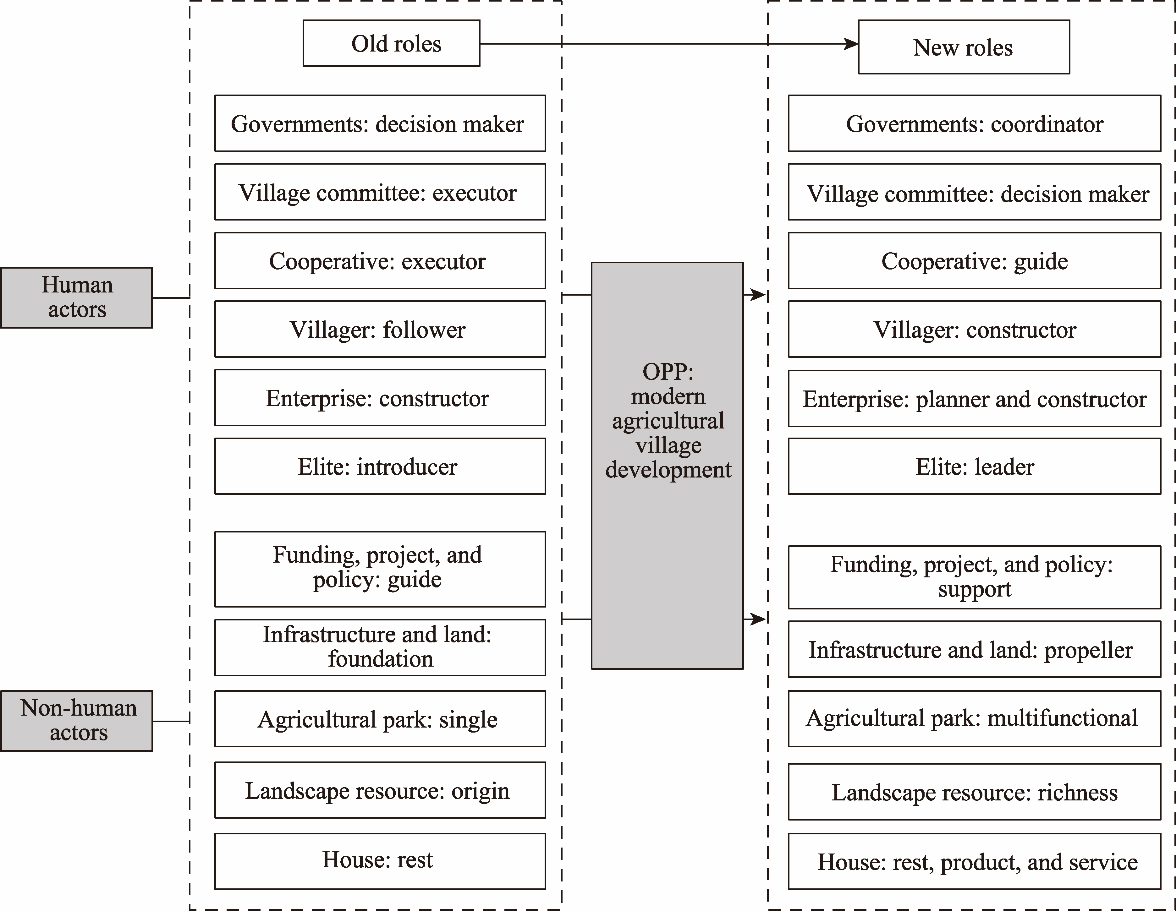
Fig. 7.
Role transformation of human and non-human actors."
| [1] | Barke, M., Newton, M., 1997. The EU LEADER initiative and endogenous rural development: The application of the programme in two rural areas of Andalusia, Southern Spain. J. Rural Stud. 13(3), 319-341. |
| [2] | Braun, Y.A., McLees, L.A., 2012. Space, ownership and inequality: Economic development and tourism in the highlands of Lesotho. Camb. J. Regions Econ. Soc. 5(3), 435-449. |
| [3] | Callon, M., Law, J., Rip, A., 1986. Mapping the Dynamics of Science and Technology. London: Palgrave Macmillan. |
| [4] | Chen, C., Gao, J.L., Chen, J.L., 2022. Behavioral logics of local actors enrolled in the restructuring of rural China: A case study of Haoqiao Village in northern Jiangsu. J. Rural Stud. 93, 223-233. |
| [5] | Chen, P.P., Zhang, M., 2015. From beautiful village to urban residents’ consumption space: Actor-network theory and the social space reconstruction of Dashiao village. Geographical Research. 34(8), 1435-1446 (in Chinese). |
| [6] | Cloke, P., Marsden, T., Mooney, P., 2006. Conceptualizing Rurality. The Handbook of Rural Studies. London: Sage. |
| [7] | Felski, R., 2016. Comparison and translation: A perspective from Actor-Network Theory. Comp. Lit. Stud. 53(4), 747-765. |
| [8] |
Ge, D.Z., Zhou, G.P., Qiao, W.F., et al., 2020. Land use transition and rural spatial governance: Mechanism, framework and perspectives. J. Geogr. Sci. 30(8), 1325-1340.
doi: 10.1007/s11442-020-1784-x |
| [9] | Holmes, J., 2006. Impulses towards a multifunctional transition in rural Australia: Gaps in the research agenda. J. Rural Stud. 22(2), 142-160. |
| [10] | Hu, X.L., Li, H.B., Zhang, X.L., et al., 2019. Multi-dimensionality and the totality of rural spatial restructuring from the perspective of the rural space system: A case study of traditional villages in the ancient Huizhou region, China. Habitat Int. 94, 102062, doi: 10.1016/j.habitatint.2019.102062. |
| [11] | Huang, H., 2020. Learning from exploratory rural practices of the Yangtze River Delta in China: New initiatives, networks and empowerment shifts, and sustainability. J. Rural Stud. 77, 63-74. |
| [12] | Huang, Z., Zhang, J.P., Hu, Y.T., et al., 2023. The process and mechanism of rural industrial integration from the perspective of the actor network: A case study of Shicha village in Haikou city. Geographical Research. 42(10), 2759-2778 (in Chinese). |
| [13] | Kvartiuk, V., Petrick, M., Bavorova, M., et al., 2020. A brain drain in Russian agriculture? Migration sentiments among skilled Russian rural youth. Eur.-Asia Stud. 72(8), 1352-1377. |
| [14] | Latour, B., 1987. Science in Action:How to Follow Scientists and Engineers Through Society. Cambridge: Harvard University Press. |
| [15] | Law, J., 1992. Notes on the theory of the actor-network: Ordering, strategy, and heterogeneity. Syst. Pract. 5, 379-393. |
| [16] | Li, S.M., Yang, R., Long, H.L., et al., 2024. Rural spatial restructuring in suburbs under capital intervention: Spatial construction based on nature. Habitat Int. 150, 103112, doi: 10.1016/j.habitatint.2024.103112. |
| [17] | Li, Y.R., Fan, P.C., Liu, Y.S., 2019. What makes better village development in traditional agricultural areas of China? Evidence from long-term observation of typical villages. Habitat Int. 83, 111-124. |
| [18] | Li, Y.R., Qin, X.F., Sullivan, A., et al., 2023. Collective action improves elite-driven governance in rural development within China. Hum. Soc. Sci. Commun. 10, 600, doi: 10.1057/s41599-023-02089-9. |
| [19] |
Li, Y.Y., Shao, L., 2024. Reconstruction process and transformation mechanism of ecological characteristic rural space based on Actor-Network Theory: A case study of Lianhu Village in the Qingpu District, Shanghai. Scientia Geographica Sinica. 44(1), 30-39 (in Chinese).
doi: 10.13249/j.cnki.sgs.20221215 |
| [20] | Liu, H.Y., Weng, D.L., Liu, H.G., 2021. Decoding rural space reconstruction using an Actor-Network methodological approach: A case study from the Yangtze River Delta, China. Land. 10(11), 1110, doi: 10.3390/land10111110. |
| [21] |
Liu, X., Wang, X.Y., 2013. A review on the application of Actor Network Theory to human geography. Progress in Geography. 32(7), 1139-1147 (in Chinese).
doi: 10.11820/dlkxjz.2013.07.016 |
| [22] | Liu, Y.S., Zhou, Y., 2015. Challenges and countermeasures for beautiful countryside construction in China. Journal of Agricultural Resources and Environment. 32(2), 97-105 (in Chinese). |
| [23] | Liu, Y.S., Li, Y.H., 2017. Revitalize the world’s countryside. Nature. 548(7667), 275-277. |
| [24] |
Liu, Y.S., 2018. Research on the urban-rural integration and rural revitalization in the new era in China. Acta Geographica Sinica. 73(4), 637-650 (in Chinese).
doi: 10.11821/dlxb201804004 |
| [25] | Long, H.L., Zou, J., Pykett, J., et al., 2011. Analysis of rural transformation development in China since the turn of the new millennium. Appl. Geogr. 31(3), 1094-1105. |
| [26] | Long, H.L., 2014. Land consolidation: An indispensable way of spatial restructuring in rural China. J. Geogr. Sci. 24(2), 211-225. |
| [27] | Long, H.L., Tu, S.S., Ge, D.Z., et al., 2016. The allocation and management of critical resources in rural China under restructuring: Problems and prospects. J. Rural Stud. 47(B), 392-412. |
| [28] | Long, H.L., Qu, Y., 2018. Land use transitions and land management: A mutual feedback perspective. Land Use Pol. 74, 111-120. |
| [29] | Ma, W.Q., Jiang, G.H., Zhang, R.J., et al., 2018. Achieving rural spatial restructuring in China: A suitable framework to understand how structural transitions in rural residential land differ across peri-urban interface? Land Use Pol. 75, 583-593. |
| [30] | Müller, M., 2015. Assemblages and actor-networks: Rethinking socio-material power, politics and space. Geogr. Compass. 9(1), 27-41. |
| [31] | National Bureau of Statistics of China, 2024. Statistical Communiqué of the People’s Republic of China on the 2023 National Economic and Social Development. [2024-05-29]. http://www.stats.gov.cn/. |
| [32] | Peng, Y., Peng, X.B., Li, X., et al., 2023. Effectiveness in rural governance: Influencing factors and driving pathways—based on 20 typical cases of rural governance in China. Land. 12(7), 1452, doi: 10.3390/land12071452. |
| [33] | Qu, L.L., Li, Y.R., Wang, J.Y., 2023. Simulation and optimization of agricultural production scenarios in loess hilly and gully region. Geographical Research. 42(6), 1647-1662 (in Chinese). |
| [34] | Qu, Y.B., Zhao, W.Y., Zhao, L.J., et al., 2022. Research on hollow village governance based on action network: Mode, mechanism and countermeasures—comparison of different patterns in plain agricultural areas of China. Land. 11(6), 792, doi: 10.3390/land11060792. |
| [35] | Qu, Y.B., Dong, X.Z., Ma, W.Q., et al., 2024. New rural community construction or retention development: A comparative analysis of rural settlement transition mechanism in plain agriculture area of China based on Actor Network Theory. Chin. Geogr. Sci. 34(3), 436-452. |
| [36] |
Ramos-Tumanan, M.A., Ryan, C., 2019. Chinese rural tourism seeking a Chinese perspective from an emic stance, or a case of post hoc reflection? Tourism Manage. 75, 284-292.
doi: 10.1016/j.tourman.2019.05.009 |
| [37] | Ray, C., 2001. Culture Economies: A Perspective on Local Rural Development in Europe. Newcastle: Centre for Rural Economy, Newcastle University. |
| [38] |
Sovacool, B.K., Hess, D.J., 2017. Ordering theories: Typologies and conceptual frameworks for sociotechnical change. Soc. Stud. Sci. 47(5), 703-750.
doi: 10.1177/0306312717709363 pmid: 28641502 |
| [39] | Su, K.C., Wu, J., Yan, Y., et al., 2022. The functional value evolution of rural homesteads in different types of villages: Evidence from a Chinese traditional agricultural village and homestay village. Land. 11(6), 903, doi: 10.3390/land11060903. |
| [40] | Suide County People’s Government, 2021a. Statistical Communiqué of Suide County on the National Economic and Social Development in 2020. [2024-06-29]. https://www.sxsd.gov.cn/zfxxgk/fdzdgknr/tjxx/ndsj/202104/t20210428_1329754.html (in Chinese). |
| [41] | Suide County People’s Government, 2021b. These Four Places in Suide have been Named as the First Batch of Film and Television Shooting Locations in Yulin City. [2024-07-01]. https://www.sxsd.gov.cn/xwzx/xzbm/202012/t20201222_544168.html (in Chinese). |
| [42] | Suide County People’s Government, 2023a. Zhaojiawa Village in Suide County Designated as Provincial-Level Rural Revitalization Practice and Exchange Base. [2024-07-01]. https://www.sxsd.gov.cn/xwzx/xzbm/202312/t20231215_544985.html (in Chinese). |
| [43] | Suide County People’s Government, 2023b. Zhaojiawa Village: Generating “Gold” from Green to Promote Rural Revitalization. [2024-07-01]. https://www.sxsd.gov.cn/xwzx/xzbm/202404/t20240426_1623148.html (in Chinese). |
| [44] | Sun, Q.H., 2023. The reconstruction strategy of rural public space in Zhaoqing under the background of rural revitalization. Academic Journal of Humanities & Social Sciences. 6(18), 142-147. |
| [45] | Tang, Y., Mason, R.J., Wang, Y.B., 2015. Governments’ functions in the process of integrated consolidation and allocation of rural-urban construction land in China. J. Rural Stud. 42, 43-51. |
| [46] | Tebboth, M.G.L., Locke, C., 2023. Rural modernization and the remaking of the rural citizen in China: Village redevelopment, migration and precarity. J. Int. Dev. 36(2), 1129-1149. |
| [47] | Terluin, I.J., 2003. Differences in economic development in rural regions of advanced countries: An overview and critical analysis of theories. J. Rural Stud. 19(3), 327-344. |
| [48] | Wang, D., Chen, C.L., Findlay, C., 2023a. A review of rural transformation studies: Definition, measurement, and indicators. J. Integr. Agric. 22(12), 3568-3581. |
| [49] | Wang, J.Y., Qu, L.L., Li, Y.R., et al., 2023b. Identifying the structure of rural regional system and implications for rural revitalization: A case study of Yanchi County in northern China. Land Use Pol. 124, 106436, doi: 10.1016/j.landusepol.2022.106436. |
| [50] | Wang, P., Xie, S.Y., Xu, H.G., 2023c. Re-conceptualizing the ideal homes in rural China: An Actor-Network Theory approach. Hum. Soc. Sci. Commun. 10(1), 513, doi: 10.1057/s41599-023-02017-x. |
| [51] | Wang, W., Qiao, J.J., Cheng, S.Y., et al., 2023d. An analysis of the evolution mechanism of Chongdu tourism village cluster based on the theory of actor network. Human Geography. 38(2), 155-163, 180 (in Chinese). |
| [52] | Woods, M., 2010. Performing rurality and practising rural geography. Prog. Hum. Geogr. 34(6), 835-846. |
| [53] | Woods, M., 2011. Regions engaging globalization: A typology of regional responses in rural Europe. J. Rural Community Dev. 8(3), 113-126. |
| [54] |
Wu, K.S., Kong, D.Y., Wang, Y., et al., 2022. The study on influencing factors of rural transformation development and their spatial differentiation of effects: Take Shaanxi province as an example. Journal of Natural Resources. 37(8), 2033-2041 (in Chinese).
doi: 10.31497/zrzyxb.20220808 |
| [55] |
Yang, R., Xu, Q., Zhou, J.D., et al., 2018. Mechanism of rural space transformation in Fengjian Acient Village of Shunde District, Foshan based on the Actor Network. Scientia Geographica Sinica. 38(11), 1817-1827 (in Chinese).
doi: 10.13249/j.cnki.sgs.2018.11.009 |
| [56] |
Yang, R., 2022. Space reconstruction process and internal driving mechanisms of Taobao villages in metropolitan fringe areas: A case study of Lirendong village in Guangzhou, China. J. Geogr. Sci. 32(12), 2599-2623.
doi: 10.1007/s11442-022-2063-9 |
| [57] | Zang, Y.Z., Yang, Y.Y., Cao, Z., 2019. Typical model of rural transformation and restructure in suburban areas: A case study of Huaming Township in Dongli District, Tianjin City. Geographical Research. 38(3), 713-724 (in Chinese). |
| [58] | Zang, Y.Z., Hu, S.G., Liu, Y.S., 2024. Rural transformation and its links to farmland use transition: Theoretical insights and empirical evidence from Jiangsu. China. Habitat Int. 49, 103094, doi: 10.1016/j.habitatint.2024.103094. |
| [59] | Zhan, L.Y., Wang, S.J., Xie, S.X., et al., 2023. Spatial path to achieve urban-rural integration development - analytical framework for coupling the linkage and coordination of urban-rural system function. Habitat Int. 142, 102953, doi: 10.1016/j.habitatint.2023.102953. |
| [60] | Zhang, J., Yu, H.Z., Qiao, W., et al., 2022a. Progress of research on the transformation and restructuring of rural development in China. Progress in Geography. 41(5), 896-904 (in Chinese). |
| [61] | Zhang, Q.F., Tang, X., Xiao, Y., et al., 2023. Coordination of industrial structure and eco-efficiency in ecologically fragile areas: A case study of the Loess Plateau, China. J. Environ. Manage. 331, 117237, doi: 10.1016/j.jenvman.2023.117237. |
| [62] | Zhang, R.Y., Li, H.B., Yuan, Y., 2022b. Analyzing space-time evolution of rural transition in a rapidly urbanizing region: A case study of Suzhou, China. J. Geogr. Sci. 32(7), 1343-1356. |
| [63] | Zhang, X.F., Xu, H., Zhang, Y., 2021. From poverty alleviation to rural revitalization: A new endogenous development theory perspective - A case study of Y County, Guizhou Province. Contemporary Economic Management. 43(10), 31-39 (in Chinese). |
| [64] | Zhang, X.L., Pan, M.M., 2022. Emerging rural spatial restructuring regimes in China: A tale of three transitional villages in the urban fringe. J. Rural Stud. 93, 287-300. |
| [65] | Zheng, Z.Q., Chou, R.J., 2024. Rebuilding the resilience of mountainous rural communities by enhancing community capital through industrial transformation: A case study from rural Fujian. China. Habitat Int. 149, 103086, doi: 10.1016/j.habitatint.2024.103086. |
| [66] | Zou, M.Y., Zhou, T.J., Pan, Y., 2019. Driving force of rural construction based on Actor-network Theory. Planners. 35(16), 62-67 (in Chinese). |
| [1] | Rizal IMANA, Andrea Emma PRAVITASARI, Didit Okta PRIBADI. Analysis of environmental protection priority zones and their impacts on urban planning in small- and medium-sized cities of Indonesia [J]. Regional Sustainability, 2025, 6(2): 100211-. |
| [2] | Gadir BAYRAMLI, Turan KARIMLI. Driving factors of CO2 emissions in South American countries: An application of Seemingly Unrelated Regression model [J]. Regional Sustainability, 2024, 5(4): 100182-. |
| [3] | Jafarpour Ghalehteimouri KAMRAN, Che Ros FAIZAH, Rambat SHUIB. Application of Cellular Automata and Markov Chain model for urban green infrastructure in Kuala Lumpur, Malaysia [J]. Regional Sustainability, 2024, 5(4): 100179-. |
| [4] | Bubun MAHATA, Siba Sankar SAHU, Archishman SARDAR, Laxmikanta RANA, Mukul MAITY. Spatiotemporal dynamics of land use/land cover (LULC) changes and its impact on land surface temperature: A case study in New Town Kolkata, eastern India [J]. Regional Sustainability, 2024, 5(2): 100138-. |
| [5] | Liton Chandra VOUMIK, Md. Hasanur RAHMAN, Md. Maznur RAHMAN, Mohammad RIDWAN, Salma AKTER, Asif RAIHAN. Toward a sustainable future: Examining the interconnectedness among Foreign Direct Investment (FDI), urbanization, trade openness, economic growth, and energy usage in Australia [J]. Regional Sustainability, 2023, 4(4): 405-415. |
| [6] | LI Guoyi, LIU Jiahong, SHAO Weiwei. Urban flood risk assessment under rapid urbanization in Zhengzhou City, China [J]. Regional Sustainability, 2023, 4(3): 332-348. |
| [7] | WANG Yuchan, GAO Genghe, NING Xiaoju, LI Yuanzheng, NIU Ning, GUO Yaqi. Willingness of returning migrant workers to purchase houses: A case study of 45 villages in Henan Province, China [J]. Regional Sustainability, 2022, 3(2): 133-145. |
| [8] | Ahmed Mohammed Sayed MOHAMMED, Tetsuya UKAI, Michael HALL. Towards a sustainable campus-city relationship: A systematic review of the literature [J]. Regional Sustainability, 2022, 3(1): 53-67. |
| [9] | Yanhua He, Yi Lin, Guohua Zhou, Yixuan Zhu, Kai Tang. Spatial pattern and drivers of urbanization in China’s mid-level developing urban agglomeration: A case study of Chang-Zhu-Tan [J]. Regional Sustainability, 2021, 2(1): 83-97. |
| [10] | Yupeng Liu, Jiajia Li, Linlin Duan, Min Dai, Wei-qiang Chen. Material dependence of cities and implications for regional sustainability [J]. Regional Sustainability, 2020, 1(1): 31-36. |
| Viewed | ||||||
|
Full text |
|
|||||
|
Abstract |
|
|||||
 REGSUS Wechat
 新公网安备 65010402001202号