
Regional Sustainability ›› 2025, Vol. 6 ›› Issue (2): 100213.doi: 10.1016/j.regsus.2025.100213cstr: 32279.14.REGSUS.2025012
• Research article • Previous Articles Next Articles
Abdul MALIKa,*( ), Muhammad Ichsan ALIb, Abdul Rasyid JALILc, Abdul MANNANa, Rahma MUSYAWARAHa
Received:2024-06-28
Revised:2025-03-04
Accepted:2025-05-06
Published:2025-04-30
Online:2025-05-21
Contact:
* E-mail address: abdulmalik@unm.ac.id (Abdul MALIK).
Abdul MALIK, Muhammad Ichsan ALI, Abdul Rasyid JALIL, Abdul MANNAN, Rahma MUSYAWARAH. Promoting sustainable mangrove tourism through payments for ecosystem services: Insights from Tongke-Tongke Village, South Sulawesi, Indonesia[J]. Regional Sustainability, 2025, 6(2): 100213.
Fig. 1.
Overview of the Tongke-Tongke mangrove tourism area."
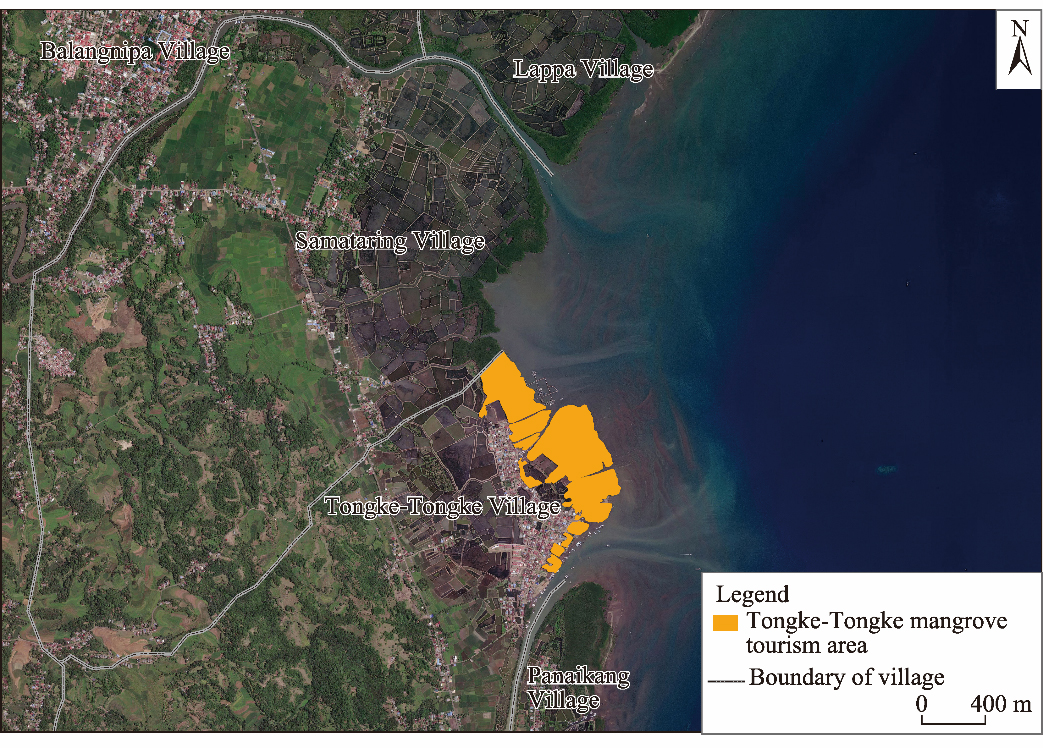
Table 1
Summary of socioeconomic and demographic characteristics of the respondents."
| Variable | Number of respondents | Percentage (%) | |
|---|---|---|---|
| Gender | Male | 96 | 87.27 |
| Female | 14 | 12.73 | |
| Age (years old) | 20-30 | 29 | 26.36 |
| 31-40 | 40 | 36.36 | |
| 41-50 | 23 | 20.91 | |
| 51-60 | 14 | 12.73 | |
| 61-70 | 4 | 3.64 | |
| Level of educational attainment | Did not complete elementary school | 50 | 45.45 |
| Elementary school | 37 | 33.64 | |
| Junior high school | 14 | 12.73 | |
| Senior high school | 7 | 6.36 | |
| University | 2 | 1.82 | |
| Livelihood | Fisherman | 63 | 57.27 |
| Shrimp farmer | 21 | 19.09 | |
| Seaweed farmer | 12 | 10.91 | |
| Firewood collector | 4 | 3.64 | |
| Civil servant | 3 | 2.73 | |
| Businessman | 7 | 6.36 | |
| Household income (USD/month) | 49-105 | 52 | 47.27 |
| 106-161 | 14 | 12.73 | |
| 162-217 | 12 | 10.91 | |
| 218-274 | 13 | 11.82 | |
| 275-330 | 9 | 8.18 | |
| >331 | 10 | 9.09 | |
Table 2
Community perceptions, attitudes, and preferences regarding mangrove tourism activities in Tongke-Tongke mangrove tourism area."
| Topic | Strongly disagree (%) | Disagree (%) | Neither agree nor disagree (%) | Agree (%) | Strongly agree (%) |
|---|---|---|---|---|---|
| Economic benefit | 5.00 | 10.00 | 15.00 | 50.00 | 20.00 |
| Environmental conservation | 3.00 | 5.00 | 10.00 | 60.00 | 22.00 |
| Cultural preservation | 2.00 | 8.00 | 15.00 | 45.00 | 30.00 |
| Overall satisfaction with tourism activities | 3.00 | 5.00 | 10.00 | 50.00 | 32.00 |
Table 3
Thematic analysis result based on stakeholders’ perceptions regarding tourism development in Tongke-Tongke mangrove tourism area."
| Topic | Description |
|---|---|
| Economic benefit | Stakeholders emphasized the significant economic benefits of tourism development, including increased revenue generation, job creation, and business opportunities within the community. |
| Environmental conservation | Stakeholders demonstrated a strong commitment to environmental conservation and sustainability, with initiatives like biodiversity conservation to preserve the mangrove ecosystem. |
| Cultural preservation | Stakeholders recognized the cultural significance of heritage and traditions in Tongke-Tongke mangrove tourism area, highlighting the value of preserving and showcasing local culture to enhance the tourism experience. |
| Challenges and aspirations | Stakeholders identified various challenges, such as infrastructure limitations, socioeconomic disparities, and land privatization, and aspirations for sustainable development and inclusive growth in the tourism sector. |
Table 4
Analysis of travel cost incurred by tourists from various origins to visit the Tongke-Tongke mangrove tourism area."
| Tourist origin | Number of tourists | Transportation cost (USD/trip) | Consumption-related cost (USD/trip) | Parking fee (USD/trip) | Entrance ticket fee (USD/trip) | Total travel cost (USD/trip) |
|---|---|---|---|---|---|---|
| Sinjai District | 75 | 106.00 | 211.00 | 26.00 | 53.00 | 396.00 |
| Bone District | 13 | 73.00 | 55.00 | 5.00 | 9.00 | 142.00 |
| Bulukumba District | 9 | 32.00 | 38.00 | 3.00 | 6.00 | 79.00 |
| Makassar City | 5 | 35.00 | 21.00 | 2.00 | 4.00 | 62.00 |
| Total | 102 | 246.00 | 325.00 | 36.00 | 72.00 | 679.00 |
Table 5
Estimated economic value of Tongke-Tongke mangrove tourism area."
| Tourist origin | Average travel cost per person (USD/person) | Total number of tourists per year (persons/a) | Annual economic value (USD/a) | Annual economic value per area (USD/(hm²•a)) |
|---|---|---|---|---|
| Sinjai District | 5.28 | 3900 | 20,599.00 | 550.00 |
| Bone District | 10.92 | 676 | 7379.00 | 197.00 |
| Bulukumba District | 8.80 | 468 | 4120.00 | 110.00 |
| Makassar City | 12.32 | 260 | 3204.00 | 86.00 |
| Total | 37.32 | 5304 | 35,301.00 | 943.00 |
Table 6
Tourists’ willingness to pay (WTP) for conserving and preserving the mangrove area in Tongke-Tongke mangrove tourism area."
| Monthly WTP per tourist (USD/(person•month)) | Frequency | Annual WTP per tourist (USD/(person•a)) | Annual WTP per area (USD/(hm²•a)) |
|---|---|---|---|
| 0.21 | 24 | 60.85 | 1.63 |
| 0.28 | 17 | 57.46 | 1.54 |
| 0.35 | 31 | 130.99 | 3.50 |
| 0.42 | 11 | 55.77 | 1.49 |
| 0.49 | 9 | 53.24 | 1.42 |
| 0.56 | 10 | 67.61 | 1.81 |
| Total | 102 | 426.00 | 11.39 |
| [1] | Asian Development Bank, 2021. Philippines: Sustainable Tourism Development Project. [2024-05-13]. https://www.adb.org/sites/default/files/project-documents/53191/53191-001-sddr-en.pdf. |
| [2] | Adhikari, B., Boag, G., 2013. Designing payments for ecosystem services schemes: Some considerations. Curr. Opin. Environ. Sustain. 5(1), 72-77. |
| [3] | Afonso, F., Félix, P.M., Chainho, P., et al., 2022. Community perceptions about mangrove ecosystem services and threats. Reg. Stud. Mar. Sci. 49, 102114, doi: 10.1016/j.rsma.2021.102114. |
| [4] | Ahmad, Y., Suratman, M.N., 2021. The roles of mangroves in sustainable tourism development. In: Rastogi, R.P., Phulwaria, M., Gupta, D.K., (eds.). Mangroves: Ecology, Biodiversity and Management. Singapore: Springer, 401-417. |
| [5] | Ali, M.I., Malik, A., Rahim, A., 2022. Environmental knowledge and attitude of coastal community in decision making to participate in mangrove rehabilitation in Sinjai District South Sulawesi Indonesia. International Journal of Sustainable Development and Planning. 17(8), 2579-2584. |
| [6] | Amri, A., 2008. Land property rights and coastal resource management:A perspective of community based mangrove conservation in Indonesia. In: The 12th Biennial Global Conference of The International Association. Cheltenham, the United Kingdom. |
| [7] | Arifanti, V.B., Sidik, F., Mulyanto, B., et al., 2022. Challenges and strategies for sustainable mangrove management in indonesia: A review. Forests. 13(5), 695, doi: 10.3390/f13050695. |
| [8] | Baloch, Q.B., Shah, S.N., Iqbal, N., et al., 2023. Impact of tourism development upon environmental sustainability: A suggested framework for sustainable ecotourism. Environ. Sci. Pollut. Res. 30(3), 5917-5930. |
| [9] | Bardhan, M., 2021. An empirical study on mangrove restoration in Indian Sundarbans—A community-based environmental approach. Modern Cartography Series. 10, 387-405. |
| [10] | Basyuni, M., Sasmito, S.D., Analuddin, K., et al., 2022. Mangrove biodiversity, conservation and roles for livelihoods in indonesia. In: Das, S.C., Pullaiah, Ashton, E.C., (eds.). Mangroves: Biodiversity, Livelihoods and Conservation. Singapore: Springer, 397-445. |
| [11] | Beyerl, K., Putz, O., Breckwoldt, A., 2016. The role of perceptions for community-based marine resource management. Front. Mar. Sci. 3, 238, doi: 10.3389/fmars.2016.00238. |
| [12] | Blanton, A., Ewane, E.B., McTavish, F., et al., 2024. Ecotourism and mangrove conservation in Southeast Asia: Current trends and perspectives. J. Environ. Manage. 365, 121529, doi: 10.1016/j.jenvman.2024.121529. |
| [13] | Blundo-Canto, G., Bax, V., Quintero, M., et al., 2018. The different dimensions of livelihood impacts of payments for environmental services (pes) schemes: A systematic review. Ecol. Econ. 149, 160-183. |
| [14] | Brownson, K., Anderson, E.P., Ferreira, S., et al., 2020. Governance of payments for ecosystem services influences social and environmental outcomes in Costa Rica. Ecol. Econ. 174, 106659, doi: 10.1016/j.ecolecon.2020.106659. |
| [15] | Carandang, A.P., Camacho, L.D., Gevaña, D.T., et al., 2013. Economic valuation for sustainable mangrove ecosystems management in Bohol and Palawan, Philippines. For. Sci. Technol. 9(3), 118-125. |
| [16] | Castleberry, A., Nolen, A., 2018. Thematic analysis of qualitative research data: Is it as easy as it sounds? Curr. Pharm. Teach. Learn. 10(6), 807-815. |
| [17] | Central Statistics Agency of Sinjai District, 2006. Sinjai District in Figures 2005/2006. [2024-05-05]. https://sinjaikab.bps.go.id/id/publication/ 2006/09/26/a1bd86d69cb4e0ac7c5ecfff/kab-sinjai-dalam-angka-2005-2006.html (in Indonesian). |
| [18] | Central Statistics Agency of Sinjai District, 2022. Sinjai District in Figures 2022. [2024-05-05]. https://sinjaikab.bps.go.id/publication/2022/02/25/64524eba66e248c576476052/kabupaten-sinjai-dalam-angka-2022.html (in Indonesian). |
| [19] | Dahliah, D., 2020. Mangrove forest tourism contribution to local revenue in the tourism sector. Point of View Research Economic Development. 1(4), 51-59. |
| [20] | Das, S.C., Das, S., Tah, J., 2022. Mangrove forests and people’s livelihoods. In: Das, S.C., Pullaiah, Ashton, E.C., (eds.). Mangroves: Biodiversity, Livelihoods and Conservation. Singapore: Springer, 153-173. |
| [21] | DasGupta, R., Shaw, R., 2017. Perceptive insight into incentive design and sustainability of participatory mangrove management: A case study from the Indian Sundarbans. J. For. Res. 28(4), 815-829. |
| [22] | Domingo, S.N., Manejar, A.J.A., Ocbina, J.J.S., 2022. Looking at payments for ecosystems services in the Philippines. [2024-05-12]. https://www.pids.gov.ph/publication/discussion-papers/looking-at-payments-for-ecosystems-services-in-the-philippines. |
| [23] | Dunlop, T., Corbera, E., 2016. Incentivizing REDD plus : How developing countries are laying the groundwork for benefit-sharing. Environ. Sci. Policy. 63, 44-54. |
| [24] | Etikan, I., 2016. Comparison of convenience sampling and purposive sampling. American Journal of Theoretical and Applied Statistics. 5(1), 1, doi: 10.11648/j.ajtas.20160501.11. |
| [25] | Etikan, I., Bala, K., 2017. Sampling and sampling methods. Biometrics & Biostatistics International Journal. 5(6), 215-217. |
| [26] | Fauzi, A., Anna, Z., 2013. The complexity of the institution of payment for environmental services: A case study of two Indonesian PES schemes. Ecosyst. Serv. 6, 54-63. |
| [27] | Gevaña, D.T., Camacho, L.D., Pulhin, J.M., 2018. Conserving mangroves for their blue carbon:Insights and prospects for community-based mangrove management in southeast Asia. In: Makowski, C., Finkl, C., (eds.). Threats to Mangrove Forests. Cham: Springer, 579-588. |
| [28] | Ginantra, I.K., Muksin, I.K., Martin, J., 2024. Mangrove flora as an ecotourism attraction in the Perancak Mangrove, Jembrana Bali. International Journal of Science and Research Archive. 12(2), 445-454. |
| [29] | Giri, C., Ochieng, E., Tieszen, L.L., et al., 2011. Status and distribution of mangrove forests of the world using earth observation satellite data. Glob. Ecol. Biogeogr. 20(1), 154-159. |
| [30] | Hance, J., 2020. Sulawesi. [2024-05-05]. https://worldrainforests.com/sulawesi/. |
| [31] | Heyde, J., Lukas, M.C., Flitner, M., 2012. Payments for Environmental Services in Indonesia: A Review of Watershed-related Schemes. [2024-05-20]. https://www.ssoar.info/ssoar/handle/document/58709. |
| [32] | Hidayati, N., Karuniasa, M., Patria, M.P., et al., 2018. Developing Payment for Ecosystem Services Scheme on Pari Island Kepulauan Seribu. [2024-05-20]. https://www.e3s-conferences.org/articles/e3sconf/abs/2018/43/e3sconf_sricoenv2018_02010/e3sconf_sricoenv2018_02010.html. |
| [33] | Himes-Cornell, A., Pendleton, L., Atiyah, P., 2018. Valuing ecosystem services from blue forests: A systematic review of the valuation of salt marshes, sea grass beds and mangrove forests. Ecosyst. Serv. 30(A), 36-48. |
| [34] | Inaz, A., 2020. Producing tourism policy, democracy and marginalised local communities. PhD Dissertation. New Zealand: University of Auckland. |
| [35] | Ingram, J.C., Wilkie, D., Clements, T., et al., 2014. Evidence of payments for ecosystem services as a mechanism for supporting biodiversity conservation and rural livelihoods. Ecosyst. Serv. 7, 10-21. |
| [36] | Iqbal, M.H., Hossain, M.E., 2023. Tourists’ willingness to pay for restoration of Sundarbans Mangrove forest ecosystems: A contingent valuation modeling study. Environ. Dev. Sustain. 25(3), 2443-2464. |
| [37] | Jalil, A.R., Malik, A., Nurdin, N., et al., 2020. Assessment of seawater level, inundation duration and substrate elevation for mangrove rehabilitation program in the Spermonde Archipelago South Sulawesi Indonesia. Int. J. Conserv. Sci. 11(4), 1115-1126. |
| [38] | Jiang, W.Y., Jiang, S.L., 2023. Evolution of regulations controlling human pressure in protected areas of China. Sustainability. 15(5), 4469, doi: 10.3390/su15054469. |
| [39] | Juma, L.O., Khademi-Vidra, A., 2019. Community-based tourism and sustainable development of rural regions in Kenya: Perceptions of the citizenry. Sustainability. 11(17), 4733, doi: 10.3390/su11174733. |
| [40] | Kaiser, J., Haase, D., Krueger, T., 2023. Collective payments for ecosystem services: A counterpart of commodification and privatization trends in nature conservation? Ecol. Soc. 28(1), 13, doi: 10.5751/ES-13549-280113. |
| [41] | Kala, D., Bagri, S.C., 2018. Barriers to local community participation in tourism development: Evidence from mountainous state Uttarakhand, India. Tourism. 66(3), 318-333. |
| [42] | Kathiresan, K., 2021. Mangroves:Types and importance. In: Rastogi, R.P., Phulwaria, M., Gupta, D.K., (eds.). Mangroves: Ecology, Biodiversity and Management. Singapore: Springer, 1-31. |
| [43] | Leal, M., Spalding, M.D., 2022. The State of the World’s Mangroves 2022. [2024-05-12]. https://library.sprep.org/sites/default/files/2022-09/The-State-of-the-Worlds-Mangroves-Report_2022.pdf. |
| [44] | Lee, S.L., Then, A.Y.H., Goh, H.C., et al., 2022. Strengthened multi-stakeholder linkages in valuation studies is critical for improved decision making outcomes for valuable mangroves-The Malaysian case study. Front. Mar. Sci. 9, 1033200, doi: 10.3389/ fmars.2022.1033200. |
| [45] | Lestari, R.A., Amirullah, A., Ahmadin, A., 2019. History of the Tongke-Tongke mangrove forest in Sinjai District. Journal of Pattingalloang. 6(1), 91, doi: 10.26858/pattingalloang.v6i1.10687. |
| [46] | Leung, Y.F., Spenceley, A., Hvenegaard, G., et al., 2018. Tourism and Visitor Management in Protected Areas: Guidelines for Sustainability. [2024-04-20]. https://portals.iucn.org/library/sites/library/files/documents/PAG-027-En.pdf. |
| [47] | Li, Q.R., Zander, P., 2020. Resilience building of rural livelihoods in PES programmes: A case study in China’s Loess Hills. Ambio. 49(4), 962-985. |
| [48] | Ma, B., Wen, Y.L., 2019. Community participation and preferences regarding conservation and development policies in China’s giant panda nature reserves. Sustainability. 11(18), 4852, doi: 10.3390/su11184852. |
| [49] | Malik, A., Fensholt, R., Mertz, O., 2015. Mangrove exploitation effects on biodiversity and ecosystem services. Biodivers. Conserv. 24(14), 3543-3557. |
| [50] | Malik, A., Mertz, O., Fensholt, R., 2017. Mangrove forest decline: consequences for livelihoods and environment in South Sulawesi. Reg. Envir. Chang. 17(1), 157-169. |
| [51] | Malik, A., Jalil, A.R., Arifuddin, A., et al., 2020. Biomass carbon stocks in the mangrove rehabilitated area of Sinjai district, South Sulawesi, Indonesia. Geography Environment Sustainability. 13(3), 32-38. |
| [52] | Malik, A., Rahim, A., Kaseng, E., et al., 2021. Economic Valuation of Mangrove Tourism Services for Conservation and Sustainable Management: A Case Study in Sinjai District, South Sulawesi, Indonesia. [2024-04-20]. https://eprints.unm.ac.id/28091/5/5.%20PNBP%20MBKM%20UNM%20kerjasama%20Luar%20Negeri%202021_Economic%20valuation_AM.pdf. |
| [53] | Malik, A., Rahim, A., Jalil, A.R., et al., 2023. Mangrove blue carbon stocks estimation in South Sulawesi Indonesia. Cont. Shelf Res. 269, 105139, doi: 10.1016/j.csr.2023.105139. |
| [54] | Okafor-Yarwood, I., Kadagi, N.I., Miranda, N.A.F., et al., 2020. The blue economy-cultural livelihood-ecosystem conservation triangle: The African experience. Front. Mar. Sci. 7, 586, doi: 10.3389/fmars.2020.00586. |
| [55] |
Pedroso, R., Kung’u, J.B., 2019. Tourists’ willingness to pay for upstream restoration and conservation measures. J. Sustain. Tour. 27(8), 1107-1124.
doi: 10.1080/09669582.2019.1593991 |
| [56] | Perry, M., 2024. Role of cultural heritage preservation in destination branding and tourist experience enhancement. Hospitality and Tourism Journal. 1(1), 36-47. |
| [57] | Rahadian, A., Prasetyo, L.B., Setiawan, Y., et al., 2019. A historical review of data and information of Indonesian mangroves area. Media Konservasi. 24(2), 163-178. |
| [58] | Rakotomahazo, C., Ranivoarivelo, N.L., Razanoelisoa, J., et al., 2023. Exploring the policy and institutional context of a Payment for Ecosystem Services (PES) scheme for mangroves in southwestern Madagascar. Mar. Pol. 148, 105450, doi: 10.1016/j.marpol.2022.105450. |
| [59] | Richards, D.R., Friess, D.A., 2016. Rates and drivers of mangrove deforestation in Southeast Asia, 2000-2012. Proc. Natl. Acad. Sci. U.S.A. 113(2), 344-349. |
| [60] | Samal, R., Dash, M., 2024. Stakeholder engagement in advancing sustainable ecotourism: An exploratory case study of Chilika Wetland. Discov. Sustain. 5(1), 50, doi: 10.1007/s43621-024-00233-2. |
| [61] | Saner, R., Yiu, L., Filadoro, M., 2019. Tourism development in least developed countries:Challenges and opportunities. In: Information Resources Management Association, (ed.). Sustainable Tourism: Breakthroughs in Research and Practice. New York: IGI Global, 94-120. |
| [62] | Sarker, S., 2018. Resident’s awareness towards sustainable tourism for ecotourism destination in sundarban forest, Bangladesh. Pacific International Journal. 1(1), 32-45. |
| [63] | Schuhmann, P.W., Bangwayo-Skeete, P., Skeete, R., et al., 2023. Visitors’ willingness to pay for ecosystem conservation in Grenada. J. Sustain. Tour. 32(8), 1644-1668. |
| [64] | Sidik, F., Widagti, N., Pradisty, N.A., 2021. Restored Mangrove Forests in Perancak Estuary, Bali: 17 Years of Mangrove Restoration in Abandoned Aquaculture Ponds (1st ed.). Jakarta: Institute for Marine Research and Observation, Ministry of Marine Affairs and Fisheries. |
| [65] | Suzuki, Y., Kohsaka, R., 2022. Is economic valuation utilized in policy-making? Monetary evaluation of forest multi-functions at national and sub-national levels in Japan. J. For. Res. 27(5), 342-351. |
| [66] | Thompson, B.S., Primavera, J.H., Friess, D.A., 2017. Governance and implementation challenges for mangrove forest Payments for Ecosystem Services (PES): Empirical evidence from the Philippines. Ecosyst. Serv. 23, 146-155. |
| [67] |
Thompson, B.S., Friess, D.A., 2019. Stakeholder preferences for payments for ecosystem services (PES) versus other environmental management approaches for mangrove forests. J. Environ. Manage. 233, 636-648.
doi: S0301-4797(18)31441-5 pmid: 30599416 |
| [68] | Tien, N.D., Lam Duyen, T.N., Thanh Huyen, N.T., et al., 2024. Community-based ecotourism for sustainability: An evaluative analysis of Binh Son district. Quang Ngai province in Vietnam. Social Sciences & Humanities Open. 9, 100807, doi: 10.1016/j.ssaho.2024.100807. |
| [69] | Tinh, B., Bayrak, M., Hung, P., et al., 2020. Payments for environmental services, gendered livelihoods and forest management in Vietnam: A feminist political ecology perspective. J. Polit. Ecol. 27, 317-334. |
| [70] | Titisari, P.W., Elfis, E., Chahyana, I., et al., 2022. Management strategies of mangrove biodiversity and the role of sustainable ecotourism in achieving development goals. Journal of Tropical Biodiversity and Biotechnology. 7(3), 72243, doi: 10.22146/jtbb.72243. |
| [71] | Valverde Sanchez, R., 2018. Conservation strategies, protected areas, and ecotourism in Costa Rica. J. Park Recreat. Adm. 36(3), 115-128. |
| [72] | Wegner, G.I., 2016. Payments for ecosystem services (PES): A flexible, participatory, and integrated approach for improved conservation and equity outcomes. Environ. Dev. Sustain. 18(3), 617-644. |
| [73] | Zhang, Y.L., Pan, L.H., Liu, Y., et al., 2024. Determining the payment for ecosystem services of mangrove forests: The approach combining ecosystem services and social-economic level and application in Shankou National Nature Reserve, Guangxi, China. Glob. Ecol. Conserv. 54, e03146, doi: 10.1016/j.gecco.2024.e03146. |
| No related articles found! |
| Viewed | ||||||
|
Full text |
|
|||||
|
Abstract |
|
|||||
 REGSUS Wechat
 新公网安备 65010402001202号