
Regional Sustainability ›› 2026, Vol. 7 ›› Issue (5): 100388.doi: 10.1016/j.regsus.2026.100388
• Research article • Previous Articles Next Articles
YAO Shiyua,b, WANG Haoyuea,b, ZHAO Zhengyuana,b, ZHANG Yunlongc, LYU Yihea,b, LIU Shiliangd, WU Ganga,b, WU Xinga,b,*( )
)
Received:2026-01-30
Revised:2026-05-20
Accepted:2026-09-19
Published:2026-09-30
Online:2026-10-12
Contact:
WU Xing
E-mail:xingwu@rcees.ac.cn
YAO Shiyu, WANG Haoyue, ZHAO Zhengyuan, ZHANG Yunlong, LYU Yihe, LIU Shiliang, WU Gang, WU Xing. Spatiotemporal heterogeneity of ecosystem health and its divergent responses to multidimensional urbanization in the Jialing River Basin (JRB), China[J]. Regional Sustainability, 2026, 7(5): 100388.
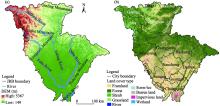
Fig. 1.
Topographic overview (a) and spatial distribution of land cover types (b) in the Jialing River Basin (JRB) in 2020. DEM, digital elevation model. Note that the figure is based on the standard map (GS(2023)2767) of the Map Service System (http://bzdt.ch.mnr.gov.cn/download.html) marked by the Ministry of Natural Resources of the People’s Republic of China, and the boundary of the standard map has not been modified."
Table 1
Indicators and data sources for ecosystem health."
| Object level | Dimension | Indicator | Unit | Resolution | Year/Period | Data source |
|---|---|---|---|---|---|---|
| Ecosystem health | Mountain | E1: topographic relief | m | 30 m | 2020 | DEM ( |
| E2: soil erosion factor (K) | t•hm2•h/ (MJ•hm2•mm) | 1 km | 2020 | HWSD version 2.0 ( | ||
| E3: gully density | km/km2 | 30 m | 2020 | DEM ( | ||
| River | E4: surface water area ratio | % | 250 m | 2000-2020 | Global surface water dynamics 1999-2021 ( | |
| E5: water occurrence frequency | % | 250 m | 2000-2020 | Global surface water dynamics 1999-2021 ( | ||
| E6: total available water resources | mm/a | 4 km | 2000-2020 | TerraClimate ( | ||
| Forest | E7: forest area ratio | % | 30 m | 2000-2020 | CLCD ( | |
| E8: forest vegetation coverage | % | 8 km | 2000-2020 | PKU GIMMS NDVI ( | ||
| Farmland | E9: food production per capita | kg | / | 2000-2020 | Rural Social and Economic Survey Division of the National Bureau of Statistics of China ( | |
| E10: proportion of farmland | % | 30 m | 2000-2020 | CLCD ( | ||
| Lake | E11: lake water clearness | m | 30 m | 2000-2020 | LAWSD30 (Chen et al., | |
| Grassland | E12: grassland area proportion | % | 30 m | 2000-2020 | CLCD ( | |
| E13: grassland vegetation coverage | % | 8 km | 2000-2020 | KU GIMMS NDVI ( | ||
| Desert | E14: desertification difference index | - | 250 m | 2000-2020 | GLASS Albedo ( | |
| E15: wind speed | m/s | 4 km | 2000-2020 | TerraClimate ( | ||
| E16: plant available water content | - | 8 km | 2000-2020 | LHScat (Tao et al., |
Table 2
Indicators and data sources for urbanization."
| Object level | Dimension | Indicator | Unit | Resolution | Period | Data source |
|---|---|---|---|---|---|---|
| Urbanization | Demographic dimension | U1: population density | persons/km2 | / | 2000-2020 | Rural Social and Economic Survey Division of the National Bureau of Statistics of China ( |
| U2: total population at the end of the year | persons | / | 2000-2020 | Rural Social and Economic Survey Division of the National Bureau of Statistics of China ( | ||
| Land dimension | U3: urban built-up area | km2 | 30 m | 2000-2020 | CLCD ( | |
| U4: proportion of the built-up area | % | 30 m | 2000-2020 | CLCD ( | ||
| Economic dimension | U5: per capita gross domestic product (GDP) | CNY/person | / | 2000-2020 | Rural Social and Economic Survey Division of the National Bureau of Statistics of China ( | |
| U6: per capita retail sales of consumer good | CNY/person | / | 2000-2020 | Rural Social and Economic Survey Division of the National Bureau of Statistics of China ( | ||
| U7: per capita investment in fixed asset | CNY/person | / | 2000-2020 | Rural Social and Economic Survey Division of the National Bureau of Statistics of China ( |
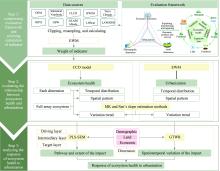
Fig. 2.
Scientific methodological flowchart of this study. DEM, digital elevation model; CLCD, China Land Cover Dataset; HWSD, Harmonized World Soil Database; NDVI, Normalized Difference Vegetation Index; GSW, Global Surface Water; GLASS Albedo, Global Land Surface Satellite Surface Broadband Albedo; LHScat, the global long-term, high resolution satellite radar backscatter; LAWSD30, the 30 m long-term Lake Water Secchi Depth (SD) dataset; EWM, Entropy Weight Method; CCD, coupling coordination degree; MK, Mann‒Kendall; PLS-SEM, partial least squares structural equation modeling; GTWR, geographically and temporally weighted regression."
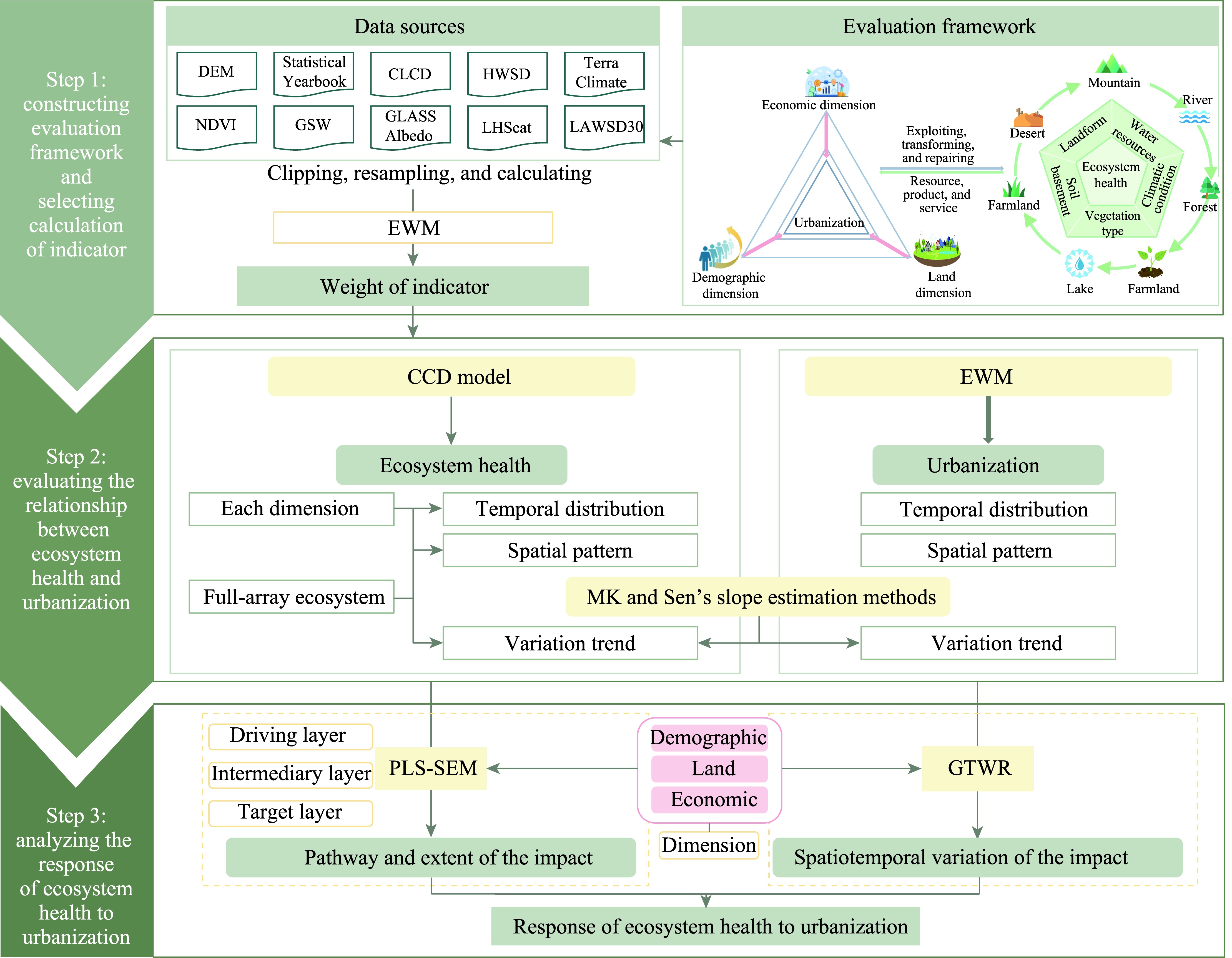
Table 3
Classification of coupling coordination degree (CCD) for ecosystem health."
| CCD | Level | Stage of development | CCD | Level | Stage of development |
|---|---|---|---|---|---|
| 0.000-0.100 | Extreme dissonance | Uncoordinated development | 0.500-0.600 | Low coordination | Transformation development |
| 0.100-0.200 | Severe dissonance | 0.600-0.700 | Primary coordination | ||
| 0.200-0.300 | Moderate dissonance | 0.700-0.800 | Mild coordination | ||
| 0.300-0.400 | Mild dissonance | 0.800-0.900 | Good coordination | ||
| 0.400-0.500 | Reluctant coordination | Transformation development | 0.900-1.000 | High coordination |
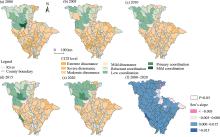
Fig. 3.
Spatiotemporal distribution of the coupling coordination degree (CCD) of ecosystem health in 2000 (a), 2005 (b), 2010 (c), 2015 (d), and 2020 (e), and Sen’s slope of CCD in ecosystem health during 2000-2020 (f) in the JRB."

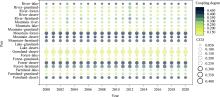
Fig. 4.
Coupling degree and CCD of pairs in ecosystem health in the JRB."
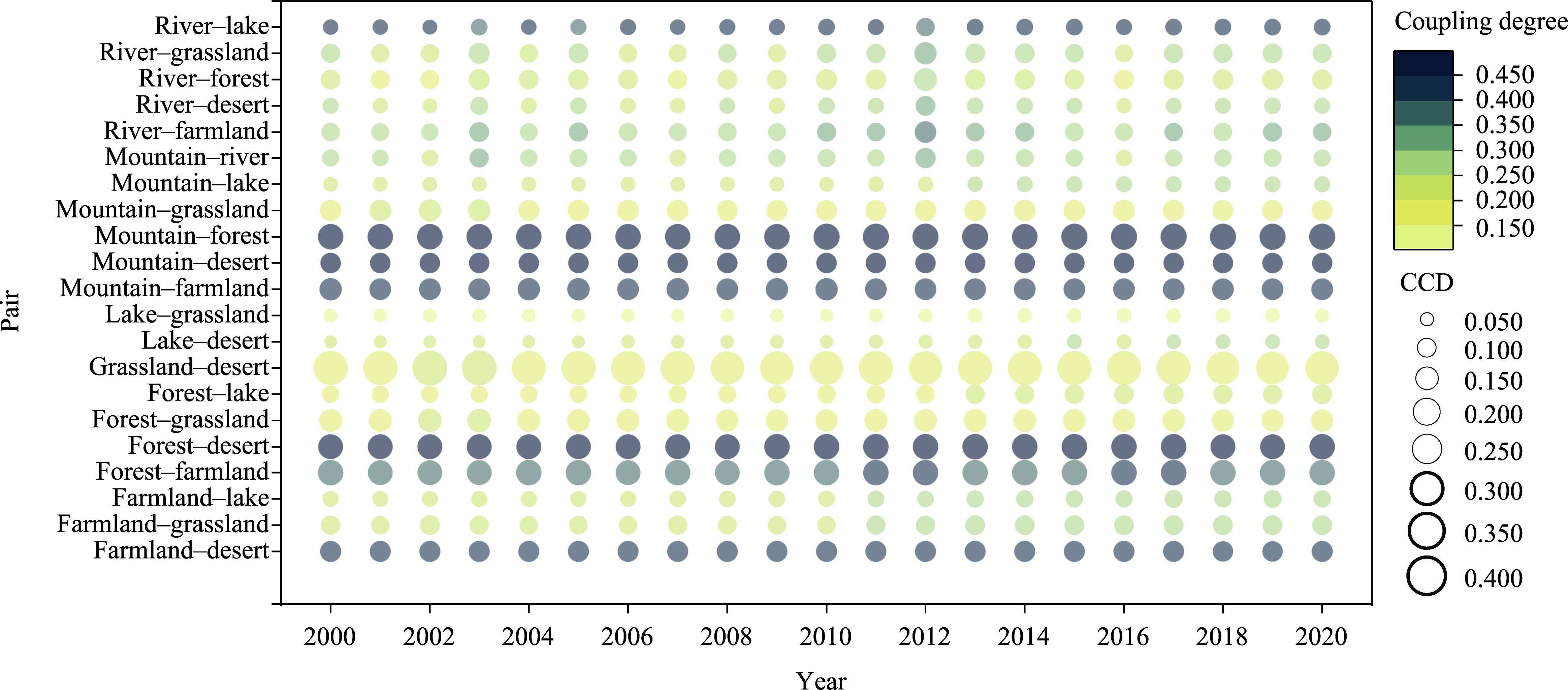
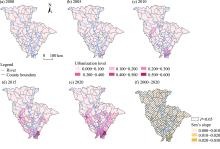
Fig. 5.
Spatiotemporal distribution of urbanization level in 2000 (a), 2005 (b), 2010 (c), 2015 (d), and 2020 (e), and Sen’s slope of urbanization level during 2000-2020 (f) in the JRB."

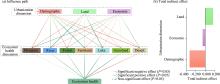
Fig. 6.
Influence path of urbanization on ecosystem health (a) and the total indirect effect of urbanization on ecosystem health (b)."
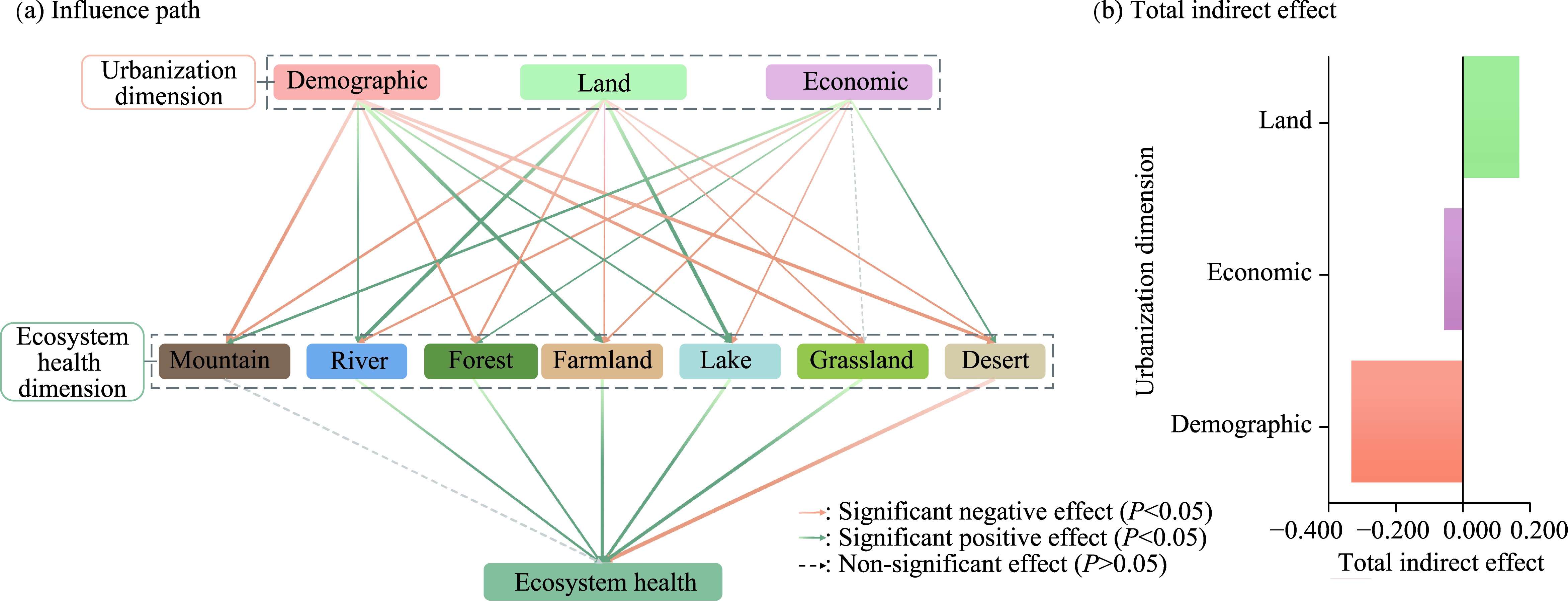
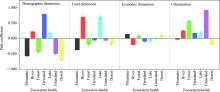
Fig. 7.
Responses of different ecosystem health dimensions to different urbanization dimensions by the PLS-SEM. Different colors represent different ecosystem health dimensions. Bars indicate the responses of these dimensions to demographic, land, and economic urbanization; and black error bars denote 95.00% confidence intervals. Positive and negative coefficients indicate positive and negative responses, respectively."
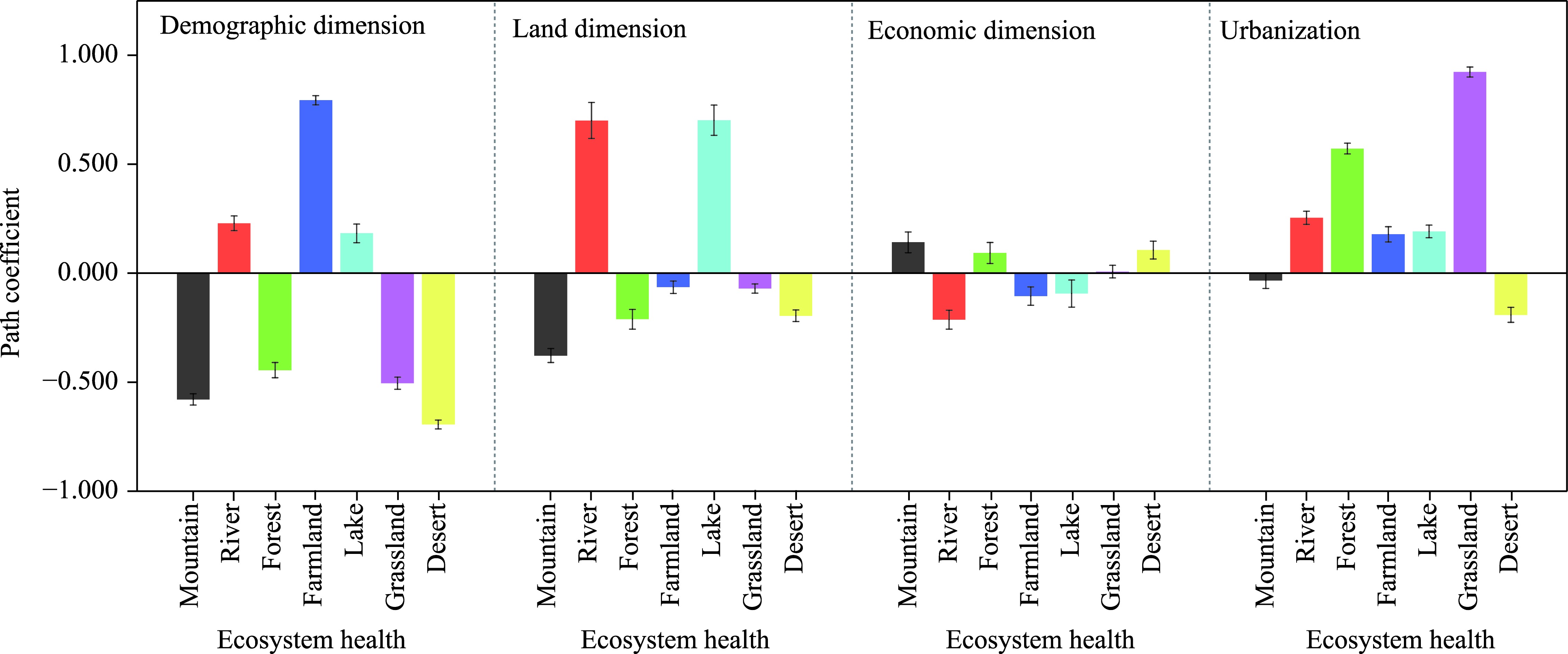
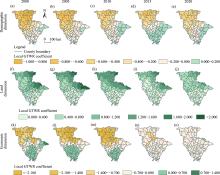
Fig. 8.
Spatiotemporal variations in the impacts of demographic dimension (a-e), land dimension (f-j), and economic dimension (k-o) of urbanization on ecosystem health in the JRB in 2000, 2005, 2010, 2015, and 2020. The values represent local regression coefficients estimated by the GTWR model. Positive coefficients indicate positive associations between a given urbanization dimension and ecosystem health, whereas negative coefficients indicate negative associations. Larger absolute values indicate stronger local effects."

| [1] | Abatzoglou J.T., Dobrowski S.Z., Parks S.A., et al., 2018. TerraClimate, a high-resolution global dataset of monthly climate and climatic water balance from 1958-2015. Scientific Data. 5, 170191, doi: 10.1038/sdata.2017.191. |
| [2] | Addai K., Serener B., Kirikkaleli D., 2023. Can environmental sustainability be decoupled from economic growth? Empirical evidence from Eastern Europe using the common correlated effect mean group test. Regional Sustainability. 4(1), 68-80. |
| [3] | Adler S.J., Sharma P.N., Radomir L., 2023. Toward open science in PLS-SEM: Assessing the state of the art and future perspectives. Journal of Business Research. 169, 114291, doi: 10.1016/j.jbusres.2023.114291. |
| [4] | Ahmed Z., Asghar M.M., Malik M.N., et al., 2020. Moving towards a sustainable environment: The dynamic linkage between natural resources, human capital, urbanization, economic growth, and ecological footprint in China. Resources Policy. 67, 101677, doi: 10.1016/j.resourpol.2020.101677. |
| [5] | Ariken M., Zhang F., Liu K., et al., 2020. Coupling coordination analysis of urbanization and eco-environment in Yanqi Basin based on multi-source remote sensing data. Ecological Indicators. 114, 106331, doi: 10.1016/j.ecolind.2020.106331. |
| [6] | Chen M.S., Wang L., 2025. Ecological sensitivity analysis of the Chengdu-Chongqing urban agglomeration toward the Yangtze River economic belt in China. Discover Sustainability. 6, 630, doi: 10.1007/s43621-025-01571-5. |
| [7] | Chen W.X., Wang G.Z., Zeng J., 2023. Impact of urbanization on ecosystem health in Chinese urban agglomerations. Environmental Impact Assessment Review. 98, 106964, doi: 10.1016/j.eiar.2022.106964. |
| [8] |
Chen X.D., Liu L.Y., Zhang X., et al., 2022. Long-term water clarity patterns of lakes across China using Landsat series imagery from 1985 to 2020. Hydrology and Earth System Sciences. Hydrology and Earth System Sciences. 26(13), 3517-3536.
doi: 10.5194/hess-26-3517-2022 |
| [9] | Cunha-Zeri G., Guidolini J.F., Branco E.A., et al., 2022. How sustainable is the nitrogen management in Brazil? A sustainability assessment using the Entropy Weight Method. Journal of Environmental Management. 316, 115330, doi: 10.1016/j.jenvman.2022.115330. |
| [10] |
Fan J.Y., Liu S.L., Wang W.T., et al., 2025. “Nature-society-economy” drivers and their impact trend on the spatial heterogeneity of ecosystem services in the Upper Yangtze River. Ecological Frontiers. 45(4), 817-828.
doi: 10.1016/j.ecofro.2025.02.005 |
| [11] |
Fischer J., Riechers M., Loos J., et al., 2021. Making the UN decade on ecosystem restoration a social-ecological endeavour. Trends in Ecology & Evolution. 36(1), 20-28.
doi: 10.1016/j.tree.2020.08.018 |
| [12] | Fu S.K., Zhao L., Qiao Z., et al., 2021. Development of ecosystem health assessment (EHA) and application method: A review. Sustainability. 13(21), 11838, doi: 10.3390/su132111838. |
| [13] | Gu T.C., Luo T., Ying Z., et al., 2024. Coupled relationships between landscape pattern and ecosystem health in response to urbanization. Journal of Environmental Management. 367, 122076, doi: 10.1016/j.jenvman.2024.122076. |
| [14] | Hair J., Hult G.T.M., Ringle C., et al., 2022. A Primer on Partial Least Squares Structural Equation Modeling (PLS-SEM). California: Sage Publishing, 587-632. |
| [15] | He J.H., Pan Z.Z., Liu D.F., et al., 2019. Exploring the regional differences of ecosystem health and its driving factors in China. Science of The Total Environment. 673, 553-564. |
| [16] | Hou X.N., Zhang S.H., Ruan Q.Y., et al., 2022. Synergetic impact of climate and vegetation cover on runoff, sediment, and nitrogen and phosphorus losses in the Jialing River Basin, China. Journal of Cleaner Production. 361, 132141, doi: 10.1016/j.jclepro.2022.132141. |
| [17] | Hu J.Y., Zhang J.X., Li Y.Q., 2022. Exploring the spatial and temporal driving mechanisms of landscape patterns on habitat quality in a city undergoing rapid urbanization based on GTWR and MGWR: The case of Nanjing, China. Ecological Indicators. 143, 109333, doi: 10.1016/j.ecolind.2022.109333. |
| [18] | Jiang S.M., Feng F., Zhang X.N., et al., 2024. Ecological transformation is the key to improve ecosystem health for resource-exhausted cities: A case study in China based on future development scenarios. Science of The Total Environment. 921, 171147, doi: 10.1016/j.scitotenv.2024.171147. |
| [19] | Kante M., Michel B., 2023. Use of partial least squares structural equation modelling (PLS-SEM) in privacy and disclosure research on social network sites: A systematic review. Computers in Human Behavior Reports. 10, 100291, doi: 10.1016/j.chbr.2023.100291. |
| [20] |
Li M.Y., Cao S., Zhu Z.C., et al., 2023. Spatiotemporally consistent global dataset of the GIMMS Normalized Difference Vegetation Index (PKU GIMMS NDVI) from 1982 to 2022. Earth System Science Data. 15(9), 4181-4203.
doi: 10.5194/essd-15-4181-2023 |
| [21] | Li Y.Y., Qin L., Wang Y.H., et al., 2024. Ecosystem health assessment of the largest lake wetland in the Yellow River basin using an improved vigor-organization-resilience-services model. Ecological Indicators. 166, 112539, doi: 10.1016/j.ecolind.2024.112539. |
| [22] | Li Z.J., Ye Y., Liu X.G., et al., 2025. Research on the coupling coordination, spatiotemporal evolution and zoning management of high-quality development and ecosystem service value in China. Scientific Reports. 15, 12665, doi: 10.1038/s41598-025-96627-x. |
| [23] | Liu R.R., Dong X.B., Wang X.C., et al., 2023a. Relationship and driving factors between urbanization and natural ecosystem health in China. Ecological Indicators. 147, 109972, doi: 10.1016/j.ecolind.2023.109972. |
| [24] |
Liu S.L., Dong Y.H., McConkey K.R., et al., 2023b. Scientific concept and practices of life community of mountains, rivers, forests, farmlands, lakes, grasslands, and deserts in China. Ambio. 52(12), 1939-1951.
doi: 10.1007/s13280-023-01898-1 |
| [25] | Liu Y.M., Xu N.Y., Li Z.J., et al., 2022. Differential impact of constructed land expansion on ecosystem health: A case study in the coastal region of the East China Sea. Ecological Engineering. 180, 106665, doi: 10.1016/j.ecoleng.2022.106665. |
| [26] | Liu Z.X., Zhang W.W., Lu H.Y., et al., 2023c. Exploring evolution characteristics of eco-environment quality in the Yangtze River Basin based on remote sensing ecological index. Heliyon. 9(12), e23243, doi: 10.1016/j.heliyon.2023.e23243. |
| [27] | Luo Q.L., Zhou J.F., Zhang Y., et al., 2022. What is the spatiotemporal relationship between urbanization and ecosystem services? A case from 110 cities in the Yangtze River Economic Belt, China. Journal of Environmental Management. 321, 115709, doi: 10.1016/j.jenvman.2022.115709. |
| [28] | Mengist W., Soromessa T., Feyisa G.L., 2021. Landscape change effects on habitat quality in a forest biosphere reserve: Implications for the conservation of native habitats. Journal of Cleaner Production. 329, 129778, doi: 10.1016/j.jclepro.2021.129778. |
| [29] | Mondal J., Basu T., Das A., 2024. Application of a novel remote sensing ecological index (RSEI) based on geographically weighted principal component analysis for assessing the land surface ecological quality. Environmental Science and Pollution Research. 31, 32350-32370. |
| [30] | Ouyang N.L., Rui X.P., Zhang X.P., et al., 2024. Spatiotemporal evolution of ecosystem health and its driving factors in the southwestern karst regions of China. Ecological Indicators. 166, 112530, doi: 10.1016/j.ecolind.2024.112530. |
| [31] | Ouyang X., Wei X., Wei G.E., et al., 2023. The expansion efficiency of urban land in China’s urban agglomerations and its impact on ecosystem services. Habitat International. 141, 102944, doi: 10.1016/j.habitatint.2023.102944. |
| [32] | Pan Z.Z., He J.H., Liu D.F., et al., 2021. Ecosystem health assessment based on ecological integrity and ecosystem services demand in the Middle Reaches of the Yangtze River Economic Belt, China. Science of The Total Environment. 774, 144837, doi: 10.1016/j.scitotenv.2020.144837. |
| [33] | Pan Z.Z., Gao G.Y., Zhang J.Z., et al., 2025. Divergent impacts of urbanization on ecosystem services in urban versus non-urban agglomerations of the Yangtze River Basin, China during 1990-2050. Landscape Ecology. 40, 176, doi: 10.1007/s10980-025-02142-9. |
| [34] | Pang B., Li X.X., Fu Y., 2024. Coupling coordination analysis and obstacle factors of water-energy-environment-economy in the Yellow River Basin. Journal of Cleaner Production. 468, 143108, doi: 10.1016/j.jclepro.2024.143108. |
| [35] | Pickens A.H., Hansen M.C., Hancher M., et al., 2020. Mapping and sampling to characterize global inland water dynamics from 1999 to 2018 with full Landsat time-series. Remote Sensing of Environment. 243, 111792, doi: 10.1016/j.rse.2020.111792. |
| [36] |
Pinto U., Maheshwari B.L., Ollerton R.L., 2013. Analysis of long-term water quality for effective river health monitoring in peri-urban landscapes-a case study of the Hawkesbury-Nepean river system in NSW, Australia. Environmental Monitoring and Assessment. 185(6), 4551-4569.
doi: 10.1007/s10661-012-2888-2 pmid: 23054266 |
| [37] | Qiao W.Y., Huang X.J., 2022. The impact of land urbanization on ecosystem health in the Yangtze River Delta urban agglomerations, China. Cities. 130, 103981, doi: 10.1016/j.cities.2022.103981. |
| [38] | Qin T., Yang P.H., Groves C., et al., 2018. Natural and anthropogenic factors affecting geochemistry of the Jialing and Yangtze Rivers in urban Chongqing, SW China. Applied Geochemistry. 98, 448-458. |
| [39] | Ran P.L., Frazier A.E., Xia C., et al., 2023. How does urban landscape pattern affect ecosystem health? Insights from a spatiotemporal analysis of 212 major cities in China. Sustainable Cities and Society. 99, 104963, doi: 10.1016/j.scs.2023.104963. |
| [40] |
Ren H., Gao L., Hui D.F., et al., 2024. Converting farmlands to forests or forests to farmlands? Biological Diversity. 1(2), 54-57.
doi: 10.1002/bod2.v1.2 |
| [41] | Rural Social and Economic Survey Division of the National Bureau of Statistics of China,2000-2020. China Statistical Yearbook (County-Level) (2001-2021 Editions). Beijing: China Statistics Press (in Chinese). |
| [42] | Shi J.H., Zhang P., Liu Y., et al., 2024. Study on spatiotemporal changes of wetlands based on PLS-SEM and PLUS model: The case of the Sanjiang Plain. Ecological Indicators. 169, 112812, doi: 10.1016/j.ecolind.2024.112812. |
| [43] | Steinbach S., Hentschel E., Hentze K., et al., 2023. Automatization and evaluation of a remote sensing-based indicator for wetland health assessment in East Africa on national and local scales. Ecological Informatics. 75, 102032, doi: 10.1016/j.ecoinf.2023.102032. |
| [44] |
Styers D.M., Chappelka A.H., Marzen L.J., et al., 2010. Developing a land-cover classification to select indicators of forest ecosystem health in a rapidly urbanizing landscape. Landscape and Urban Planning. 94(3-4), 158-165.
doi: 10.1016/j.landurbplan.2009.09.006 |
| [45] |
Tao S.L., Ao Z.R., Wigneron J., et al., 2023. A global long-term, high-resolution satellite radar backscatter data record ( 1992-2022+): merging C-band ERS/ASCAT and Ku-band QSCAT. Earth System Science Data. 15(4), 1577-1596.
doi: 10.5194/essd-15-1577-2023 |
| [46] | Tett P., Gowen R.J., Painting S.J., et al., 2013. Framework for understanding marine ecosystem health. Marine Ecology Progress Series. 494, 1-27. |
| [47] | Wang H.Y., Zhao Z.Y., Wang Y.L., et al., 2025. Integrating ecosystem reference conditions and vulnerability to identify ecological restoration priority areas. International Journal of Sustainable Development & World Ecology. 32(3), 309-321. |
| [48] | Wang J.W., Zhang J.H., Wang P.J., et al., 2022. Progress in ecosystem health research and future prospects. Sustainability. 14(23), 15814, doi: 10.3390/su142315814. |
| [49] | Wang S.R., Song Q., Zhang H.X., et al., 2026. Eco-environmental effects and driving factors of spatiotemporal change in production-living-ecological space in the source region of the Yellow River, China. Regional Sustainability. 7(2), 100335, doi: 10.1016/j.regsus.2026.100335. |
| [50] | Wang X.Y., Yao W.F., Luo Q.Z., et al., 2024. Spatial relationship between ecosystem health and urbanization in coastal mountain city, Qingdao, China. Ecological Informatics. 79, 102458, doi: 10.1016/j.ecoinf.2023.102458. |
| [51] | Wang Y.S., Yu G.R., 2023. Ecosystem quality-based management and the development of a new eco-friendly economy. The Innovation. 4(5), 100491, doi: 10.1016/j.xinn.2023.100491. |
| [52] |
Wang Y.T., Wang Y.S., Wu M.L., et al., 2021a. Assessing ecological health of mangrove ecosystems along South China Coast by the pressure-state-response (PSR) model. Ecotoxicology. 30(4), 622-631.
doi: 10.1007/s10646-021-02399-1 |
| [53] | Wang Y.Y., Cai Y.P., Liu G.Y., et al., 2021b. Evaluation of sustainable crop production from an ecological perspective based energy analysis: A case of China’s provinces. Journal of Cleaner Production. 313, 127912, doi: 10.1016/j.jclepro.2021.127912. |
| [54] | Wu J.S., Cheng D.J., Xu Y.Y., et al., 2021. Spatial-temporal change of ecosystem health across China: Urbanization impact perspective. Journal of Cleaner Production. 326, 129393, doi: 10.1016/j.jclepro.2021.129393. |
| [55] | Wu X., Lyu Y.H., Zhang J.Z., et al., 2023a. Adapting ecosystem restoration for sustainable development in a changing world. The Innovation. 4(1), 100375, doi: 10.1016/j.xinn.2023.100375. |
| [56] | Wu X.T., Fu B.J., Wang S., et al., 2023b. Three main dimensions reflected by national SDG performance. The Innovation. 4(6), 100507, doi: 10.1016/j.xinn.2023.100507. |
| [57] | Xiao R., Liu Y., Fei X.F., et al., 2019. Ecosystem health assessment: A comprehensive and detailed analysis of the case study in coastal metropolitan region, eastern China. Ecological Indicators. 98, 363-376. |
| [58] | Xiao R., Lin M., Fei X.F., et al., 2020. Exploring the interactive coercing relationship between urbanization and ecosystem service value in the Shanghai-Hangzhou Bay Metropolitan Region. Journal of Cleaner Production. 253, 119803, doi: 10.1016/j.jclepro.2019.119803. |
| [59] | Xie Z.Y., He L.J., Mao Z., et al., 2024. Spatial heterogeneity of natural and socio-economic features shape that of ecosystem services. A large-scale study on the Yangtze River economic belt, China. Ecological Indicators. 159, 111729, doi: 10.1016/j.ecolind.2024.111729. |
| [60] | Xiong S.W., Yang F., Fan H.Y., et al., 2025. Multiscale coordination dynamics in large freshwater lake basin ecosystems: machine learning reveals spatiotemporal variations and driving mechanisms of risk-quality-service process interactions. Ecological Indicators. 180, 114381, doi: 10.1016/j.ecolind.2025.114381. |
| [61] |
Yang J., Huang X., 2021. The 30 m annual land cover dataset and its dynamics in China from 1990 to 2019. Earth System Science Data. 13(8), 3907-3925.
doi: 10.5194/essd-13-3907-2021 |
| [62] | Yuan Y.J., Chen D.X., Wu S.H., et al., 2019. Urban sprawl decreases the value of ecosystem services and intensifies the supply scarcity of ecosystem services in China. Science of The Total Environment. 697, 134170, doi: 10.1016/j.scitotenv.2019.134170. |
| [63] | Zhang S.H., Li W.D., An W.J., et al., 2023. Temporal and spatial evolutionary trends of regional extreme precipitation under different emission scenarios: Case study of the Jialing River Basin, China. Journal of Hydrology. 617, 129156, doi: 10.1016/j.jhydrol.2023.129156. |
| [64] | Zhang Y.L., Zhao Z.Y., Zhu J., et al., 2024. The dynamic patterns of critical ecological areas in the Yellow River Basin are driven primarily by climate factors but threatened by human activities. Journal of Environmental Management. 371, 123282, doi: 10.1016/j.jenvman.2024.123282. |
| [65] | Zhao C., Shao N., Yang S., et al., 2019. Integrated assessment of ecosystem health using multiple indicator species. Ecological Engineering. 130, 157-168. |
| [66] |
Zhao G.L., Tian S.M., Chen R.X., et al., 2024b. Study on the ecosystem service value and inter-basin ecological compensation between provinces in China. Water Policy. 27(1), 118-140.
doi: 10.2166/wp.2024.270 |
| [67] | Zhao Z.Y., Fu B.J., Lyu Y.H., et al., 2024a. Variable climatic conditions dominate decreased wetland vulnerability on the Qinghai-Tibet Plateau: Insights from the ecosystem pattern-process-function framework. Journal of Cleaner Production. 458, 142496, doi: 10.1016/j.jclepro.2024.142496. |
| [68] | Zheng Y., Zhuang G.Y., 2021. Systemic governance of mountains, rivers, forests, farmlands, lakes and grasslands: Theoretical framework and approaches. Chinese Journal of Urban and Environmental Studies. 9(4), 2150021, doi: 10.1142/S2345748121500214. |
| [69] | Zhu T.Y., Zhang S.M., Wang Y.B., et al., 2023. Integrated assessment and restoration pathways for holistic ecosystem health in Anxi County, China. Sustainability. 15(22), 15932, doi: 10.3390/su152215932. |
| [70] | Zuo Z.L., Guo H.X., Cheng J.H., et al., 2021. How to achieve new progress in ecological civilization construction?—Based on cloud model and coupling coordination degree model. Ecological Indicators. 127, 107789, doi: 10.1016/j.ecolind.2021.107789. |
| Viewed | ||||||
|
Full text |
|
|||||
|
Abstract |
|
|||||
 REGSUS Wechat
 新公网安备 65010402001202号