
Regional Sustainability ›› 2025, Vol. 6 ›› Issue (2): 100210.doi: 10.1016/j.regsus.2025.100210cstr: 32279.14.REGSUS.2025009
• Research article • Previous Articles Next Articles
Funda KAYAa, Badsha MIAb, Most. Asikha AKTARc, Md. Shaddam HOSSAINd, Md Mahedi HASSANe, Muhammad Abdur RAHAMANf, Liton Chandra VOUMIKd,*( )
)
Received:2024-05-09
Revised:2024-12-22
Accepted:2025-05-06
Published:2025-04-30
Online:2025-05-21
Contact:
* E-mail address: litonvoumik@gmail.com (Liton Chandra VOUMIK).
Funda KAYA, Badsha MIA, Most. Asikha AKTAR, Md. Shaddam HOSSAIN, Md Mahedi HASSAN, Muhammad Abdur RAHAMAN, Liton Chandra VOUMIK. Impact of environmental taxes, hydroelectricity consumption, economic globalization, and gross domestic product (GDP) on the load capacity factor in the selected European Union (EU) member countries[J]. Regional Sustainability, 2025, 6(2): 100210.
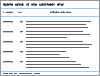
Table 1
Detailed information about the variables, description, and sources."
| Variable | Short form for variables after logarithmic transformation | Description and measurement | Source |
|---|---|---|---|
| Load capacity factor (LCF) | lnLCF | LCF is the ratio of biocapacity and ecological footprint. It reflects the ecological sustainability of a country by comparing its biocapacity to ecological footprint (LCF>1 indicates ecological reserve, and LCF<1 indicates ecological deficit). | Global Footprint Network ( |
| Hydroelectricity consumption | lnHYD | Hydroelectricity consumption measures the amount of electricity generated from hydropower sources. | British Petroleum ( |
| Environmental taxes | lnENV | Environmental taxes represent the share of environmentally related tax revenues in GDP, indicating the fiscal effort toward environmental protection. | OECD ( |
| Economic globalization | lnGLOB | Economic globalization captures the extent of economic integration through trade, investment, and financial flows, as measured by the KOF economic globalization index. | KOF Swiss Economic Institute ( |
| Gross domestic product (GDP) | lnGDP | GDP reflects the economic performance of a country in terms of income per capita. | World Bank ( |

Fig. 1.
Stepwise empirical strategy applied in this study."

Table 2
Descriptive statistics of variables used in this study."
| Statistic | lnLCF | lnHYD | lnENV | lnGLOB | lnGDP |
|---|---|---|---|---|---|
| Mean | -0.283 | -0.724 | 0.385 | 1.886 | 4.424 |
| Median | -0.340 | -0.642 | 0.387 | 1.893 | 4.509 |
| Maximum | 0.373 | -0.077 | 0.556 | 1.945 | 4.728 |
| Minimum | -0.769 | -1.758 | 0.201 | 1.746 | 3.750 |
| Standard deviation | 0.304 | 0.476 | 0.077 | 0.042 | 0.233 |
Table 3
Results of Pesaran and Yamagata slope heterogeneity test."
| Test statistic | Probability value |
|---|---|
| Δ | 8.623*** |
| Δadj | 9.832*** |
Table 4
Results of Pesaran cross-sectional dependence (CSD) test."
| Variable | Pesaran CSD value |
|---|---|
| lnLCF | 12.658*** |
| lnHYD | 8.483*** |
| lnENV | 4.489*** |
| lnGLOB | 33.537*** |
| lnGDP | 26.711*** |
Table 5
Results of cross-sectional augmented Im-Pesaran-Shin (CIPS) unit root test."
| Variable | Test statistic | |
|---|---|---|
| I(0) | I(1) | |
| lnLCF | -2.297 | -5.789*** |
| lnHYD | -4.403*** | -6.060*** |
| lnENV | -1.856 | -4.824*** |
| lnGLOB | -2.656*** | -5.175*** |
| lnGDP | -1.267 | -2.561** |
Table 6
Results of Westerlund cointegration test."
| Test statistic | Estimated test statistic value | Z-statistic |
|---|---|---|
| Gt | -3.082** | -2.107 |
| Ga | -10.986 | 0.813 |
| Pt | -10.799*** | -3.697 |
| Pa | -12.881* | -1.491 |
Table 7
Long-run estimation results from the Augmented Mean Group (AMG) model."
| Variable | Long-run coefficient | Standard error |
|---|---|---|
| lnHYD | 0.048* | 0.0263 |
| lnENV | 0.175*** | 0.0586 |
| lnGLOB | -0.368** | 0.1938 |
| lnGDP | -0.854*** | 0.1039 |
| Constant term | 4.047*** | 0.3360 |
Table 8
Results of pooled mean group-autoregressive distributed lag (PMG-ARDL) method."
| Variable | Long-run coefficient | Standard error |
|---|---|---|
| lnHYD | 0.042 | 0.0256 |
| lnENV | 0.106*** | 0.0331 |
| lnGLOB | -0.457*** | 0.1193 |
| lnGDP | -1.060*** | 0.0882 |
| Constant term | 4.695*** | 0.4148 |
| [1] | Adebayo, T.S., Agboola, M.O., Rjoub, H., et al., 2021. Linking economic growth, urbanization, and environmental degradation in China: What is the role of hydroelectricity consumption? Int. J. Environ. Res. Public Health. 18(13), 6975, doi: 10.3390/ijerph18136975. |
| [2] | Ahmed, Z., Zhang, B., Cary, M., 2021. Linking economic globalization, economic growth, financial development, and ecological footprint: Evidence from symmetric and asymmetric ARDL. Ecol. Indic. 121, 107060, doi: 10.1016/j.ecolind.2020.107060. |
| [3] | Alam, Q., Voumik, L.C., Rahman, M.H., et al., 2025. Impact of globalization, tourism, energy, and education on load capacity factors in selected 14 Indo-Pacific nations: An advanced econometric analysis. All Earth. 37(1), 1-16. |
| [4] | Al-Mulali, U., Weng-Wai, C., Sheau-Ting, L., et al., 2015. Investigating the environmental Kuznets curve (EKC) hypothesis by utilizing the ecological footprint as an indicator of environmental degradation. Ecol. Indic. 48, 315-323. |
| [5] | Alnour, M., Atik, H., 2021. The dynamic implications of globalization and renewable energy in Turkey: Are they vital for environmental sustainability? An SVAR analysis. Bilgi Sosyal Bilimler Dergisi. 23(2), 288-314. |
| [6] | Alnour, M., Ali, M., Abdalla, A., et al., 2022. How do urban population growth, hydropower consumption and natural resources rent shape environmental quality in Sudan? World Development Sustainability. 1(2022), 100029, doi: 10.1016/j.wds.2022.100029. |
| [7] | Aydin, C., Esen, Ö., 2018. Reducing CO2 emissions in the EU member states: Do environmental taxes work? J. Environ. Plan. Manag. 61(13), 2396-2420. |
| [8] |
Azam, M., 2020. Energy and economic growth in developing Asian economies. J. Asia. Pac. Econ. 25(3), 447-471.
doi: 10.1080/13547860.2019.1665328 |
| [9] | Bandyopadhyay, A., Rej, S., Abbasi, K.R., et al., 2022. Nexus between tourism, hydropower, and CO2 emissions in India: fresh insights from ARDL and cumulative Fourier frequency domain causality. Environ. Dev. Sustain. 25(10), 10903-10927. |
| [10] | Bashir, M.F., Ma, B.J., Shahbaz, M., et al., 2020. The nexus between environmental tax and carbon emissions with the roles of environmental technology and financial development. PLoS One. 15(11), e0242412, doi: 10.1371/journal.pone.0242412. |
| [11] | Bekun, F.V., Yalçiner, K., Etokakpan, M.U., et al., 2020. Renewed evidence of environmental sustainability from globalization and energy consumption over economic growth in China. Environ. Sci. Pollut. Res. 27, 29644-29658. |
| [12] | Bello, M.O., Solarin, S.A., Yen, Y.Y., 2018. The impact of electricity consumption on CO2 emission, carbon footprint, water footprint and ecological footprint: The role of hydropower in an emerging economy. J. Environ. Manage. 219, 218-230. |
| [13] | Bilgili, F., Lorente, D.B., Kuşkaya, S., et al., 2021. The role of hydropower energy in the level of CO2 emissions: An application of continuous wavelet transform. Renew. Energy. 178, 283-294. |
| [14] | Bilgili, F., Soykan, E., Dumrul, C., et al., 2023. Disaggregating the impact of natural resource rents on environmental sustainability in the MENA region: A quantile regression analysis. Resour. Policy. 85, 103825, doi: 10.1016/j.resourpol.2023.103825. |
| [15] | Borucke, M., Moore, D., Cranston, G., et al., 2013. Accounting for demand and supply of the biosphere’s regenerative capacity: The National Footprint Accounts’ underlying methodology and framework. Ecol. Indic. 24, 518-533. |
| [16] | British Petroleum, 2022. bp Statistical Review of World Energy. [2024-03-23]. https://www.bp.com/content/dam/bp/business-sites/en/global/corporate/pdfs/energy-economics/statistical-review/bp-stats-review-2022-full-report.pdf. |
| [17] | Caglar, A.E., Daştan, M., Mehmood, U., et al., 2024. Assessing the connection between competitive industrial performance on load capacity factor within the LCC framework: Implications for sustainable policy in BRICS economies. Environ. Sci. Pollut. Res. 31(60), 67197-67214. |
| [18] | Chen, C.C., 2024. Comparative impacts of energy sources on environmental quality: A five-decade analysis of Germany’s Energiewende. Energy Rep. 11, 3550-3561. |
| [19] | Christmann, P., Taylor, G., 2001. Globalization and the environment: Determinants of firm self-regulation in China. J. Int. Bus. Stud. 32(3), 439-458. |
| [20] | Costanza, R., 2000. The dynamics of the ecological footprint concept. Ecol. Econ. 32(3), 341-345. |
| [21] | Destek, M.A., Aslan, A., 2020. Disaggregated renewable energy consumption and environmental pollution nexus in G-7 countries. Renew. Energy. 151, 1298-1306. |
| [22] | Doğan, B., Chu, L.K., Ghosh, S., et al., 2022. How environmental taxes and carbon emissions are related in the G 7 economies? Renew. Energy. 187, 645-656. |
| [23] | Emir, F., Karlilar, S., 2023. Application of RALS cointegration test assessing the role of natural resources and hydropower energy on ecological footprint in emerging economy. Energy Environ. 34(4), 764-779. |
| [24] | Erdoğan, S., Çakar, N.D., Ulucak, R., et al., 2021. The role of natural resources abundance and dependence in achieving environmental sustainability: Evidence from resource‐based economies. Sustain. Dev. 29(1), 143-154. |
| [25] | European Environment Agency, 2023. State of Europe’s Environment. [2024-04-01]. https://www.eea.europa.eu/en/topics/at-a-glance/state-of-europes-environment. |
| [26] | Famulska, T., Kaczmarzyk, J., Grząba-Włoszek, M., 2022. Environmental taxes in the member states of the European Union—Trends in energy taxes. Energies. 15(22), 8718, doi: 10.3390/en15228718. |
| [27] | Gao, X.D., Fan, M.J., 2023. Environmental taxes, eco-innovation, and environmental sustainability in EU member countries. Environ. Sci. Pollut. Res. 30(45), 101637-101652. |
| [28] | Ghosh, S., 2010. Examining carbon emissions economic growth nexus for India: A multivariate cointegration approach. Energy Policy. 38(6), 3008-3014. |
| [29] | Global Footprint Network, 2023. Ecological Footprint. [2024-04-01]. https://www.footprintnetwork.org/our-work/ecological-footprint/. |
| [30] | Hao, L.N., Umar, M., Khan, Z., et al., 2021. Green growth and low carbon emission in G 7 countries: How critical the network of environmental taxes, renewable energy and human capital is? Sci. Total Environ. 752, 141853, doi: 10.1016/j.scitotenv.2020.141853. |
| [31] | Ibrahim, S.S., Samour, A., Almassri, H., et al., 2024. Renewable energy, financial globalization and load capacity factor in the US: Ecological neutrality in the context of natural resources. Geol. J. 59(11), 3017-3032. |
| [32] | Işık, C., Dogru, T., Turk, E.S., 2018. A nexus of linear and non-linear relationships between tourism demand, renewable energy consumption, and economic growth: Theory and evidence. Int. J. Tour. Res. 20(1), 38-49. |
| [33] | Işık, C., Ongan, S., Özdemir, D., 2019. Testing the EKC hypothesis for ten US states: An application of heterogeneous panel estimation method. Environ. Sci. Pollut. Res. 26(11), 10846-10853. |
| [34] | Işık, C., Bulut, U., Ongan, S., et al., 2024. Exploring how economic growth, renewable energy, internet usage, and mineral rents influence CO2 emissions: A panel quantile regression analysis for 27 OECD countries. Resour. Policy. 92, 105025, doi: 10.1016/j.resourpol.2024.105025. |
| [35] | Jahanger, A., Usman, M., Balsalobre-Lorente, D., 2021. Autocracy, democracy, globalization, and environmental pollution in developing world: Fresh evidence from STIRPAT model. J. Public Aff. 22(4), e2753, doi: 10.1002/pa.2753. |
| [36] | Kalaycı, C., Hayaloğlu, P., 2019. The impact of economic globalization on CO2 emissions: The case of NAFTA countries. International Journal of Energy Economics and Policy. 9(1), 356-360. |
| [37] | Kocoglu, M., Awan, A., Tunc, A., et al., 2021. The nonlinear links between urbanization and CO2: Evidence from unconditional quantile and threshold regression. Research Square. 2021, doi: 10.21203/rs.3.rs-676290/v1. |
| [38] | KOF Swiss Economic Institute, 2022. KOF Index of Globalization. [2024-04-04]. https://kof.ethz.ch/en/forecasts-and-indicators/indicators/kof-globalisation-index.html. |
| [39] | Le, H.P., Ozturk, I., 2020. The impacts of globalization, financial development, government expenditures, and institutional quality on CO2 emissions in the presence of environmental Kuznets curve. Environ. Sci. Pollut. Res. 27(18), 22680-22697. |
| [40] | Lenz, N.V., Fajdetić, B., 2021. Globalization and GHG emissions in the EU: Do we need a new development paradigm? Sustainability. 13(17), 9936, doi: 10.3390/su13179936. |
| [41] | Lin, D., Hanscom, L., Murthy, A., et al., 2018. Ecological footprint accounting for countries: Updates and results of the National Footprint Accounts, 2012-2018. Resources-Basel. 7(3), 58, doi: 10.3390/resources7030058. |
| [42] | Majeed, A., Wang, L.J., Zhang, X.H., et al., 2021. Modeling the dynamic links among natural resources, economic globalization, disaggregated energy consumption, and environmental quality: Fresh evidence from GCC economies. Resour. Policy. 73, 102204, doi: 10.1016/j.resourpol.2021.102204. |
| [43] | Mehboob, M.Y., Ma, B.J., Sadiq, M., et al., 2024. How do nuclear energy consumption, environmental taxes, and trade globalization impact ecological footprints? Novel policy insight from nuclear power countries. Energy. 313, 133661, doi: 10.1016/j.energy.2024.133661. |
| [44] | Mehmood, S., Kaewsaeng-on, R., 2024. Quantifying environmental degradation through renewable energy, financial development and economic sustainability: Insights from panel quantile regression analysis. Glob. Bus. Rev. 09721509241242530, doi: 10.1177/09721509241242530. |
| [45] | Mikayilov, J.I., Mukhtarov, S., Mammadov, J., et al., 2019. Re-evaluating the environmental impacts of tourism: Does EKC exist? Environ. Sci. Pollut. Res. 26(31), 32674, doi: 10.1007/s11356-019-05269-w. |
| [46] | Mohsin, M., Orynbassarov, D., Anser, M.K., et al., 2023. Does hydropower energy help to reduce CO2 emissions in European Union countries? Evidence from quantile estimation. Environ. Dev. 45, 100794, doi: 10.1016/j.envdev.2022.100794. |
| [47] | Murshed, M., Alam, R., Ansarin, A., 2021. The environmental Kuznets curve hypothesis for Bangladesh: the importance of natural gas, liquefied petroleum gas, and hydropower consumption. Environ. Sci. Pollut. Res. 28(14), 17208-17227. |
| [48] | Nica, E., Poliakova, A., Popescu, G.H., et al., 2023. The impact of financial development, health expenditure, CO2 emissions, institutional quality, and energy mix on life expectancy in Eastern Europe: CS-ARDL and quantile regression Approaches. Heliyon. 9(11), e21084, doi: 10.1016/ j.heliyon.2023.e21084. |
| [49] | OECD (Organisation for Economic Cooperation and Development), 2023. OECD Data Explorer. [2024-04-09]. https://stats.oecd.org/. |
| [50] | Olabi, A.G., 2012. Developments in sustainable energy and environmental protection. Energy. 39(1), 2-5. |
| [51] | Ozcan, B., Depren, S.K., Kartal, M.T., 2024. Impact of nuclear energy and hydroelectricity consumption in achieving environmental quality: Evidence from load capacity factor by quantile based nonlinear approaches. Gondwana Res. 129, 412-424. |
| [52] | Ozturk, I., Al-Mulali, U., Saboori, B., 2016. Investigating the environmental Kuznets curve hypothesis: The role of tourism and ecological footprint. Environ. Sci. Pollut. Res. 23(2), 1916-1928. |
| [53] | Pata, U.K., 2018. Renewable energy consumption, urbanization, financial development, income and CO2 emissions in Turkey: Testing EKC hypothesis with structural breaks. J. Clean Prod. 187, 770-779. |
| [54] | Pata, U.K., Aydin, M., 2020. Testing the EKC hypothesis for the top six hydropower energy-consuming countries: Evidence from Fourier Bootstrap ARDL procedure. J. Clean Prod. 264, 121699, doi: 0.1016/j.jclepro.2020.121699. |
| [55] | Pata, U.K., 2021a. Linking renewable energy, globalization, agriculture, CO2 emissions and ecological footprint in BRIC countries: A sustainability perspective. Renew. Energy. 173, 197-208. |
| [56] | Pata, U.K., 2021b. Do renewable energy and health expenditures improve load capacity factor in the USA and Japan? A new approach to environmental issues. Eur. J. Health Econ. 22(9), 1427-1439. |
| [57] | Pata, U.K., Isik, C., 2021. Determinants of the load capacity factor in China: A novel dynamic ARDL approach for ecological footprint accounting. Resour. Policy. 74, 102313, doi: 10.1016/j.resourpol.2021.102313. |
| [58] | Pata, U.K., Kartal, M.T., 2023. Impact of nuclear and renewable energy sources on environment quality: Testing the EKC and LCC hypotheses for South Korea. Nucl. Eng. Technol. 55(2), 587-594. |
| [59] | Pesaran, M.H., Yamagata, T., 2008. Testing slope homogeneity in large panels. J. Econom. 142(1), 50-93. |
| [60] | Rafique, M.Z., Fareed, Z., Ferraz, D., et al., 2022. Exploring the heterogenous impacts of environmental taxes on environmental footprints: An empirical assessment from developed economies. Energy. 238(A), 121753, doi: 10.1016/j.energy.2021.121753. |
| [61] | Rees, W.E., 1992. Ecological footprints and appropriated carrying capacity:What urban economics leaves out. In: Tacoli, C., (ed.). The Earthscan Reader in Rural-Urban Linkages (1st ed.). London: Routledge, 121-130. |
| [62] | Rehman, A., Alam, M.M., Ozturk, I., et al., 2023. Globalization and renewable energy use: How are they contributing to upsurge the CO₂ emissions? A global perspective. Environ. Sci. Pollut. Res. 30(4), 9699-9712. |
| [63] | Samour, A., Radmehr, R., Ali, E.B., et al., 2024. The role of financial inclusion and technological innovation in stimulating environmental sustainability in the European countries: A new perspective based on load capacity factor. Heliyon. 10(22), e39970, doi: 10.1016/j.heliyon.2024.e39970. |
| [64] | Shahbaz, M., Mahalik, M.K., Shahzad, S.J.H., et al., 2019. Testing the globalization-driven carbon emissions hypothesis: International evidence. International Economics. 158, 25-38. |
| [65] | Shayanmehr, S., Radmehr, R., Ali, E.B., et al., 2023. How do environmental tax and renewable energy contribute to ecological sustainability? New evidence from top renewable energy countries. Int. J. Sustain. Dev. World Ecol. 30(6), 650-670. |
| [66] | Siche, R., Pereira, L., Agostinho, F., et al., 2010. Convergence of ecological footprint and emergy analysis as a sustainability indicator of countries: Peru as case study. Commun. Nonlinear Sci. Numer. Simul. 15(10), 3182-3192. |
| [67] | Solarin, S.A., Bello, M.O., 2018. Persistence of policy shocks to an environmental degradation index: the case of ecological footprint in 128 developed and developing countries. Ecol. Indic. 89, 35-44. |
| [68] | Steckel, J.C., Brecha, R.J., Jakob, M., et al., 2013. Development without energy? Assessing future scenarios of energy consumption in developing countries. Ecol. Econ. 90, 53-67. |
| [69] | Tiwari, A.K., Kocoglu, M., Banday, U.J., et al., 2022. Hydropower, human capital, urbanization and ecological footprints nexus in China and Brazil: Evidence from quantile ARDL. Environ. Sci. Pollut. Res. 29(45), 68923-68940. |
| [70] | Topcu, B.A., 2021. The impact of export, import, and renewable energy consumption on Turkey’s ecological footprint. J. Econ. Finance Account. 8(1), 31-38. |
| [71] |
Ulucak, R., Danish, Kassouri, Y., 2020. An assessment of the environmental sustainability corridor: Investigating the nonlinear effects of environmental taxation on CO2 emissions. Sustain. Dev. 28(4), 1010-1018.
doi: 10.1002/sd.2057 |
| [72] | Ulussever, T., Kartal, M.T., Pata, U.K., 2024. Environmental role of technology, income, globalization, and political stability: Testing the LCC hypothesis for the GCC countries. J. Clean. Prod. 451, 142056, doi: 10.1016/j.jclepro.2024.142056. |
| [73] | Uzar, U., Eyuboglu, K., 2022. Does income inequality increase the ecological footprint in the US: Evidence from FARDL test? Environ. Sci. Pollut. Res. 30(4), 9514-9529. |
| [74] | Vlahinić Lenz, N., Fajdetić, B., 2021. Globalization and GHG emissions in the EU: Do we need a new development paradigm? Sustainability. 13(17), 9936, doi: 10.3390/su13179936. |
| [75] | Wang, Y., Zhou, T., Chen, H., et al., 2019. Environmental homogenization or heterogenization? The effects of globalization on carbon dioxide emissions, 1970-2014. Sustainability. 11(10), 2752, doi: 10.3390/su11102752. |
| [76] | Westerlund, J., 2007. Testing for error correction in panel data. Oxf. Bull. Econ. and Stat. 69(6), 709-748. |
| [77] | World Bank, 2023. World Development Indicators Database. [2024-04-06]. https://databank.worldbank.org/source/world-development-indicators. |
| [78] | Xue, J., Rasool, Z., Nazar, R., et al., 2021. Revisiting natural resources—Globalization-environmental quality nexus: Fresh insights from South Asian countries. Sustainability. 13(8), 4224, doi: 10.3390/su13084224. |
| [79] | Yang, B., Jahanger, A., Khan, M.A., 2020. Does the inflow of remittances and energy consumption increase CO2 emissions in the era of globalization? A global perspective. Air Qual. Atmos. Health. 13(11), 1313-1328. |
| [80] | Yang, B., Jahanger, A., Usman, M., et al., 2021. The dynamic linkage between globalization, financial development, energy utilization, and environmental sustainability in GCC countries. Environ. Sci. Pollut. Res. 28 (13), 16568-16588. |
| [81] | Zaidi, S.A.H., Zafar, M.W., Shahbaz, M., et al., 2019. Dynamic linkages between globalization, financial development and carbon emissions: Evidence from Asia Pacific Economic Cooperation countries. J. Clean. Prod. 228, 533-543. |
| [82] | Zhang, X.S., Jiang, Q.Q., Iqbal, K.S., et al., 2021. Achieving sustainability and energy efficiency goals: assessing the impact of hydroelectric and renewable electricity generation on carbon dioxide emission in China. Energy Policy. 155, 112332, doi: 10.1016/j.enpol.2021.112332. |
| [1] | Z. R. M. Abdullah KAISER, Apu DEB. Sustainable smart city and Sustainable Development Goals (SDGs): A review [J]. Regional Sustainability, 2025, 6(1): 100193-. |
| [2] | Nazim Forid ISLAM, Bhoirob GOGOI, Rimon SAIKIA, Balal YOUSAF, Mahesh NARAYAN, Hemen SARMA. Encouraging circular economy and sustainable environmental practices by addressing waste management and biomass energy production [J]. Regional Sustainability, 2024, 5(4): 100174-. |
| [3] | Debanjan BASAK, Indrajit Roy CHOWDHURY. Role of self-help groups on socioeconomic development and the achievement of Sustainable Development Goals (SDGs) among rural women in Cooch Behar District, India [J]. Regional Sustainability, 2024, 5(2): 100140-. |
| [4] | Anastasia CHAPLITSKAYA, Wim HEIJMAN, Johan van OPHEM. Exploring well-being disparities between urban and rural areas: A case study in the Stavropol Territory, Russia [J]. Regional Sustainability, 2024, 5(1): 100114-. |
| [5] | WANG Tao, ZHOU Daojing, FAN Jie. Spatial differences of Sustainable Development Goals (SDGs) among counties (cities) on the northern slope of the Kunlun Mountains [J]. Regional Sustainability, 2024, 5(1): 100108-. |
| [6] | LIU Binsheng, ZHANG Xiaohui, TIAN Junfeng, CAO Ruimin, SUN Xinzhang, XUE Bin. Rural sustainable development: A case study of the Zaozhuang Innovation Demonstration Zone in China [J]. Regional Sustainability, 2023, 4(4): 390-404. |
| [7] | Md. Mominur RAHMAN. Impact of taxes on the 2030 Agenda for Sustainable Development: Evidence from Organization for Economic Co-operation and Development (OECD) countries [J]. Regional Sustainability, 2023, 4(3): 235-248. |
| [8] | Surendra Singh JATAV, Kalu NAIK. Measuring the agricultural sustainability of India: An application of Pressure-State-Response (PSR) model [J]. Regional Sustainability, 2023, 4(3): 218-234. |
| [9] | Edson Elídio BALATA, Hugo PINTO, Manuela Moreira da SILVA. Latent dimensions between water use and socio-economic development: A global exploratory statistical analysis [J]. Regional Sustainability, 2022, 3(3): 269-280. |
| [10] | Firoz AHMAD, Nazimur Rahman TALUKDAR, Laxmi GOPARAJU, Chandrashekhar BIRADAR, Shiv Kumar DHYANI, Javed RIZVI. GIS-based assessment of land-agroforestry potentiality of Jharkhand State, India [J]. Regional Sustainability, 2022, 3(3): 254-268. |
| [11] | Dave Paladin BUENAVISTA, Eefke Maria MOLLEE, Morag MCDONALD. Any alternatives to rice? Ethnobotanical insights into the dietary use of edible plants by the Higaonon tribe in Bukidnon Province, the Philippines [J]. Regional Sustainability, 2022, 3(2): 95-109. |
| [12] | Uswathul HASANA, Sampada Kumar SWAIN, Babu GEORGE. A bibliometric analysis of ecotourism: A safeguard strategy in protected areas [J]. Regional Sustainability, 2022, 3(1): 27-40. |
| [13] | LIU Haimeng, LIU Huaming, CHENG Yi. Illustrating the multi-stakeholder perceptions of environmental pollution based on big data: Lessons from China [J]. Regional Sustainability, 2022, 3(1): 12-26. |
| [14] | Giribabu DANDABATHULA, Sudhakar Reddy CHINTALA, Sonali GHOSH, Padmapriya BALAKRISHNAN, Chandra Shekhar JHA. Exploring the nexus between Indian forestry and the Sustainable Development Goals [J]. Regional Sustainability, 2021, 2(4): 308-323. |
| [15] | Lingxiao Sun, Xiang Yu, Boshan Li, Haiyan Zhang, Dong Sha, Yao Wang, Jiaqiang Lei, Yang Yu, Martin Welp, Ruide Yu. Coupling analysis of the major impact on sustainable development of the typical arid region of Turpan in Northwest China [J]. Regional Sustainability, 2020, 1(1): 48-58. |
| Viewed | ||||||
|
Full text |
|
|||||
|
Abstract |
|
|||||
 REGSUS Wechat
 新公网安备 65010402001202号