
Regional Sustainability ›› 2026, Vol. 7 ›› Issue (4): 100367.doi: 10.1016/j.regsus.2026.100367
• Research article • Previous Articles Next Articles
Anindita SARKARa,b,*( )
)
Received:2025-09-02
Revised:2026-04-09
Accepted:2026-07-15
Published:2026-08-30
Online:2026-08-05
Contact:
*E-mail address: anindita@uni-bonn.de (Anindita SARKAR).
Anindita SARKAR. From breadbasket to sustainability challenge: A rice-wheat system of Punjab, India[J]. Regional Sustainability, 2026, 7(4): 100367.
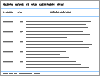
Table 1
Sustainable Development Goal (SDG) indicators in India and its state (Punjab)."
| SDG | Indicator | Punjab | India | Data source |
|---|---|---|---|---|
| SDG 1: No poverty | Total population (×107 persons) | 3.17 | 145.09 | Census of India ( |
| Percentage of population below the international poverty line (%) | 4.75 | 14.96 | UNSDG statistics ( | |
| Per capita income during 2022-2023 (USD/person) | 2173.0 | 2051.0 | Ministry of Finance, Government of India ( | |
| Average monthly income per agricultural household (USD/(month•household)) | 318.0 | 121.7 | Ministry of Agriculture & Farmers’ Welfare ( | |
| Average size of land holding (hm2/household) | 3.62 | 1.08 | Ministry of Agriculture & Farmers’ Welfare ( | |
| Proportion of indebtedness of farmers (%) | 54.40 | 50.20 | Ministry of Agriculture & Farmers’ Welfare ( | |
| SDG 2: Zero hunger | Children under 5 years old who are underweight (%) | 16.9 | 32.1 | National Health Systems Resource Centre ( |
| Children under 5 years old who are stunted (%) | 25.0 | 35.5 | National Health Systems Resource Centre ( | |
| Rice and wheat produced per unit area (3-a average) (kg/hm2) | 4491.8 | 3052.3 | Directorate of Statistics, Government of Punjab ( | |
| Total food grain production (×106 t) | 28.21 | 315.72 | NITI Aayog ( | |
| Agriculture value added share of the gross domestic product (GDP) (%) | 19.00 | 16.13 | UNSDG statistics ( | |
| Agriculture share of government expenditure (%) | 10.02 | 7.55 | NITI Aayog ( | |
| SDG 6: Clean water and sanitation | Percentage of irrigated area (%) | 98.78 | 56.96 | Government of Punjab, Economic & Statistical Organization ( |
| Percentage of groundwater irrigated area (%) | 71.19 | 60.46 | Government of Punjab, Economic & Statistical Organization ( | |
| Water use efficiency (m3/USD) | - | 3.13 | UNSDG statistics ( | |
| Stage of groundwater extraction (%) | 163.76 | 59.30 | CGWB ( | |
| SDG 7: Affordable and clean energy | Percentage of electrified village (%) | 100.00 | 100.00 | NITI Aayog ( |
| Number of irrigation pump sets and energized tube-wells | 1,378,967 | 26,671,275 | Directorate of Statistics, Government of Punjab ( | |
| Agricultural electricity consumption to the total electricity consumption in the region (%) | 22.36 | 17.35 | Directorate of Statistics, Government of Punjab ( | |
| Average capacity of energized pump set (kW) | 7.55 | 5.66 | Directorate of Statistics, Government of Punjab ( | |
| Average consumption per energized pump set (kW•h) | 9117 | 8565 | Directorate of Statistics, Government of Punjab ( | |
| SDG12: Responsible consumption and production | Percentage of over-exploited blocks/ mandals/taluka (%) | 76.47 | 11.23 | CGWB ( |
| Percentage of the use of nitrogenous fertilizer out of the total nitrogen, phosphorus, and potassium (%) | 79.10 | 65.24 | NITI Aayog ( |
Table 2
District-wise change in crop combinations during 1970-2021: from diversified cropping patterns to a rice-wheat crop combination."
| District | 1970 | 1980 | 1990 | 2000 | 2010 | 2021 |
|---|---|---|---|---|---|---|
| Gurdaspur | W, R, M, Su, S, Be, Rp, C, Bj, and L | W and R | W and R | W, R, and Su | W and R | W and R |
| Amritsar | W, R, M, Rp, C, Su, Bj, S, Be, and L | W and R | W and R | W and R | W and R | W and R |
| Kapurthala | W, R, M, and Gr | W and R | W and R | W and R | R and W | R and W |
| Jalandhar | W, M, R, Gr, Su, C, Rp, Be, S, and L | W, R, and M | W and R | W and R | W and R | W and R |
| Hoshiarpur | W, M, and R | W, M, T, and R | W, M, and R | W, M, R, and Su | W, R, and M | W, R, and M |
| Rupnagar | W, M, Su, Gr, R, Rp, C, S, B, and So | W, M, R, Su, G, T, Gr, Ma, B, and C | W, R, M, Su, Mo, C, A, B, and RP | W, R, and M | R and M | W and R |
| Ludhiana | W, M, Gr, C, R, Be, Su, Rp, and Bj | W, R, M, Gr, C, Su, B, Mo, P, and G | W and R | W and R | W and R | R and W |
| Ferozpur | W, C, R, Rp, Bj, M, Be, Su, So, and Gr | W, R, C, G, R, B, M, Bj, Mo, and Mas | W, R, and C | W, R, and C | W and R | W and R |
| Faridkot | - | W, C, R, G, R, B, Bj, M, Mo, and Su | W, C, and R | W, R, and C | W and R | W and R |
| Bhatinda | W, C, Bj, Rp, M, Su, Be, R, Gr, and So | W, C, and G | W and C | C and R | W, C, and R | W and R |
| Sangrur | C, M, S, Rp, W, Be, Gr, L, Bj, and Cs | W, C, R, M, G, Bj, Gr, and B | W and R | W and R | W and R | R and W |
| Patiala | C, W, M, S, Be, Gr, Rp, L, R, and Sa | W and R | W and R | W and R | R and W | R and W |
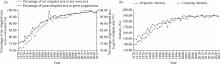
Fig. 1.
Trends of irrigated area (a) and irrigation intensity and cropping intensity (b) in Punjab during 1970-2022."
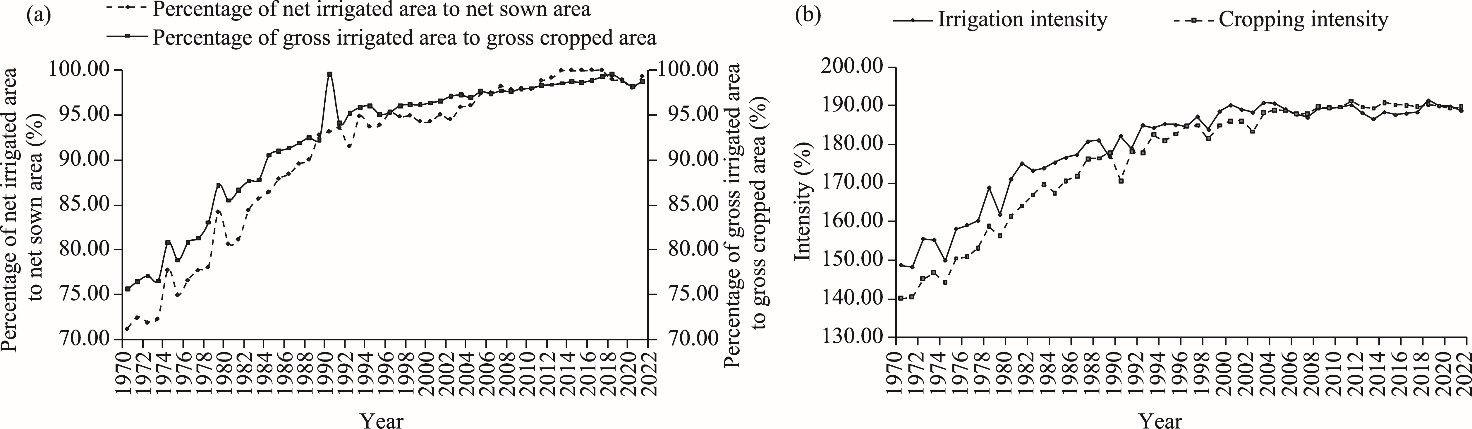
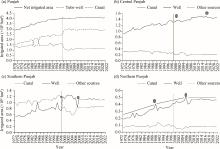
Fig. 2.
Trend of irrigated area from different irrigation sources in Punjab (a) during 1970-2022, and in central Punjab (b), southern Punjab (c), and northern Punjab (d) during 1972-2022. The green vertical line is the year when the farm electricity was made free by the government. The dots show the years with the peak values of the irrigation area."

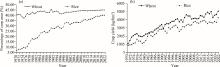
Fig. 3.
Change trend of crop area (a) and crop yield (b) of rice and wheat in Punjab during 1970-2022."
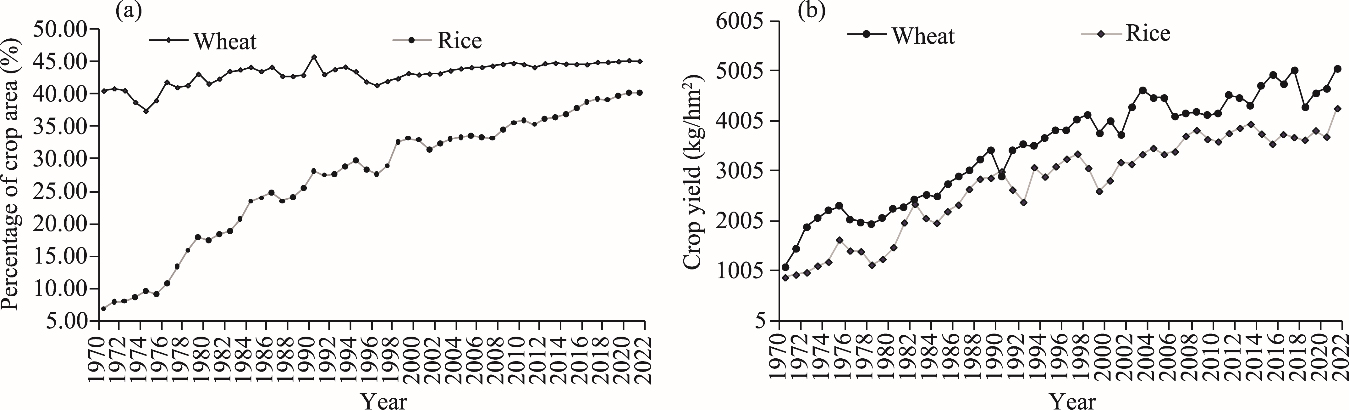
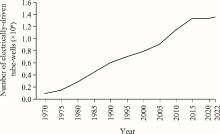
Fig. 4.
Number of electrically-driven tube-wells in Punjab during 1970-2022."
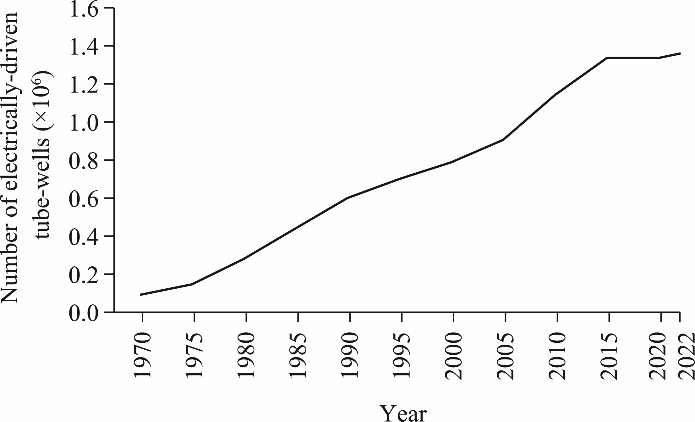
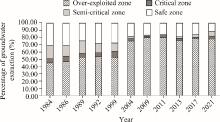
Fig. 5.
Change trend of groundwater extraction in Punjab during 1984-2021."
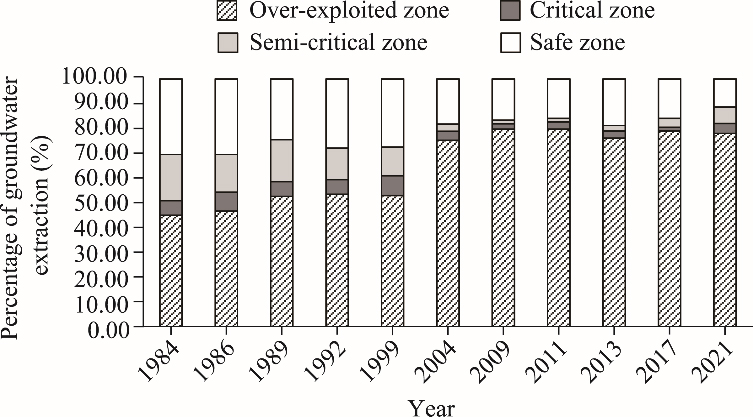
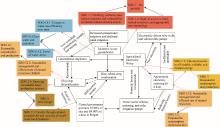
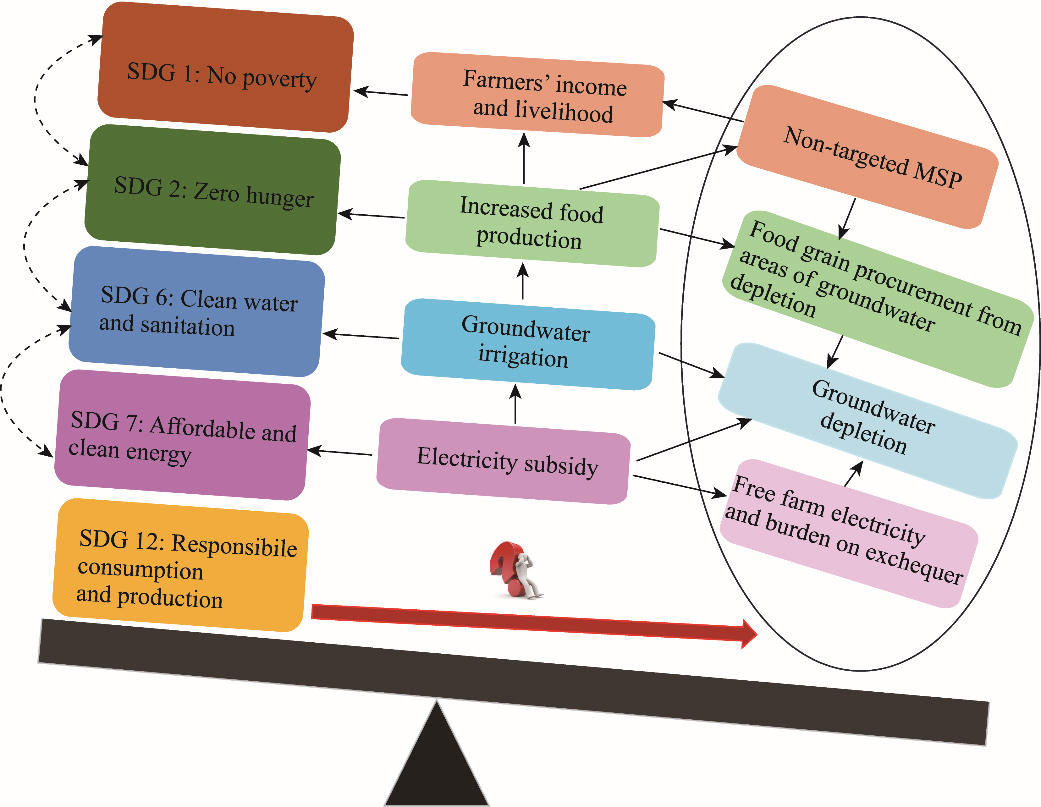
Fig. 6.
An interconnected trajectory of groundwater irrigation and agricultural development in Punjab. SDG, Sustainable Development Goal; MSP, minimum support price."
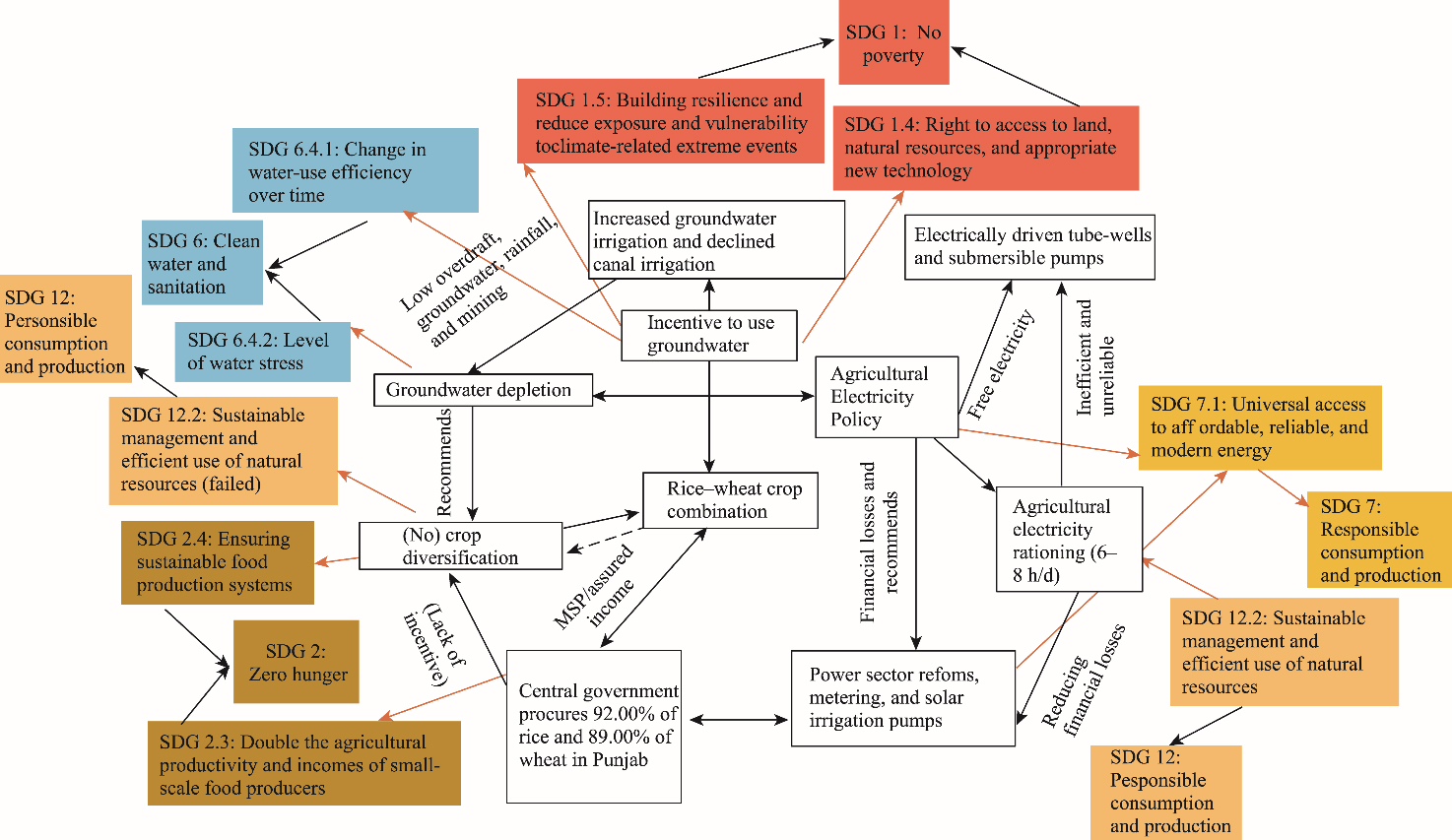
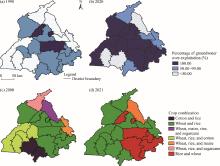
Fig. 7.
Spatial distribution of groundwater over-exploitation in 1998 (a) and 2020 (b) and spatial distribution of crop combination in 2000 (c) and 2021 (d) in Punjab."

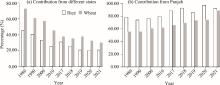
Fig. 8.
Punjab’s contribution of food grains to the central pool during 1980-2021. (a), percentage of rice and wheat procured from Punjab to the total rice and wheat procured from different states by the central government of India for the Public Distribution System of India; (b), percentage of rice and wheat procured from Punjab to the total rice and wheat produced from Punjab by the central government of India for the Public Distribution System of India."
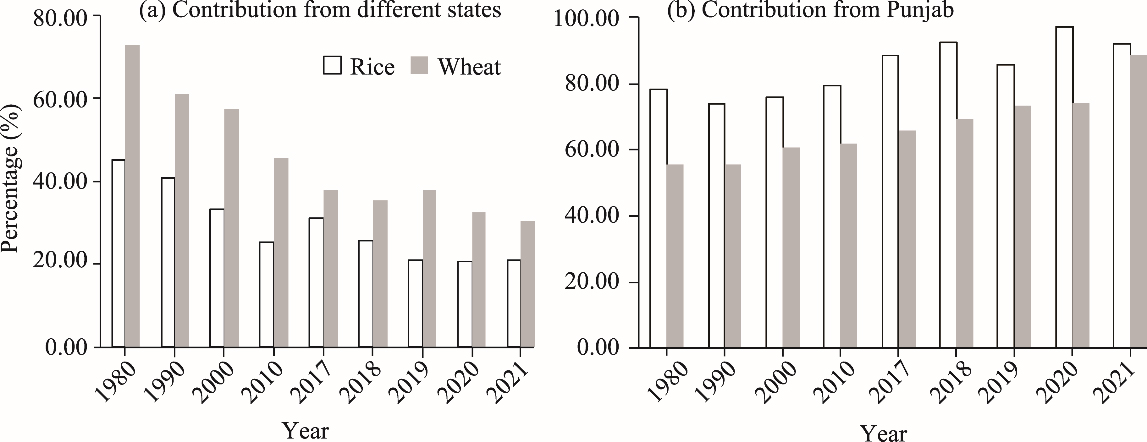
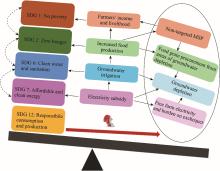
Fig. 9.
Balancing the SDGs with national and local goals."
| [1] | Afzal M., Liu T., Bao A.M., et al., 2024. Groundwater hydrodynamics and supply sustainability in Punjab, Pakistan: A geological statistical approach using the GAMEAS algorithm based on data from 1105 boreholes. China Geology. 9(1), 44-59. |
| [2] |
Aryal J.P., Rahut D.B., Sapkota T.B., et al., 2020. Climate change mitigation options among farmers in South Asia. Environment, Development and Sustainability. 22(4), 3267-3289.
doi: 10.1007/s10668-019-00345-0 |
| [3] |
Avellán T., Ardakanian R., Perret S.R., et al., 2018. Considering resources beyond water: irrigation and drainage management in the context of the water-energy-food nexus. Irrigation and Drainage. 67(1), 12-21.
doi: 10.1002/ird.v67.1 |
| [4] |
Beck T., 1995. The green revolution and poverty in India: A case study of West Bengal. Applied Geography. 15(2), 161-181.
doi: 10.1016/0143-6228(94)00002-8 |
| [5] | Boas I., Biermann F., Kanie N., 2016. Cross-sectoral strategies in global sustainability governance: towards a nexus approach. International Environmental Agreements: Politics, Law and Economics. 16, 449-464. |
| [6] | Burke, J.J., 2002. Groundwater for irrigation:productivity gains and the need to manage hydro-environmental risk. In: Balkema A.A., Llamas, M.R., Custodio, E., (eds.). Intensive Use of Groundwater:Challenges and Opportunities. Rotterdam: Springer, 59-92. |
| [7] |
Caron P., Ferrero y de Loma-Osorio G., Nabarro D., et al., 2018. Food systems for sustainable development: proposals for a profound four-part transformation. Agronomy for Sustainable Development. 38, 41, doi: 10.1007/s13593-018-0519-1.
pmid: 30956691 |
| [8] | CGWB (Central Ground Water Board), 2022. Dynamic Ground Water Resources Assessment of India, 2022. New Delhi: Ministry of Jal Shakti, Department of Water Resources, River Development and Ganga Rejuvenation, Government of India. |
| [9] | Chand R., 1999. Emerging crisis in Punjab agriculture: Severity and options for future. Economic and Political Weekly. 34(13), A2-A10. |
| [10] | Concern Worldwide, 2024. Global Hunger Index: How Gender Justice Can Advance Climate Resilience and Zero Hunger. [2025-06-15]. https://www.globalhungerindex.org/download/2024-download.html. |
| [11] | Conijn J.G., Bindraban P.S., Schröder J.J., et al., 2018. Can our global food system meet food demand within planetary boundaries? Agriculture, Ecosystems & Environment. 251, 244-256. |
| [12] | Dhawan B.D., 1982. Development of Tubewell Irrigation in India. New Delhi: Agricole Publishing Academy. |
| [13] | Dhawan B.D., 1988. Irrigation in India’s Agricultural Development: Productivity, Stability, Equity. New Delhi: Sage Publications. |
| [14] | Dhawan B.D., 1990. Studies in Minor Irrigation: With Special Reference to Groundwater. New Delhi: Commonwealth Publications. |
| [15] | Directorate of Statistics, Government of Punjab, 1971-2023. Statistical Abstract of Punjab. Economic Adviser to Government Punjab Government of Punjab, Chandigarh. Chandigarh: Government of Punjab. |
| [16] | Dutta S., Dhillon S.S., 2020. Structural transformation of Punjab agriculture and its environmental implications. Indian Journal of Economics and Development. 16(4), 533-546. |
| [17] |
Estudillo J.P., Sawada Y., Otsuka K., 2006. The Green Revolution, development of labor markets, and poverty reduction in the rural Philippines, 1985-2004. Agricultural Economics. 35(S3), 399-407.
doi: 10.1111/agec.2006.35.issue-s3 |
| [18] |
Gerten D., Heck V., Jägermeyr J., et al., 2020. Feeding ten billion people is possible within four terrestrial planetary boundaries. Nature Sustainability. 3(3), 200-208.
doi: 10.1038/s41893-019-0465-1 |
| [19] | Government of Punjab, Economic & Statistical Organization, 1971-2024. Statistical Abstract of Punjab. Chandigarh: Government of Punjab. |
| [20] |
Grafton R.Q., Williams J., Perry C.J., et al., 2018. The paradox of irrigation efficiency. Science. 361(6404), 748-750.
doi: 10.1126/science.aat9314 pmid: 30139857 |
| [21] | Griggs D., Smith M.S., Rockström J., et al., 2014. An integrated framework for sustainable development goals. Ecology and Society. 19(4), 49, doi: 10.5751/es-07082-190449. |
| [22] | Gulati A., Fan S., 2008. The Dragon and the Elephant:Agricultural and Rural Reforms in China and India. New Delhi: Oxford University Press, 576. |
| [23] | Gulati, A., Roy R., Hussain S., 2021. Performance of agriculture in Punjab. In: Gulati A., Roy R., Saini S., (eds.). Revitalizing Indian Agriculture and Boosting Farmer Incomes, India Studies in Business and Economics. Singapore: Springer, 77-112. |
| [24] |
Gupta D., 2023. Free power, irrigation, and groundwater depletion: Impact of farm electricity policy of Punjab, India. Agricultural Economics. 54(4), 515-541.
doi: 10.1111/agec.v54.4 |
| [25] | Gupta J., Vegelin C., 2016. Sustainable development goals and inclusive development. International Environmental Agreements: Politics, Law and Economics. 16, 433-448. |
| [26] | Hazell P.B., 2010. Asia’s Green Revolution: Past Achievements and Future Challenges. Rice in the Global Economy: Strategic Research and Policy Issues for Food Security. Washington, DC.: International Food Policy Research Institute (IFRI). |
| [27] |
Headey D., 2011. Rethinking the global food crisis: the role of trade shocks. Food Policy. 36(2), 136-146.
doi: 10.1016/j.foodpol.2010.10.003 |
| [28] | Hossain A., 1992. Green revolution, income distribution and rural poverty-the case of Bangladesh. Bangladesh Journal of Agricultural Economics. 15(1), 1-31. |
| [29] | Humphreys E., Kukal S.S., Christen E., et al., 2010. Halting the groundwater decline in north-west India—which crop technologies will be winners? Advances in Agronomy. 109, 155-217. |
| [30] | Johl S.S., 1996. Future of agriculture in Punjab: Some policy issues. Journal of Agriculture Development and Policy. 7(1), 1-21. |
| [31] | Johl S.S., 2002. Agricultural Production Pattern Adjustment Programme in Punjab for Productivity and Growth Expert Committee Report. Punjab: Government of Punjab. |
| [32] | John D.A., Babu G.R., 2021. Lessons from the aftermaths of green revolution on food system and health. Frontiers in Sustainable Food Systems. 5, 644559, doi: 10.3389/fsufs.2021.644559. |
| [33] | Kaul J.L., Sekhon S., 1991. Flexibility and reliability of irrigation systems and their effect on farming - A case of Punjab. Indian Journal of Agricultural Economics. 46(4), 587-592. |
| [34] |
Kumar M.D., Bassi N., Verma M.S., 2022. Direct delivery of electricity subsidy to farmers in Punjab: will it help conserve groundwater? International Journal of Water Resources Development. 38(2), 306-321.
doi: 10.1080/07900627.2021.1899900 |
| [35] | Lal, R., 2010. Soil degradation and food security in South Asia. In: Lal R.,Sivakumar, M.V.K., Faiz, S.M.A., et al., (eds.). Climate Change and Food Security in South Asia. Dordrecht: Springer, 137-152. |
| [36] |
López-Gunn E., Llamas. M.R., 2008. Re-thinking water scarcity: can science and technology solve the global water crisis? Natural Resource Forum. 32(3), 228-238.
doi: 10.1111/narf.2008.32.issue-3 |
| [37] | Mbow, C., Rosenzweig C.E., Barioni L.G., 2019. Food security-special report:special report on climate change and land. In: Shukla J., Skea, E., Calvo Buendia, V., et al., (eds.). Food Security-Supplementary Material. IPCC Special Report on Climate Change, Desertification, Land Degradation, Sustainable Land Management, Food Security, and Greenhouse Gas Fluxes in Terrestrial Ecosystems. Geneva: IPCC. |
| [38] | Ministry of Agriculture & Farmers’ Welfare, 2022. Agricultural Statistics at a Glance 2022. [2025-06-15]. https://desagri.gov.in/wp-content/uploads/2023/05/Agricultural-Statistics-at-a-Glance-2022.pdf. |
| [39] | Ministry of Finance, Government of India, 2024. Economic Survey 2024-25. [2025-06-14]. https://www.indiabudget.gov.in/economicsurvey/doc/echapter.pdf. |
| [40] | Mirabi M., Javan K., Darestani M., et al., 2025. Integrating circular economy and life cycle assessment in virtual water management: a case study of food consumption across economic classes in Iran. Sustainability. 17(6), 2743, doi: 10.3390/su17062743. |
| [41] | Mirzaei A., Saghafian B., Mirchi A., et al., 2019. The groundwater-energy-food nexus in Iran’s agricultural sector: implications for water security. Water. 11(9), 1835, doi: 10.3390/w11091835. |
| [42] |
Mitra A., Balasubramanya S., Brouwer R., 2023. Can cash incentives modify groundwater pumping behaviors? Evidence from an experiment in Punjab. American Journal of Agricultural Economics. 105(3), 861-887.
doi: 10.1111/ajae.v105.3 |
| [43] | Moench M., Burke J.J., Moench Y., 2003. Rethinking the Approach to Groundwater and Food Security (No. 24). [2025-06-11]. https://openknowledge.fao.org/server/api/core/bitstreams/9563db5e-398b-4ee1-8d59-42a19bf2784d/content/y4495e00.htm. |
| [44] | Mukherji A., 2016. Evolution of irrigation sector. Economic and Political Weekly. 51(52), 44-47. |
| [45] | Nasir J., Ashfaq M., Baig I.A., et al., 2021. Socioeconomic impact assessment of water resources conservation and management to protect groundwater in Punjab, Pakistan. Water. 13(19), 2672, doi: 10.3390/w13192672. |
| [46] | National Health Systems Resource Centre, 2021. Health Dossier 2021: Reflections on Key Health Indicators-Punjab. New Delhi: National Health Systems Resource Centre, Ministry of Health and Family Welfare, Government of India. |
| [47] |
Nazli S., Liu J.H., Wang H.B., et al., 2024. Water resources in Pakistan: a comprehensive overview and management challenges. Journal of Water and Climate Change. 15(10), 4919-4935.
doi: 10.2166/wcc.2024.415 |
| [48] |
Nelson G., Bogard J., Lividini K., et al., 2018. Income growth and climate change effects on global nutrition security to mid-century. Nature Sustainability. 1(12), 773-781.
doi: 10.1038/s41893-018-0192-z |
| [49] | NITI Aayog (National Institution for Transforming India), 2024a. SDG India Index 2023-24. New Delhi: Government of India. |
| [50] | NITI Aayog, 2024b. Working Group Report on Crop Husbandry, Agricultural Inputs, Demand & Supply. New Delhi: Government of India. |
| [51] | Pal Sharma A., 2013. Farmer Bodies Oppose Meters On New Pump Set Connections. [2025-06-11]. https://newspaperspk.com/indian/times-of-india.html. |
| [52] | Pandey, R., 2016. Groundwater irrigation in Punjab:Some issues and a way forward. In: SinghL., Singh N., (eds.). Economic Transformation of a Developing Economy. India Studies in Business and Economics. Singapore: Springer, 97-117. |
| [53] | Patnaik, U., 2014. Some economic and political consequences of the Green Revolution in India. In: Crow B., (ed.). The Food Question (1st edition). London: Routledge, 80-90. |
| [54] | Pingali P., Plavšić M., 2022. Hunger and environmental goals for Asia: Synergies and trade-offs among the SDGs. Environmental Challenges. 7, 100491, doi: 10.1016/j.envc.2022.100491. |
| [55] |
Potapov P., Turubanova S., Hansen M.C., et al., 2022. Global maps of cropland extent and change show accelerated cropland expansion in the twenty-first century. Nature Food. 3(1), 19-28.
doi: 10.1038/s43016-021-00429-z pmid: 37118483 |
| [56] |
Pradhan P., Costa L., Rybski D., et al., 2017. A systematic study of sustainable development goal (SDG) interactions. Earth’s Future. 5(11), 1169-1179.
doi: 10.1002/eft2.2017.5.issue-11 |
| [57] | Praharaj S., Lal B., Gouda H.S., et al., 2025. Conservation agriculture for sustainable food system: Current insights and emerging perspectives. Regional Sustainability. 6(5), 100264, doi: 10.1016/j.regsus.2025.100264. |
| [58] |
Pretty J., Benton T.G., Bharucha Z.P., et al., 2018. Global assessment of agricultural system redesign for sustainable intensification. Nature Sustainability. 1(8), 441-446.
doi: 10.1038/s41893-018-0114-0 |
| [59] | PSERC (Punjab State Electricity Regulatory Commission), 2023. Tariff Order for FY 2023-24. Punjab State Power Corporation Limited (PSPCL), Chandigarh. [2025-06-07]. https://pspcl.in/pdfs/currenttariff/sesalesto2023052610211318601062023.pdf. |
| [60] | Pujara M.K., Shahid A., 2016. Crop diversification: Challenges of switching crops in Punjab. Indian Journal of Economics and Development. 12(1a), 579-582. |
| [61] | Punjab State Power Corporation Limited, 2024. Tariff Order for FY 2024-25. Punjab State Electricity Regulatory Commission (PSERC), Chandigarh. [2025-06-07]. https://www.eqmagpro.com/wp-content/uploads/2024/07/PSPCL-TO-2024-25_compressed.pdf. |
| [62] | Rangi P.S., Sidhu M.S., 2004. New farm technology and changing structure of agricultural labour employment in Punjab. Man and Development. 26(4), 61-80. |
| [63] |
Razzaq A., Liu H., Xiao M., et al., 2023. Analyzing past and future trends in Pakistan’s groundwater irrigation development: Implications for environmental sustainability and food security. Environmental Science and Pollution Research. 30(12), 35413-35429.
doi: 10.1007/s11356-022-24736-5 |
| [64] |
Rodriguez-Diaz J.A., Perez-Urrestarazu L., Camacho-Poyato E., et al., 2011. The paradox of irrigation scheme modernization: more efficient water use linked to higher energy demand. Spanish Journal of Agricultural Research. 9(4), 1000-1008.
doi: 10.5424/sjar/20110904-492-10 |
| [65] |
Sarkar A., Sen S., Kumar A., 2008. Rice-wheat cropping cycle in Punjab: a comparative analysis of sustainability status in different irrigation systems. Environment, Development and Sustainability. 11(4), 751-763.
doi: 10.1007/s10668-008-9141-8 |
| [66] | Sarkar A., Das A., 2014. Groundwater irrigation-electricity-crop diversification nexus in Punjab: Trends, turning points and policy initiatives. Economic and Political Weekly. 49(52), 64-73. |
| [67] | Sarkar A., 2016. Structural Changes in Irrigation Systems and Accessibility of Groundwater in Punjab. New Delhi: Manak Publications Private Limited. |
| [68] | Sarkar A., 2020. Groundwater irrigation and farm power policies in Punjab and West Bengal: Challenges and opportunities. Energy Policy. 140, 111437, doi: 10.1016/j.enpol.2020.111437. |
| [69] |
Shah T., Roy A.D., Qureshi A.S., et al., 2003. Sustaining Asia’s groundwater boom: an overview of issues and evidence. Natural Resources Forum. 27(2), 130-141.
doi: 10.1111/narf.2003.27.issue-2 |
| [70] | Shah, T., 2007. The groundwater economy of South Asia:an assessment of size, significance and socio-ecological impacts. In: Giordano M., Villholth, K.G., (eds.). The Agricultural Groundwater Revolution:Opportunities and Threats to Development. Wallingford: CAB International, 7-36. |
| [71] | Shah, T., Scott C., Berkoff J., et al., 2007a. The energy-irrigation nexus in South Asia:Groundwater conservation and power sector viability. In: Molle F., Berkoff Wallingford, J., (eds.). Irrigation Water Pricing:The Gap Between Theory and Practice. Wallingford: CABI Publishing, 208-232. |
| [72] | Siddhu H.S., 2002. Crisis in agrarian economy in Punjab: Some urgent steps. Economic and Political Weekly. 37(30), 3132-3138. |
| [73] | Sidhu D.S., Chand R., Kaul J.K., 1984. An economic analysis of various sources of irrigation in Punjab. Indian Journal of Agricultural Economics. 39(3), 506-511. |
| [74] | Sidhu R.S., Vatta K., Dhaliwal H.S., 2010. Conservation agriculture in Punjab: economic implications of technologies and practices. Indian Journal of Agricultural Economics. 65(3), 1-15. |
| [75] | Siebert S., Döll P., 2010. Quantifying blue and green virtual water contents in global crop production as well as potential production losses without irrigation. Journal of Hydrology. 384, 198-217. |
| [76] | Singh B., 1992. Groundwater resource and agricultural development strategy: Punjab experience. Indian Journal of Agricultural Economics. 47(1), 105-113. |
| [77] | Singh D., Kaur P., 2020. Resource conservation technologies in Punjab: Status and problems. Indian Journal of Economics and Development. 16(2), 281-287. |
| [78] | Singh S., 2000. Crisis in Punjab Agriculture. Economic and Political Weekly. 35(23), 1889-1892. |
| [79] |
Tripathi A., Mishra A.K., Verma G., 2016. Impact of preservation of subsoil water act on groundwater depletion: the case of Punjab, India. Environmental Management. 58(1), 48-59.
doi: 10.1007/s00267-016-0693-3 pmid: 27015967 |
| [80] | Tripathi A.R., Prasad A., 2009. Agricultural development in India since independence: A study on progress, performance and determinants. Journal of Emerging Knowledge on Emerging Markets. 1(1), 63-92. |
| [81] | United Nations, 2024. The Sustainable Development Goals Report, 2024. [2025-06-15]. https://unstats.un.org/sdgs/report/2024/The-Sustainable-Development-Goals-Report-2024.pdf |
| [82] | Vahedi R., Ledari M.B., Fani M., 2025. Advancing circular economy in the water-energy-food nexus: A framework for sustainable resource use. Journal of Environmental Management. 376, 124324, doi: 10.1016/j.jenvman.2025.124324. |
| [83] | Vaidyanathan A., 1999. Water Resource Management:Institutions and Irrigation Development in India. New Delhi: Oxford University Press. |
| [84] | Vatta, K., 2019. Sustainability of groundwater use in Punjab agriculture:issues and options. In: Peshin R., Dhawan A., (eds.). Natural Resource Management:Ecological Perspectives. Sustainability in Plant and Crop Protection. Cham: Springer, 19-30. |
| [85] |
Vora N., Shah A., Bilec M.M., et al., 2017. Food-energy-water-nexus: quantifying embodied energy and GHG emissions from irrigation through virtual water transfers in food trade. ACS Sustainable Chemistry and Engineering. 5(3), 2119-2128.
doi: 10.1021/acssuschemeng.6b02122 |
| [86] |
Weaver J.C., 1954. Crop-combination regions in the Middle West. Geographical Review. 44(2), 175-200.
doi: 10.2307/212355 |
| [87] |
Wichelns D., Oster J.D., 2006. Sustainable irrigation is necessary and achievable, but direct costs and environmental impacts can be substantial. Agricultural Water Management. 86(1-2), 114-127.
doi: 10.1016/j.agwat.2006.07.014 |
| [88] | World Bank Group, 2021. Food Finance Architecture: Financing a Healthy, Equitable and Sustainable Food System. [2025-07-13]. http://documents.worldbank.org/curated/en/879401632342154766/Food-Finance-Architecture-Financing-a-Healthy-Equitable-and-Sustainable-Food-System. |
| [1] | A. B. M. Mainul BARI, Md Mahfujur RAHMAN, Asif RAIHAN, Umar Muhammad MODIBBO, Ashish TRIVEDI, Nuhu AMIN, Amirhossein TAGHIPOUR. Exploring the challenges to circular supply chain (CSC) implementation in the chemical-intensive manufacturing industries of emerging economies: Implications toward sustainability [J]. Regional Sustainability, 2025, 6(6): 100278-. |
| [2] | Kazi Atiah TAIYEBI, Natalie Ann Cooper WELDEN, Md Sarwar HOSSAIN. Social-ecological indicators and framework for assessing the sustainability of shrimp farming in coastal Bangladesh [J]. Regional Sustainability, 2025, 6(5): 100260-. |
| [3] | Z. R. M. Abdullah KAISER, Apu DEB. Sustainable smart city and Sustainable Development Goals (SDGs): A review [J]. Regional Sustainability, 2025, 6(1): 100193-. |
| [4] | Nazim Forid ISLAM, Bhoirob GOGOI, Rimon SAIKIA, Balal YOUSAF, Mahesh NARAYAN, Hemen SARMA. Encouraging circular economy and sustainable environmental practices by addressing waste management and biomass energy production [J]. Regional Sustainability, 2024, 5(4): 100174-. |
| [5] | LIU Binsheng, ZHANG Xiaohui, TIAN Junfeng, CAO Ruimin, SUN Xinzhang, XUE Bin. Rural sustainable development: A case study of the Zaozhuang Innovation Demonstration Zone in China [J]. Regional Sustainability, 2023, 4(4): 390-404. |
| [6] | Md. Mominur RAHMAN. Impact of taxes on the 2030 Agenda for Sustainable Development: Evidence from Organization for Economic Co-operation and Development (OECD) countries [J]. Regional Sustainability, 2023, 4(3): 235-248. |
| [7] | Surendra Singh JATAV, Kalu NAIK. Measuring the agricultural sustainability of India: An application of Pressure-State-Response (PSR) model [J]. Regional Sustainability, 2023, 4(3): 218-234. |
| [8] | Firoz AHMAD, Nazimur Rahman TALUKDAR, Laxmi GOPARAJU, Chandrashekhar BIRADAR, Shiv Kumar DHYANI, Javed RIZVI. GIS-based assessment of land-agroforestry potentiality of Jharkhand State, India [J]. Regional Sustainability, 2022, 3(3): 254-268. |
| [9] | Giribabu DANDABATHULA, Sudhakar Reddy CHINTALA, Sonali GHOSH, Padmapriya BALAKRISHNAN, Chandra Shekhar JHA. Exploring the nexus between Indian forestry and the Sustainable Development Goals [J]. Regional Sustainability, 2021, 2(4): 308-323. |
| Viewed | ||||||
|
Full text |
|
|||||
|
Abstract |
|
|||||
 REGSUS Wechat
 新公网安备 65010402001202号