
Regional Sustainability ›› 2025, Vol. 6 ›› Issue (6): 100278.doi: 10.1016/j.regsus.2025.100278cstr: 32279.14.REGSUS.20250040
• Full Length Article • Previous Articles Next Articles
A. B. M. Mainul BARIa,*( ), Md Mahfujur RAHMANa, Asif RAIHANb, Umar Muhammad MODIBBOc, Ashish TRIVEDId, Nuhu AMINe, Amirhossein TAGHIPOURf
Received:2024-06-21
Revised:2025-08-30
Accepted:2025-12-11
Published:2025-12-31
Online:2026-01-08
Contact:
* E-mail address: A. B. M. Mainul BARI, Md Mahfujur RAHMAN, Asif RAIHAN, Umar Muhammad MODIBBO, Ashish TRIVEDI, Nuhu AMIN, Amirhossein TAGHIPOUR. Exploring the challenges to circular supply chain (CSC) implementation in the chemical-intensive manufacturing industries of emerging economies: Implications toward sustainability[J]. Regional Sustainability, 2025, 6(6): 100278.
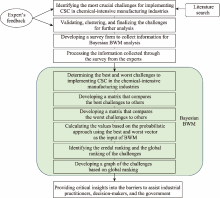
Fig. 1.
Framework of this research. CSC, circular supply chain; BWM, best-worst method."
Table 1
List of the search strings."
| Subject | Search string |
|---|---|
| Challenges to implementing circular supply chain (CSC) | “challenges to implementing CSC”, or “barriers to implementing CSC”, or “CSC challenges”, or “CSC barriers”, or “challenges to implementing closed-loop supply chain”, or “barriers to implementing closed-loop supply chain” |
| Chemical-intensive manufacturing industries | “chemical-intensive industry”, or “chemical-intensive sector”, or “manufacturing industry”, or “chemical industry”, or “chemical-based industrial sector” |
Table 2
Summary profile of the experts."
| No. | Company age (a) | Company size | Does the company have ISO 9000 certification? | Job title | Experience (a) | Expertise | Education | Industry |
|---|---|---|---|---|---|---|---|---|
| 1 | 31 | Large | Yes | Chemist | 5-10 | Chemical department | Post graduate | Pharmaceuticals |
| 2 | 24 | Small | No | Manager | >10 | Supply chain | Post graduate | Plastics |
| 3 | 70 | Large | No | Pharmacist | 5-10 | Chemical department | Post graduate | Pharmaceuticals |
| 4 | 31 | Large | Yes | Manager | >10 | Supply chain | Post graduate | Leather industry |
| 5 | 20 | Medium | No | Chemical engineer | >10 | Chemical department | Under graduate | Paint manufacturing |
| 6 | 69 | Large | Yes | Manager | >10 | Supply chain | Under graduate | Textile industry |
| 7 | 65 | Large | Yes | Analytical chemist | >10 | Chemical department | Post graduate | Leather industry |
| 8 | 65 | Large | Yes | Chemist | >10 | Chemical department | Post graduate | Chemical manufacturing |
| 9 | 31 | Medium | Yes | Chemist | 5-10 | Chemical department | Under graduate | Textile industry |
| 10 | 31 | Large | Yes | Chemist | 5-10 | Chemical department | Post graduate | Chemical manufacturing |
| 11 | 69 | Large | Yes | Manager | >10 | Supply chain | Under graduate | Textile industry |
| 12 | 70 | Large | No | Manager | >10 | Supply chain | Post graduate | Paint manufacturing |
Table 3
Finalized challenges for further analysis."
| Cluster | Challenge | Source |
|---|---|---|
| Decision-making-related challenges | Inadequate policies, rules, and environmental regulations | Farooque et al. ( |
| Lack of standardization of CSC activities | Kumar et al. ( | |
| Insufficient assistance and commitment from management | Mangla et al. ( | |
| Inadequate strategic planning | Ozkan-Ozen et al. ( | |
| Lack of locally available CSC technologies | Expert feedback | |
| Employment-related challenges | Insufficient technical knowledge | Farooque et al. ( |
| Lack of proper training | Mangla et al. ( | |
| Scarcity of skilled labor | Ada et al. ( | |
| Insufficient theoretical knowledge | Ada et al. ( | |
| Inadequate coordination of reverse logistics activities | Kazancoglu et al. ( | |
| Design- and materials-related challenges | Strong emphasis on the take-make-dispose policy | Govindan and Hasanagic ( |
| Limited utilization for end-of-life product design concepts | Mangla et al. ( | |
| Lack of proper information management | Farooque et al. ( | |
| Scarcity of sustainable and recyclable materials | Govindan and Hasanagic ( | |
| Chemical composition-related complexity | Expert feedback | |
| Financial and infrastructural challenges | Expensive waste collection and segregation processes | Kazancoglu et al. ( |
| Uncertain economic benefits in the short run | Ada et al. ( | |
| Insufficient investment and financial resources | Govindan and Hasanagic ( | |
| High testing, research, and analysis cost | Expert feedback | |
| Inadequate collection points and recycling plants | Kazancoglu et al. ( | |
| Scarcity of proper infrastructure | Kumar et al. ( | |
| Customer- and stakeholder-related challenges | Concerns about the quality of refurbished and recycled materials | Govindan and Hasanagic ( |
| Negative perception of reusing recycled materials | Bhatia et al. ( | |
| Lack of market demand for products made from recycled materials | Expert feedback | |
| Lack of mass awareness and sense of social responsibility | Expert feedback | |
| Resistance toward the transition from conventional supply chain to CSC | Expert feedback |
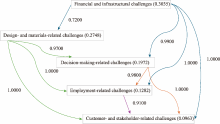
Fig. 2.
Credal ranking of the main clusters. Different colors of the directed graph/arc indicate which nodes they are originating from. Lines with the same color mean that they are originating from the same nodes. Arcs originating from different nodes will have different colors. The value on each arc (between any two nodes) indicates the corresponding confidence score between the two corresponding nodes. Again, each value inside the first bracket placed in each node indicates the corresponding weight score of that node within the corresponding cluster. The meaning is the same in the following figures."
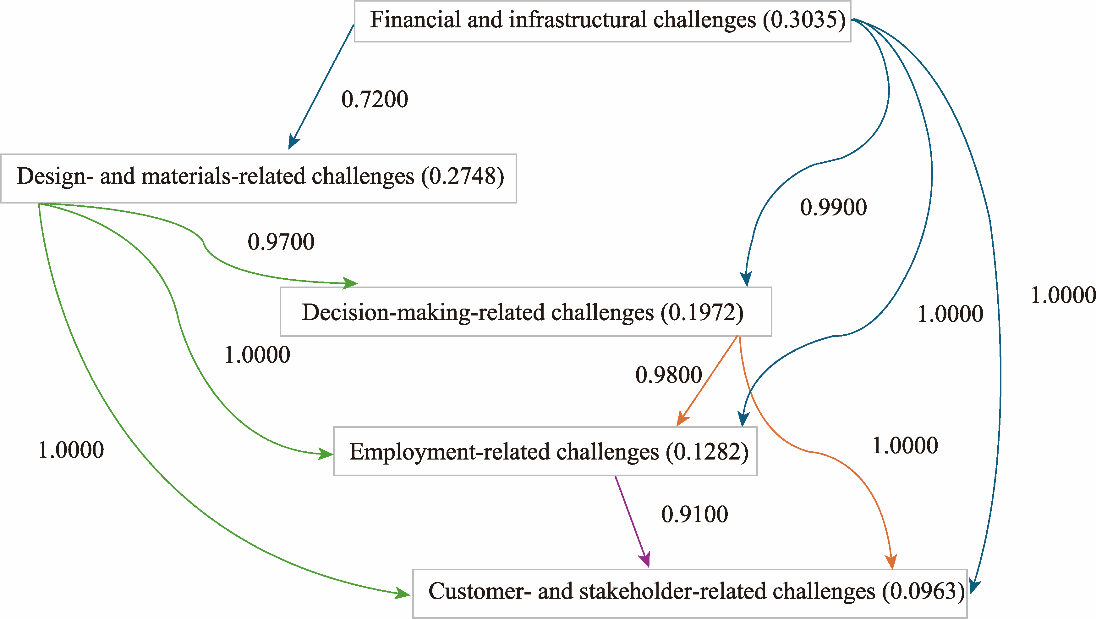
Fig. 3.
Credal ranking of the decision-making-related challenges."
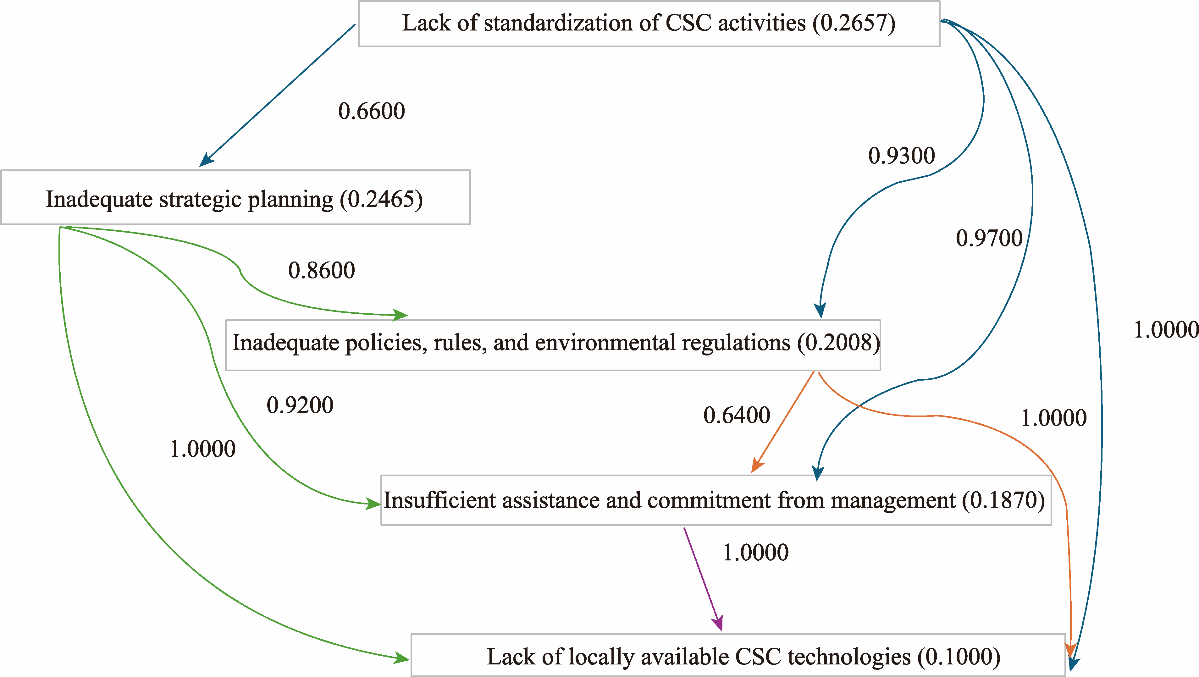
Fig. 4.
Credal ranking of the employment-related challenges."
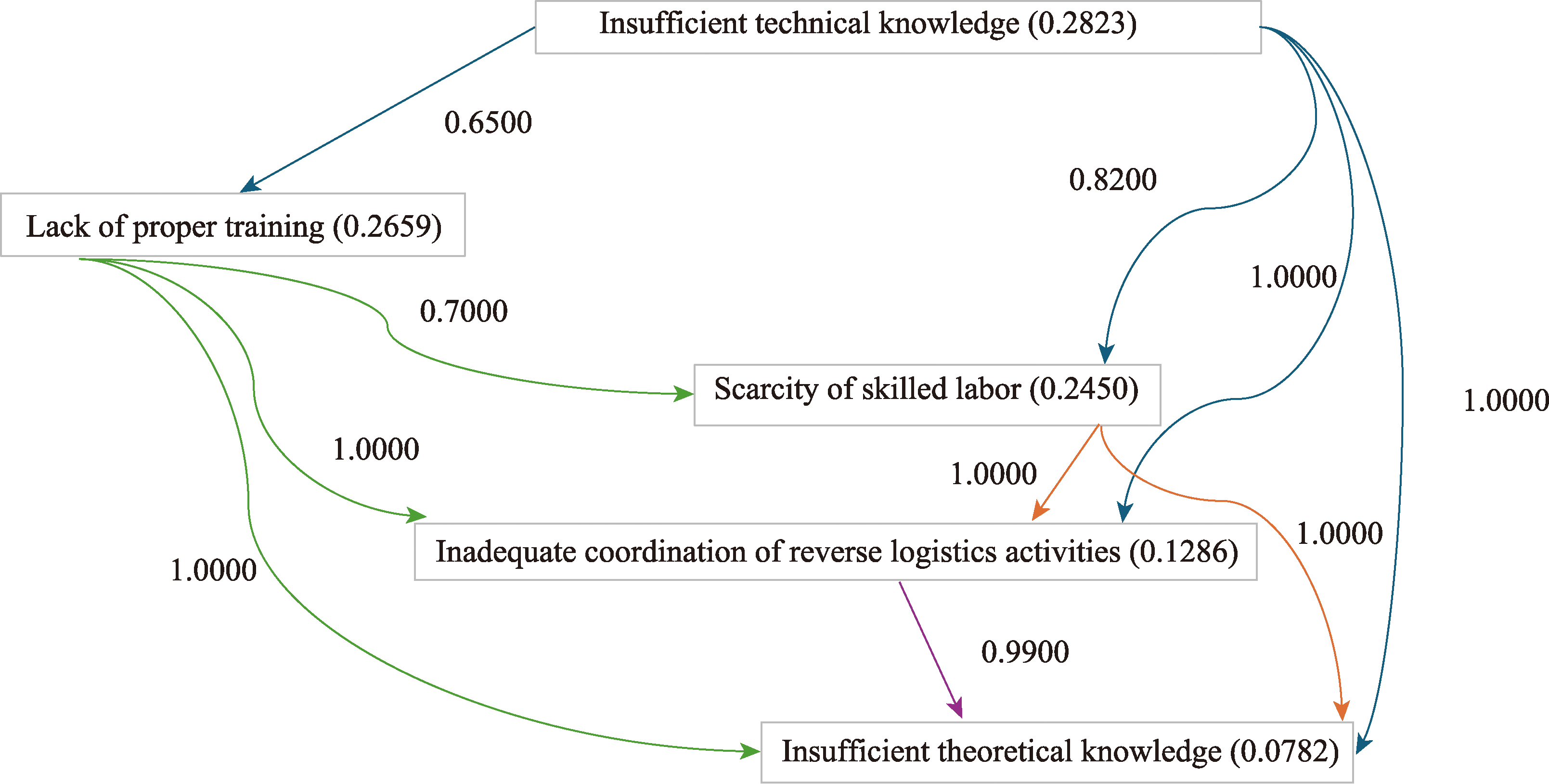
Fig. 5.
Credal ranking of design- and materials-related challenges."
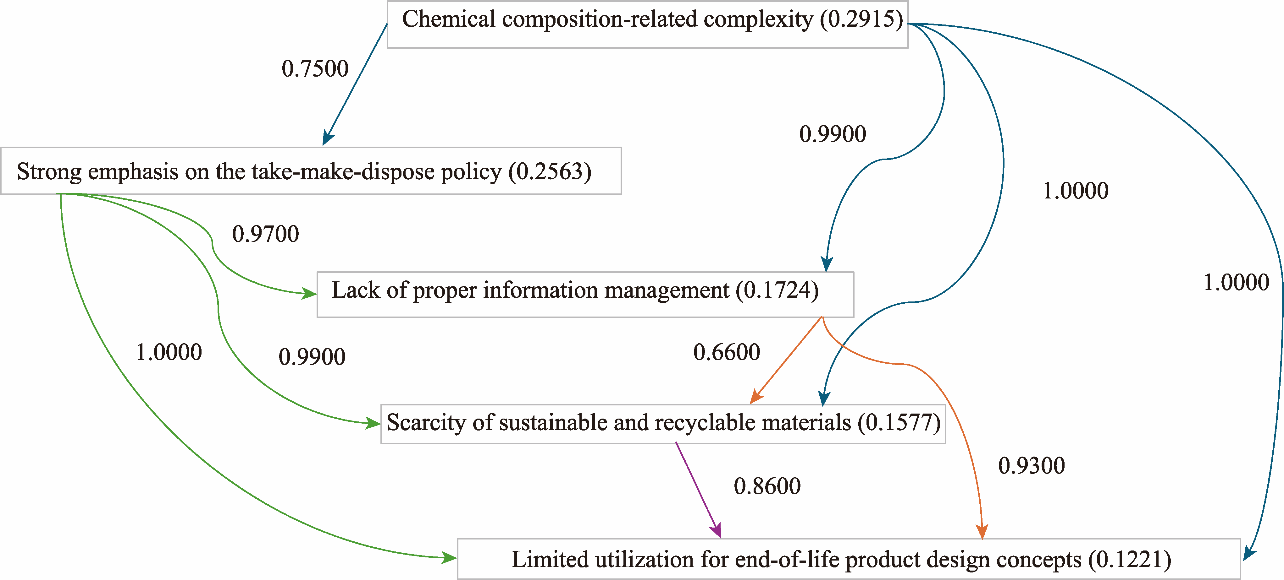
Fig. 6.
Credal ranking of financial and infrastructural challenges."

Fig. 7.
Credal ranking of customer- and stakeholder-related challenges."
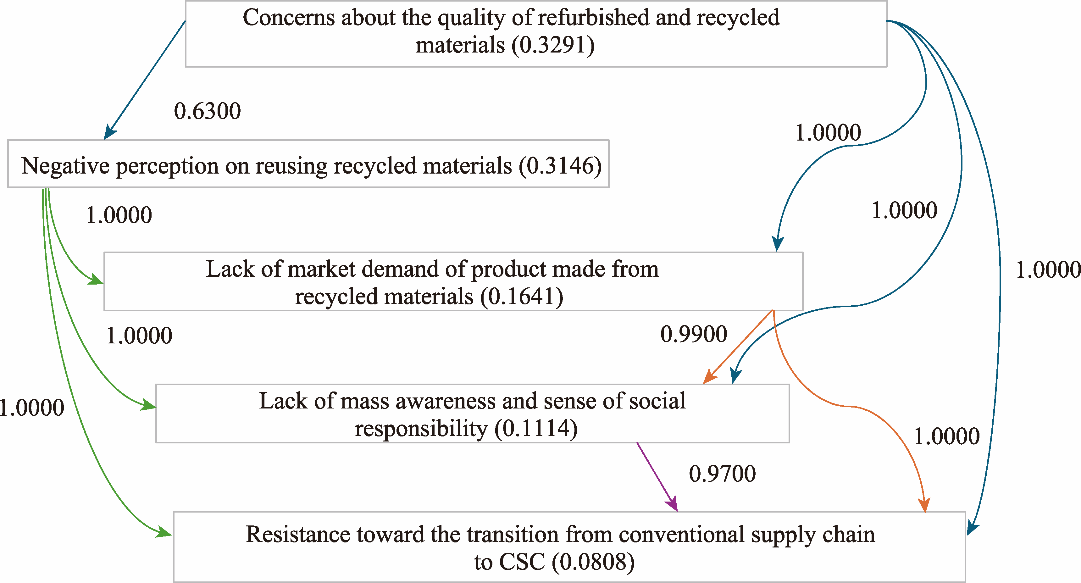
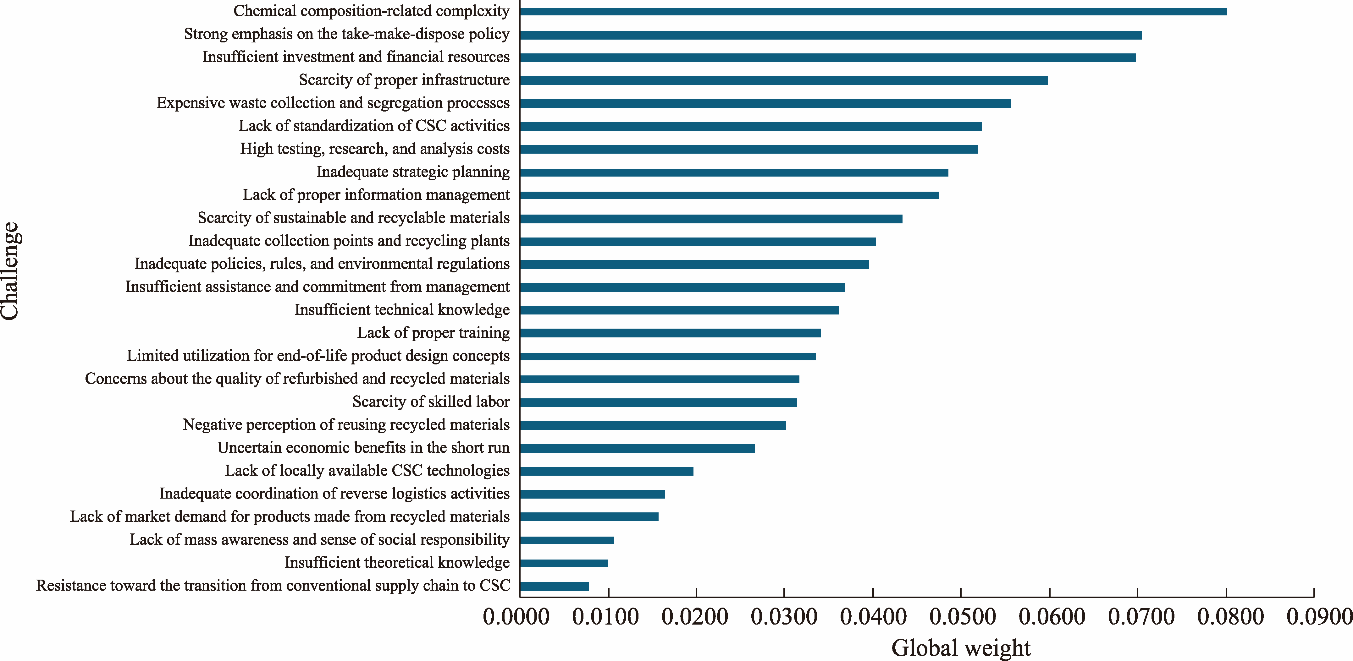
Fig. 8.
Final ranking of all the challenges based on global weight."
| [1] | Ada, N., Kazancoglu, Y., Sezer, M.D., et al., 2021. Analyzing barriers of circular food supply chains and proposing industry 4.0 solutions. Sustainability. 13(12), 6812, doi: 10.3390/su13126812. |
| [2] | Agyemang, M., Kusi-Sarpong, S., Khan, S.A., et al., 2019. Drivers and barriers to circular economy implementation: An explorative study in Pakistan’s automobile industry. Manag. Decis. 57(4), 931-948. |
| [3] | Ahmed, S.M., Karmaker, C.L., Doss, D.A., et al., 2020. Modelling the barriers in managing closed loop supply chains of automotive industries in Bangladesh. International Journal of Supply and Operations Management. 7(1), 76-92. |
| [4] | Ahmed, Z., Mahmud, S., Acet, D.H., 2022. Circular economy model for developing countries: evidence from Bangladesh. Heliyon. 8(5), e09530, doi: 10.1016/j.heliyon.2022.e09530. |
| [5] |
Amiri, M.K., Hashemi-Tabatabaei, M., Ghahremanloo, M., et al., 2022. Evaluating barriers and challenges of circular supply chains using a decision-making model based on rough sets. Int. J. Environ. Sci. Technol. 19(8), 7275-7296.
doi: 10.1007/s13762-021-03899-7 |
| [6] | Anam, M.Z., Sarkar, S., Bari, A.B.M.M., et al., 2025a. Exploring blockchain technology adoption challenges in the pharmaceutical industry to promote sustainability: A Pythagorean fuzzy approach. Next Sustainability. 6, 100162, doi: 10.1016/j.nxsust.2025.100162. |
| [7] | Anam, M.Z., Shakur, M.S., Bari, A.B.M.M., et al., 2025b. Exploring the barriers to decarbonizing the transportation system: A pathway to a cleaner future in emerging economies. Innovation and Green Development. 4(4), 100256, doi: 10.1016/j.igd.2025.100256. |
| [8] | Arman, M.H., Al Aziz, R., Bari, A.B.M.M., et al., 2025. Improving supply chain responsiveness through the drivers of Industry 5.0: Sustainability implications for emerging economies. Sust. Oper. Comput. 6, 256-269. |
| [9] |
Batista, L., Bourlakis, M., Smart, P., et al., 2018. In search of a circular supply chain archetype—a content-analysis-based literature review. Prod. Plan. Control. 29(6), 438-451.
doi: 10.1080/09537287.2017.1343502 |
| [10] |
Bhatia, M.S., Jakhar, S.K., Dora, M., 2022. Analysis of barriers to closed-loop supply chain: A case of the Indian automotive industry. IEEE Trans. Eng. Manage. 69(5), 1999-2013.
doi: 10.1109/TEM.2020.2998794 |
| [11] | De Felice, F., Ferraro, A., Garofalo, A., et al., 2025. Digital-driven circular ecosystems for the textile sector: Insights from a survey on sustainable practices in Italy. Appl. Sci.-Basel. 15(6), 3266, doi: 10.3390/app15063266. |
| [12] | Debnath, B., Shakur, M.S., Bari, A.B.M.M., et al., 2023. Assessing the critical success factors for implementing industry 4.0 in the pharmaceutical industry: Implications for supply chain sustainability in emerging economies. PLoS One. 18(6), e0287149, doi: 10.1371/journal.pone.0287149. |
| [13] |
Dossa, A.A., Gough, A., Batista, L., et al., 2022. Diffusion of circular economy practices in the UK wheat food supply chain. Int. J. Logist.-Res. Appl. 25(3), 328-347.
doi: 10.1080/13675567.2020.1837759 |
| [14] |
Farooque, M., Zhang, A., Liu, Y.P., 2019a. Barriers to circular food supply chains in China. Supply Chain Manag. 24(5), 677-696.
doi: 10.1108/SCM-10-2018-0345 |
| [15] | Farooque, M., Zhang, A., Thürer, M., et al., 2019b. Circular supply chain management: A definition and structured literature review. J. Clean Prod. 228, 882-900. |
| [16] | Fussone, R., Cannella, S., Dominguez, R., et al., 2025. On the bullwhip effect in circular supply chains combining by-products and end-of-life returns. Appl. Math. Model. 137, 115670, doi: 10.1016/j.apm.2024.115670. |
| [17] |
Govindan, K., Hasanagic, M., 2018. A systematic review on drivers, barriers, and practices towards circular economy: a supply chain perspective. Int. J. Prod. Res. 56(1-2), 278-311.
doi: 10.1080/00207543.2017.1402141 |
| [18] |
Goyal, S., Esposito, M., Kapoor, A., 2018. Circular economy business models in developing economies: lessons from India on reduce, recycle, and reuse paradigms. Thunderbird Int. Bus. Rev. 60(5), 729-740.
doi: 10.1002/tie.2018.60.issue-5 |
| [19] | Gupta, H., Yadav, A.K., Kusi-Sarpong, S., et al., 2022. Strategies to overcome barriers to innovative digitalisation technologies for supply chain logistics resilience during pandemic. Technol. Soc. 69, 101970, doi: 10.1016/j.techsoc.2022.101970. |
| [20] | Imran, M.T.I., Karmaker, C.L., Karim, R., et al., 2024. Modeling the supply chain sustainability imperatives in the fashion retail industry: Implications for sustainable development. PLoS One. 19(12), e0312671, doi: 10.1371/journal.pone.0312671. |
| [21] | Jihu, L., 2024. Green Supply Chain Management Optimization Based on Chemical Industrial Clusters. [2024-06-01]. https://arxiv.org/abs/2406.00478#:-:text=The%20results%20show%20that%20these%20factors%20significantly%20enhance,efficiency%20in%20chemical%20clusters%2C%20promoting%20sustainable%20industry%20growth. |
| [22] | Jones, G.L., Qin, Q., 2022. Markov Chain Monte Carlo in practice. Annu. Rev. Stat. Application. 9, 557-578. |
| [23] | Karuppiah, K., Sankaranarayanan, B., Ali, S.M., et al., 2021. Inhibitors to circular economy practices in the leather industry using an integrated approach: Implications for sustainable development goals in emerging economies. Sustain. Prod. Consump. 27, 1554-1568. |
| [24] |
Kazancoglu, I., Kazancoglu, Y., Yarimoglu, E., et al., 2020. A conceptual framework for barriers of circular supply chains for sustainability in the textile industry. Sustain. Dev. 28(5), 1477-1492.
doi: 10.1002/sd.2100 |
| [25] |
Kazancoglu, I., Kazancoglu, Y., Kahraman, A., et al., 2022. Investigating barriers to circular supply chain in the textile industry from stakeholders’ perspective. Int. J. Logist.-Res. Appl. 25(4-5), 521-548.
doi: 10.1080/13675567.2020.1846694 |
| [26] |
Khan, F., Ali, Y., 2022. Implementation of the circular supply chain management in the pharmaceutical industry. Environ. Dev. Sustain. 24(12), 13705-13731.
doi: 10.1007/s10668-021-02007-6 |
| [27] | Khandelwal, C., Barua, M.K., 2024. Prioritizing circular supply chain management barriers using fuzzy AHP: Case of the Indian plastic industry. Glob. Bus. Rev. 25(1), 232-251. |
| [28] | Kumar, S., Raut, R.D., Nayal, K., et al., 2021. To identify industry 4.0 and circular economy adoption barriers in the agriculture supply chain by using ISM-ANP. J. Clean Prod. 293, 126023, doi: 10.1016/j.jclepro.2021.126023. |
| [29] | Lahane, S., Kant, R., 2021. Evaluating the circular supply chain implementation barriers using Pythagorean fuzzy AHP-DEMATEL approach. Clean. Logist. Supply Chain. 2, 100014, doi: 10.1016/j.clscn.2021.100014. |
| [30] | Lengyel, P., Bai, A., Gabnai, Z., et al., 2021. Development of the concept of circular supply chain management—a systematic review. Processes. 9(10), 1740, doi: 10.3390/pr9101740. |
| [31] | Lubaba, M., Hassan, S., Sultana, M., et al., 2025a. Assessment of the challenges to implementing green manufacturing in the food and beverage industry: an emerging economy perspective. Waste Management Bulletin. 3(3), 100225, doi: 10.1016/j.wmb.2025.100225. |
| [32] | Lubaba, M., Hosen, M.I., Shakur, M.S., et al., 2025b. An intuitionistic fuzzy approach to assessing the barriers to quality 4.0 adoption in the footwear manufacturing industry: Implications for sustainability in emerging economy. Journal of Open Innovation: Technology, Market, and Complexity. 11(3), 100604, doi: 10.1016/j.joitmc.2025.100604. |
| [33] | Maliha, M., Moktadir, M.A., Bag, S., et al., 2024. Circular economy practices in the leather products industry toward waste valorization: An approach of sustainable environmental management. Benchmarking. 31(3), 731-798. |
| [34] |
Mangla, S.K., Luthra, S., Mishra, N., et al., 2018. Barriers to effective circular supply chain management in a developing country context. Prod. Plan. Control. 29(6), 551-569.
doi: 10.1080/09537287.2018.1449265 |
| [35] |
Masud, M.H., Akram, W., Ahmed, A., et al., 2019. Towards the effective E-waste management in Bangladesh: a review. Environ. Sci. Pollut. Res. 26(2), 1250-1276.
doi: 10.1007/s11356-018-3626-2 |
| [36] | Modibbo,, U.M., D’Adamo, I., Morone, P., et al., 2022. The implementation challenges to circular economy via-sectoral exploration. In: Ali, I., Chatterjee, P., Shaikh, A.A., (eds.). Computational Modelling in Industry 4.0: A Sustainable Resource Management Perspective. Singapore: Springer Nature, 11-21. |
| [37] | Mohammadi, M., Rezaei, J., 2020. Bayesian best-worst method: A probabilistic group decision making model. Omega. 96, 102075, doi: 10.1016/j.omega.2019.06.001. |
| [38] | Mostakim, K., Arefin, M.A., Islam, M.T., et al., 2021. Harnessing energy from the waste produced in Bangladesh: Evaluating potential technologies. Heliyon. 7(10), e08221, doi: 10.1016/j.heliyon.2021.e08221. |
| [39] | Munim, Z.H., Balasubramaniyan, S., Kouhizadeh, M., et al., 2022. Assessing blockchain technology adoption in the Norwegian oil and gas industry using Bayesian Best Worst Method. J. Ind. Inf. Integr. 28, 100346, doi: 10.1016/j.jii.2022.100346. |
| [40] | Nakandala, D., Tsang, Y.P., Lau, H., et al., 2022. An industrial blockchain-based multi-criteria decision framework for global freight management in agricultural supply chains. Mathematics. 10(19), 3550, doi: 10.3390/math10193550. |
| [41] | Nasir, M.H.A., Genovese, A., Acquaye, A.A., et al., 2017. Comparing linear and circular supply chains: A case study from the construction industry. Int. J. Prod. Econ. 183, 443-457. |
| [42] | Nayeem, A.R., Shakur, M.S., Debnath, B., et al., 2025. Unraveling the blockchain technology adoption barriers in the fast-moving consumer goods supply chain: An integrated fuzzy-set qualitative comparative analysis approach. Asia Pac. Manag. Rev. 100374, doi: 10.1016/j.apmrv.2025.100374. |
| [43] | Ncube, A., Mtetwa, S., Bukhari, M., et al., 2023. Circular economy and green chemistry: The need for radical innovative approaches in the design for new products. Energies. 16(4), 1752, doi: 10.3390/en16041752. |
| [44] | Ozkan-Ozen, Y.D., Kazancoglu, Y., Mangla, S.K., 2020. Synchronized barriers for circular supply chains in industry 3.5/industry 4.0 transition for sustainable resource management. Resour. Conserv. Recycl. 161, 104986, doi: 10.1016/j.resconrec.2020.104986. |
| [45] | Palma, D., Hodgett, R., 2025. Barriers to sustainable manufacturing in the chemical industry: A qualitative study. Sustainability. 17(7), 3241, doi: 10.3390/su17073241. |
| [46] | Plummer, M., 2007. JAGS: Just Another Gibbs Sampler. [2024-05-28]. https://pdfs.semanticscholar.org/837b/9203abc8b3416e620d4c99d8500b4bd9be20.pdf. |
| [47] | Rahman, M.M., Bari, A.B.M.M., Ali, S.M., et al., 2022. Sustainable supplier selection in the textile dyeing industry: An integrated multi-criteria decision analytics approach. Resour. Conserv. Recycl. Adv. 15, 200117, doi: 10.1016/j.rcradv.2022.200117. |
| [48] | Raja, K.S., Maliha, A., Paul, S., et al., 2025. Unraveling the obstacles to transform agro-wastes into value-added bioproducts: Implications for sustainability. Sustainable Operations and Computers. 6, 171-188. |
| [49] |
Raunaq, F.F., Islam, S., Anam, M.Z., et al., 2025. Assessing the challenges to digital technology adoption in the healthcare sector: Implications for sustainability in emerging economies. Informatics and Health. 2(2), 194-209.
doi: 10.1016/j.infoh.2025.09.001 |
| [50] | Ravindra, K., Sareen, A., Dogra, S., et al., 2023. Appraisal of biomedical waste management practice in India and associated human health and environmental risk. J. Environ. Biol. 44, 541-551. |
| [51] |
Saeed, S., Arshad, M.Y., Ahmed, A.S., 2023. Advancing circular economy in industrial chemistry and environmental engineering: Principles, alignment with United Nations sustainable development goals, and pathways to implementation. European Journal of Chemistry. 14(3), 414-428.
doi: 10.5155/eurjchem.14.3.414-428.2452 |
| [52] | Trivedi, A., Trivedi, V., Debnath, B., et al., 2025. A goal programming based bi-stage network design for covid-19 immunization waste management. International Journal of Supply and Operations Management. 12(2), 149-167. |
| [53] |
Tusher, H.M., Munim, Z.H., Nazir, S., 2024. An evaluation of maritime simulators from technical, instructional, and organizational perspectives: A hybrid multi-criteria decision-making approach. WMU J. Marit. Aff. 23(2), 165-194.
doi: 10.1007/s13437-023-00318-1 |
| [1] | Kazi Atiah TAIYEBI, Natalie Ann Cooper WELDEN, Md Sarwar HOSSAIN. Social-ecological indicators and framework for assessing the sustainability of shrimp farming in coastal Bangladesh [J]. Regional Sustainability, 2025, 6(5): 100260-. |
| [2] | Z. R. M. Abdullah KAISER, Apu DEB. Sustainable smart city and Sustainable Development Goals (SDGs): A review [J]. Regional Sustainability, 2025, 6(1): 100193-. |
| [3] | Nazim Forid ISLAM, Bhoirob GOGOI, Rimon SAIKIA, Balal YOUSAF, Mahesh NARAYAN, Hemen SARMA. Encouraging circular economy and sustainable environmental practices by addressing waste management and biomass energy production [J]. Regional Sustainability, 2024, 5(4): 100174-. |
| [4] | LIU Binsheng, ZHANG Xiaohui, TIAN Junfeng, CAO Ruimin, SUN Xinzhang, XUE Bin. Rural sustainable development: A case study of the Zaozhuang Innovation Demonstration Zone in China [J]. Regional Sustainability, 2023, 4(4): 390-404. |
| [5] | Md. Mominur RAHMAN. Impact of taxes on the 2030 Agenda for Sustainable Development: Evidence from Organization for Economic Co-operation and Development (OECD) countries [J]. Regional Sustainability, 2023, 4(3): 235-248. |
| [6] | Surendra Singh JATAV, Kalu NAIK. Measuring the agricultural sustainability of India: An application of Pressure-State-Response (PSR) model [J]. Regional Sustainability, 2023, 4(3): 218-234. |
| [7] | Firoz AHMAD, Nazimur Rahman TALUKDAR, Laxmi GOPARAJU, Chandrashekhar BIRADAR, Shiv Kumar DHYANI, Javed RIZVI. GIS-based assessment of land-agroforestry potentiality of Jharkhand State, India [J]. Regional Sustainability, 2022, 3(3): 254-268. |
| [8] | Giribabu DANDABATHULA, Sudhakar Reddy CHINTALA, Sonali GHOSH, Padmapriya BALAKRISHNAN, Chandra Shekhar JHA. Exploring the nexus between Indian forestry and the Sustainable Development Goals [J]. Regional Sustainability, 2021, 2(4): 308-323. |
| Viewed | ||||||
|
Full text |
|
|||||
|
Abstract |
|
|||||
 REGSUS Wechat
 新公网安备 65010402001202号