
Regional Sustainability ›› 2025, Vol. 6 ›› Issue (6): 100279.doi: 10.1016/j.regsus.2025.100279cstr: 32279.14.REGSUS.20250041
• Full Length Article • Previous Articles Next Articles
Ari RAHMANa,b, Evi Siti SOFIYAHa,b, Imelda Masni Juniaty SIANIPARc, Cut Maisarah ZULFAa, Sapta SUHARDONOd, Chun Hung LEEb,e, I Wayan Koko SURYAWANa,b,e,*( )
)
Received:2025-01-22
Revised:2025-08-28
Accepted:2025-12-12
Published:2025-12-31
Online:2026-01-08
Contact:
* E-mail address: Ari RAHMAN, Evi Siti SOFIYAH, Imelda Masni Juniaty SIANIPAR, Cut Maisarah ZULFA, Sapta SUHARDONO, Chun Hung LEE, I Wayan Koko SURYAWAN. Promoting responsible visitor behavior through green tourism initiatives: Willingness to pay for support scenarios in Labuan Bajo and Komodo National Park, Indonesia[J]. Regional Sustainability, 2025, 6(6): 100279.
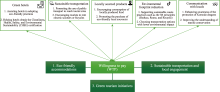
Fig. 1.
Conceptual framework for hypothetical scenarios in green tourism initiatives."
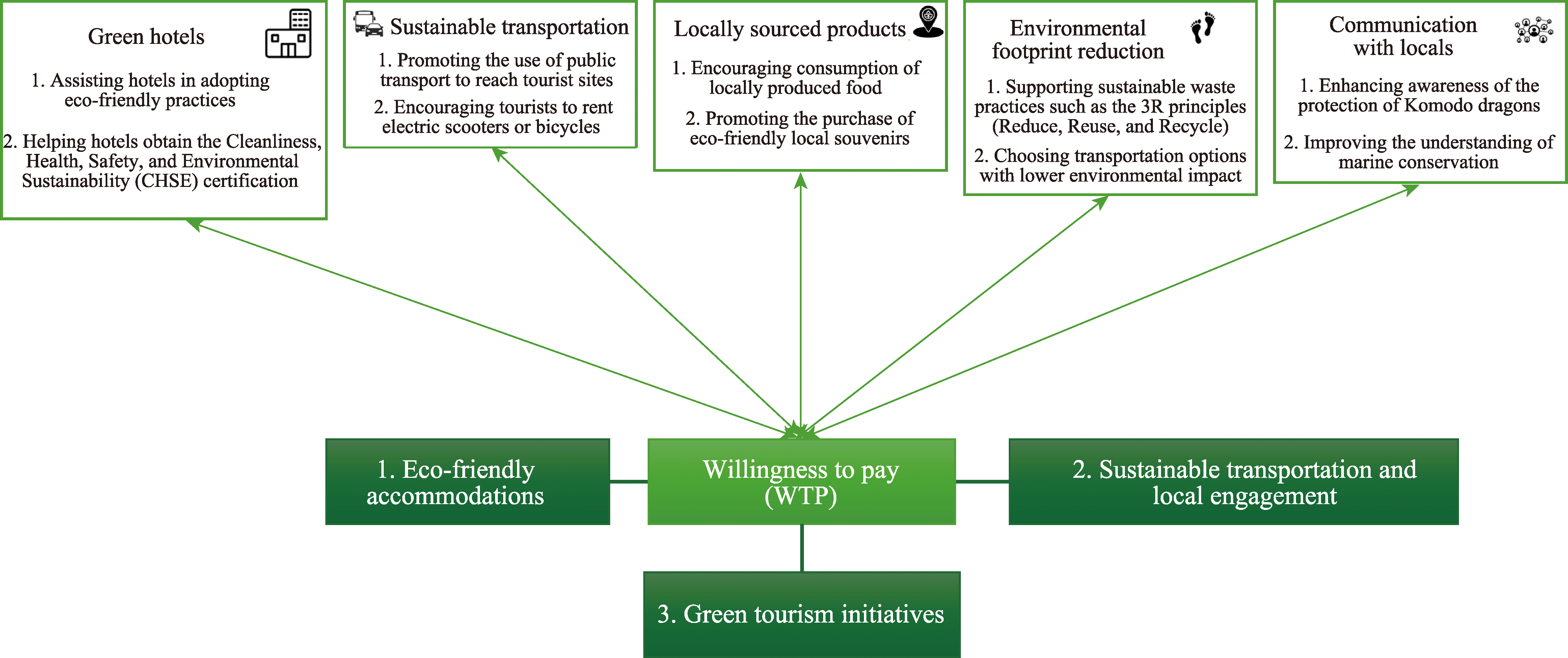
Table 1
Attributes and levels related to green tourism initiatives in Labuan Bajo and Komodo National Park (KNP) case study."
| Attribute | Status quo and different improvement levels | Variable |
|---|---|---|
| Green hotels | Status quo: The implementation of green hotels in Labuan Bajo is not yet comprehensive. | Green hotels 0 |
| Level 1: Hotels receive support to implement eco-friendly programs focusing on energy efficiency, water conservation, and waste recycling. | Green hotels 1 | |
| Level 2: Hotels receive assistance in obtaining the Cleanliness, Health, Safety, and Environment Sustainability (CHSE) certification, demonstrating compliance with sustainable tourism standards. | Green hotels 2 | |
| Sustainable transportation | Status quo: Public transportation access for tourists remains unavailable, forcing reliance on private vehicles. | Sustainable transportation 0 |
| Level 1: Public bus services are introduced to connect visitors with major tourist destinations, reducing private-vehicle use. | Sustainable transportation 1 | |
| Level 2: Electric scooters and bicycles are available for rent to encourage flexible and zero-emission mobility options for tourists. | Sustainable transportation 2 | |
| Locally sourced products | Status quo: National branding and promotion of locally produced goods are still inadequate. | Locally sourced products 0 |
| Level 1: Visitors are encouraged to consume locally produced food to support farmers and minimize food-transport emissions. | Locally sourced products 1 | |
| Level 2: Tourists are encouraged to purchase eco-friendly local souvenirs, thereby supporting artisans and environmentally responsible small businesses. | Locally sourced products 2 | |
| Environmental footprint reduction | Status quo: Opportunities for reducing energy, water, and waste utilities remain limited. | Environmental footprint reduction 0 |
| Level 1: Tourists participate in sustainable waste management programs promoting the 3R principles (Reduce, Reuse, and Recycle). | Environmental footprint reduction 1 | |
| Level 2: Visitors adopt eco-friendly transport modes—walking, cycling, or using electric vehicles—to minimize carbon emissions. | Environmental footprint reduction 2 | |
| Communication with locals | Status quo: Information and education about Komodo dragons and marine ecosystem protection are still inadequate. | Communication with locals 0 |
| Level 1: Tourists participate in programs that increase knowledge and awareness about the protection of Komodo dragons. | Communication with locals 1 | |
| Level 2: Tourists receive educational sessions to improve understanding of marine ecosystem protection and local ecosystem preservation. | Communication with locals 2 | |
| WTP | Status quo: No additional payment is paid (0.000 USD/(person·times)). | WTP |
| Level 1: Tourists are willing to pay 13.160 USD/(person·times) to support green tourism initiatives. | ||
| Level 2: Tourists are willing to pay 19.750 USD/(person·times) to support green tourism initiatives. | ||
| Level 3: Tourists are willing to pay 32.910 USD/(person·times) to support green tourism initiatives. | ||
| Level 4: Tourists are willing to pay 210.620 USD/(person·times) to support green tourism initiatives. |
Table 2
Random parameters logit (RPL) model results for green tourism initiatives."
| Variable | RPL model with WTP interaction | MWTP (USD/(person·times)) | RPL model without WTP interaction |
|---|---|---|---|
| Green hotels 1 | 0.306*** (0.061) | 5.145 | 0.543*** (0.093) |
| Green hotels 2 | -0.185** (0.081) | - | -0.601*** (0.113) |
| Sustainable transportation 1 | 0.329*** (0.068) | 6.154 | 0.670*** (0.108) |
| Sustainable transportation 2 | -0.203** (0.099) | - | -0.613*** (0.152) |
| Locally sourced products 1 | 0.276*** (0.078) | 5.166 | 0.590*** (0.112) |
| Locally sourced products 2 | 0.143* (0.083) | 2.681 | 0.130 (0.118) |
| Environmental footprint reduction 1 | 0.127* (0.070) | 2.382 | 0.262*** (0.098) |
| Environmental footprint reduction 2 | -0.020 (0.075) | - | -0.047 (0.111) |
| Communication with locals 1 | 0.206*** (0.071) | 3.853 | 0.308*** (0.103) |
| Communication with locals 2 | -0.004 (0.076) | - | 0.017 (0.104) |
| WTP | -2.648×10⁻⁵*** (3.384×10⁻⁶) | - | - |
| Log likelihood function | -1802.328 | - | -1882.327 |
| LLR | 350.347 | - | 357.641 |
| McFadden’s pseudo R² | 0.089 | - | 0.129 |
| AIC/N | 2.026 | - | 1.956 |
| Chi square | 38.932 | - | 37.570 |
| Choice sets | 1800 | - | 1800 |
Table 3
Latent class model (LCM) results for green tourism initiatives."
| Variable | Class 1 | Class 2 | MWTP (USD/(person·times)) |
|---|---|---|---|
| Green hotels 1 | 35.318 (5329.700) | 0.264*** (0.074) | 10.405 |
| Green hotels 2 | 57.379 (7670.714) | -0.449*** (0.114) | 17.927 |
| Sustainable transportation 1 | -12.984 (29,023.190) | 0.455*** (0.086) | - |
| Sustainable transportation 2 | -0.530 (44,046.680) | -0.316** (0.124) | 13.982 |
| Locally sourced products 1 | 4.942 (9387.350) | 0.355*** (0.096) | 5.892 |
| Locally sourced products 2 | -4.123 (5872.383) | 0.150* (0.102) | 2.677 |
| Environmental footprint reduction 1 | -15.739 (21,019.750) | 0.163** (0.082) | 6.433 |
| Environmental footprint reduction 2 | 61.483 (12,020.520) | -0.220** (0.108) | - |
| Communication with locals 1 | 63.155 (4332.998) | 0.097 (0.091) | 6.311 |
| Communication with locals 2 | -94.050 (7337.722) | 0.160** (0.098) | - |
| WTP | -2.648×10⁻⁴ (1.001×10⁻²) | -1.671×10⁻⁶*** (4.660×10⁻⁷) | - |
| Log likelihood function | -1698.512 | - | - |
| LLR | 821.648 | - | - |
| McFadden’s pseudo R² | 0.195 | - | - |
| AIC/N | 1.792 | - | - |
| Chi square | 49.588 | - | - |
| Choice sets | 1800 | - | - |
Table 4
Characteristics of tourist segments: visitor preferences for green tourism initiatives."
| Variable | Category | Class 1 | Class 2 | Chi square | df | P-value |
|---|---|---|---|---|---|---|
| Supporting mass tourism practices | No | 20 (3.33%) | 209 (34.83%) | 21.545 | 1 | <0.010 |
| Yes | 88 (14.67%) | 283 (47.17%) | ||||
| Preference for eco-friendly hotels | No | 37 (6.17%) | 165 (27.50%) | 0.021 | 1 | 0.886 |
| Yes | 71 (11.83%) | 327 (54.50%) | ||||
| Concern for environmental issues | No | 79 (13.17%) | 476 (79.33%) | 71.097 | 1 | <0.010 |
| Yes | 29 (4.83%) | 16 (2.67%) | ||||
| Income (USD/month) | <165.000 | 36 (6.00%) | 80 (13.33%) | 48.977 | 4 | <0.010 |
| 165.000-330.000 | 32 (5.33%) | 61 (10.17%) | ||||
| 330.000-660.000 | 16 (2.67%) | 87 (14.50%) | ||||
| 660.000-820.000 | 12 (2.00%) | 130 (21.67%) | ||||
| >820.000 | 12 (2.00%) | 134 (22.33%) | ||||
| Frequent travel (times/a) | 1 | 29 (4.83%) | 112 (18.67%) | 20.470 | 4 | <0.010 |
| 2 | 31 (5.17%) | 129 (21.50%) | ||||
| 3 | 35 (5.83%) | 94 (15.67%) | ||||
| 4 | 6 (1.00%) | 71 (11.83%) | ||||
| >4 | 7 (1.17%) | 86 (14.33%) | ||||
| Education level | High school or below | 64 (10.67%) | 167 (27.83%) | 23.972 | 1 | <0.010 |
| Diploma or above | 44 (7.33%) | 325 (54.17%) | ||||
| Gender | Male | 53 (8.83%) | 250 (41.67%) | 0.107 | 1 | 0.743 |
| Female | 55 (9.17%) | 242 (40.33%) |
Table 5
Hypothetical scenarios for assessing green tourism initiatives."
| Attribute | Scenario 1 (eco-friendly accommodations) | Scenario 2 (sustainable transportation and local engagement) | Scenario 3 (comprehensive green tourism initiatives) |
|---|---|---|---|
| Green hotels | Eco-friendly program | - | Eco-friendly program |
| Sustainable transportation | - | Public bus | Public bus |
| Locally sourced products | Local food | Eco-friendly souvenirs | Local food+eco-friendly souvenirs |
| Environmental footprint reduction | Waste management (3R principles) | - | Waste management (3R principles) |
| Communication with locals | - | Protection of Komodo dragons | Protection of Komodo dragons |
| MWTP (USD/(person·times)) | 23.170 | 22.160 | 45.330 |
| 95.00% confidence interval | 23.1567-23.1577 | 22.1588-22.1596 | 45.3336-45.3341 |
| [1] | Abdou, A.H., Hassan, T.H., El Dief, M.M., 2020. A description of green hotel practices and their role in achieving sustainable development. Sustainability. 12(22), 9624, doi: 10.3390/su12229624. |
| [2] | Abdou, A.H., Hassan, T.H., Salem, A.E., et al., 2022. Determinants and consequences of green investment in the Saudi Arabian hotel industry. Sustainability. 14(24), 16905, doi: 10.3390/su142416905. |
| [3] | Alamatsaz, K., Quesnel, F., Eicker, U., 2024. Enhancing electric shuttle bus efficiency: a case study on timetabling and scheduling optimization. Energies. 17(13), 3149, doi: 10.3390/en17133149. |
| [4] | Ali, Y., Anjum, F., 2024. Decision framework for eco-friendly hospitality: a sustainable future for hotel industry in high-altitude regions. J. Qual. Assur. Hosp. Tour. doi: 10.1080/1528008X.2024.2444537. |
| [5] | Apak, Ö.C., Gürbüz, A., 2023. The effect of local food consumption of domestic tourists on sustainable tourism. J. Retail. Consum. Serv. 71, 103192, doi: 10.1016/j.jretconser.2022.103192. |
| [6] | Ardin, A., 2025. 334,206 Tourists Visited Komodo National Park in 2024, with Foreign Tourists Dominating the Visitor Composition. [2025-01-06]. https://www.detik.com/bali/wisata/d-7719681/334-206-wisatawan-kunjungi-taman-nasional-komodo-pada-2024-wisman-mendominasi (in Indonesian). |
| [7] | Ashraf, S., Ali, S.Z., Khan, T.I., et al., 2024. Fostering sustainable tourism in Pakistan: exploring the influence of environmental leadership on employees’ green behavior. Bus. Strategy Dev. 7(1), e328, doi: 10.1002/bsd2.328. |
| [8] | Astawa, I.K., Widhari, C.I.S., Budarma, I.K., et al., 2022. Green hotel promotion strategy in Bali:a study using SWOT analysis. In: International Conference on Applied Science and Technology on Social Science 2021 (iCAST-SS 2021). Paris: Atlantis Press, 460-466. |
| [9] |
Baloch, Q.B., Shah, S.N., Iqbal, N., et al., 2023. Impact of tourism development upon environmental sustainability: a suggested framework for sustainable ecotourism. Environ. Sci. Pollut. Res. 30, 5917-5930.
doi: 10.1007/s11356-022-22496-w |
| [10] | Basendwah,, M., Amarneh, S., Majid, H.H., et al., 2024. The expectations and motivations of tourists from green destinations. In: Alnoor, A., Bayram, G.E., XinYing, C., (eds.). The Role of Artificial Intelligence in Regenerative Tourism and Green Destinations. Leeds: Emerald Publishing, 207-222. |
| [11] | Batool, N., Wani, M.D., Shah, S.A., et al., 2025. Tourists’ attitude and willingness to pay on conservation efforts: evidence from the west Himalayan eco-tourism sites. Environ. Dev. Sustain. 27, 18933-18951. |
| [12] | Bhat, R.A., Singh, D.V., Qadri, H., et al., 2022. Vulnerability of municipal solid waste: an emerging threat to aquatic ecosystems. Chemosphere. 287, 132223, doi: 10.1016/j.chemosphere.2021.132223. |
| [13] | Bhatia, L., Jha, H., Sarkar, T., et al., 2023. Food waste utilization for reducing carbon footprints towards sustainable and cleaner environment: A review. Int. J. Environ. Res. Public Health. 20(3), 2318, doi: 10.3390/ijerph20032318. |
| [14] |
Bilynets, I., Knezevic Cvelbar, L., Dolnicar, S., 2023. Can publicly visible pro-environmental initiatives improve the organic environmental image of destinations? J. Sustain. Tour. 31(1), 32-46.
doi: 10.1080/09669582.2021.1926469 |
| [15] |
Boto-García, D., Mariel, P., Pino, J.B., et al., 2022. Tourists’ willingness to pay for holiday trip characteristics: a discrete choice experiment. Tour. Econ. 28(2), 349-370.
doi: 10.1177/1354816620959901 |
| [16] | Brotosusilo, A., Nabila, S.H., Negoro, H.A., et al., 2020. The level of individual participation of community in implementing effective solid waste management policies. Glob. J. Environ. Sci. Manag. 6(3), 341-354. |
| [17] | Campos, C., Laso, J., Cristóbal, J., et al., 2022. Towards more sustainable tourism under a carbon footprint approach: The Camino Lebaniego case study. J. Clean Prod. 369, 133222, doi: 10.1016/j.jclepro.2022.133222. |
| [18] | Chakraborty,, P.P., 2024. The role of technology in enhancing sustainable tourism practices:Innovations and impacts. In: Wongmahesak, K., Suanpang, P., (eds.). Special Interest Trends for Sustainable Tourism. Hershey: IGI Global, 195-230. |
| [19] | Chan, J.K.L., Marzuki, K.M., Mohtar, T.M., 2021. Local community participation and responsible tourism practices in ecotourism destination: A case of lower Kinabatangan, Sabah. Sustainability. 13(23), 13302, doi: 10.3390/su132313302. |
| [20] |
Chia-Jung, C., Pei-Chun, C., 2014. Preferences and willingness to pay for green hotel attributes in tourist choice behavior: The case of Taiwan. J. Travel Tour. Mark. 31(8), 937-957.
doi: 10.1080/10548408.2014.895479 |
| [21] |
Damaianti, I., Farradia, Y., Shafi, S., et al., 2023. Sustainable practices in West Java hotels: perspectives from the hotel association, hotel management, and visitors. International Journal of Sustainable Development and Planning. 18(11), 3575-3584.
doi: 10.18280/ijsdp |
| [22] | Das, S.S., Behera, D.D., Nayak, B.B., et al., 2024. Towards sustainable mobility: A framework and strategies for rural transportation sustainability. Journal of Physics: Conference Series. 2818, 12019, doi: 10.1088/1742-6596/2818/1/012019. |
| [23] | Dawane,, V., Yatoo, S.A., Piplode, S., et al., 2023. Importance of climatological contributions in green infrastructure designs, sustainable city planning towards better urban settlement. In: Pathak, B., Dubey, R.S., (eds.). Climate Change and Urban Environment Sustainability. Singapore: Springer, 47-79. |
| [24] | De Matteis, F., Notaristefano, G., Bianchi, P., 2021. Public-private partnership governance for accessible tourism in marine protected areas. Sustainability. 13(15), 8455, doi: 10.3390/su13158455. |
| [25] | Debrah, J.K., Vidal, D.G., Dinis, M.A.P., 2021. Raising awareness on solid waste management through formal education for sustainability: A developing countries evidence review. Recycling. 6(1), 6, doi: 10.3390/recycling6010006. |
| [26] |
Della Lucia, M., Dimanche, F., Giudici, E., et al., 2021. Enhancing tourism education: The contribution of humanistic management. Humanistic Management Journal. 6(3), 429-449.
doi: 10.1007/s41463-021-00111-3 pmid: 40477750 |
| [27] |
Dias, Á., Silva, G.M., Patuleia, M., et al., 2023. Developing sustainable business models: local knowledge acquisition and tourism lifestyle entrepreneurship. J. Sustain. Tour. 31(4), 931-950.
doi: 10.1080/09669582.2020.1835931 |
| [28] | Dolasinski, M.J., Roberts, C., Young, L., 2025. Sustainability, the balanced scorecard, and event tourism: The SBSC-ET model. Sustainability. 17(5), 2174, doi: 10.3390/su17052174. |
| [29] | Duric, Z., Topler, J.P., 2021. The role of performance and environmental sustainability indicators in hotel competitiveness. Sustainability. 13(12), 6574, doi: 10.3390/su13126574. |
| [30] |
Elkhwesky, Z., 2022. A systematic and major review of proactive environmental strategies in hospitality and tourism: looking back for moving forward. Bus. Strateg. Environ. 31(7), 3274-3301.
doi: 10.1002/bse.v31.7 |
| [31] | Elshaer, I., Moustafa, M., Sobaih, A.E., et al., 2021. The impact of women’s empowerment on sustainable tourism development: mediating role of tourism involvement. Tour. Manag. Perspect. 38, 100815, doi: 10.1016/j.tmp.2021.100815. |
| [32] | Farlynda,, T., 2024. Small island sustainability:A comparative analysis of Bali and Palau Islands. In: Monaco, E., Abe, M., (eds.). Sustainable Development Across Pacific Islands. Singapore: Springer, 147-170. |
| [33] | Fatina, S., Soesilo, T.E.B., Tambunan, R.P., 2023. Collaborative integrated sustainable tourism management model using system dynamics: A case of Labuan Bajo, Indonesia. Sustainability. 15(15), 11937, doi: 10.3390/su151511937. |
| [34] | Frías-Jamilena, D.M., Fernández-Ruano, M.L., Polo-Peña, A.I., 2022. Gamified environmental interpretation as a strategy for improving tourist behavior in support of sustainable tourism: The moderating role of psychological distance. Tourism Manage. 91, 104519, doi: 10.1016/j.tourman.2022.104519. |
| [35] |
Galati, A., Thrassou, A., Christofi, M., et al., 2023. Exploring travelers’ willingness to pay for green hotels in the digital era. J. Sustain. Tour. 31(11), 2546-2563.
doi: 10.1080/09669582.2021.2016777 |
| [36] | García-Milon,, A., Juaneda-Ayensa, E., 2024. Local tourist shopping:How purchases in a destination can contribute to sustainability. In: Walker, T., Demir, E., Machnik-Kekesi, G., (eds.). Sustainable Tourism: Frameworks, Practices, and Innovative Solutions. Cham: Springer Verlag, 129-150. |
| [37] |
Gonda, T., Angler, K., Csóka, L., 2021. The role of local products in tourism. Eur. Countrys. 13(1), 91-107.
doi: 10.2478/euco-2021-0006 |
| [38] | Gunduz Songur, A., Turktarhan, G., Cobanoglu, C., 2023. Progress on green technology research in hotels: a literature review. J. Hosp. Tour. Insights. 6(5), 2052-2072. |
| [39] |
Gunter, U., Wöber, K., 2021. Estimating transportation-related CO2 emissions of European city tourism. J. Sustain. Tour. 30(1), 145-168.
doi: 10.1080/09669582.2021.1939708 |
| [40] | Guo, Y., Chai, Y., 2025. Toward green tourism: the role of renewable energy for sustainable development in developing nations. Frontiers in Sustainable Tourism. 4, 1512922, doi: 10.3389/frsut.2025.1512922. |
| [41] | Gurung, B., Thapa, A., 2023. Exploring the impact of community engagement, including mental health, on the efficacy of environmental education and biodiversity conservation: a systematic literature review. Journal of Empirical Social Science Studies. 7(4), 16-50. |
| [42] |
Hakim, I.N., Rosyidi, M.I., Faisyal, F., 2023. The value of CHSE hotel certificates in increasing hotel loyalty among domestic tourists. Journal of Governance and Public Policy. 10(3), 216-233.
doi: 10.18196/jgpp.v10i3.15870 |
| [43] |
He, M., Blye, C.J., Halpenny, E., 2023. Impacts of environmental communication on pro-environmental intentions and behaviours: a systematic review on nature-based tourism context. J. Sustain. Tour. 31(8), 1921-1943.
doi: 10.1080/09669582.2022.2095392 |
| [44] | Ho, C.Y., Tsai, B.H., Chen, C.S., et al., 2021. Exploring green marketing orientations toward sustainability in the hospitality industry in the COVID-19 pandemic. Sustainability. 13(8), 4348, doi: 10.3390/su13084348. |
| [45] | Ijatuyi, E.J., Yessoufou, K., Patrick, H.O., 2025. Sustainable tourism and green space: exploring how green spaces and natural attractions contribute to local tourism economies and revenue generation in Gauteng province. Discov. Sustain. 6, 236, doi: 10.1007/s43621-025-00958-8. |
| [46] | Iqbal, M., Nur, Y., Fahmi, M.R.A., 2025. The ‘clean, health, safety and environment sustainability’ (CHSE) in tourism in the post-COVID-19 era: a shared value perspective in Malang Regency, Indonesia. Cogent Soc. Sci. 11, 2454741, doi: 10.1080/23311886.2025.2454741. |
| [47] | Jarvis, N., Weeden, C., Simcock, N., 2010. The benefits and challenges of sustainable tourism certification: A case study of the Green Tourism Business Scheme in the West of England. J. Hosp. Tour. Manag. 17(1), 83-93. |
| [48] | Jiang, R., Zhang, X.W., 2024. Cross-cultural communication and conflict resolution in tourism. Journal of Social Science Humanities and Literature. 7(4), 6-10. |
| [49] | Juliana,, J., Hubner, I.B., Pramono, R., et al., 2024. CHSE inclusion model concept (cleanliness, health, safety, environment) towards an adaptive tourism destination image. In: Hamdan, A., (eds.). Achieving Sustainable Business through AI, Technology Education and Computer Science. Cham: Springer Nature, 179-190. |
| [50] | Kanwal,, N., Meng, C.S., Watabe, M., et al., 2024. Carbon footprint of tourism activities including transportation, accommodation, and infrastructure:A critical analysis. In: Singh, P., Daga, S., Yadav, K., (eds.). The Need for Sustainable Tourism in an Era of Global Climate Change: Pathway to a Greener Future. Leeds: Emerald Publishing, 95-120. |
| [51] |
Kasavan, S., Siron, R., Yusoff, S., et al., 2022. Drivers of food waste generation and best practice towards sustainable food waste management in the hotel sector: a systematic review. Environ. Sci. Pollut. Res. 29(32), 48152-48167.
doi: 10.1007/s11356-022-19984-4 |
| [52] |
Khater, M., Ibrahim, O., Sayed, M.N.E., et al., 2024. Legal frameworks for sustainable tourism: balancing environmental conservation and economic development. Curr. Issues Tour. 28(22), 3693-3714.
doi: 10.1080/13683500.2024.2404181 |
| [53] | Kurniawan, T.A., Meidiana, C., Othman, M.H.D., et al., 2023. Strengthening waste recycling industry in Malang (Indonesia): lessons from waste management in the era of Industry 4.0. J. Clean Prod. 382, 135296, doi: 10.1016/j.jclepro.2022.135296. |
| [54] |
Le, T.H., Nguyen, C.P., 2021. The impact of tourism on carbon dioxide emissions: insights from 95 countries. Appl. Econ. 53(2), 235-261.
doi: 10.1080/00036846.2020.1804051 |
| [55] |
Li, J.W., Coca-Stefaniak, J.A., Nguyen, T.H.H., et al., 2024. Sustainable tourist behavior: A systematic literature review and research agenda. Sustain. Dev. 32(4), 3356-3374.
doi: 10.1002/sd.v32.4 |
| [56] |
Li, Q.C., Wu, M.Y., 2020. Tourists’ pro-environmental behaviour in travel destinations: benchmarking the power of social interaction and individual attitude. J. Sustain. Tour. 28(9), 1371-1389.
doi: 10.1080/09669582.2020.1737091 |
| [57] | Li, Y.X., Yao, Z.L., Guo, Z.F., 2023. Willingness to pay and preferences for rural tourism attributes among urban residents: A discrete choice experiment in China. Econ. Anal. Policy. 77, 460-471. |
| [58] | Longo, M., Leone, C., Foiadelli, F., 2021. Future mobility and environmental sustainability: A preliminary study on electric scooters. In: Mansouri, S.A., Nematbakhsh, E., Javadi, M.S., (eds.). 2021 IEEE International Conference on Environment and Electrical Engineering and 2021 IEEE Industrial and Commercial Power Systems Europe. Bari: EEEIC, 1-6. |
| [59] | Lu, C.W., Huang, J.C., Chen, C., et al., 2021. An energy-efficient smart city for sustainable green tourism industry. Sustain. Energy Technol. Assess. 47, 101494, doi: 10.1016/j.seta.2021.101494. |
| [60] |
Luo, Z.R., Yun, L.Y., 2023. Investigating risks and strategies in adopting green tourism practices in developing economy. Environ. Sci. Pollut. Res. 30, 123710-123728.
doi: 10.1007/s11356-023-30700-8 |
| [61] |
Luu, T.T., 2021. Green creative behavior in the tourism industry: the role of green entrepreneurial orientation and a dual-mediation mechanism. J. Sustain. Tour. 29(8), 1290-1318.
doi: 10.1080/09669582.2020.1834565 |
| [62] | Mahmood, S., Misra, P., Sun, H.P., et al., 2024. Sustainable infrastructure, energy projects, and economic growth: mediating role of sustainable supply chain management. Ann. Oper. Res. doi: 10.1007/s10479-023-05777-6. |
| [63] | Markose, N., Vazhakkatte Tazhathethil, B., George, B., 2022. Sustainability initiatives for green tourism development: the case of Wayanad, India. J. Risk Financ. Manag. 15(2), 52, doi: 10.3390/jrfm15020052. |
| [64] | Mihai,, F.C., Gündoğdu, S., Khan, F.R., et al., 2022. Plastic pollution in marine and freshwater environments:abundance, sources, and mitigation. In: Sarma, H., Dominguez, D.C., Lee, W.Y., (eds.). Emerging Contaminants in the Environment. Amsterdam: Elsevier, 241-274. |
| [65] | Ministry of Tourism Republic of Indonesia, 2023. 5 Ways to Travel Responsibly and Support Green Tourism. [2024-12-31]. https://www.indonesia.travel/en/US/travel-ideas/5-way-s-to-travel-responsibly-and-support-green-tourism. |
| [66] |
Mofid-Nakhaee, E., Barzinpour, F., Pishvaee, M.S., 2020. A sustainable municipal solid waste system design considering public awareness and education: A case study. Waste Manage. Res. 38(6), 626-638.
doi: 10.1177/0734242X20910206 pmid: 32167030 |
| [67] |
Muangasame, K., McKercher, R.D., 2015. The challenge of implementing sustainable tourism policy: a 360-degree assessment of Thailand’s “7 Greens sustainable tourism policy”. J. Sustain. Tour. 23(4), 497-516.
doi: 10.1080/09669582.2014.978789 |
| [68] | Mun Ng, K., Wah Yuen, C., Chuen Onn, C., et al., 2024. Urban mobility mode shift to active transport: sociodemographic dependency and potential greenhouse gas emission reduction. SAGE Open. 14(1), 1-21. |
| [69] |
Murtaza, S.H., Khan, A., Mustafa, S.M., 2024. Eco-centric success: stakeholder approaches to sustainable performance via green improvisation behavior and environmental orientation in the hotel industry. Bus. Strateg. Environ. 33(7), 7273-7286.
doi: 10.1002/bse.v33.7 |
| [70] | Musa, F., Nadarajah, R., 2023. Valuing visitors’ willingness to pay for green tourism conservation: A case study of Bukit Larut forest recreation area, Perak, Malaysia. Sustain. Environ. 9, 2188767, doi: 10.1080/27658511.2023.2188767. |
| [71] |
Nainggolan, H.L., Tamba, O., Sihotang, D., et al., 2022. Souvenir traders and their impact on cultural tourism and economic development. Jurnal Ilmu Pendidikan dan Humaniora. 11(3), 188-205.
doi: 10.35335/jiph.v11i3 |
| [72] | Nelson, K.M., Partelow, S., Stäbler, M., et al., 2021. Tourist willingness to pay for local green hotel certification. PLoS One. 16(2), e0245953, doi: 10.1371/journal.pone.0245953. |
| [73] | Obaid, M., Torok, A., Ortega, J., 2021. A comprehensive emissions model combining autonomous vehicles with park-and-ride and electric vehicle transportation policies. Sustainability. 13(9), 4653, doi: 10.3390/su13094653. |
| [74] | Obersteiner, G., Gollnow, S., Eriksson, M., 2021. Carbon footprint reduction potential of waste management strategies in tourism. Environ. Dev. 39, 100617, doi: 10.1016/j.envdev.2021.100617. |
| [75] | Olszewski-Strzyżowski, D.J., 2022. Promotional activities of selected National Tourism Organizations (NTOs) in the light of sustainable tourism (including sustainable transport). Sustainability. 14(5), 2561, doi: 10.3390/su14052561. |
| [76] | Pearson, N., Thompson, B.S., 2023. Saving two fish with one wreck: maximizing synergies in marine biodiversity conservation and underwater cultural heritage protection. Mar. Pol. 152, 105613, doi: 10.1016/j.marpol.2023.105613. |
| [77] | Rahman, A., Sofiyah, E.S., Sianipar, I.M.J., et al., 2025. Evaluating tourist importance-performance and support for development in Komodo National Park. Environmental Challenges. 20, 101229, doi: 10.1016/j.envc.2025.101229. |
| [78] | Rahman, I., Chen, H., Bernard, S., 2023. The incidence of environmental status signaling on three hospitality and tourism green products: A scenario-based quasi-experimental analysis. Tour. Manag. Perspect. 46, 101076, doi: 10.1016/j.tmp.2023.101076. |
| [79] | Rahman, M.H., Tanchangya, T., Rahman, J., et al., 2024. Corporate social responsibility and green financing behavior in Bangladesh: Towards sustainable tourism. Innovation and Green Development. 3(3), 100133, doi: 10.1016/j.igd.2024.100133. |
| [80] | Roblek, V., Drpić, D., Meško, M., et al., 2021. Evolution of sustainable tourism concepts. Sustainability. 13(22), 12829, doi: 10.3390/su132212829. |
| [81] | Ruhanen, L., Bowles, L., 2020. Student perspectives of responsible tourism behaviour: The role of tourism education. J. Hosp. Tour. Educ. 32(4), 255-265. |
| [82] |
Sakshi, S., Cerchione, R., Bansal, H., 2020. Measuring the impact of sustainability policy and practices in tourism and hospitality industry. Bus. Strateg. Environ. 29(3), 1109-1126.
doi: 10.1002/bse.v29.3 |
| [83] | Salehi, M., Filimonau, V., Ghaderi, Z., et al., 2021. Energy conservation in large-sized hotels: insights from a developing country. Int. J. Hosp. Manag. 99, 103061, doi: 10.1016/j.ijhm.2021.103061. |
| [84] |
Schuhmann, P.W., Bangwayo-Skeete, P., Skeete, R., et al., 2024. Visitors’ willingness to pay for ecosystem conservation in Grenada. J. Sustain. Tour. 32(8), 1644-1668.
doi: 10.1080/09669582.2023.2259119 |
| [85] | Shah, K.J., Pan, S.Y., Lee, I., et al., 2021. Green transportation for sustainability: Review of current barriers, strategies, and innovative technologies. J. Clean Prod. 326, 129392, doi: 10.1016/j.jclepro.2021.129392. |
| [86] | Sianipar, I.M.J., Lee, C.H., Wang, H.J., et al., 2024a. Determinant of importance-performance and willingness to participate in Komodo adaptive conservation programs. J. Nat. Conserv. 81, 126697, doi: 10.1016/j.jnc.2024.126697. |
| [87] |
Sianipar, I.M.J., Lee, C.H., Wang, H.J., et al., 2024b. Unraveling factors influencing local willingness to participate in sustainable Komodo conservation and protected area tourism. For. Soc. 8(2), 350-371.
doi: 10.1177/003803857400800234 |
| [88] | Sofiyah, E.S., Sianipar, I.M.J., Rahman, A., et al., 2025. A scenario analysis for community-based sanitation planning in Labuan Bajo, a tourism hub in Indonesia. Socio-Ecological Practice Research. 7, 193-212. |
| [89] |
Stein, A.J., Santini, F., 2022. The sustainability of “local” food: a review for policy-makers. Review of Agricultural, Food and Environmental Studies. 103(1), 77-89.
doi: 10.1007/s41130-021-00148-w |
| [90] |
Sun, L.X., Yu, X., Li, B.S., et al., 2020. Coupling analysis of the major impact on sustainable development of the typical arid region of Turpan in Northwest China. Reg. Sustain. 1(1), 48-58.
doi: 10.1016/j.regsus.2020.08.002 |
| [91] | Sun, Y.Y., Faturay, F., Lenzen, M., et al., 2024. Drivers of global tourism carbon emissions. Nat. Commun. 15(1), 10384, doi: 10.1038/s41467-024-54582-7. |
| [92] | Suryawan, I.W.K., Rahman, A., Suhardono, S., et al., 2025a. Evaluating tourist preferences influences on renewable energy initiatives in coastal tourism settings. Reg. Stud. Mar. Sci. 85, 104148, doi: 10.1016/j.rsma.2025.104148. |
| [93] | Suryawan, I.W.K., Rahman, A., Suhardono, S., et al., 2025b. Visitor willingness to pay for decarbonizing tourism: supporting a net-zero transition in Nusa Penida, Indonesia. Energy Sustain Dev. 85, 101628, doi: 10.1016/j.esd.2024.101628. |
| [94] | Suryawan, I.W.K., Sianipar, I.M.J., Lee, C.H., 2025c. Community importance-performance preferences and policy adaptiveness in marine debris management: a case study from the Komodo Subdistrict, Indonesia. Mar. Pol. 174, 106592, doi: 10.1016/j.marpol.2025.106592. |
| [95] |
Susilo, D., Santos, M.C.K., 2023. Digital marketing communication for promoting Philippines tourism. International Journal of Research and Review. 10(6), 209-220.
doi: 10.52403/ijrr |
| [96] |
Tabaeeian, R.A., Yazdi, A., Mokhtari, N., et al., 2023. Host-tourist interaction, revisit intention and memorable tourism experience through relationship quality and perceived service quality in ecotourism. J. Ecotourism. 22(3), 406-429.
doi: 10.1080/14724049.2022.2046759 |
| [97] | Tepliuk, M., Sahaidak, M., Petrishyna, T., et al., 2023. Managing of responsible consumption and sustainable production enterprises in the glocalization conditions. Acta Innovations. 48, 75-91. |
| [98] | Tomasi, S., Paviotti, G., Cavicchi, A., 2020. Educational tourism and local development: the role of universities. Sustainability. 12(17), 6766, doi: 10.3390/su12176766. |
| [99] | Tussadiah, A., Sujiwo, A.S., Andesta, I., et al., 2021. Assessment of coastal ecosystem services and its condition for policy management plan in East Nusa Tenggara, Indonesia. Reg. Stud. Mar. Sci. 47, 101941, doi: 10.1016/j.rsma.2021.101941. |
| [100] | Vargas, A.M., de Moura, A.P., Deliza, R., et al., 2021. The role of local seasonal foods in enhancing sustainable food consumption: A systematic literature review. Foods. 10(9), 2206, doi: 10.3390/foods10092206. |
| [101] | Wang, K.C.M., Lee, K.E., Mokhtar, M., 2021. Solid waste management in small tourism islands: an evolutionary governance approach. Sustainability. 13(11), 5896, doi: 10.3390/su13115896. |
| [102] | Wisnumurti, A.A.G.O., Candranegara, I.M.W., Suryawan, D.K., et al., 2020. Collaborative governance:Synergy among local government, higher education, and community in empowerment of communities and management of potential tourism village. In: Proceedings of the 2nd Annual International Conference on Business and Public Administration. Pairs: Atlantis Press, 112-115. |
| [103] | Wu, J., Wang, S., Liu, Y.L., et al., 2023. Measurement of tourism-related CO2 emission and the factors influencing low-carbon behavior of tourists: Evidence from protected areas in China. Int. J. Environ. Res. Public Health. 20(2), 1277, doi: 10.3390/ijerph20021277. |
| [104] | Yang, B.C., Lee, C.H., Suryawan, I.W.K., 2025. Resilient socio-technical systems for adaptive consumer e-waste management. Sust. Cities Soc. 118, 106026, doi: 10.1016/j.scs.2024.106026. |
| [105] | Yang, S.Y., Hao, Q., Wang, Y.C., et al., 2022. Impact of the participation of the tourism sector on carbon emission reduction in the tourism industry. Sustainability. 14(23), 15570, doi: 10.3390/su142315570. |
| [106] | Yasir, Y., Firzal, Y., Sulistyani, A., et al., 2021. Penta helix communication model through community-based tourism for tourism village development in Koto Sentajo, Riau, Indonesia. Geo Journal of Tourism and Geosites. 37(3), 851-860. |
| [107] | Yousaf, Z., Radulescu, M., Sinisi, C.I., et al., 2021. Harmonization of green motives and green business strategies towards sustainable development of hospitality and tourism industry: Green environmental policies. Sustainability. 13(12), 6592, doi: 10.3390/su13126592. |
| [108] | Zanon, J., Teichmann, K., 2016. The role of message strategies in promoting eco-friendly accommodations. Int. J. Cult. Tour. Hosp. Res. 10(4), 410-423. |
| [109] | Zhao, W.Y., Chan, C.S., 2023. What interpretation service are cultural tourists willing to pay for? A choice-experiment approach for cultural heritage sites in China. Tour. Manag. Perspect. 46, 101091, doi: 10.1016/j.tmp.2023.101091. |
| [110] | Zientara, P., Jażdżewska-Gutta, M., Bąk, M., et al., 2024. What drives tourists’ sustainable mobility at city destinations? Insights from ten European capital cities. J. Destin. Mark. Manag. 33, 100931, doi: 10.1016/j.jdmm.2024.100931. |
| [1] | Abdul MALIK, Muhammad Ichsan ALI, Abdul Rasyid JALIL, Abdul MANNAN, Rahma MUSYAWARAH. Promoting sustainable mangrove tourism through payments for ecosystem services: Insights from Tongke-Tongke Village, South Sulawesi, Indonesia [J]. Regional Sustainability, 2025, 6(2): 100213-. |
| Viewed | ||||||
|
Full text |
|
|||||
|
Abstract |
|
|||||
 REGSUS Wechat
 新公网安备 65010402001202号