
Regional Sustainability ›› 2026, Vol. 7 ›› Issue (3): 100349.doi: 10.1016/j.regsus.2026.100349
• Research article • Previous Articles Next Articles
DU Mengbinga, ZHANG Caijinga, QIU Ningb, ZHANG Zhec, LI Wenb, SHAN Wanyued, ZHANG Lie,*( )
)
Received:2025-03-26
Revised:2026-01-05
Accepted:2026-04-30
Published:2026-06-30
Online:2026-05-22
Contact:
*E-mail address: zhangli_1122@outlook.com (ZHANG Li).
About author:The first three authors contributed equally to this work.
DU Mengbing, ZHANG Caijing, QIU Ning, ZHANG Zhe, LI Wen, SHAN Wanyue, ZHANG Li. Broadband China Policy can alleviate city-level carbon inequality in China[J]. Regional Sustainability, 2026, 7(3): 100349.

Table 1
Descriptive statistics of variables used in this study."
| Category | Variable | Measurement | n | Mean | Standard deviation |
|---|---|---|---|---|---|
| Dependent variable | CI | Carbon inequality | 5706 | 0.0014 | 0.0015 |
| Independent variable | BCP | Whether the city is a BCP pilot city in the corresponding year: 1=yes; 0=no | 5706 | 0.1521 | 0.3592 |
| Control variable | GDP | Real GDP per capita (10,000 CNY/capita) | 5706 | 3.6324 | 2.6015 |
| FE | The ratio of local general public budget revenue to GDP | 5706 | 0.2842 | 0.2284 | |
| PD | The ratio of permanent population to built-up area (10,000 persons/km2) | 5706 | 5.0676 | 3.3930 | |
| BA | The ratio of internet broadband access users to permanent population | 5706 | 0.1508 | 0.0942 | |
| MPP | The ratio of mobile phone users to permanent population | 5706 | 0.9559 | 0.3734 | |
| Mediating variable | ISU | The ratio of the tertiary industry output to the secondary industry output | 5706 | 1.0416 | 0.6493 |
| TIL | The number of patents per 10,000 people (patents/10,000 persons) | 4592 | 9.3906 | 17.6442 |
Table 2
Estimated impact of the BCP on CI without and with control variables."
| Variable | lnCI (without control variables) | lnCI (with control variables) |
|---|---|---|
| BCP | -0.068*** (0.0090) | -0.072*** (0.0100) |
| Constant term | -6.685*** (0.0030) | -6.685*** (0.0030) |
| Year fixed effect | Yes | Yes |
| City fixed effect | Yes | Yes |
| Adjusted R2 | 0.861 | 0.864 |
| n | 5706 | 5706 |
Table 3
Impact of the BCP on ISU and TIL."
| Variable | ISU | TIL |
|---|---|---|
| BCP | 0.056*** (0.0150) | 3.514*** (0.5760) |
| Constant term | 1.027*** (0.0040) | 8.897*** (0.1400) |
| Control variables | Yes | Yes |
| Year fixed effect | Yes | Yes |
| City fixed effect | Yes | Yes |
| Adjusted R2 | 0.750 | 0.823 |
| n | 5706 | 4592 |
Table 4
Heterogeneity analysis of the BCP’s impact on city-level CI in the eastern and non-eastern regions."
| Variable | Eastern region | Non-eastern region |
|---|---|---|
| BCP | -0.052*** (0.0150) | -0.085*** (0.0130) |
| Constant term | -6.796*** (0.0040) | -6.641*** (0.0030) |
| Control variables | Yes | Yes |
| Year fixed effect | Yes | Yes |
| City fixed effect | Yes | Yes |
| Adjusted R2 | 0.761 | 0.885 |
| n | 1584 | 4122 |
Table 5
Regional mechanism heterogeneity of the BCP’s impact on city-level CI in the eastern and non-eastern regions."
| Variable | ISU | TIL | ||
|---|---|---|---|---|
| Eastern region | Non-eastern region | Eastern region | Non-eastern region | |
| BCP | 0.172*** (0.0230) | 0.014 (0.0180) | 1.933 (1.4230) | 3.700*** (0.3930) |
| Constant term | 1.029*** (0.0070) | 1.025*** (0.0050) | 18.788*** (0.3580) | 4.675*** (0.0810) |
| Control variables | Yes | Yes | Yes | Yes |
| Year fixed effect | Yes | Yes | Yes | Yes |
| City fixed effect | Yes | Yes | Yes | Yes |
| Adjusted R2 | 0.899 | 0.777 | 0.857 | 0.759 |
| Observations | 1548 | 4104 | 1392 | 3200 |
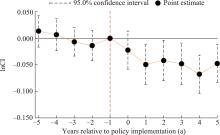
Fig. 1.
Parallel trend test and dynamic effects of the impact of the Broadband China Policy (BCP) on carbon inequality (CI). lnCI, carbon inequality in logarithmic form. The graph shows the results of the parallel trend test with lnCI as the explained variable. The confidence interval is at 95.0%. Bar indicates standard deviation. The red dashed line represents the control group selected for the period prior to the implementation of the BCP, with positive years representing the period after policy implementation and negative years representing the period before policy implementation."
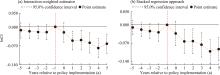
Fig. 2.
Heterogeneous robust estimator test based on interaction-weighted estimator (a) and stacked regression approach (b). The graph shows the results of the parallel trend test with lnCI as the explained variable. The confidence interval is at 95.0%. Bar indicates standard deviation. The red dashed line represents the control group selected for the period prior to the BCP policy implementation, with positive years representing the period after policy implementation and negative years representing the period before policy implementation."
Table 6
Alternative samples excluding provincial-level municipalities and winsorization at the 99th and 1st percentiles."
| Variable | lnCI in cities (excluding provincial-level municipalities) | lnCI (winsorized at the 99th and 1st percentiles) |
|---|---|---|
| BCP | -0.071*** (0.0100) | -0.070*** (0.0100) |
| Constant term | -6.683*** (0.0030) | -6.688*** (0.0030) |
| Control variables | Yes | Yes |
| Year fixed effect | Yes | Yes |
| City fixed effect | Yes | Yes |
| Adjusted R2 | 0.874 | 0.872 |
| n | 5634 | 5706 |
Table 7
Estimated impact of the BCP on city-level CI based on propensity score matching in difference-in-differences (PSM-DID) model."
| Variable | lnCI (without control variables) | lnCI (with control variables) |
|---|---|---|
| BCP | -0.071*** (0.0090) | -0.071*** (0.0100) |
| Constant term | -6.687*** (0.0030) | -6.687*** (0.0030) |
| Year fixed effect | Yes | Yes |
| City fixed effect | Yes | Yes |
| Adjusted R2 | 0.867 | 0.872 |
| n | 5637 | 5637 |
Table 8
Estimated impact of the BCP on CI by controlling for other policy effects."
| Variable | lnCI (controlling for the LCCP policy) | lnCI (controlling for the ECP policy) | lnCI (controlling for the BDCP policy) |
|---|---|---|---|
| BCP | -0.073*** (0.0100) | -0.064*** (0.0100) | -0.072*** (0.0100) |
| LCCP | -0.042*** (0.0100) | ||
| ECP | -0.041*** (0.0100) | ||
| BDCP | -0.010 (0.0090) | ||
| Constant term | -6.675*** (0.0030) | -6.681*** (0.0030) | -6.684*** (0.0030) |
| Control variables | Yes | Yes | Yes |
| Year fixed effect | Yes | Yes | Yes |
| City fixed effect | Yes | Yes | Yes |
| Adjusted R2 | 0.875 | 0.874 | 0.874 |
| n | 5706 | 5706 | 5706 |
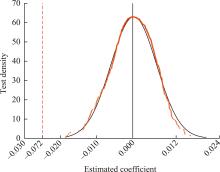
Fig. 3.
Distribution of estimates in the placebo test. The orange dots indicate the coefficients obtained from the placebo test, the black curve shows the corresponding normal distribution, and the vertical red dashed line corresponds to the estimated coefficient from the baseline regression."

Table 9
Instrumental variable (IV) estimation for the causal relationship between BCP and CI."
| Variable | First stage of the IV estimation | Second stage of the IV estimation |
|---|---|---|
| IV_Tel | 0.0018*** (0.0002) | |
| BCP | -0.290*** (0.1030) | |
| Control variables | Yes | Yes |
| Year fixed effect | Yes | Yes |
| City fixed effect | Yes | Yes |
| n | 4014 | 4014 |
| Kleibergen-Paap rank Lagrange Multiplier statistic | 35.320*** | |
| Kleibergen-Paap rank Wald F statistic | 52.239 | |
| Critical value at the 10.0% level in the Stock-Yogo weak identification test | 16.380 | |
| [1] | Asongu, S.A., 2018. ICT, openness and CO2 emissions in Africa. Environmental Science and Pollution Research. 25(10), 9351-9359. |
| [2] | Baron, R.M., Kenny, D.A., 1986. The moderator-mediator variable distinction in social psychological research: Conceptual, strategic, and statistical considerations. Journal of Personality and Social Psychology. 51(6), 1173-1182. |
| [3] | Beck, T., Levine, R., Levkov, A., 2010. Big bad banks? The winners and losers from bank deregulation in the United States. The Journal of Finance. 65(5), 1637-1667. |
| [4] | Cai, B.F., Liang, S., Zhou, J., et al., 2018. China high resolution emission database (CHRED) with point emission sources, gridded emission data, and supplementary socioeconomic data. Resources, Conservation and Recycling. 129, 232-239. |
| [5] | Cengiz, D., Dube, A., Lindner, A., et al., 2019. The effect of minimum wages on low-wage jobs. The Quarterly Journal of Economics. 134(3), 1405-1454. |
| [6] | Chancel, L., 2022. Global carbon inequality over 1990-2019. Nature Sustainability. 5(11), 931-938. |
| [7] | Chang, H., Ding, Q.Y., Zhao, W.Z., et al., 2023. The digital economy, industrial structure upgrading, and carbon emission intensity—empirical evidence from China’s provinces. Energy Strategy Reviews. 50, 101218, doi: 10.1016/j.esr.2023.101218. |
| [8] | Che, S., Wen, L., Wang, J., 2024. Global insights on the impact of digital infrastructure on carbon emissions: a multidimensional analysis. Journal of Environmental Management. 368, 122144, doi: 10.1016/j.jenvman.2024.122144. |
| [9] | Chen, J., Xu, C., Wang, Y.Z., et al., 2021. Carbon neutrality based on vegetation carbon sequestration for China’s cities and counties: Trend, inequality and driver. Resources Policy. 74, 102403, doi: 10.1016/j.resourpol.2021.102403. |
| [10] | Chen, L., Xu, L.Y., Yang, Z.F., 2019. Inequality of industrial carbon emissions of the urban agglomeration and its peripheral cities: A case in the Pearl River Delta, China. Renewable and Sustainable Energy Reviews. 109, 438-447. |
| [11] | Chen, Y., Fan, Z.Y., Fu, X.M., et al., 2020. Arrival of young talent: The send-down movement and rural education in China. American Economic Review. 110(11), 3393-3430. |
| [12] | Chen, Y., Jiang, C.L., Peng, L., et al., 2025. Digital infrastructure construction and urban industrial chain resilience: Evidence from the “Broadband China” strategy. Sustainable Cities and Society. 121, 106228, doi: 10.1016/j.scs.2025.106228. |
| [13] | Chen, Z.A., Xing, R.K., 2025. Digital economy, green innovation and high-quality economic development. International Review of Economics & Finance. 99, 104029, doi: 10.1016/j.iref.2025.104029. |
| [14] | Cheng, Y., Zheng, D., 2023. Does the digital economy promote coordinated urban-rural development? Evidence from China. Sustainability. 15(6), 5460, doi: 10.3390/su15065460. |
| [15] | Clarke-Sather, A., Qu, J.S., Wang, Q., et al., 2011. Carbon inequality at the sub-national scale: A case study of provincial-level inequality in CO2 emissions in China 1997-2007. Energy Policy. 39(9), 5420-5428. |
| [16] | Du, M.B., Zhang, X.L., 2020. Urban greening: A new paradox of economic or social sustainability? Land Use Policy. 92, 104487, doi: 10.1016/j.landusepol.2020.104487. |
| [17] | Du, M.B., He, L., Zhao, M.X., et al., 2022a. Examining the relations of income inequality and carbon productivity: A panel data analysis. Sustainable Production and Consumption. 31, 249-262. |
| [18] | Du, M.B., Zhang, X.L., Xia, L., et al., 2022b. The China Carbon Watch (CCW) system: A rapid accounting of household carbon emissions in China at the provincial level. Renewable and Sustainable Energy Reviews. 155, 111825, doi: 10.1016/J.RSER.2021.111825. |
| [19] | Evans, G., Phelan, L., 2016. Transition to a post-carbon society: Linking environmental justice and just transition discourses. Energy Policy. 99, 329-339. |
| [20] | Gao, X., Chen, X., Liu, L.C., 2024. Exploring the determinants of the evolution of urban and rural household carbon footprints inequality in China. Energy Policy. 185, 113955, doi: 10.1016/j.enpol.2023.113955. |
| [21] | Han, M.Y., Lao, J.M., Yao, Q.H., et al., 2020. Carbon inequality and economic development across the Belt and Road regions. Journal of Environmental Management. 262, 110250, doi: 10.1016/j.jenvman.2020.110250. |
| [22] | Hao, X.L., Li, Y.H., Ren, S.Y., et al., 2023. The role of digitalization on green economic growth: Does industrial structure optimization and green innovation matter? Journal of Environmental Management. 325, 116504, doi: 10.1016/j.jenvman.2022.116504. |
| [23] | Huang, Y.Z., Shigetomi, Y., Matsumoto, K., 2022. Evaluating carbon inequality by household type and income level across prefectures in Japan. Sustainable Cities and Society. 87, 104236, doi: 10.1016/j.scs.2022.104236. |
| [24] | Huang, Z., Tang, L., Chen, Z., et al., 2025. Can the digital economy really narrow the innovation efficiency gap among cities in China?—A study from the perspective of triple networks. Sustainability. 17(9), 4058, doi: 10.3390/su17094058. |
| [25] | Judd, C.M., Kenny, D.A., 2010. Data analysis in social psychology:Recent and recurring issues. In: Fiske, S.T., Gilbert, D.T., Lindzey, G., (eds.). Handbook of Social Psychology. Hoboken: John Wiley & Sons, 115-139. |
| [26] | Kuang, Y.M., Fan, Y.J., Bin, J., et al., 2024. Impact of the digital economy on carbon dioxide emissions in resource-based cities. Scientific Reports. 14(1), 16514, doi: 10.1038/s41598-024-66005-0. |
| [27] | Lee, S., Nam, Y., Lee, S., et al., 2016. Determinants of ICT innovations: A cross-country empirical study. Technological Forecasting and Social Change. 110, 71-77. |
| [28] | Li, B., Liu, J., Liu, Q., et al., 2022a. The effects of broadband infrastructure on carbon emission efficiency of resource-based cities in China: a quasi-natural experiment from the “Broadband China” pilot policy. International Journal of Environmental Research and Public Health. 19(11), 6734, doi: 10.3390/ijerph19116734. |
| [29] | Li, G.X., Zhang, R., Feng, S.L., et al., 2022b. Digital finance and sustainable development: Evidence from environmental inequality in China. Business Strategy and the Environment. 31(7), 3574-3594. |
| [30] | Li, G.X., Wen, H., Sun, Q., et al., 2025. The role of the digital economy in promoting energy justice: Evidence from procedural justice and restorative justice. China Economic Review. 89, 102334, doi: 10.1016/j.chieco.2024.102334. |
| [31] | Li, Z., Zhou, Q., 2021. Research on the spatial effect and threshold effect of industrial structure upgrading on carbon emissions in China. Journal of Water and Climate Change. 12(8), 3886-3898. |
| [32] | Liao, T.F., 2022. Individual components of three inequality measures for analyzing shapes of inequality. Sociological Methods & Research. 51(3), 1325-1356. |
| [33] | Liu, G., Zhang, F., 2022. China’s carbon inequality of households: perspectives of the aging society and urban-rural gaps. Resources, Conservation and Recycling. 185, 106449, doi: 10.1016/j.resconrec.2022.106449. |
| [34] | Liu, Y.W., Liu, K.S., Zhang, X.L., et al., 2024. Does digital infrastructure improve public Health? A quasi-natural experiment based on China’s Broadband policy. Social Science & Medicine. 344, 116624, doi: 10.1016/j.socscimed.2024.116624. |
| [35] | Lv, L.J., Chen, Y., 2024. The collision of digital and green: Digital transformation and green economic efficiency. Journal of Environmental Management. 351, 119906, doi: 10.1016/j.jenvman.2023.119906. |
| [36] | Mi, Z.F., Zheng, J.L., Meng, J., et al., 2020. Economic development and converging household carbon footprints in China. Nature Sustainability. 3(7), 529-537. |
| [37] | Miao, Y.M., Li, Y.K., Wu, Y.R., 2024. Digital economy and economic competitive pressure on local governments: Evidence from China. Economic Modelling. 140, 106859, doi: 10.1016/j.econmod.2024.106859. |
| [38] | Mussard, S., Seyte, F., Terraza, M., 2003. Decomposition of Gini and the generalized entropy inequality measures. Economics Bulletin. 4(3), 1-5. |
| [39] | National Bureau of Statistics of China, 2006-2023a. China Statistical Yearbook. Beijing: China Statistics Press (in Chinese). |
| [40] | National Bureau of Statistics of China, 2006-2023b. China City Statistical Yearbook. Beijing: China Statistics Press (in Chinese). |
| [41] | Ramlogan, A., Nelson, A., 2024. Assessing the influence of fiscal and monetary policies on carbon dioxide emissions. Latin American Journal of Central Banking. 5(3), 100114, doi: 10.1016/j.latcb.2023.100114. |
| [42] | Ribeiro, H.V., Rybski, D., Kropp, J.P., 2019. Effects of changing population or density on urban carbon dioxide emissions. Nature Communications. 10(1), 3204, doi: 10.1038/s41467-019-11184-y. |
| [43] | Sobel, M.E., 1982. Asymptotic confidence intervals for indirect effects in structural equation models. Sociological Methodology. 13, 290-312. |
| [44] | Sun, L.Y., Abraham, S., 2021. Estimating dynamic treatment effects in event studies with heterogeneous treatment effects. Journal of Econometrics. 225(2), 175-199. |
| [45] | Ullman, A.N., Kittner, N., 2024. Are global efforts coordinated for a Just Transition? A review of civil society, financial, government, and academic Just Transition frameworks. Energy Research & Social Science. 108, 103371, doi: 10.1016/j.erss.2023.103371. |
| [46] | Wang, H.P., Liu, P.L., 2024. Characteristics of the urban environmental regulation network and its impact on carbon emission efficiency in China. Humanities and Social Sciences Communications. 11(1), 1378, doi: 10.1057/s41599-024-03919-0. |
| [47] | Wang, J.B., Dong, K.Y., Sha, Y.Z., et al., 2022. Envisaging the carbon emissions efficiency of digitalization: The case of the internet economy for China. Technological Forecasting and Social Change. 184, 121965, doi: 10.1016/j.techfore.2022.121965. |
| [48] | Wang, L.H., Shao, J., 2024. The energy saving effects of digital infrastructure construction: Empirical evidence from Chinese industry. Energy. 294, 130778, doi: 10.1016/j.energy.2024.130778. |
| [49] | Wang, T.T., Li, R., Zhang, Q.P., et al., 2025a. Digitalization and urban carbon emissions: Unraveling the mechanisms of agglomeration economics. Journal of Environmental Management. 387, 125855, doi: 10.1016/j.jenvman.2025.125855. |
| [50] | Wang, Y.L., Long, Y.L., Wang, J., 2025b. Does the innovation-driven digital economy improve the resilience of industrial and supply chains? Journal of Innovation & Knowledge. 10(3), 100733, doi: 10.1016/j.jik.2025.100733. |
| [51] | Wei, C., 2024. Historical trend and drivers of China’s CO2 emissions from 2000 to 2020. Environment, Development and Sustainability. 26(1), 2225-2244. |
| [52] | Wiedenhofer, D., Guan, D., Liu, Z., et al., 2017. Unequal household carbon footprints in China. Nature Climate Change. 7(1), 75-80. |
| [53] | Wu, S.M., Chen, Z.M., 2023. Carbon inequality in China: Evidence from city-level data. China Economic Review. 78, 101940, doi: 10.1016/j.chieco.2023.101940. |
| [54] | Xia, Y.F., Wu, Y.Z., Qin, Y.L., et al., 2025. Mechanism and spatial spillover effect of the digital economy on carbon emission efficiency in Chinese provinces. Scientific Reports. 15(1), 19025, doi: 10.1038/s41598-025-02184-8. |
| [55] | Xiao, X., Liu, C., Li, S.X., 2024. How the digital infrastructure construction affects urban carbon emissions—A quasi-natural experiment from the “Broadband China” policy. Science of The Total Environment. 912, 169284, doi: 10.1016/j.scitotenv.2023.169284. |
| [56] | Xu, C., Wang, B.J., Chen, J.D., et al., 2022. Carbon inequality in China: novel drivers and policy driven scenario analysis. Energy Policy. 170, 113259, doi: 10.1016/j.enpol.2022.113259. |
| [57] | Xu, C., 2023. Economic inequality and carbon inequality: Multi-evidence from China’s cities and counties. Journal of Environmental Management. 327, 116871, doi: 10.1016/j.jenvman.2022.116871. |
| [58] | Yang, G.G., Deng, F., Wang, F.Y., et al., 2024a. Digital economy, resource distortion and low-carbon inclusive development-Evidence from the perspectives of a threshold effect and knowledge spillover effect. PloS ONE. 19(7), e0302402, doi: 10.1371/journal.pone.0302402. |
| [59] | Yang, S.M., Wang, J.D., Tao, M.M., 2024b. Is fair carbon mitigation practicable in China? Insights from digital technology innovation and carbon inequality. Environmental Impact Assessment Review. 108, 107608, doi: 10.1016/j.eiar.2024.107608. |
| [60] | Yin, S.G., Shi, R.R., Wu, N.N., et al., 2025. Measuring the impact of technological innovation on urban resilience through explainable machine learning: A case study of the Yangtze River Delta region, China. Sustainable Cities and Society. 127, 106457, doi: 10.1016/j.scs.2025.106457. |
| [61] | Yu, J.Z., Hu, W.Z., 2024. The impact of digital infrastructure construction on carbon emission efficiency: Considering the role of central cities. Journal of Cleaner Production. 448, 141687, doi: 10.1016/j.jclepro.2024.141687. |
| [62] | Zhang, L., Ruan, J.H., Zhang, Z., et al., 2024. City-level pathways to carbon peak and neutrality in China. Cell Reports Sustainability. 1(5), 100102, doi: 10.1016/j.crsus.2024.100102. |
| [63] | Zhang, S., Kharrazi, A., Yu, Y.D., et al., 2021. What causes spatial carbon inequality? Evidence from China’s Yangtze River economic Belt. Ecological Indicators. 121, 107129, doi: 10.1016/j.ecolind.2020.107129. |
| [64] | Zhang, X.M., Wei, C., 2024. Inequality of carbon intensity in the Chinese manufacturing sector: The role of information and communication technology infrastructure. Structural Change and Economic Dynamics. 68, 194-203. |
| [65] | Zhao, C.Y., Wang, J.D., Dong, K.Y., et al., 2023. A blessing or a curse? Can digital economy development narrow carbon inequality in China? Carbon Neutrality. 2(1), 15, doi: 10.1007/s43979-023-00056-6. |
| [66] | Zheng, H.R., Long, Y., Wood, R., et al., 2022. Ageing society in developed countries challenges carbon mitigation. Nature Climate Change. 12(3), 241-248. |
| [67] | Zheng, H.R., Wood, R., Moran, D., et al., 2023. Rising carbon inequality and its driving factors from 2005 to 2015. Global Environmental Change. 82, 102704, doi: 10.1016/j.gloenvcha.2023.102704. |
| [68] | Zheng, S.Y., Ding, M.L., Li, Q., et al., 2025. How does environmental policy stringency affect clean energy justice? The role of digital infrastructure. Energy. 318, 134800, doi: 10.1016/j.energy.2025.134800. |
| [69] | Zhou, Q., Cheng, C.G., Fang, Z., et al., 2024a. How does the development of the digital economy affect innovation output? Exploring mechanisms from the perspective of regional innovation systems. Structural Change and Economic Dynamics. 70, 1-17. |
| [70] | Zhou, T., Huang, X.H., Zhang, N., 2023. The effect of innovation pilot on carbon total factor productivity: quasi-experimental evidence from China. Energy Economics. 125, 106895, doi: 10.1016/j.eneco.2023.106895. |
| [71] | Zhou, X.N., Hu, Q., Luo, H.T., et al., 2024b. The impact of digital infrastructure on industrial ecology: Evidence from broadband China strategy. Journal of Cleaner Production. 447, 141589, doi: 10.1016/j.jclepro.2024.141589. |
| [72] | Zhu, M.C., Zhao, Z.B., Meng, Y., et al., 2022. Unfolding the evolution of carbon inequality embodied in inter-provincial trade of China: network perspective analysis. Environmental Impact Assessment Review. 97, 106884, doi: 10.1016/j.eiar.2022.106884. |
| [73] | Zhu, Q.Y., Xu, C.Z., Lee, C.C., 2024. Trade-induced carbon-economic inequality within China: Measurement, sources, and determinants. Energy Economics. 136, 107731, doi: 10.1016/j.eneco.2024.107731. |
| [1] | MENG Gui, WANG Kaiyong, WANG Fuyuan, LI He. Impact of county-to-district conversion on the urban-rural integration development: A case study from Jiangsu Province, China [J]. Regional Sustainability, 2026, 7(2): 100331-. |
| [2] | WEI Meng, RU Lifei, CAI Zhi, MA Minda. Dual impact of digitalization on the carbon emissions of Yangtze River Delta urban agglomerations in China: A spatiotemporal perspective [J]. Regional Sustainability, 2025, 6(5): 100263-. |
| [3] | Kwaku ADDAI, Berna SERENER, Dervis KIRIKKALELI. Can environmental sustainability be decoupled from economic growth? Empirical evidence from Eastern Europe using the common correlated effect mean group test [J]. Regional Sustainability, 2023, 4(1): 68-80. |
| [4] | HE Jianjian, ZHANG Pengyan. Evaluation of carbon emissions associated with land use and cover change in Zhengzhou City of China [J]. Regional Sustainability, 2022, 3(1): 1-11. |
| Viewed | ||||||
|
Full text |
|
|||||
|
Abstract |
|
|||||
 REGSUS Wechat
 新公网安备 65010402001202号