
Regional Sustainability ›› 2026, Vol. 7 ›› Issue (3): 100354.doi: 10.1016/j.regsus.2026.100354
• Research article • Previous Articles Next Articles
LI Zhiqiaoa,b, XIONG Donghonga,c,*( ), ZHANG Wenduoa,b, LIU Qina, ZHAO Dongmeia,b, LIU Lina,b, Sheikh LARAIBa,b, Dil Kumar RAIa,b, Buddhi Raj SHRESTHAa,b, QIN Xiaomina,b
Received:2025-06-06
Revised:2025-11-13
Accepted:2026-05-07
Published:2026-06-30
Online:2026-05-22
Contact:
*E-mail address: dhxiong@imde.ac.cn (XIONG Donghong).
LI Zhiqiao, XIONG Donghong, ZHANG Wenduo, LIU Qin, ZHAO Dongmei, LIU Lin, Sheikh LARAIB, Dil Kumar RAI, Buddhi Raj SHRESTHA, QIN Xiaomin. Impact of land use/cover change on ecosystem services and sustainable optimization in the dry-hot valley region of Southwest China[J]. Regional Sustainability, 2026, 7(3): 100354.
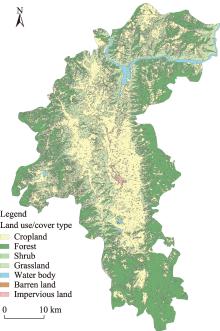
Fig. 1.
Land use/cover types of Yuanmou County. The data were derived from the annual land cover dataset based on Landsat images."

Table 1
Data sources of this study."
| Data type | Resolution | Data source |
|---|---|---|
| Digital elevation model (DEM) | 30 m | http://srtm.csi.cgiar.org/ |
| Evapotranspiration | 1 km | https://data.tpdc.ac.cn/ |
| Precipitation | 1 km | https://data.tpdc.ac.cn/ |
| Land use/cover types | 30 m | https://doi.org/10.5281/zenodo.8176941 |
| Net primary productivity (NPP) | 500 m | https://earthdata.nasa.gov/ |
| Normalized difference vegetation index (NDVI) | 250 m | https://www.earthdata.nasa.gov/ |
| Soil | - | Wen ( |
| Population | 100 m | https://figshare.com/ |
| Socioeconomic data | - | Yunnan Statistical Yearbook (Yunnan Provincial Bureau of Statistics, |
Table 2
Neighborhood weight parameters under different scenarios in Yuanmou County."
| Scenario | Cropland | Forest | Shrub | Grassland | Water body | Barren land | Impervious land |
|---|---|---|---|---|---|---|---|
| Ecological scenario | 0.30 | 1.00 | 0.80 | 1.00 | 0.50 | 0.00 | 0.00 |
| Anthropogenic disturbance scenario | 1.00 | 0.00 | 0.00 | 0.10 | 0.70 | 0.00 | 1.00 |
Table 3
Conversion matrix under different scenarios in Yuanmou County."
| Scenario | Land use/cover type | Cropland | Forest | Shrub | Grassland | Water body | Barren land | Impervious land |
|---|---|---|---|---|---|---|---|---|
| Ecological scenario | Cropland | 1 | 1 | 1 | 1 | 1 | 0 | 0 |
| Forest | 0 | 1 | 1 | 1 | 0 | 0 | 0 | |
| Shrub | 0 | 1 | 1 | 1 | 0 | 0 | 0 | |
| Grassland | 0 | 1 | 1 | 1 | 0 | 0 | 0 | |
| Water body | 1 | 1 | 1 | 1 | 1 | 0 | 0 | |
| Barren land | 1 | 1 | 1 | 1 | 1 | 1 | 0 | |
| Impervious land | 1 | 1 | 1 | 1 | 1 | 0 | 1 | |
| Anthropogenic disturbance scenario | Cropland | 1 | 0 | 0 | 0 | 1 | 0 | 1 |
| Forest | 1 | 1 | 0 | 0 | 1 | 0 | 1 | |
| Shrub | 1 | 0 | 1 | 0 | 1 | 0 | 1 | |
| Grassland | 1 | 0 | 0 | 1 | 1 | 0 | 1 | |
| Water body | 1 | 0 | 0 | 0 | 1 | 0 | 1 | |
| Barren land | 1 | 0 | 0 | 0 | 1 | 1 | 1 | |
| Impervious land | 1 | 0 | 0 | 0 | 1 | 0 | 1 |
Table 4
Ecosystem service equivalent value per unit area in Yuanmou County."
| Land use/cover type | Ecosystem service equivalent value (CNY/hm2) | |||
|---|---|---|---|---|
| Water yield (WY) | Soil retention (SR) | Carbon sequestration (CS) | Food production (FP) | |
| Cropland | 0.27 | 1.03 | 0.67 | 1.25 |
| Forest | 4.74 | 2.65 | 2.17 | 0.95 |
| Shrub | 3.35 | 1.72 | 1.41 | 0.62 |
| Grassland | 0.98 | 0.62 | 0.51 | 0.24 |
| Water body | 102.24 | 0.93 | 0.77 | 1.03 |
| Barren land | 0.03 | 0.02 | 0.00 | 0.00 |
| Impervious land | -8.58 | 0.00 | 0.00 | 0.00 |
Table 5
Area change amount of each land use/cover type in Yuanmou County from 2002 to 2022 (unit: hm2)."
| Land use/cover type | Cropland | Forest | Shrub | Grassland | Water body | Barren land | Impervious land | Total |
|---|---|---|---|---|---|---|---|---|
| Cropland | 42,910.83 | 1887.66 | 426.06 | 2634.75 | 817.38 | 0.63 | 407.70 | 49,085.01 |
| Forest | 4300.56 | 67,028.04 | 740.34 | 682.65 | 6.93 | 0.00 | 3.15 | 72,761.67 |
| Shrub | 1507.86 | 761.04 | 3587.04 | 1960.47 | 0.09 | 0.00 | 0.00 | 7816.50 |
| Grassland | 24,300.81 | 2257.38 | 578.52 | 41,849.10 | 633.69 | 0.36 | 192.42 | 69,812.28 |
| Water body | 147.96 | 2.52 | 0.00 | 50.94 | 1309.68 | 0.36 | 17.55 | 1529.01 |
| Barren land | 0.72 | 0.00 | 0.00 | 0.72 | 179.64 | 1.08 | 0.27 | 182.43 |
| Impervious land | 2.61 | 0.00 | 0.00 | 0.09 | 132.66 | 0.00 | 607.68 | 743.04 |
| Total | 73,171.35 | 71,936.64 | 5331.96 | 47,178.72 | 3080.07 | 2.43 | 1228.77 | 201,929.94 |
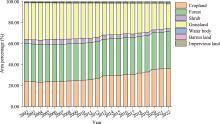
Fig. 2.
Area percentage change of land use/cover types in Yuanmou County from 2002 to 2022."

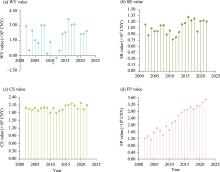
Fig. 3.
Change of ecosystem service values (ESVs) in Yuanmou County from 2002 to 2022. (a), the value of water yield (WY); (b), the value of soil retention (SR); (c), the value of carbon sequestration (CS); (d), the value of food production (FP)."

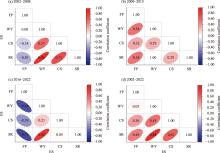
Fig. 4.
Trade-off and synergy relationships among ecosystem services (ESs) during 2002-2008 (a), 2009-2015 (b), 2016-2022 (c), and 2002-2022 (d). Ellipse circularity is inversely related to the correlation strength."

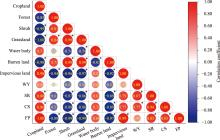
Fig. 5.
Relationships between land use/cover types and ESs in Yuanmou County during 2002-2022. * represents significance at P<0.05 level. Bubble size increases with the absolute value of the correlation coefficient."

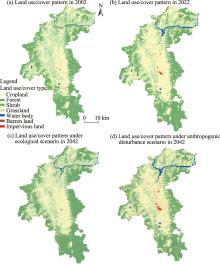
Fig. 6.
Projection of land use/cover patterns in Yuanmou County in 2042 based on land use/cover types in 2002 and 2022. (a), land use/cover pattern in 2002; (b), land use/cover pattern in 2022; (c), land use/cover pattern under ecological scenario in 2042; (d), land use/cover pattern under anthropogenic disturbance scenario in 2042."

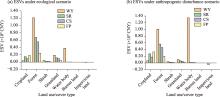
Fig. 7.
ESVs under ecological scenario (a) and anthropogenic disturbance scenario (b) in Yuanmou County in 2042."

Table 6
Areas of land use/cover type under different scenarios."
| Land use/cover type | Area (hm2) | ||
|---|---|---|---|
| Ecological scenario | Anthropogenic disturbance scenario | Max ESV scenario | |
| Cropland | 48,318.34 | 87,079.31 | 73,171.35 |
| Forest | 84,288.01 | 70,224.36 | 71,939.07 |
| Shrub | 4729.73 | 4144.73 | 5331.96 |
| Grassland | 63,707.29 | 34,812.46 | 47,178.72 |
| Water body | 1231.96 | 4346.20 | 3080.07 |
| Barren land | 0.10 | 1.78 | 0.00 |
| Impervious land | 157.91 | 1824.67 | 1228.77 |
Table 7
Ecological security index system under different scenarios."
| Ecological security index system | Ecological scenario | Anthropogenic disturbance scenario | Max ESV scenario |
|---|---|---|---|
| ERI | 0.18 | 0.23 | 0.21 |
| ESI | 0.42 | 0.52 | 0.62 |
| LDI | 3.02 | 3.36 | 3.26 |
| CESI | 0.48 | 0.49 | 0.53 |
| [1] | Abson, D.J., von Wehrden, H., Baumgärtner, S., et al., 2014. Ecosystem services as a boundary object for sustainability. Ecological Economics. 103, 29-37. |
| [2] | Aneseyee, A.B., Soromessa, T., Elias, E., et al., 2022. Evaluation of water provision ecosystem services associated with land use/cover and climate variability in the Winike watershed, Omo Gibe Basin of Ethiopia. Environmental Management. 69(2), 367-383. |
| [3] | Baude, M., Meyer, B.C., Schindewolf, M., 2019. Land use change in an agricultural landscape causing degradation of soil based ecosystem services. Science of The Total Environment. 659, 1526-1536. |
| [4] | Bui, D.H., Mucsi, L., 2021. From land cover map to land use map: A combined pixel-based and object-based approach using multi-temporal Landsat data, a random forest classifier, and decision rules. Remote Sensing. 13(9), 1700, doi: 10.3390/rs13091700. |
| [5] | Chen, B.M., Jing, X., Liu, S.S., et al., 2022. Intermediate human activities maximize dryland ecosystem services in the long-term land-use change: Evidence from the Sangong River watershed, Northwest China. Journal of Environmental Management. 319, 115708, doi: 10.1016/j.jenvman.2022.115708. |
| [6] | Chen, X., He, L., Luo, F., et al., 2023. Dynamic characteristics and impacts of ecosystem service values under land use change: A case study on the Zoige Plateau, China. Ecological Informatics. 78, 102350, doi: 10.1016/j.ecoinf.2023.102350. |
| [7] | Chen, Y.H., He, G.X., Shi, L.T., et al., 2021. Land use change and dynamic prediction in Yuanmou County, a typical dry and hot valley area. Science Technology and Engineering. 21(20), 8366-8375 (in Chinese). |
| [8] | Chen, Y.H., Xu, C.C., Ge, Y., et al., 2024a. A 100 m gridded population dataset of China’s seventh census using ensemble learning and big geospatial data. Earth System Science Data. 16(8), 3705-3718. |
| [9] | Chen, Y.Q., Liu, W., Zhao, F., et al., 2024b. Multi-scale analysis of ecosystem service trade-offs/synergies in the Yangtze River Delta. Land. 13(9), 1462, doi: 10.3390/land13091462. |
| [10] | Choruma, D.J., Odume, O.N., 2019. Exploring farmers’ management practices and values of ecosystem services in an agroecosystem context—A case study from the Eastern Cape, South Africa. Sustainability. 11(23), 6567, doi: 10.3390/su11236567. |
| [11] | Costanza, R., de Groot, R., Sutton, P., et al., 2014. Changes in the global value of ecosystem services. Global Environmental Change. 26, 152-158. |
| [12] | Costanza, R., 2020. Valuing natural capital and ecosystem services toward the goals of efficiency, fairness, and sustainability. Ecosystem Services. 43, 101096, doi: 10.1016/j.ecoser.2020.101096. |
| [13] | Dong, Y.F., Xiong, D.H., Su, Z.A., et al., 2013. Critical topographic threshold of gully erosion in Yuanmou dry-hot valley in Southwestern China. Physical Geography. 34(1), 50-59. |
| [14] | Duan, X.W., Liu, B., Gu, Z.J., et al., 2016. Quantifying soil erosion effects on soil productivity in the dry-hot valley, southwestern China. Environmental Earth Sciences. 75(16), 1164, doi: 10.1007/s12665-016-5986-6. |
| [15] | Fang, G.J., Sun, X., Sun, R.H., et al., 2024. Advancing the optimization of urban-rural ecosystem service supply-demand mismatches and trade-offs. Landscape Ecology. 39(2), 32, doi: 10.1007/s10980-024-01849-5. |
| [16] | Ferreira, L.M.R., Esteves, L.S., de Souza, E.P., et al., 2019. Impact of the urbanisation process in the availability of ecosystem services in a tropical ecotone area. Ecosystems. 22(2), 266-282. |
| [17] | Fu, B.J., Zhou, G.Y., Bai, Y.F., et al., 2009. The main terrestrial ecosystem services and ecological security in China. Advances in Earth Science. 24(6), 571-576 (in Chinese). |
| [18] | Gu, X.K., Shen, D.S., Qin, Y.F., et al., 2024. The impact path and assessment framework of comprehensive land consolidation on rural adaptation to climate change. Journal of Natural Resources. 39(11), 2588-2600 (in Chinese). |
| [19] | Guan, J., Yu, P., 2021. Does coal mining have effects on land use changes in a coal resource-based city? Evidence from Huaibei City on the North China Plain. International Journal of Environmental Research and Public Health. 18(21), 11616, doi: 10.3390/ijerph182111616. |
| [20] | He, Q.Q., Wang, J.W., Bi, X., et al., 2024. Temporal and spatial dynamics of water conservation in Shanxi Province (2005-2020): Patterns and influence analysis. Research of Environmental Sciences. 37(4), 862-873 (in Chinese). |
| [21] | He, Z.Q., Shang, X., Zhang, T.H., et al., 2022. Coupled regulatory mechanisms and synergy/trade-off strategies of human activity and climate change on ecosystem service value in the loess hilly fragile region of northern Shaanxi, China. Ecological Indicators. 143, 109325, doi: 10.1016/j.ecolind.2022.109325. |
| [22] | Hermann, A., Kuttner, M., Hainz-Renetzeder, C., et al., 2014. Assessment framework for landscape services in European cultural landscapes: An Austrian Hungarian case study. Ecological Indicators. 37, 229-240. |
| [23] | Hu, Y., Lu, Y., Jin, K., et al., 2021. Discussion on ecological restoration in dry-hot valley. Journal of Changjiang River Scientific Research Institute. 38(10), 69-75 (in Chinese). |
| [24] | Huang, Y., Feng, T., Niu, S.F., et al., 2022. Integrating the effects of driving forces on ecosystem services into ecological management: A case study from Sichuan Province, China. PLoS ONE. 17(6), e0270365, doi: 10.1371/journal.pone.0270365. |
| [25] | Jiang, H.L., Xu, X., Guan, M.X., et al., 2019. Simulation of spatiotemporal land use changes for integrated model of socioeconomic and ecological processes in China. Sustainability. 11(13), 3627, doi: 10.3390/su11133627. |
| [26] | Jiang, L., Wang, Z.Z., Zuo, Q.T., et al., 2023. Simulating the impact of land use change on ecosystem services in agricultural production areas with multiple scenarios considering ecosystem service richness. Journal of Cleaner Production. 397, 136485, doi: 10.1016/j.jclepro.2023.136485. |
| [27] | Jie, Y., Huang, X., 2023. The 30 m annual land cover datasets and its dynamics in China from 1985 to 2022. Earth System Science Data. 13(1), 3907-3925. |
| [28] | Kafy, A.A., Altuwaijri, H.A., 2024. Eco-climatological modeling approach for exploring spatiotemporal dynamics of ecosystem service values in response to land use and land cover changes in Riyadh, Saudi Arabia. Theoretical and Applied Climatology. 155(11), 9497-9516. |
| [29] | Li, H.P., He, Y.Q., Lai, W.T., 2022. Research on the method of applying multi-scenario simulation to village land use layout. Journal of Human Settlements in West China. 37(4), 40-47 (in Chinese). |
| [30] | Li, J., Liu, H.H., Sheng, Y.Z., et al., 2025a. Investigating groundwater-surface water interactions and transformations in a typical dry-hot valley through environmental isotopes analysis. Water. 17(6), 775, doi: 10.3390/w17060775. |
| [31] | Li, Y.L., Tang, Y.T., Ives, C.D., 2025b. Policy-driven scenarios for sustainable peri-urban land use: Production-living-ecological space in Yubei District, Chongqing. Land. 14(5), 1074, doi: 10.3390/land14051074. |
| [32] | Liang, W.H., Liao, H.P., Yang, W., et al., 2012. Optimization of land use pattern based on ecological security in the mountainous region in Southwest China: A case study of Kaixian County, Chongqing. Journal of Southwest China Normal University. Natural Science Edition. 37(5), 119-126 (in Chinese). |
| [33] | Liu, L., Xiong, D.H., Zhang, W.D., et al., 2020. Benefits and ecological risks of Gully Reclamation Project in Yuanmou dry-hot valley region. Transactions of the Chinese Society of Agricultural Engineering. 36(4), 251-258 (in Chinese). |
| [34] | Mashizi, A.K., Heshmati, G.A., Mahini, A.R.S., et al., 2019. Exploring management objectives and ecosystem service trade-offs in a semi-arid rangeland basin in southeast Iran. Ecological Indicators. 98, 794-803. |
| [35] | Ou, Z.R., Zhu, Q.K., Sun, Y.Y., 2018. Land use and ecosystem services value in the dry-hot valley region: A case study in Yuanmou County, Yunnan Province. Research of Agricultural Modernization. 39(3), 494-502 (in Chinese). |
| [36] | Ou, Z.R., Yuan, J.Y., Lei, C.Y., et al., 2021. Spatial differentiation characteristics of forest ecosystem service values in the Yuanmou dry-hot valley ecotone. Chinese Journal of Applied and Environmental Biology. 27(2), 357-365 (in Chinese). |
| [37] | Padilha, J., Carvalho-Santos, C., Cássio, F., et al., 2023. Land cover implications on ecosystem service delivery: a multi-scenario study of trade-offs and synergies in river basins. Environmental Management. 73, 753-768. |
| [38] | Pan, K.L., Guo, L., Chen, X., et al., 2022. Advance in the research on agroforestry ecosystem services. Journal of Ecology and Rural Environment. 38(12), 1535-1544 (in Chinese). |
| [39] | Peng, S.Z., Ding, Y.X., Wen, Z.M., et al., 2017. Spatiotemporal change and trend analysis of potential evapotranspiration over the Loess Plateau of China during 2011-2100. Agricultural and Forest Meteorology. 233, 183-194. |
| [40] | Rao, Y.X., Zhou, M., Ou, G.L., et al., 2018. Integrating ecosystem services value for sustainable land-use management in semi-arid region. Journal of Cleaner Production. 186, 662-672. |
| [41] | Rusch, A., Bommarco, R., Jonsson, M., et al., 2013. Flow and stability of natural pest control services depend on complexity and crop rotation at the landscape scale. Journal of Applied Ecology. 50(2), 345-354. |
| [42] | Schröter, M., Egli, L., Bruening, L., et al., 2021. Distinguishing anthropogenic and natural contributions to coproduction of national crop yields globally. Scientific Reports. 11(1), 10821, doi: 10.1038/s41598-021-90340-1. |
| [43] | Shi, H., Li, X., Liu, X.P., et al., 2020. Global protected areas boost the carbon sequestration capacity: Evidences from econometric causal analysis. Science of The Total Environment. 715, 137001, doi: 10.1016/j.scitotenv.2020.137001. |
| [44] | Shirmohammadi, B., Malekian, A., Salajegheh, A., et al., 2020. Impacts of future climate and land use change on water yield in a semiarid basin in Iran. Land Degradation & Development. 31(10), 1252-1264. |
| [45] | Song, F., Su, F.L., Mi, C.X., et al., 2021. Analysis of driving forces on wetland ecosystem services value change: A case in Northeast China. Science of The Total Environment. 751, 141778, doi: 10.1016/j.scitotenv.2020.141778. |
| [46] | Tsai, H.W., Lee, Y.C., 2023. Effects of land use change and crop rotation practices on farmland ecosystem service valuation. Ecological Indicators. 155, 110998, doi: 10.1016/j.ecolind.2023.110998. |
| [47] | Wang, D.C., Zhang, X., Huang, Y., et al., 2021a. Comparative study on temperature response of hydropower development in the dry-hot valley. GeoHealth. 5(7), e2021GH000438, doi: 10.1029/2021GH000438. |
| [48] | Wang, J., Yan, S.C., Guo, Y.Q., et al., 2015. The effects of land consolidation on the ecological connectivity based on ecosystem service value: A case study of Da’an land consolidation project in Jilin Province. Journal of Geographical Sciences. 25(5), 603-616. |
| [49] | Wang, J.W., Xiong, W.S., Liu, A.P., et al., 2011. Study on effect of runoff interception and sediment reduction by site preparation in sloping area for afforestation in dry-hot valley of Yuanmou County. Journal of Southwest Forestry University. 31(6), 31-35 (in Chinese). |
| [50] | Wang, X.Z., Wu, J.Z., Liu, Y.L., et al., 2022a. Driving factors of ecosystem services and their spatiotemporal change assessment based on land use types in the Loess Plateau. Journal of Environmental Management. 311, 114835, doi: 10.1016/j.jenvman.2022.114835. |
| [51] | Wang, Y.B., Zhang, S.P., Li, Z.G., et al., 2022b. Study on ecosystem health change of Cangshan Erhai National Nature Reserve in Yunnan Province. Ecological Science. 41(2), 131-136 (in Chinese). |
| [52] | Wang, Y.C., Shen, J.K., Xiang, W.N., et al., 2018. Ecosystem service of green infrastructure for adaptation to urban growth: function and configuration. Ecosystem Health and Sustainability. 4(5), 132-143. |
| [53] | Wang, Y.C., Zhao, J., Fu, J.W., et al., 2019. Effects of the Grain for Green Program on the water ecosystem services in an arid area of China-Using the Shiyang River Basin as an example. Ecological Indicators. 104, 659-668. |
| [54] | Wang, Z.H., Wubshet, T.T., Chen, H.F., et al., 2021b. Effects of degraded grassland conversion to mango plantation on soil CO2 fluxes. Applied Soil Ecology. 167, 104045, doi: 10.1016/j.apsoil.2021.104045. |
| [55] | Wartenberg, A.C., Moanga, D., Potts, M.D., et al., 2021. Limited economic-ecological trade-offs in a shifting agricultural landscape: A case study from Kern County, California. Frontiers in Sustainable Food Systems. 5, 650727, doi: 10.3389/fsufs.2021.650727. |
| [56] | Wei, Z., Yang, C.L., Tian, Y.F., et al., 2024. Spatial-temporal variations of soil erosion and quantitative attribution analysis in the dry-hot valleys of the Jinsha River: A case study of Yuanmou County, Yunnan. Geoscience. 38(3), 683-693 (in Chinese). |
| [57] | Wen, X., Zhen, L., 2020. Soil erosion control practices in the Chinese Loess Plateau: A systematic review. Environmental Development. 34, 100493, doi: 10.1016/j.envdev.2019.100493. |
| [58] | Wen, X.L., 2022. Effects of vegetation restoration on soil physical and chemical properties in gully development area of Yuanmou dry-hot valley. MSc Thesis. Kunming: Yunnan University (in Chinese). |
| [59] | Wen, X.Y., Liu, T.T., Wang, Z.J., 2023. Assessment of ecological security risk in rocky desertification area based on land-use change model. Ecological Indicators. 156, 111000, doi: 10.1016/j.ecolind.2023.111000. |
| [60] | Xiao, D.N., Chen, W.B., 2002. On the basic concepts and contents of ecological security. Chinese Journal of Applied Ecology. 13(3), 354-358 (in Chinese). |
| [61] | Xie, G.D., Zhang, C.X., Zhang, L.M., et al., 2015. Improvement of the evaluation method for ecosystem service value based on per unit area. Journal of Natural Resources. 30(8), 1243-1254 (in Chinese). |
| [62] | Xiong, D.H., Zhou, H.Y., Yang, Z., et al., 2005. Slope lithologic property, soil moisture condition and revegetation in dry-hot valley of Jinsha River. Chinese Geographical Science. 15(2), 186-192. |
| [63] | Xu, C., Rahman, M., Haase, D., et al., 2020. Surface runoff in urban areas: The role of residential cover and urban growth form. Journal of Cleaner Production. 262, 121421, doi: 10.1016/j.jclepro.2020.121421. |
| [64] | Xu, J., Zhang, Y., Wang, H.Y., et al., 2022. Distribution characteristics and anomaly analysis of soil nutrient elements in Yuanmou County, Central Yunnan Province. Southwest China Journal of Agricultural Sciences. 35(5), 1151-1158 (in Chinese). |
| [65] | Xu, Y., Yang, D.W., Tang, L.H., et al., 2023. Exploring the impact of grain-for-green program on trade-offs and synergies among ecosystem services in West Liao River Basin, China. Remote Sensing. 15(10), 2490, doi: 10.3390/rs15102490. |
| [66] | Yang, H.J., Gou, X.H., Tang, C.R., et al., 2024. Research progress on the valuation of forest ecosystem services in China during 2010 to 2021. Chinese Journal of Ecology. 43(1), 244-253 (in Chinese). |
| [67] | Yang, L.A., Li, Y.L., Jia, L.J., et al., 2023. Ecological risk assessment and ecological security pattern optimization in the middle reaches of the Yellow River based on ERI plus MCR model. Journal of Geographical Sciences. 33(4), 823-844. |
| [68] | Yohannes, H., Soromessa, T., Argaw, M., et al., 2021. Spatio-temporal changes in habitat quality and linkage with landscape characteristics in the Beressa watershed, Blue Nile basin of Ethiopian highlands. Journal of Environmental Management. 281, 111885, doi: 10.1016/j.jenvman.2020.111885. |
| [69] | Yu, P.T., Wang, Y.H., Wu, X.D., et al., 2010. Water yield reduction due to forestation in arid mountainous regions, Northwest China. International Journal of Sediment Research. 25(4), 423-430. |
| [70] | Yuan, Z.Z., Wang, Q.H., Wang, Y., et al., 2023. Impacts of land use change on ecosystem health in Chongqing under multi-scenario simulation. Acta Ecologica Sinica. 43(20), 8279-8291 (in Chinese). |
| [71] | Yunnan Provincial Bureau of Statistics, 2003-2023. Yunnan Statistical Yearbook. [2025-04-29]. http://stats.yn.gov.cn/List22.aspx (in Chinese). |
| [72] | Zhang, B., Li, L., Xia, Q.Y., et al., 2022a. Trade off/synergy analysis of ecosystem services in Wuhan City Circle based on land use. Research of Soil and Water Conservation. 29(4), 377-386, 393 (in Chinese). |
| [73] | Zhang, B.Y., Xiong, D.H., Li, X.Y., et al., 2022b. Physical properties of soil moisture of gully reclamation project with different implementation year in Yuanmou dry-hot valley area. Southwest China Journal of Agricultural Sciences. 35(8), 1870-1877 (in Chinese). |
| [74] | Zhang, J.Y., Qiao, X.N., Yang, Y.J., et al., 2025. Ecological security driving mechanisms and optimization of zoning in Chinese urban agglomerations: A case study of the central plains urban agglomeration. Ecological Indicators. 171, 113190, doi: 10.1016/j.ecolind.2025.113190. |
| [75] | Zhang, W., Liu, G.Y., Yang, Q., et al., 2021a. Urban ecological risk transmission model based on Bayesian network. Journal of Cleaner Production. 296, 126559, doi: 10.1016/j.jclepro.2021.126559. |
| [76] | Zhang, Y., Li, Y.Z., Lv, J., et al., 2021b. Scenario simulation of ecological risk based on land use/cover change—A case study of the Jinghe County, China. Ecological Indicators. 131, 108176, doi: 10.1016/j.ecolind.2021.108176. |
| [77] | Zhao, L.S., Liu, G.S., Xian, C.L., et al., 2022. Simulation of land use pattern based on land ecological security: A case study of Guangzhou, China. International Journal of Environmental Research and Public Health. 19(15), 9281, doi: 10.3390/ijerph19159281. |
| [78] | Zheng, P.F., Zheng, Y.D., Zhao, L.H., et al., 2018. Study on suitability evaluation of regional cultivated land consolidation based on dual constraints. Journal of China Agricultural Resources and Regional Planning. 39(1), 83-91 (in Chinese). |
| [79] | Zhou, C.Y., Chen, X., Liu, X.L., et al., 2011. Assessment of Karst regional ecosystem service functions based on land use change: A case study in Guizhou, China. Chinese Journal of Applied and Environmental Biology. 17(2), 174-179 (in Chinese). |
| [80] | Zhu, K., Cheng, Y.F., Zang, W.Y., et al., 2023. Multiscenario simulation of land-use change in Hubei Province, China Based on the Markov-FLUS Model. Land. 12(4), 744, doi: 10.3390/land12040744. |
| [81] | Zhu, Y.F., Zhou, M., 2025. Optimization of land use structure integrating ecosystem service function and economic development—A case study in Dongting Lake Ecological and Economic Zone, China. Environmental and Sustainability Indicators. 26, 100604, doi: 10.1016/j.indic.2025.100604. |
| [1] | LI Pei, SHI Peiji, LIU Haimeng, LI Jie, WANG Ziyang. Multi-scenario simulation of land use spatial patterns in arid metropolitan regions of China with a coupled WESP-FLUS model [J]. Regional Sustainability, 2026, 7(2): 100336-. |
| [2] | Wassie Abuhay ASCHENEFE, Temesgen Gashaw TAREKEGN, Betelhem Fetene ADMAS, Solomon Mulu TAFERE. Quantifying the impacts of land use/land cover changes on ecosystem service values in the upper Gilgel Abbay watershed, Ethiopia [J]. Regional Sustainability, 2025, 6(1): 100197-. |
| [3] | Braja SUNDAR PANI, Diptimayee MISHRA. Sustainable livelihood security in Odisha, India: A district level analysis [J]. Regional Sustainability, 2022, 3(2): 110-121. |
| Viewed | ||||||
|
Full text |
|
|||||
|
Abstract |
|
|||||
 REGSUS Wechat
 新公网安备 65010402001202号