
Regional Sustainability ›› 2026, Vol. 7 ›› Issue (2): 100331.doi: 10.1016/j.regsus.2026.100331
• Research article • Previous Articles Next Articles
MENG Guia, WANG Kaiyongb,*( ), WANG Fuyuanb, LI Hec
Received:2025-04-01
Revised:2025-10-28
Accepted:2026-02-19
Published:2026-04-30
Online:2026-03-17
Contact:
* E-mail address: wangky@igsnrr.ac.cn (WANG Kaiyong).
MENG Gui, WANG Kaiyong, WANG Fuyuan, LI He. Impact of county-to-district conversion on the urban-rural integration development: A case study from Jiangsu Province, China[J]. Regional Sustainability, 2026, 7(2): 100331.
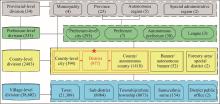
Fig. 1.
Schematic diagram of China’s administrative division adjustment hierarchy and the occurrence of the county-to-district conversion (CDC). Value in parentheses indicates the number of corresponding administrative divisions in 2023. Red arrow indicates the direction of the CDC."
Table 1
Indicator for measuring urban-rural integration development (URID)."
| Dimension | Indicator | Calculation method | Unit | Property | Weight |
|---|---|---|---|---|---|
| Economic integration | Ratio of per capita disposable income of urban-rural residents (X1) | The ratio of per capita disposable income between urban and rural residents | % | − | 0.19 |
| Ratio of per capita consumption of urban-rural residents (X2) | The ratio of per capita consumption between urban and rural residents | % | − | 0.25 | |
| Ratio of Engel’s coefficient of urban-rural residents (X3) | The ratio of the Engel’s coefficients between urban and rural residents | % | + | 0.22 | |
| Urban-rural duality comparison coefficient (X4) | The ratio of labor input per unit output of the primary industry to that of the secondary and tertiary industries | % | + | 0.18 | |
| Level of agricultural mechanization (X5) | The ratio of the total power of agricultural machinery to the cultivated land area of crops | kW/hm2 | + | 0.16 | |
| Social integration | Internet coverage coefficient (X6) | The ratio of the number of households with Internet access to the permanent resident population | % | + | 0.15 |
| Student-teacher ratio (X7) | The ratio of the number of middle school students to that of middle school teachers | % | - | 0.31 | |
| Healthcare coverage coefficient (X8) | The ratio of the number of health technicians to the number of permanent residents | % | + | 0.21 | |
| Industrial-agricultural electricity ratio (X9) | The ratio of rural electricity consumption to industrial electricity consumption | % | - | 0.33 | |
| Ecological integration | Green space coverage in built-up areas (X10) | The ratio of the green space area in the built-up area to the built-up area | % | + | 0.31 |
| Sewage treatment rate (X11) | The ratio of sewage treatment volume to sewage discharge volume | % | - | 0.33 | |
| Comprehensive utilization rate of industrial solid waste (X12) | The ratio of solid waste discharge volume to utilization volume | % | - | 0.37 | |
| Spatial integration | Land allocation between urban and rural areas (X13) | The ratio of the sown area of crops to the built-up area | % | + | 0.34 |
| Urban-rural spatial circulation capacity (X14) | The ratio of the number of private cars to the area of administrative regions | Private cars/hm2 | + | 0.41 | |
| Urban-rural spatial circulation network (X15) | The ratio of road area to administrative area | % | + | 0.09 | |
| Urban-rural service supply coefficient (X16) | The ratio of the number of street lamps to the area of administrative regions | Street lamps/hm2 | + | 0.15 |
Table 2
Description and calculation methods of variables."
| Type | Variable | Abbreviation | Unit | Calculation method |
|---|---|---|---|---|
| Dependent variable | Urban-rural integrated development | URID | - | f(x)=∑wij×dij, where f(x) represents the level of URID; wij represents the weight of indicator j in dimension i; and dij denotes the normalized value of indicator j in dimension i. |
| Core independent variable | Status of policy adjustments | dt×du | - | Adjustment is set to 1, otherwise 0 |
| Control variable | Per capita gross domestic product (GDP) | PGDP | CNY/capita | Ratio of the total GDP to the total population |
| Government expenditure level | GEL | % | Ratio of public fiscal expenditure to GDP | |
| Government investment level | GIL | % | Ratio of fixed asset investment to GDP | |
| Consumption level | CL | % | Ratio of the total social retail sales to GDP | |
| Import and export level | IEL | % | Ratio of the total exports and imports to GDP | |
| Technical development level | TDL | piece | Annual granted patents |
Table 3
Descriptive statistics of variables."
| Variable | Observation | Mean | Standard deviation | Minimum | Maximum |
|---|---|---|---|---|---|
| URID | 884 | 2.093 | 0.386 | 1.140 | 3.360 |
| dt×du | 884 | 0.118 | 0.322 | 0.000 | 1.000 |
| PGDP (CNY/capita) | 884 | 67,398.134 | 48,654.042 | 4379.000 | 259,470.950 |
| GEL (%) | 884 | 63.882 | 52.897 | 3.300 | 402.670 |
| GIL (%) | 884 | 305.131 | 240.924 | 7.930 | 1155.300 |
| CL (%) | 884 | 184.727 | 181.374 | 12.010 | 1640.181 |
| IEL (%) | 884 | 40.955 | 117.793 | 0.050 | 1036.888 |
| TDL (piece) | 884 | 1950.140 | 3393.617 | 10.000 | 40,878.000 |
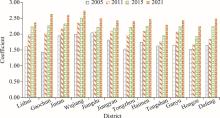
Fig. 2.
Level of urban-rural integration development (URID) in 12 districts in 2005, 2011, 2015, and 2021. These districts underwent CDC between 2005 and 2021. Lishui, Gaochun, Jintan, and Wujiang districts belong to the southern Jiangsu Province; Jiangdu, Jiangyan, Tongzhou, and Haimen districts belong to the central Jiangsu Province; Tongshan, Ganyu, Hongze, and Dafeng districts belong to the northern Jiangsu Province."
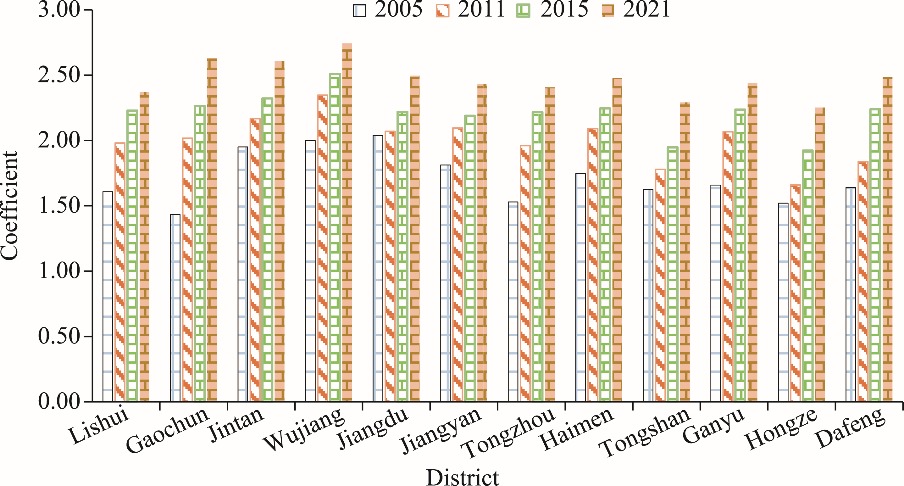
Fig. 3.
Parallel trend test results of the multi-period difference-in-differences (DID) model. Time point indicates the year when the policy was implemented. Time point 0 represents the base year for the implementation of the policy; 1 represents the first year after the implementation of the policy; -1 indicates the year prior to the implementation of this policy; and so on."
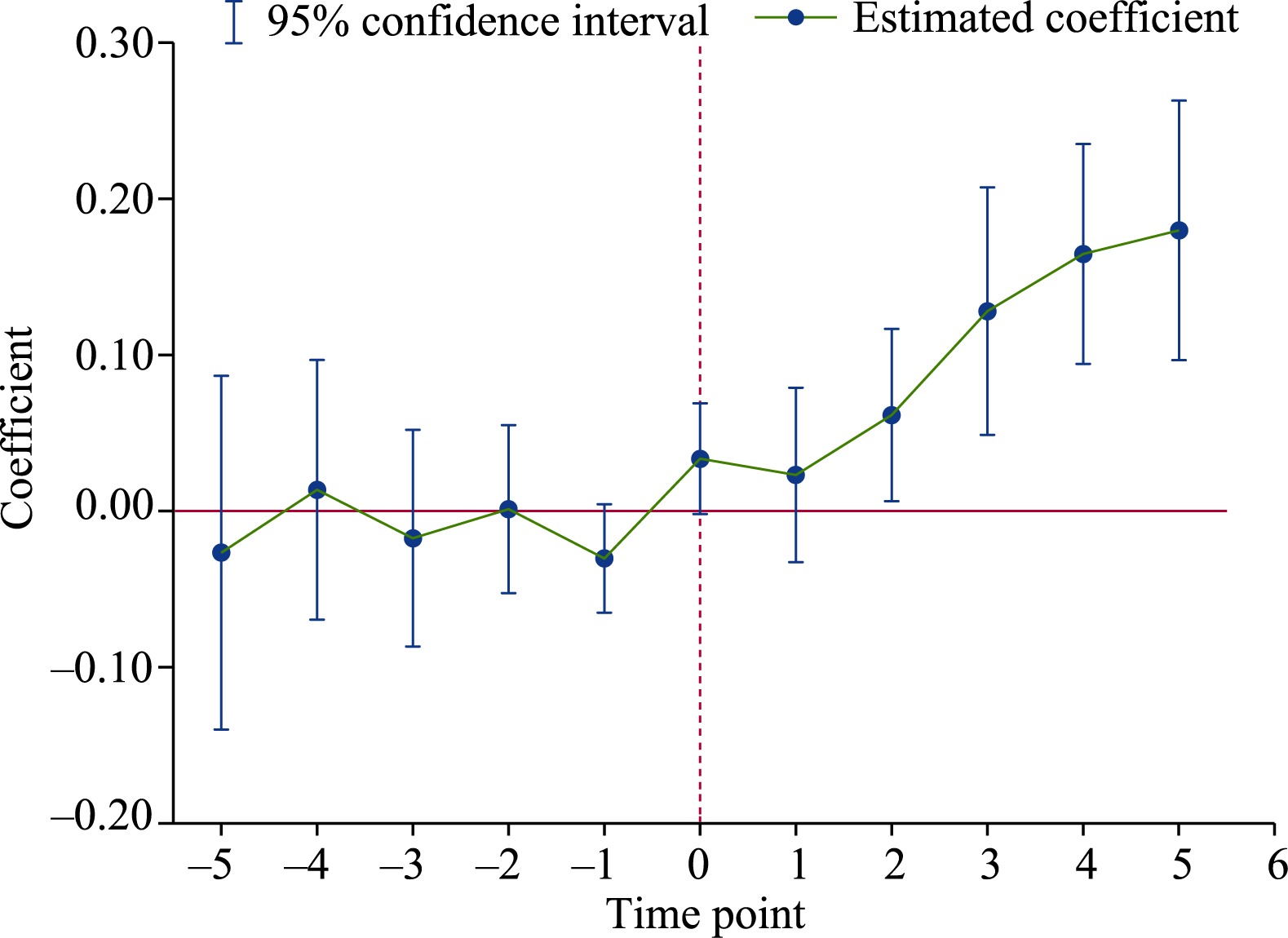
Table 4
Baseline regression results of the impact of the CDC on URID."
| Variable | Benchmark regression without control variable | Benchmark regression (with control variable) |
|---|---|---|
| dt×du | 0.025** (0.012) | 0.085** (0.040) |
| ln(PGDP) | - | 0.324*** (0.032) |
| ln(GEL) | - | -0.325 (0.386) |
| ln(GIL) | - | -0.085** (0.386) |
| ln(CL) | - | 0.352*** (0.108) |
| ln(IEL) | - | -2.031*** (0.480) |
| ln(TDL) | - | 0.085 (0.069) |
| Constant term | 1.707*** (0.009) | -1.563*** (0.222) |
| Year fixed effect | Yes | Yes |
| City fixed effect | Yes | Yes |
| Observation | 884 | 884 |
| Adjusted coefficient of determination (R2) | 0.917 | 0.868 |
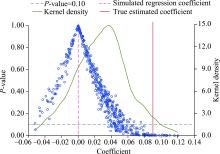
Fig. 4.
Baseline regression results by the Placebo test."

Table 5
Robustness test results of the impact of the CDC on URID."
| Variable | 2 a in advance | 3 a in advance | Shrink-tail at the 1.00% level | Shrink-tail at the 5.00% level |
|---|---|---|---|---|
| dt×du | 0.066 (0.040) | 0.055 (0.039) | 0.090** (0.038) | 0.096*** (0.036) |
| Control variable | Yes | Yes | Yes | Yes |
| City-fixed effect | Yes | Yes | Yes | Yes |
| Year-fixed effect | Yes | Yes | Yes | Yes |
| Observation | 884 | 884 | 884 | 884 |
| Adjusted R2 | 0.864 | 0.863 | 0.866 | 0.859 |
Table 6
Regional heterogeneity of the impact of the CDC on URID."
| Variable | Southern Jiangsu Province | Central Jiangsu Province | Northern Jiangsu Province |
|---|---|---|---|
| dt×du | 0.059** (0.030) | 0.211*** (0.036) | -0.006 (0.038) |
| Control | Yes | Yes | Yes |
| Year fixed effect | Yes | Yes | Yes |
| City fixed effect | Yes | Yes | Yes |
| Observation | 238 | 408 | 238 |
| Adjusted R2 | 0.809 | 0.750 | 0.753 |
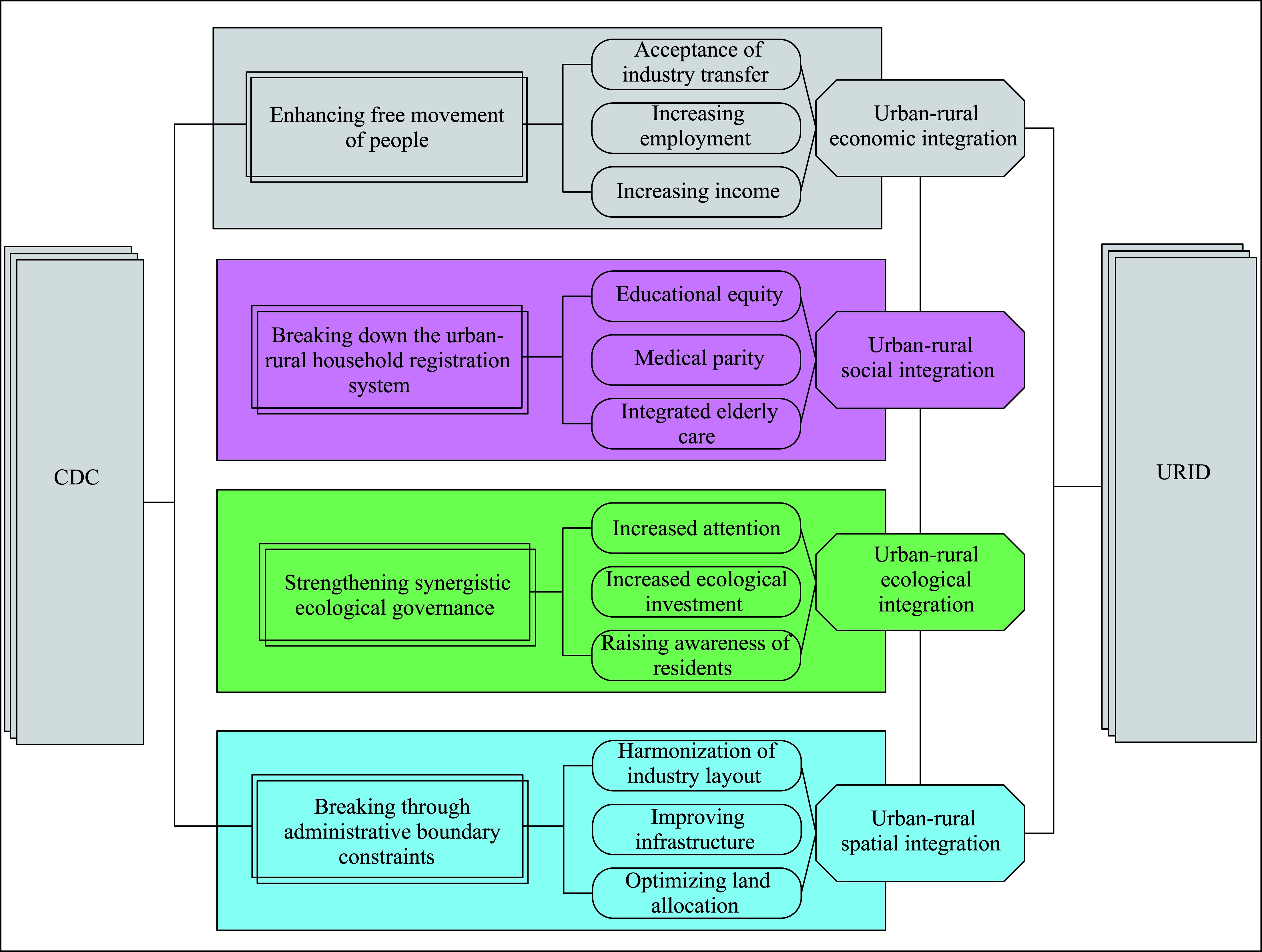
Fig. 5.
Mechanism of CDC in promoting URID."
| [1] | Cao S., Zhang Z.T., 2022. Towards a county-free era? Summary and reflections on city-county merge in contemporary China. Open Times. 4, 62-77 (in Chinese). |
| [2] | Chen B.K., Kang T.K., Hou J.Y., 2023a. Equalization of public services, educational equity and common prosperity. China Economic Quarterly. 23(6), 2104-2118 (in Chinese). |
| [3] | Chen F.H., Ye J.J., 2023. Growing beyond administrative borders: County-to-district reform and mobilizing intra-city synergies. China Economic Quarterly. 23(5), 1776-1792 (in Chinese). |
| [4] | Chen J.Y., Luo W.J., Ren X.H., et al., 2023b. The local-neighborhood effects of low-carbon city pilots program on PM2.5 in China: A spatial difference-in-differences analysis. Science of The Total Environment. 857, 159511, doi: 10.1016/j.scitotenv.2022.159511. |
| [5] | Cheng C., Liu Y.L., Liu Y.F., et al., 2020. Cropland use sustainability in Cheng-Yu Urban Agglomeration, China: Evaluation framework, driving factors and development paths. Journal of Cleaner Production. 256, 120692, doi: 10.1016/j.jclepro.2020.120692. |
| [6] | Darly S., Torre A., 2013. Conflicts over farmland uses and the dynamics of “agri-urban” localities in the Greater Paris Region: An empirical analysis based on daily regional press and field interviews. Land Use Policy. 33, 90-99. |
| [7] | Deng H.H., Pan X.T., 2020. How government-driven urbanization promote industrial upgrading? World Economic Papers. 1(6), 88-103 (in Chinese). |
| [8] | Feng R.D., Wang K.Y., 2021. Spatiotemporal effects of administrative division adjustment on urban expansion in China. Land Use Policy. 101, 105143, doi: 10.1016/j.landusepol.2020.105143. |
| [9] | Feng R.D., Wang K.Y., 2022. The direct and lag effects of administrative division adjustment on urban expansion patterns in Chinese mega-urban agglomerations. Land Use Policy. 112, 105805, doi: 10.1016/j.landusepol.2021.105805. |
| [10] | Fu Y., He C.Y., Luo L., 2021. Does the low-carbon city policy make a difference? Empirical evidence of the pilot scheme in China with DEA and PSM-DID. Ecological Indicators. 122, 107238, doi: 10.1016/j.ecolind.2020.107238. |
| [11] | Guo Q.B., Zhong J.R., 2022. The effect of urban innovation performance of smart city construction policies: Evaluate by using a multiple period difference-in-differences mode. Technological Forecasting and Social Change. 184, 122003, doi: 10.1016/j.techfore.2022.122003. |
| [12] | Guo Q.Y., Wang Y., 2020. A study on the regional economic balanced growth effect of city-county mergers. Nanjing Journal of Social Sciences. 9, 39-48 (in Chinese). |
| [13] | Ji X.L., Wei J., Li X.Z., 2018. Setting counties to districts vs. district expansion: Empirical study on the effect of expanding municipal districts of prefectural-level city to economic development. Social Sciences in Guangdong. 6, 46-57 (in Chinese). |
| [14] | Jiangsu Provincial Bureau of Statistics, 2023. Jiangsu Statistical Yearbook. Beijing: China Statistics Press (in Chinese). |
| [15] | Jin H., Liu W.H., Chen S.Y., 2023. Centralization and firm pollution emissions: Evidence from City-county Merger in China. Journal of Cleaner Production. 416, 137964, doi: 10.1016/j.jclepro.2023.137964. |
| [16] | Liang Z.Y., Zhao Y., 2019. Does the city-county merger improve urban public services? Evaluation based on the PSM-DID method. Journal of Eco-Civilization Studies. 1(6), 49-59 (in Chinese). |
| [17] | Liu M.S., Lo K., 2022. The territorial politics of urban expansion: Administrative annexation and land acquisition. Cities. 126, 103704, doi: 10.1016/j.cities.2022.103704. |
| [18] | Liu W., Zhou J.Y., Yang X., 2022. The impact of government driven urbanization on enterprise pollution emission. Chinese Journal of Environmental Management. 14(5), 60-69 (in Chinese). |
| [19] | Liu X.Q., You C., Cifuentes-Faura J., et al., 2024. Bigger cities and less carbon? Government-driven urbanization and carbon emissions in China. Journal of Cleaner Production. 467, 142808, doi: 10.1016/j.jclepro.2024.142808. |
| [20] | Lu S.F., Chen S.X., 2017. Does governmental favoritism reduce financing constraints of firms: A quasi-natural experiment from China. Journal of Management World. 5, 51-65 (in Chinese). |
| [21] | Lu X.X., Xu C., Zhang F., 2023. Research on the impact of city-county merger on urban economic resilience. Public Finance Research. 3, 63-77 (in Chinese). |
| [22] | Lu Y.P., Zhang J.K., Mao J., et al., 2024. Land financialization and debt expansion: Evidence from city-county mergers in China. Cities. 146, 104679, doi: 10.1016/j.cities.2023.104679. |
| [23] | Ma H.Q., Zou J.X., Cai H.B., et al., 2024. Administrative division adjustment and environmental pollution: Evidence from City-County Mergers in China. China Economic Review. 84, 102141, doi: 10.1016/j.chieco.2024.102141. |
| [24] | Ma L.B., Liu S.C., Fang F., et al., 2020a. Evaluation of urban-rural difference and integration based on quality of life. Sustainable Cities and Society. 54, 101877, doi: 10.1016/j.scs.2019.101877. |
| [25] | Ma W.Q., Jiang G.H., Chen Y.H., et al., 2020b. How feasible is regional integration for reconciling land use conflicts across the urban-rural interface? Evidence from Beijing-Tianjin-Hebei metropolitan region in China. Land Use Policy. 92, 104433, doi: 10.1016/j.landusepol.2019.104433. |
| [26] | Ma Z.P., Zhou G.L., Zhang J., et al., 2025. Demographic trends in China’s northeast borderlands: Shocks from core-periphery relations and border effects. Cities. 166, 106235, doi: 10.1016/j.cities.2025.106235. |
| [27] | Meng G., Wang K.Y., Wang F.Y., et al., 2023. Analysis of the tourism-economy-ecology coupling coordination and high-quality development path in karst Guizhou Province, China. Ecological Indicators. 154, 110858, doi: 10.1016/j.ecolind.2023.110858. |
| [28] | National Bureau of Statistics of China, 2023a. China Urban Statistical Yearbook. Beijing: China Statistics Press (in Chinese). |
| [29] | National Bureau of Statistics of China, 2023b. China Regional Economic Statistical Yearbook. Beijing: China Statistics Press (in Chinese). |
| [30] |
Newton K., 1982. Is small really so beautiful? Is big really so ugly? Size, effectiveness, and democracy in local government. Political Studies. 30(2), 190-206.
doi: 10.1111/j.1467-9248.1982.tb00532.x |
| [31] |
Paweł S., 2021. From post-communist democratic laissez-faire to prevention of territorial fragmentation: Tightening the rules of municipal splits in Central and Eastern Europe after 1990. Miscellanea Geographica. 25(1), 5-17.
doi: 10.2478/mgrsd-2020-0046 |
| [32] | Qiao J.F., Huang Z.C., 2021. Why local government debts are lasting enlargement: Evidence based on city-county merger. Nankai Economic Studies. 6, 127-143 (in Chinese). |
| [33] | Qiao J.F., Li Y., Yu J., 2024. Administrative-led urbanization and urban carbon emission intensity: Evidence from city-county merger in China. Energy Economics. 136, 107615, doi: 10.1016/j.eneco.2024.107615. |
| [34] |
Qiao Y.B., He C.F., 2024. Impact of turning counties into districts on county manufacturing upgrading: Policy evaluation with difference in differences in differences. Acta Geographica Sinica. 79(4), 909-930 (in Chinese).
doi: 10.11821/dlxb202404006 |
| [35] | Shao Z.D., Su D.N., Bao Q., 2018. Growth performance evaluation of city-county merger under the Chinese style decentralization. The Journal of World Economy. 41(10), 101-125 (in Chinese). |
| [36] | Song D.Y., Zhang Q., Yang L.Q.Q., 2020. Environmental effect of flattening administrative structure on local water quality: A county-level analysis of China’s County-Power-Expansion reform. Journal of Cleaner Production. 276, 123256, doi: 10.1016/j.jclepro.2020.123256. |
| [37] | Song M.Z., Qi J.Y., 2023. The impact of administrative power adjustment on urban green total factor productivity: Evidence from the reform of “city-county merger” and “province-managing-county”. Chinese Journal of Environmental Management. 15(4), 140-150 (in Chinese). |
| [38] | Tang W., Wang Y., 2015. Administrative boundary adjustment and urbanization of population: Evidence from city-county merger in China. Economic Research Journal. 50(9), 72-85 (in Chinese). |
| [39] |
Tang W., 2021. Decentralization and development of small cites: Evidence from county-to-city upgrading in China. China Economic Quarterly International. 1(3), 191-207.
doi: 10.1016/j.ceqi.2021.05.002 |
| [40] | Wang C., Wang L., 2023. Does regional market integration promote urban technological innovation? An empirical analysis based on “county-to-district conversion”. Collected Essays on Finance and Economics. 39(12), 3-13 (in Chinese). |
| [41] |
Wang K.Y., Qi W., 2017. Space-time relationship between urban municipal district adjustment and built-up area expansion in China. Chinese Geographical Science. 27(2), 165-175.
doi: 10.1007/s11769-017-0856-z |
| [42] | Wang K.Y., Chen T., Liu Y., 2019. New discussion and reflection on “Administrative division itself can be seen as a resource”. Geographical Research. 38(2), 195-206 (in Chinese). |
| [43] | Wang S.L., Chen X., 2022. The impact of transformation of counties into districts on urban land use efficiency. China Land Science. 36(12), 117-127 (in Chinese). |
| [44] |
Wang Y.F., Peng Q.Y., Jin C., et al., 2023. Whether the digital economy will successfully encourage the integration of urban and rural development: A case study in China. Chinese Journal of Population, Resources and Environment. 21(1), 13-25.
doi: 10.1016/j.cjpre.2023.03.002 |
| [45] |
Wu F.L., 2016. China’s emergent City-region governance: A new form of state spatial selectivity through state-orchestrated rescaling. International Journal of Urban and Regional Research. 40(6), 1134-1151.
doi: 10.1111/ijur.v40.6 |
| [46] | Xu F.X., Li X.W., 2024. The influence of the city-county merger reform on public service level of counties: Empirical analysis based on county panel data in Jiangsu Province. Urban Problems. 342(1), 65-74 (in Chinese). |
| [47] | Yan J.M., Chen H., Xia F.Z., 2018. Toward improved land elements for urban-rural integration: A cell concept of an urban-rural mixed community. Habitat International. 77, 110-120. |
| [48] | Yu F., Xiao D., Chang M.S., 2021. The impact of carbon emission trading schemes on urban-rural income inequality in China: A multi-period difference-in-differences method. Energy Policy. 159, 112652, doi: 10.1016/j.enpol.2021.112652. |
| [49] |
Yu H., Deng Y., Xu S., 2018. Evolutionary pattern and effect of administrative division adjustment during urbanization of China: Empirical analysis on multiple scales. Chinese Geographical Science. 28(5), 758-772.
doi: 10.1007/s11769-018-0990-2 |
| [50] | Zhan X.Y., Zeng F.W., 2021. Does adjustment of administrative divisions improve economic development quality? Empirical evidence from the “city-county merger”. Finance and Trade Research. 32(4), 70-82 (in Chinese). |
| [51] | Zhang K.Y., Li C., 2021. The course, characteristics and prospect of administrative division adjustment in 70 years of China. Social Science Journal. 1, 118-128 (in Chinese). |
| [52] | Zhang K.Y., Wang Y.Z., 2022. The synchronization between “district-county merger” and “sub district-town merger” and the focal point and orientation of the adjustment of urban administrative division. Chinese Public Administration. 12, 33-40 (in Chinese). |
| [53] | Zhang L., Pi J.Y., Song G.X., 2018. Government competition and preference for productive expenditure: The political economy in county-to-district reforms in China. Finance and Trade Economics. 39(3), 65-78 (in Chinese). |
| [54] | Zhang Y.J., Dai X.J., Yu X.F., et al., 2020. Urban integration of land-deprived households in China: Quality of living and social welfare. Land Use Policy. 96, 104671, doi: 10.1016/j.landusepol.2020.104671. |
| [55] | Zhang Y.Z., Wang J., Zhang M., et al., 2023. The mechanism of revoking counties or county-level cities to municipal districts and its effect on urban expansion in Chinese cities. Applied Geography. 159, 103068, doi: 10.1016/j.apgeog.2023.103068. |
| [56] | Zhao H., Li Y.Y., Wang Z.T., et al., 2024. Trade liberalization, regional trade openness degree, and foreign direct investment: Evidence from China. Emerging Markets Review. 59, 101103, doi: 10.1016/j.ememar.2023.101103. |
| [57] | Zhou J.N., Qin F.C., Liu J., et al., 2019. Measurement, spatial-temporal evolution and influencing mechanism of urban-rural integration level in China from a multidimensional perspective. China Population, Resources and Environment. 29(9), 166-176 (in Chinese). |
| No related articles found! |
| Viewed | ||||||
|
Full text |
|
|||||
|
Abstract |
|
|||||
 REGSUS Wechat
 新公网安备 65010402001202号