

Social development and living environment changes in the Northeast Tibetan Plateau and contiguous regions during the late prehistoric period
Received date: 2020-04-03
Revised date: 2020-07-03
Accepted date: 2020-09-01
Online published: 2020-10-17
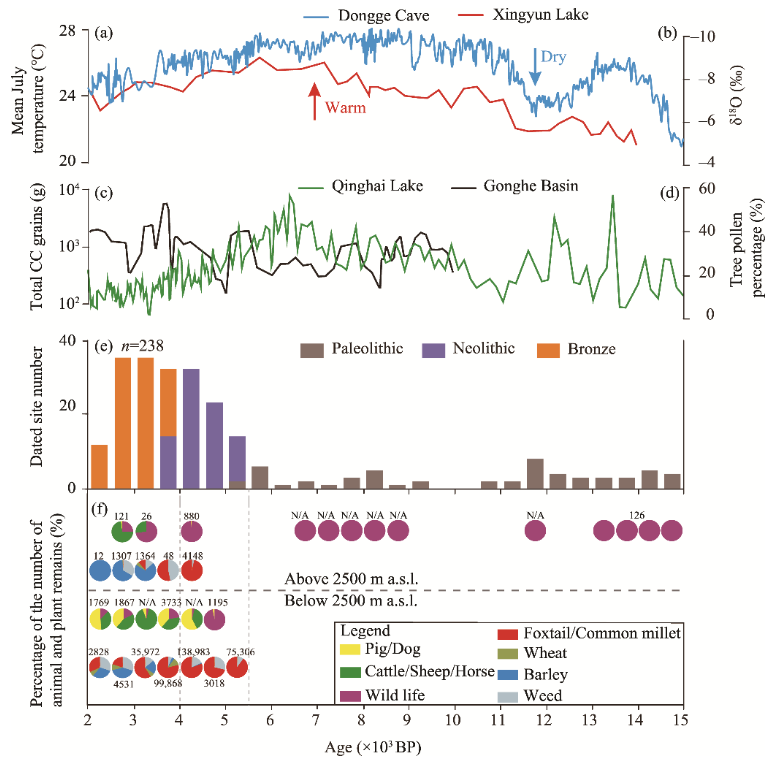
The relationship between the evolution of human societies and their living environments has been discussed intensively in recent decades. It is important to understand the patterns and mechanisms of human–environment interaction and evolution in order to cope with rapidly changing environments in the modern world. We reviewed the results of dating, archaeobotanical, and zooarchaeological studies from 139 prehistoric sites in the Northeast Tibetan Plateau (NETP) and contiguous regions (NETP-CR: i.e., the Hexi Corridor and western margin of the Chinese Loess Plateau) and compared them with paleoenvironmental records to study variations in spatiotemporal patterns of social development in the area and their relationships with climate and vegetation changes. Our results show that hunter-gatherer groups occupied vast areas of the NETP at low intensities during ~15,000–5500 BP (years before present). This was directly related to forest cover and climate change. An increase in temperature and precipitation turnover of vegetation from desert steppe to alpine meadow/subalpine shrub, and recovery of animal population on the Tibetan Plateau created more food resources and space for hunter-gatherers. Millet farmers settled extensively below 2500 m a.s.l. (meters above sea level) in the NETP-CR between ~5500 and 3600 BP, and might have coexisted with hunting groups above 2500 m a.s.l. via subsistence exchange. The distribution of human settlements during that period was affected by climate change, with the relatively warm and wet climate promoting the expansion of millet agriculture to the NETP-CR during 5500–4500 BP, while climate deterioration caused humans to retreat to lower altitudes. During 3600–2200 BP, a range of livelihoods emerged in different regions of the NETP-CR. This was promoted by early trans-Eurasian exchange and the development of an agro-pastoral economy that utilized cold-tolerant crops and livestock. This eventually promoted the expansion of permanent human settlements to high-altitude areas in the NETP. This study found that human societies adopted various strategies to adapt to the changing living environment throughout late prehistoric times in the NETP-CR. The results provide a long-term perspective on the trajectory of regional socio-environmental co-evolution.
Huihui Cao , Guanghui Dong . Social development and living environment changes in the Northeast Tibetan Plateau and contiguous regions during the late prehistoric period[J]. Regional Sustainability, 2020 , 1(1) : 59 -67 . DOI: 10.1016/j.regsus.2020.09.001
| [1] | Aldenderfer, M ., 2011. Peopling the Tibetan Plateau: insights from archaeology. High Alt. Med. Biol. 12(2), 141-147. |
| [2] | An, J.Y., Chen, H.H. , 2010. Report of the faunal remains from Zongri Culture sites. In: Henan Provincial Institute of Cultural Relics and Archaeology (ed.). The first series of Chinese zooarchaeology. Beijing: Cultural Relics. 232-240. (in Chinese) |
| [3] | Barton, L., Newsome, S.D., Chen, F.H ., et al., 2009. Agricultural origins and the isotopic identity of domestication in northern China. Proc. Natl. Acad. Sci. U. S. A. 106(14), 5523-5528. |
| [4] | Brantingham, P.J., Gao, X., Olsen, J.W ., et al., 2007. A short chronology for the peopling of the Tibetan Plateau. Developments in Quaternary Sciences. 9, 129-150. |
| [5] | Brantingham, P.J., Gao, X., Madsen, D.B ., et al., 2013. Late occupation of the high-elevation northern Tibetan Plateau based on cosmogenic, luminescence, and radiocarbon ages. Geoarchaeology. 28(5), 413-431. |
| [6] | Bronk Ramsey, C ., 2017. OxCal version 4.3.2. https://c14.arch.ox.ac.uk/oxcal.html. |
| [7] | Bureau of National Cultural Relics, 1996. Atlas of Chinese Cultural Relics-Fascicule of Qinghai Province. Beijing: China Cartograghic Publishing House Press. (in Chinese) |
| [8] | Bureau of National Cultural Relics, 2011. Atlas of Chinese Cultural Relics-Fascicule of Gansu Province. Beijing: Surveying and Mapping Press. (in Chinese) |
| [9] | Chen, F.H., Dong, G.H., Zhang, D.J ., et al., 2015. Agriculture facilitated permanent human occupation of the Tibetan Plateau after 3600 B.P. Science. 347(6219), 248-250. |
| [10] | Chen, F.H., Fu, B.J., Xia, J ., et al., 2019a. Major advances in studies of the physical geography and living environment of China during the past 70 years and future prospects. Sci. China-Earth Sci. 62(11), 1665-1701. |
| [11] | Chen, F.H., Welker, F., Shen, C.C ., et al., 2019b. A late Middle Pleistocene Denisovan mandible from the Tibetan Plateau. Nature. 569(7756), 409-412. |
| [12] | Chen, H.H., Ge, S.B., Li, G.L ., 1998. A tentative study of the cultural nature of Zongri Culture. Archaeology. ( 5), 15-26. (in Chinese) |
| [13] | Chen, S.Q ., 2006. Adaptive changes of hunter-gatherers during the late Pleistocene-early Holocene transition in China. Acta Anthropologica Sinica. 25, 195-207. (in Chinese) |
| [14] | Cheng, Z.J., Weng, C.Y., Steinke, S ., et al., 2018. Anthropogenic modification of vegetated landscapes in southern China from 6,000 years ago. Nat. Geosci. 11(12), 939-943. |
| [15] | Cheung, C., Jing, Z.C., Tang, J.G ., et al., 2017. Examining social and cultural differentiation in early Bronze Age China using stable isotope analysis and mortuary patterning of human remains at Xin’anzhuang, Yinxu. Archaeol. Anthropol. Sci. 9(5), 799-816. |
| [16] | Cui, Y.F., Yang, Y.S., Zhang, S.J ., et al., 2020. Discuss on the trade and motive force of Majiayao cultural painted pottery in Gansu-Qinghai region. Quaternary Sciences. 40(2), 538-546. (in Chinese) |
| [17] | Cui, Y.P., Hu, Y.W., Chen, H.H ., et al., 2006. Stable isotopic analysis on human bones from Zongri site. Quaternary Sciences. 26(4), 604-611. (in Chinese) |
| [18] | d’Alpoim, Guedes , J.A., 2015. Rethinking the spread of agriculture to the Tibetan Plateau. Holocene. 25(9), 1498-1510. |
| [19] | d’Alpoim Guedes, J.A., Lu, H.L., Hein, A.M ., et al., 2015. Early evidence for the use of wheat and barley as staple crops on the margins of the Tibetan Plateau. Proc. Natl. Acad. Sci. U. S. A. 112(18), 5625-5630. |
| [20] | d’Alpoim, Guedes , J.A., 2018. Did foragers adopt farming? A perspective from the margins of the Tibetan Plateau. Quat. Int. 489(S1), 91-100. |
| [21] | Dodson, J.R., Li, X.Q., Zhou, X.Y ., et al., 2013. Origin and spread of wheat in China. Quat. Sci. Rev. 72, 108-111. |
| [22] | Dong, G.H., Jia, X., An, C.B ., et al., 2012. Mid-Holocene climate change and its effect on prehistoric cultural evolution in eastern Qinghai Province, China. Quat. Res. 77(1), 23-30. |
| [23] | Dong, G.H., Jia, X., Elston, R ., et al., 2013a. Spatial and temporal variety of prehistoric sites and its influencing factors in the upper Yellow River valley, Qinghai Province, China. J. Archaeol. Sci. 40(5), 2538-2546. |
| [24] | Dong, G.H., Wang, L., Cui, Y.F ., et al., 2013b. The spatiotemporal pattern of the Majiayao cultural evolution and its relation to climate change and variety of subsistence strategy during late Neolithic period in Gansu and Qinghai Provinces, northwest China. Quat. Int. 316, 155-161. |
| [25] | Dong, G.H., Ren, L.L., Jia, X ., et al., 2016. Chronology and subsistence strategy of Nuomuhong culture in the Tibetan Plateau. Quat. Int. 426, 42-49. |
| [26] | Dong, G.H., Liu, F.W., Chen, F.H ., 2017. Environmental and technological effects on ancient social evolution at different spatial scales. Sci. China-Earth Sci. 60(12), 2067-2077. |
| [27] | Dong, G.H ., 2018. Understanding past human-environment interaction from an interdisciplinary perspective. Sci. Bull. 63(16), 1023-1024. |
| [28] | Dong, G.H., Yang, Y.S., Liu, X.Y ., et al., 2018. Prehistoric trans-continental cultural exchange in the Hexi Corridor, northwest China. Holocene. 28(4), 621-628. |
| [29] | Dong, G.H., Li, R., Lu, M.X ., et al., 2020. Evolution of human-environmental interactions in China from the Late Paleolithic to the Bronze Age. Prog. Phys. Geogr. 44(2), 233-250. |
| [30] | Dykoski, C.A., Edwards, R.L., Cheng, H ., et al., 2005. A high-resolution, absolute-dated Holocene and deglacial Asian monsoon record from Dongge Cave, China. Earth Planet. Sci. Lett. 233(1-2), 71-86. |
| [31] | Elston, R.G., Dong, G.H., Zhang, D.J ., 2011. Late Pleistocene intensification technologies in Northern China. Quat. Int. 242(2), 401-415. |
| [32] | Fiorentino, G., Caldara, M., De Santis, V ., et al., 2013. Climate changes and human-environment interactions in the Apulia region of southeastern Italy during the Neolithic period. Holocene. 23(9), 1297-1316. |
| [33] | Gai, P., Wang, G.D ., 1983. Excavation report on a Mesolithic site at Layihai, upper Yellow River. Acta Anthropologica Sinica. 2(1), 49-59, 116. (in Chinese) |
| [34] | Hou, G.L., Xu, C.J., Fan, Q.S ., 2010. Three expansions of prehistoric humans towards northeast margin of Qinghai-Tibet Plateau and environmental change. Acta Geographica Sinica. 65(1), 65-72. (in Chinese) |
| [35] | Hou, G.L., Lai, Z.P., Sun, Y.J ., et al., 2013. Impact of the Holocene climatic optimum on human activities in the northeastern margin of the Qinghai-Tibetan Plateau. Arid Land Geography. 36(6), 971-978. (in Chinese) |
| [36] | Hou, G.L., Cao, G.C., E, C.Y ., et al., 2016. New evidence of human activities at an altitude of 4000 meters area of Qinghai-Tibetan Plateau. Acta Geographica Sinica. 71(7), 1231-1240. (in Chinese) |
| [37] | Hou, J.Z., Huang, Y.S., Zhao, J.T ., et al., 2016. Large Holocene summer temperature oscillations and impact on the peopling of the northeastern Tibetan Plateau. Geophys. Res. Lett. 43(3), 1323-1330. |
| [38] | Huang, W.W., Chen, K.Z., Yuan, B.Y. , 1987. Discovery of Paleolithic Artifacts in the Xiao Qaidam Lake Area, Qinghai Province. Beijing: Sciences Press. (in Chinese) |
| [39] | Huang, X.Z., Liu, S.S., Dong, G.H ., et al., 2017. Early human impacts on vegetation on the northeastern Qinghai-Tibetan Plateau during the middle to late Holocene. Prog. Phys. Geogr. 41(3), 286-301. |
| [40] | Hong, L.Y., Cui, J.F., Chen, H.H ., 2012. Migration, trade, imitation and innovation: analysis of the Late Neolithic pottery from the Zongri site. A Collection of Studies on Archaeology. 19, 325-345. (in Chinese) |
| [41] | Institute of Archaeology, Chinese Academy of Social Sciences, 2011. Science for Archaeology (3 rd album) . Beijing: Science press, 80-99. (in Chinese) |
| [42] | Jia, X., Dong, G.H., Li, H ., et al., 2013. The development of agriculture and its impact on cultural expansion during the late Neolithic in the Western Loess Plateau, China. Holocene. 23(1), 85-92. |
| [43] | Li, S.C ., 2005. Regional characteristics and interaction of early copper smelting between northwest and Central Plain of China. Acta Archaeologica Sinica.( 3), 239-275, 278. (in Chinese) |
| [44] | Li, X., Zhang, S.J., Lu, M.X ., et al., 2020. Dietary shift and social hierarchy from the Proto-Shang to Zhou Dynasty in the Central Plains of China. Environ. Res. Lett. 15(3), doi: 10.1088/1748-9326/ab6783 |
| [45] | Li, Y.C., Tian, J.Y., Liu, F.W ., et al., 2019. Neolithic millet farmers contributed to the permanent settlement of the Tibetan Plateau by adopting barley agriculture. Natl. Sci. Rev. 6(5), 1005-1013. |
| [46] | Liu, X.Y., Jones, P.J., Matuzeviciute, G.M ., et al., 2019. From ecological opportunism to multi-cropping: Mapping food globalisation in prehistory. Quat. Sci. Rev. 206, 21-28. |
| [47] | Ma, M.M., Dong, G.H., Jia, X ., et al., 2016. Dietary shift after 3600 cal yr BP and its influencing factors in northwestern China: evidence from stable isotopes. Quat. Sci. Rev. 145, 57-70. |
| [48] | Madsen, D.B., Ma, H.Z., Brantingham, P.J ., et al., 2006. The Late Upper Paleolithic occupation of the northern Tibetan Plateau margin. J. Archaeol. Sci. 33(10), 1433-1444. |
| [49] | Madsen, D.B., Perreault, C., Rhode, D ., et al., 2017. Early foraging settlement of the Tibetan Plateau highlands. Archaeological Research in Asia. 11, 15-26. |
| [50] | Marinova, E., Atanassova, J ., 2006. Anthropogenic impact on vegetation and environment during the Bronze Age in the area of Lake Durankulak, NE Bulgaria: pollen, microscopic charcoal, non-pollen palynomorphs and plant macrofossils. Rev. Palaeobot. Palynology. 141(1-2), 165-178. |
| [51] | Marshall, F., Reid, R.E.B., Goldstein, S ., et al., 2018. Ancient herders enriched and restructured African grasslands. Nature. 561(7723), 387-390. |
| [52] | Meyer, M.C., Aldenderfer, M.S., Wang, Z ., et al., 2017. Permanent human occupation of the central Tibetan Plateau in the early Holocene. Science. 355(6320), 64-67. |
| [53] | Miao, Y.F., Zhang, D.J., Cai, X.M ., et al., 2017. Holocene fire on the northeast Tibetan Plateau in relation to climate change and human activity. Quat. Int. 443, 124-131. |
| [54] | Qiang, M.R., Song, L., Jin, Y.X ., et al., 2017. A 16-ka oxygen-isotope record from Genggahai Lake on the northeastern Qinghai-Tibetan Plateau: hydroclimatic evolution and changes in atmospheric circulation. Quat. Sci. Rev. 162, 72-87. |
| [55] | Reimer, P.J., Bard, E., Bayliss, A ., et al., 2013. IntCal13 and Marine13 radiocarbon age calibration curves 0-50,000 years cal BP. Radiocarbon. 55(4), 1869-1887. |
| [56] | Ren, L.L ., 2017. A study on animal exploitation strategies from the late Neolithic to Bronze Age in northeastern Tibetan Plateau and its surrounding areas, China. PhD Dissertation. Lanzhou: Lanzhou University. (in Chinese) |
| [57] | Ren, L.L., Dong, G.H., Liu, F.W ., et al., 2020. Foraging and farming: archaeobotanical and zooarchaeological evidence for Neolithic exchange on the Tibetan Plateau. Antiquity. 94(375), 637-652. |
| [58] | Revelles, J., Burjachs, F., Palomo, A ., et al., 2018. Human-environment interaction during the Mesolithic- Neolithic transition in the NE Iberian Peninsula. Vegetation history, climate change and human impact during the Early-Middle Holocene in the Eastern Pre-Pyrenees. Quat. Sci. Rev. 184, 183-200. |
| [59] | Rhode, D., Zhang, H.Y., Madsen, D.B ., et al., 2007. Epipaleolithic/early Neolithic settlements at Qinghai Lake, western China. J. Archaeol. Sci. 34(4), 600-612. |
| [60] | Rhode, D., Brantingham, P.J., Perreault, C ., et al., 2014. Mind the gaps: testing for hiatuses in regional radiocarbon date sequences. J. Archaeol. Sci. 52, 567-577. |
| [61] | Samuels, K.L ., 2016. The cadence of climate: heritage proxies and social change. J. Soc. Archaeol. 16(2), 142-163. |
| [62] | Shen, J., Liu, X.Q., Wang, S.M ., et al., 2005. Palaeoclimatic changes in the Qinghai Lake area during the last 18,000 years. Quat. Int. 136, 131-140. |
| [63] | Spengler, R., Frachetti, M., Doumani, P ., et al., 2014. Early agriculture and crop transmission among Bronze Age mobile pastoralists of Central Eurasia. Proc. R. Soc. B-Biol. Sci. 281(1783), doi: 10.1098/rspb.2013.3382 |
| [64] | Sun, Y.J., Lai, Z.P., Long, H ., et al., 2010. Quartz OSL dating of archaeological sites in Xiao Qaidam Lake of the NE Qinghai-Tibetan Plateau and its implications for palaeoenvironmental changes. Quat. Geochronol. 5(2-3), 360-364. |
| [65] | Tallavaara, M., Eronen, J.T., Luoto, M ., 2018. Productivity, biodiversity, and pathogens influence the global hunter-gatherer population density. Proc. Natl. Acad. Sci. U. S. A. 115(6), 1232-1237. |
| [66] | Tang, H.S., Zhou, C.L., Li, Y.Q ., et al., 2013. A new discovery of microlithic information at the entrance to the Northern Qingzang Plateau of the Kunlun Mountains of Qinghai. Chinese Science Bulletin. 58(3), 247-253. (in Chinese) |
| [67] | Wang, J., Xia, H., Yao, J.T ., et al., 2020. Subsistence strategies of prehistoric hunter-gatherers on the Tibetan Plateau during the Last Deglaciation. Sci. China-Earth Sci. 63(3), 395-404. |
| [68] | Wang, L., Yang, Y.S., Jia, X ., 2016. Hydrogeomorphic settings of late Paleolithic and early-mid Neolithic sites in relation to subsistence variation in Gansu and Qinghai Provinces, northwest China. Quat. Int. 426, 18-25. |
| [69] | Wang, Y.R ., 2017. Identify the beginning of sheep husbandry in western China. PhD Dissertation. Cambridge: University of Cambridge. |
| [70] | Wu, D., Chen, X.M., Lv, F.Y ., et al., 2018. Decoupled early Holocene summer temperature and monsoon precipitation in southwest China. Quat. Sci. Rev. 193, 54-67. |
| [71] | Xie, D.J. , 2002. Prehistoric Archaeology of Gansu Province and Qinghai Province. Beijing: Cultural Relics Press. (in Chinese) |
| [72] | Yang, Y.S., Dong, G.H., Zhang, S.J ., et al., 2017. Copper content in anthropogenic sediments as a tracer for detecting smelting activities and its impact on environment during prehistoric period in Hexi Corridor, Northwest China. Holocene. 27(2), 282-291. |
| [73] | Yang, Y.S., Ren, L.L., Dong, G.H ., et al., 2019a. Economic change in the prehistoric Hexi Corridor (4800-2200 BP), north-west China. Archaeometry. 61(4), 957-976. |
| [74] | Yang, Y.S., Zhang, S.J., Oldknow, C ., et al., 2019b. Refined chronology of prehistoric cultures and its implication for re-evaluating human-environment relations in the Hexi Corridor, northwest China. Sci. China-Earth Sci. 62(10), 1578-1590. |
| [75] | Yi, M.J., Gao, X., Zhang, X.L ., et al., 2011. A preliminary report on investigations in 2009 of some prehistoric sites in the Tibetan Plateau marginal region. Acta Anthropologica Sinica. 30(2), 124-136. (in Chinese) |
| [76] | Zhang, D.J., Dong, G.H., Wang, H ., et al., 2016. History and possible mechanisms of prehistoric human migration to the Tibetan Plateau. Sci. China-Earth Sci. 59(9), 1765-1778. |
| [77] | Zhang, J., Huang, X.Z., Wang, Z.L ., et al., 2018. A late-Holocene pollen record from the western Qilian Mountains and its implications for climate change and human activity along the Silk Road, Northwestern China. Holocene. 28(7), 1141-1150. |
| [78] | Zhang, S.J., Dong, G.H ., 2017. Human adaptation strategies to different altitude environment during mid-late Bronze age in northeast Tibetan Plateau. Quaternary Sciences. 37(4), 696-708. (in Chinese) |
| [79] | Zhang, S.J., Yang, Y.S., Storozum, M.J ., et al., 2017. Copper smelting and sediment pollution in Bronze Age China: a case study in the Hexi Corridor, Northwest China. Catena. 156, 92-101. |
| [80] | Zhang, X.H ., 2012. Plant archaeological survey and achievement in Guanting basin, Qinghai Province and related issues. Archaeology and Cultural Relics. ( 3), 26-33. (in Chinese) |
| [81] | Zhang, X.L., Ha, B.B., Wang, S.J ., et al., 2018. The earliest human occupation of the high-altitude Tibetan Plateau 40 thousand to 30 thousand years ago. Science. 362(6418), 1049-1051. |
| [82] | Zhou, X.Y., Li, X.Q., Dodson, J ., et al., 2012. Land degradation during the Bronze Age in Hexi Corridor (Gansu, China). Quat. Int. 254, 42-48. |
| [83] | Zhou, X.Y., Li, X.Q., Dodson, J ., et al., 2016. Rapid agricultural transformation in the prehistoric Hexi Corridor, China. Quat. Int. 426, 33-41. |
| [84] | Zhuang, Y.J., Kidder, TR ., 2014. Archaeology of the Anthropocene in the Yellow River region, China, 8000-2000 cal. BP. Holocene. 24(11), 1602-1623. |
/
| 〈 |
|
〉 |
 REGSUS Wechat
 新公网安备 65010402001202号