

Potential risks and challenges of climate change in the arid region of northwestern China
Received date: 2020-04-12
Revised date: 2020-06-01
Accepted date: 2020-06-27
Online published: 2020-10-20
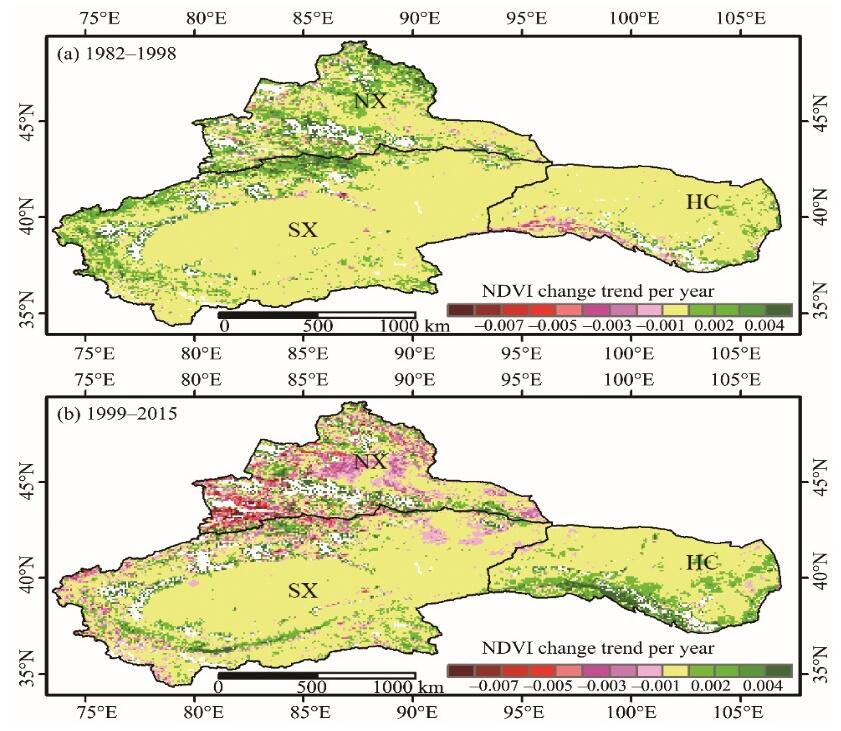
In the arid region of northwestern China (ARNC), water resources are the most critical factor restricting socioeconomic development and influencing the stability of the area’s ecological systems. The region’s complex water system and unique hydrological cycle show distinctive characteristics. Moreover, the intensified hydrological cycle and extreme climatic and hydrological events resulting from global warming have led to increased uncertainty around water resources as well as heightened conflict between water supply and water demand. All of these factors are exerting growing pressures on the socioeconomic development and vulnerable ecological environment in the region. This research evaluates the impacts of climate change on water resources, hydrological processes, agricultural system, and desert ecosystems in the ARNC, and addresses some associated risks and challenges specific to this area. The temperature is rising at a rate of 0.31°C per decade during 1961-2017 and hydrological processes are being significantly influenced by changes in glaciers, snow cover, and precipitation form, especially in the rivers recharged primarily by melt water. Ecosystems are also largely influenced by climate change, with the Normalized Difference Vegetation Index (NDVI) of natural vegetation exhibited an increasing trend prior to 1998, and then reversed in Xinjiang while the Hexi Corridor of Gansu showed the opposite trends. Furthermore, the desert-oasis transition zone showed a reduction in area due to the warming trend and the recent rapid expansion of irrigated area. Both the warming and intensified drought are threatening agriculture security. The present study could shed light on sustainable development in this region under climate change and provides scientific basis to the construction of the “Silk Road Economic Belt”.
Yaning Chen , Xueqi Zhang , Gonghuan Fang , Zhi Li , Fei Wang , Jingxiu Qin , Fan Sun . Potential risks and challenges of climate change in the arid region of northwestern China[J]. Regional Sustainability, 2020 , 1(1) : 20 -30 . DOI: 10.1016/j.regsus.2020.06.003
| [1] | Barnett, T.P., Adam, J.C., Lettenmaier, D.P ., 2005. Potential impacts of a warming climate on water availability in snow-dominated regions. Nature. 438, 303-309. |
| [2] | Berdugo, M., Delgado-Baquerizo, M., Soliveres, S ., et al., 2020. Global ecosystem thresholds driven by aridity. Science. 367(6479), 787-790. |
| [3] | Berghuijs, W.R., Woods, R.A., Hrachowitz, M ., et al., 2014. A precipitation shift from snow towards rain leads to a decrease in streamflow. Nature Clim. Change. 4, 583-586. |
| [4] | Best, J ., 2019. Anthropogenic stresses on the world’s big rivers. Nature Geosci. 12, 7-21. |
| [5] | Chen, Y.N ., 2014. Water Resources Research in Northwest China. New York: Springer, 440. doi: 10.1007/978-94-017-8017-9. |
| [6] | Chen, Y.N., Deng, H.J., Li, B.F ., et al., 2014. Abrupt change of temperature and precipitation extremes in the arid region of Northwest China. Quaternary International. 336, 35-43. |
| [7] | Chen, Y.N., Li, Z., Li, W ., et al., 2016a. Water and ecological security: dealing with hydroclimatic challenges at the heart of China’s Silk Road. Environ. Earth Sci. 75(10), 881. |
| [8] | Chen, Y.N, Li, W.H., Deng, H.J ., et al., 2016 b. Changes in Central Asia’s water tower: Past, present and future. Sci. Rep. 6, 35458. doi: 10.1038/srep35458. |
| [9] | Chen, Y.N., Li, Z., Fang, G.H ., et al., 2017. Impact of climate change on water resources in the Tianshan Mountians, Central Asia. Acta Geographic Sinica. 72(1), 18-26. (in Chinese) |
| [10] | Deng, H.J., Chen, X., Shi, W ., et al., 2014. Dynamics of temperature and precipitation extremes and their spatial variation in the arid region of northwest China. Atmos. Res. 138, 346-355. |
| [11] | Deng, H.J., Chen, Y.N ., 2017. Influences of recent climate change and human activities on water storage variations in Central Asia. J. Hydrol. 544, 46-57. |
| [12] | Deng, H.Y., Yin, Y.H., Wu, S.H ., et al., 2019. Contrasting drought impacts on the start of phenological growing season in Northern China during 1982-2015. Int. J. Clim. 40(7), 3330-3347. |
| [13] | Deng, Z.Y., Zhang, Q., Xu, J.F ., et al., 2009. Comparative studies on the harm characteristic of hot-dry wind and high temperature heat waves. Advances in Earth Science. 24(8), 865-873. (in Chinese) |
| [14] | Durack, P.J., Wijffels, S.E., Matear, R.J ., 2012. Ocean salinities reveal strong global water cycle intensification during 1950 to 2000. Science. 336(6080), 455-458. |
| [15] | Fang, G.H., Yang, J., Chen, Y.N ., et al., 2018a. How hydrologic processes differ spatially in a large basin: multisite and multiobjective modeling in the Tarim River Basin. J. Geophys. Res. Atmos. 123(4), 7089-7113. |
| [16] | Fang, G.H., Chen, Y.N., Li, Z ., 2018b. Variation in agricultural water demand and its attributions in the arid Tarim River Basin. J. Agricul. Sci. 156(3), 301-311. |
| [17] | Gao, X., Zhang, S.Q., Ye, B.S ., et al., 2011. Recent changes of glacier runoff in the Hexi Inland river basin. Adv. Water Sci. 22(3), 344-350. (in Chinese) |
| [18] | Harris, I.C., Jones, P.D ., 2019. CRU TS3.26: Climatic Research Unit (CRU) Time-Series (TS) Version 3.26 of High-Resolution Gridded Data of Month-by-month Variation in Climate. Centre for Environmental Data Analysis, University of East Anglia Climatic Research Unit. doi: 10.5285/7ad889f2cc1647efba7e6a356098e4f3. |
| [19] | Huang, J.P., Yu, H.P., Guan, X.D ., et al., 2016. Accelerated dryland expansion under climate change. Nat. Clim. Change. 6(2), 166-171. |
| [20] | Immerzeel, W.W., Lutz, A.F., Andrade, M ., et al., 2020. Importance and vulnerability of the world’s water towers. Nature. 577, 364-369. |
| [21] | Jin, L.Y., Li, J., Wang, X ., et al., 2004. The temporal and spatial distribution of surface dry-wet conditions over Northwestern China in recent 50 years. Acta Geographic Sinica. 59(6), 847-854. (in Chinese) |
| [22] | Kong, Y.L., Pang, Z.H ., 2012. Evaluating the sensitivity of glacier rivers to climate change based on hydrograph separation of discharge. J. Hydrol. 434-435, 121-129. |
| [23] | Li, B.F., Chen, Y.N., Shi, X ., 2012. Why does the temperature rise faster in the arid region of northwest China? J Geophys. Res. 117(D16), 115. doi: 10.1029/2012JD017953. |
| [24] | Li, B.F., Chen, Y.N., Shi, X ., et al., 2013. Temperature and precipitation changes in different environments in the arid region of northwest China. Theor. Appl. Climatol. 112(3), 589-596. |
| [25] | Li, Y.P., Chen, Y.N., Li, Z ., 2019. Dry/wet pattern changes in global dryland areas over the past six decades. Global Planet. Change. 178, 184-192. |
| [26] | Li, Z., Chen, Y.N., Shen, Y ., et al., 2013. Analysis of changing pan evaporation in the arid region of Northwest China. Water Resour. Res. 49(4), 2205-2212. |
| [27] | Li, Z., Chen, Y.N., Li, W.H ., et al., 2015. Potential impacts of climate change on vegetation dynamics in Central Asia. J. Geophys. Res. Atmos. 120(24), 12345-12356. |
| [28] | Li, Z., Chen, Y.N., Fang, G.H ., et al., 2017. Multivariate assessment and attribution of droughts in Central Asia. Sci. Rep. 7, 1316. doi: 10.1038/s41598-017-01473-1. |
| [29] | Li, Z., Fang, G.H., Chen, Y.N ., et al., 2020a. Agricultural water demands in Central Asia under 1.5°C and 2.0°C global warming. Agr. Water Manage. 231, 106020. doi: 10.1016/j.agwat.2020.106020. |
| [30] | Li, Z., Chen, Y.N., Li, Y.P ., 2020 b. Declining snowfall fraction in the alpine regions, central Asia. Sci Rep. 10, 3476. doi: 10.1038/s41598-020-60303-z. |
| [31] | Li, Z.Q., Li, K.M., Wang, L ., 2010. Research on recent changes of Xinjiang glacier and its impact on water resources. Quaternary Sciences. 30(1), 96-106. (in Chinese) |
| [32] | Liu, D.X., Dong, A.X., Deng, Z.Y ., 2005. Impact of climate warming on agriculture in Northwest China. Journal of Natural Resources. 1, 119-125. (in Chinese) |
| [33] | Liu, X.M., Zhang, D., Luo, Y.Z ., et al., 2013. Spatial and temporal changes in aridity index in northwest China: 1960 to 2010. Theor. Appl. Climatol. 112(1), 307-316. |
| [34] | Liu, Y.S., Liu, Y., Guo, L.Y ., 2010. Impact of climatic change on agricultural production and response strategies in China. Chinese Journal of Eco-Agriculture. 18(4), 905-910. (in Chinese) |
| [35] | Piao, S.L., Ciais, P., Huang, Y ., et al., 2010. The impacts of climate change on water resources and agriculture in China. Nature. 467(7311), 43-51. |
| [36] | Qin, D.H., Ding, Y.H., Wang, S.W ., et al., 2002. A study of environment change and its impacts in western China. Earth Science Frontiers. 9(2), 321-328. (in Chinese) |
| [37] | Regonda, S. K., Rajagopalan, B., Clark, M ., 2005. Seasonal cycle shifts in hydroclimatology over the western United States. J. Climate. 18(2), 372-384. |
| [38] | Shen, Y.P., Su, H.C., Wang, G.Y ., et al., 2013. The responses of glaciers and snow cover to climate change in Xinjiang (I): hydrological effects. Journal of Glaciology and Geocryology. 35(3), 513-527. (in Chinese) |
| [39] | Sun, M.P., Li, Z.Q., Yao, X.J ., et al., 2013. Rapid shrinkage and hydrological response of a typical continental glacier in the arid region of northwest China: Taking Urumqi Glacier No. 1 as an example. Ecohydrology. 6(6), 909-916. |
| [40] | Swain, D.L., Langenbrunner, B., Neelin, J.D ., et al., 2018. Increasing precipitation volatility in twenty-first-century California. Nat. Clim. Change. 8, 427-433. |
| [41] | Trenberth, K.E ., 2011. Changes in precipitation with climate change. Clim. Res. 47(1-2), 123-138. |
| [42] | Wang, H.J., Chen, Y.N., Pan, Y.P ., 2015a. Characteristics of drought in the arid region of northwestern China. Clim. Res. 62(2), 99-113. |
| [43] | Wang, H.J., Chen, Y.N., Pan, Y.P ., et al., 2015b. Spatial and temporal variability of drought in the arid region of China and its relationships to teleconnection indices. J. Hydrol. 523, 283-296. |
| [44] | Wang, H.J., Chen, Y.N., Li, W ., 2015c. Characteristics in streamflow and extremes in the Tarim River, China: Trends, distribution and climate linkage. Int. J. Climatol. 35(5), 761-776. |
| [45] | Wang, H.J., Pan, Y.P., Chen, Y.N ., 2017. Comparison of three drought indices and their evolutionary characteristics in the arid region of northwestern China. Atmos. Sci. Let. 18(3), 132-139. |
| [46] | Wang, Y.F., Shen, Y.J., Chen, Y.N ., et al., 2013. Vegetation dynamics and their response to hydroclimatic factors in the Tarim River Basin, China. Ecohydrology. 6(6), 927-936. |
| [47] | Williams, C.A., Albertson, J.D ., 2006. Dynamical effects of the statistical structure of annual rainfall on dryland vegetation. Global Change Biol. 12(5), 777-792. |
| [48] | Xiao, G.J., Zhang, Q., Wang, J ., 2007. Impact of global climate change on agro-ecosystem: A review. Chinese Journal of Applied Ecology. 18(8), 1877-1885. (in Chinese) |
| [49] | Xu, B.R., Lu, Z.X., Liu, S.Y ., et al., 2015. Glacier changes and their impacts on the discharge in the past half-century in Tekes watershed, Central Asia. Phys. Chem. Earth. 89-90, 96-103. |
| [50] | Yang, P., Xia, J., Zhang, Y.Y ., et al., 2017. Temporal and spatial variations of precipitation in Northwest China during 1960-2013. Atmos. Res. 183, 283-295. |
| [51] | Yang, Z.N. , 1991. China Glacier Water Resources. Lanzhou: Gansu Science and Technology Press, 1-158. (in Chinese) |
| [52] | Yao, J.Q., Chen, Y.N., Yang, Q ., 2016a. Spatial and temporal variability of water vapor pressure in the arid region of northwest China, during 1961-2011. Theor. Appl. Climatol. 123(3-4), 683-691. |
| [53] | Yao, J.Q., Yang, Q., Mao, W.Y ., et al., 2016b. Precipitation trend-Elevation relationship in arid regions of the China. Global Planet. Change. 143, 1-9. |
| [54] | Yao, J.Q., Zhao, Y., Chen, Y.N ., et al., 2018. Multi-scale assessments of droughts: A case study in Xinjiang, China. Sci. Total Environ. 630, 444-452. |
| [55] | Zeitoun, M., Goulden, M., Tickner, D ., 2013. Current and future challenges facing transboundary river basin management. Wires. Clim. Change. 4(5), 331-349. |
| [56] | Zhang, R.J., He, X.F ., 1997. Potential effects of climate change on agricultural insect pests. Chinese Journal of Ecology. 6, 37-41. (in Chinese) |
| [57] | Zhou, Y.C. , 1999. Xinjiang River Hydrology and Water Resources. Urumqi: Xinjiang Science and Technology Press, 1-445. (in Chinese) |
| [58] | Zhu, B.W., Xie, X.H., Meng, S.S ., et al., 2020. Sensitivity of soil moisture to precipitation and temperature over China: Present state and future projection. Sci. Total Environ. 705, 135774. doi: 10.1016/j.scitotenv.2019.135774. |
/
| 〈 |
|
〉 |
 REGSUS Wechat
 新公网安备 65010402001202号