

Integrating neglected and underutilized crops (NUCs) in South Asian cropping systems and diets: Challenges and prospects
Received date: 2024-10-28
Revised date: 2025-03-24
Online published: 2025-09-15
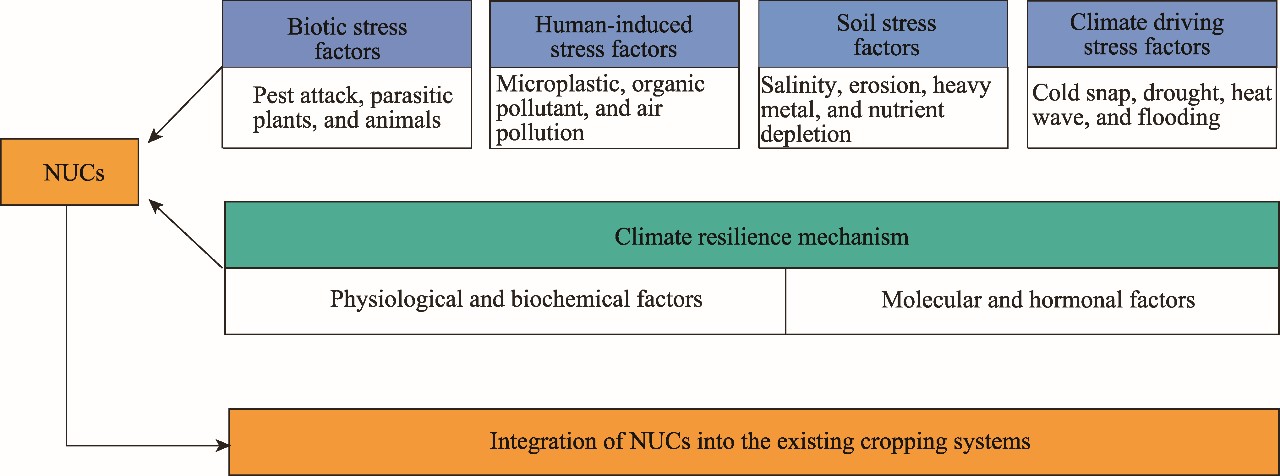
The present review critically examines the role of neglected and underutilized crops (NUCs) in enhancing the resilience of South Asian cropping systems and diets in the context of climate change and nutritional challenges. This analysis reveals that integrating NUCs, such as millets, sorghums, amaranth, and indigenous legumes, into existing cropping systems can significantly improve the climate resilience, dietary diversity, and ecological sustainability of the food systems. These crops exhibit superior tolerance to abiotic stress and offer higher nutritional density compared to staple cereals, such as rice and wheat. However, their adoption faces challenges, including limited research investment, fragmented value chains, etc. We further identify that complementary cropping strategies and climate-smart agriculture (CSA) practices can optimize resource use while boosting smallholder farmers’ income. NUCs are pivotal for the transformation of exist cropping systems towards nutrition-sensitive and climate-resilient agricultural and food systems. Strategic integration of NUCs can simultaneously address food insecurity, biodiversity loss, and rural poverty. Yet, unlocking their potential requires coordinated efforts in genetic improvement, market development, and policy frameworks tailored to regional contexts. This synthesis provides a comprehensive roadmap for policy-makers, researchers, and farmers to leverage NUCs as “Future Smart Food”. By bridging agronomic, nutritional, and socioeconomic perspectives, this study highlights the transformative potential of NUCs in achieving Sustainable Development Goals (SDGs) across South Asian countries.
Saira SHAFIQ , Muhammad ZIA UL HAQ , Syed Abbas RAZA NAQVI , Wardha SARFARAZ , Hina ALI , Muhammad Majid ISLAM , Gul Zaib HASSAN , Muhammad NAWAZ , Tasawer ABBAS . Integrating neglected and underutilized crops (NUCs) in South Asian cropping systems and diets: Challenges and prospects[J]. Regional Sustainability, 2025 , 6(4) : 100242 . DOI: 10.1016/j.regsus.2025.100242
| [1] | Abbas G., Ahmad S., Ahmad A., et al., 2017. Quantification the impacts of climate change and crop management on phenology of maize-based cropping system in Punjab, Pakistan. Agric. For. Meteorol. 247, 42-55. |
| [2] | Aderibigbe O.R., Ezekiel O.O., Owolade S.O., et al., 2022. Exploring the potentials of underutilized grain amaranth (Amaranthus spp.) along the value chain for food and nutrition security: A review. Crit. Rev. Food Sci. Nutr. 62(3), 656-669. |
| [3] | Adhikari L., Hussain A., Rasul G., 2017. Tapping the potential of neglected and underutilized food crops for sustainable nutrition security in the mountains of Pakistan and Nepal. Sustainability. 9(2), 291, doi: 10.3390/su9020291. |
| [4] | Akinola R., Pereira L.M., Mabhaudhi T., et al., 2020. A review of indigenous food crops in Africa and the implications for more sustainable and healthy food systems. Sustainability. 12(8), 3493, doi: 10.3390/su12083493. |
| [5] | Akpojotor U., Oluwole O., Oyatomi O., et al., 2025. Research and developmental strategies to hasten the improvement of orphan crops. GM Crops Food. 16(1), 46-71. |
| [6] | Ali A., Bhattacharjee B., 2023. Nutrition security, constraints, and agro-diversification strategies of neglected and underutilized crops to fight global hidden hunger. Front. Nutr. 10, 1144439, doi: 10.3389/fnut.2023.1144439. |
| [7] | Aryal J.P., Sapkota T.B., Khurana R., et al., 2020. Climate change and agriculture in South Asia: adaptation options in smallholder production systems. Environmental Development and Sustainability. 22, 5045-5075. |
| [8] | Aziz N., He J., Raza A., et al., 2021. Elucidating the macroeconomic determinants of undernourishment in South Asian countries: Building the framework for action. Front. Public Health. 9, 696789, doi: 10.3389/fpubh.2021.696789. |
| [9] | Bhadkaria A., Narvekar D.T., Gupta N., et al., 2022. Moth bean (Vigna aconitifolia (Jacq.) Marechal) seeds: A review on nutritional properties and health benefits. Discovery Food. 2, 18, doi: 10.1007/s44187-022-00019-3. |
| [10] | Bogdanski A., 2012. Integrated food-energy systems for climate-smart agriculture. Agriculture Food Security. 1, 9, doi: 10.1186/2048-7010-1-9. |
| [11] | Chávez-Dulanto P.N., Thiry A.A., Glorio-Paulet P., et al., 2021. Increasing the impact of science and technology to provide more people with healthier and safer food. Food Energy Secur. 10(1), 259, doi: 10.1002/fes3.259. |
| [12] | Chimonyo V.G.P., Chibarabada T.P., Choruma D.J., et al., 2022. Modelling neglected and underutilized crops: A systematic review of progress, challenges, and opportunities. Sustainability. 14, 13931, doi: 10.3390/su142113931. |
| [13] | El-Sayed A., Kamel M., 2020. Climatic changes and their role in emergence and re-emergence of diseases. Environ. Sci. Pollut. Res. 27(18), 22336-22352. |
| [14] | ESSRG(Environmental Social Science Research Group), 2021. Environmental Social Science Research Group. RADIANT Project Encourages Agrobiodiversity and Battles the Monoculture Paradigm. [2024-09-01]. https://www.essrg.hu/en/radiant-project-encourages-agrobiodiversity-and-battles-the-monoculture-paradigm/. |
| [15] | FAO (Food and Agriculture Organization of the United Nations), 2023a. The Plants that Feed the World. [2024-09-01]. https://www.fao.org/newsroom/story/The-plants-that-feed-the-world/en. |
| [16] | FAO, 2023b. International Year of Millets 2023. [2024-09-01]. https://www.icrisat.org/storage/file-managers/file-66f654f1614ca3.48559673.pdf. |
| [17] | Ghosh S., Meyer-Rochow V.B., Jung C., 2023. Embracing tradition: The vital role of traditional foods in achieving nutrition security. Foods. 12(23), 4220, doi: 10.3390/foods12234220. |
| [18] | Goel K., Kundu P., Gahlaut V., et al., 2023. Functional divergence of Heat Shock Factors (Hsfs) during heat stress and recovery at the tissue and developmental scales in C4 grain amaranth (Amaranthus hypochondriacus). Front. Plant Sci. 14, 1151057, doi: 10.3389/fpls.2023.1151057. |
| [19] | Goulart R.Z., Reichert J.M., Rodrigues M.F., 2020. Cropping poorly-drained lowland soils: Alternatives to rice monoculture, their challenges and management strategies. Agric. Sys. 177, 102715, doi: 10.1016/j.agsy.2019.102715. |
| [20] | Grote U., Fasse A., Nguyen T.T., et al., 2021. Food security and the dynamics of wheat and maize value chains in Africa and Asia. Front. Sustain. Food Syst. 4, 617009, doi: 10.3389/fsufs.2020.617009. |
| [21] | Gruère G., Giuliani A., Smale M., 2006. Marketing Underutilized Plant Species for the Benefit of the Poor: A Conceptual Framework. Washington: International Food Policy Research Institute, 1-54. |
| [22] | Gupta S.M., Arora S., Mirza N., et al., 2017. Finger millet: A “certain” crop for an “uncertain” future and a solution to food insecurity and hidden hunger under stressful environments. Front. Plant Sci. 8, 643, doi: 10.3389/fpls.2017.00643. |
| [23] | Habib-ur-Rahman M., Ahmad A., Raza A., et al., 2022. Impact of climate change on agricultural production; Issues, challenges, and opportunities in Asia. Front. Plant Sci. 13, 925548, doi: 10.3389/fpls.2022.925548. |
| [24] | Harish M.S., Bhuker A., Chauhan B.S., 2024. Millet production, challenges, and opportunities in the Asia-Pacific region: a comprehensive review. Front. Sustain. Food Syst. 8, 1386469, doi: 10.3389/fsufs.2024.1386469. |
| [25] | Hassan Z.M., Sebola N.A., Mabelebele M., 2021. The nutritional use of millet grain for food and feed: A review. Agric. Food Secur. 10, 16, doi: 10.1186/s40066-020-00282-6. |
| [26] | Horizon Europe, 2024. New Sustainable Business and Production Models for Farmers and Rural Communities. [2024-09-17]. https://cordis.europa.eu/programme/id/HORIZON_HORIZON-CL6-2024-COMMUNITIES-02-2-two-stage. |
| [27] | ICRISAT(International Crops Research Institute for the Semi-Arid Tropics), 2003. Alternative Uses of Sorghum and Pearl Millet in Asia. [2024-09-17]. https://oar.icrisat.org/3555/1/AlternativeUses.pdf. |
| [28] | Ifeh C., 2024. How AI Can Expedite Underutilized Crop Innovation for Mitigating Climate Change. [2024-09-17]. https://www.climaterealityproject.org/blog/how-ai-can-expedite-underutilized-crop-innovation-mitigating-climate-change. |
| [29] | Ikhajiagbe B., Ogwu M.C., Ogochukwu O.F., et al., 2022. The place of neglected and underutilized legumes in human nutrition and protein security in Nigeria. Crit. Rev. Food Sci. Nutr. 62(14), 3930-3938. |
| [30] | IPCC (Intergovernmental Panel on Climate Change), 2014. The IPCC’s Fifth Assessment Report. What’s in It for South Asia? [2024-09-17]. https://innovation.brac.net/fif2016/images/library/CDKN-IPCC-Whats-in-it-for-South-Asia-AR5.pdf. |
| [31] | Jaenicke H., Lengkeek A., 2006. Marketing the products of underutilized crops-challenges and opportunities for pro-poor economic development. In: XXVII International Horticultural Congress-IHC, 2006: International Symposium on Cultivation and Utilization of Asian. Seoul, Korea. |
| [32] | Jagdale Y.D., Mahale S.V., Zohra B., et al., 2021. Nutritional profile and potential health benefits of super foods: A review. Sustainability. 13(16), 9240, doi: 10.3390/su13169240. |
| [33] | Jang J.A., Oh J.E., Na Y., et al., 2021. Emotions evoked by colors and health functionality information of colored rice: A cross-cultural study. Foods. 10(2), 231, doi: 10.3390/foods10020231. |
| [34] | Jayathilake C., Visvanathan R., Deen A., et al., 2018. Cowpea: An overview on its nutritional facts and health benefits. J. Sci. Food Agric. 98(13), 4793-4806. |
| [35] | Joshi B.K., Shrestha R., Gauchan D., et al., 2020. Neglected, underutilized, and future smart crop species in Nepal. J. Crop Improv. 34(3), 291-313. |
| [36] | Joshi B.K., Mainali R.P., Bhandari S., et al., 2023. Neglected and underutilized crop species of Nepal: Smart foods for uncertain future. J. Agric. Environ. 24, 187-196. |
| [37] | Karunaratne A.S., Wimalasiri E.M., Esham M., et al., 2024. Editorial: Crop modelling-underutilized crops for climate-smart agrifood systems. Front. Sustain. Food Syst. 8, 1305909, doi: 10.3389/fsufs.2024.1305909. |
| [38] | Kumar A., Anju T., Kumar S., et al., 2021. Integrating omics and gene editing tools for rapid improvement of traditional food plants for diversified and sustainable food security. National Library of Medicine. 22(15), 8093, doi: 10.3390/ijms22158093. |
| [39] | Kunene S., Odindo A., Gerrano A., et al., 2022. Screening bambara groundnut (Vigna subterranea L. Verdc) genotypes for drought tolerance at the germination stage under simulated drought conditions. Plants. 11, 3562, doi: 10.3390/plants11243562. |
| [40] | Lambers H., de Britto Costa P., Oliveira R.S., et al., 2020. Towards more sustainable cropping systems: Lessons from native Cerrado species. Theor. Exp. Plant Physiol. 32(3), 175-194. |
| [41] | Li X., Siddique K.H.M., 2018. Future Smart Food-Rediscovering Hidden Treasures of Neglected and Underutilized Species for Zero Hunger in Asia. Bangkok: FAO, 242. |
| [42] | Li X., Yadav R., Siddique K.H.M., 2020. Neglected and underutilized crop species: The key to improving dietary diversity and fighting hunger and malnutrition in Asia and the Pacific. Front. Nutr. 7, 593711, doi: 10.3389/fnut.2020.593711. |
| [43] | Mabhaudhi T., Hlahla S., Chimonyo V.G.P., et al., 2022. Diversity and diversification: Ecosystem services derived from underutilized crops and their co-benefits for sustainable agricultural landscapes and resilient food systems in Africa. Front. Agron. 4, 859223, doi: 10.3389/fagro.2022.859223. |
| [44] | Malézieux E., Verger E.O., Avallone S., et al., 2024. Biofortification versus diversification to fight micronutrient deficiencies: An interdisciplinary review. Food Secur. 16(1), 261-275. |
| [45] | MassChallenge, 2023. Agriculture Innovation: 10 Tech Trends to Watch in 2023. [2024-09-17]. https://masschallenge.org/articles/agriculture-innovation/. |
| [46] | Mir N.A., Riar C.S., Singh S., 2018. Nutritional constituents of pseudo cereals and their potential use in food systems: A review. Trends Food Sci. Technol. 75, 170-180. |
| [47] | Mohyuddin S.G., Riaz A., Qamar A., et al., 2019. Quinoa is beneficial to the comprehensive nutritional value of potential health. Pak. J. Sci. 70, 69-74. |
| [48] | Mottaleb K.A., Rejesus R.M., Murty M.V.R., et al., 2017. Benefits of the development and dissemination of climate-smart rice: ex ante impact assessment of drought-tolerant rice in South Asia. Mitig. Adapt. Strateg. Glob. Chang. 22, 879-901. |
| [49] | Mudau F.N., Chimonyo V.G.P., Modi A.T., et al., 2022. Neglected and underutilized crops: A systematic review of their potential as food and herbal medicinal crops in South Africa. Front. Pharmacol. 12, 809866, doi: 10.3389/fphar.2021.809866. |
| [50] | Mugiyo H., Chimonyo V.G., Sibanda M., et al., 2021. Multi-criteria suitability analysis for neglected and underutilized crop species in South Africa. PLoS One. 16(1), e0259427, doi: 10.1371/journal.pone.0244734. |
| [51] | Musokwa M., Mafongoya P., 2021. Pigeonpea yield and water use efficiency: A savior under climate change-induced water stress. Agronomy. 11, 5, doi: 10.3390/agronomy11010005. |
| [52] | Neupane D., Adhikari P., Bhattarai D., et al., 2022. Does climate change affect the yield of the top three cereals and food security in the world? Earth. 3(1), 45-71. |
| [53] | Nguyen V., Riley S., Nagel S., et al., 2020. Common vetch: A drought tolerant, high protein neglected leguminous crop with potential as a sustainable food source. Front. Plant Sci. 11, 818, doi: 10.3389/fpls.2020.00818. |
| [54] | Noort M.W., Renzetti S., Linderhof V., et al., 2022. Towards sustainable shifts to healthy diets and food security in sub-Saharan Africa with climate-resilient crops in bread-type products: A food system analysis. Foods. 11(2), 135, doi: 10.3390/foods11020135. |
| [55] | Ojuederie O.B., Igwe D.O., Ludidi N.N., et al., 2024. Editorial: Neglected and underutilized crop species for sustainable food and nutritional security: Prospects and hidden potential. Front. Plant Sci. 14, 1358220, doi: 10.3389/fpls.2023.1358220. |
| [56] | Perelli C., Cacchiarelli L., Peveri V., et al., 2024. Gender equality and sustainable development: A cross-country study on women’s contribution to the adoption of the climate-smart agriculture in Sub-Saharan Africa. Ecol. Econ. 219, 108145, doi: 10.1016/j.ecolecon.2024.108145. |
| [57] | Porcuna-Ferrer A., Calvet-Mir L., Faye N.F., et al., 2024. Drought-tolerant indigenous crop decline in the face of climate change: A political agroecology account from south-eastern Senegal. J. Rural Stud. 105, 103163, doi: 10.1016/j.jrurstud.2023.103163. |
| [58] | Raimondo M., Nazzaro C., Marotta G., et al., 2021. Land degradation and climate change: Global impact on wheat yields. Land Degrad. Dev. 32(1), 387-398. |
| [59] | Rasul G., 2016. Managing the food, water, and energy nexus for achieving the Sustainable Development Goals in South Asia. Environ. Dev. 18, 14-25. |
| [60] | Ray A., Ray R., 2022. The leafy greens of India-their diversity, pattern of consumption, and overriding implication on food and nutrition security. Agroecol. Sustain. Food Syst. 46(3), 432-451. |
| [61] | Ren G.X., Teng C., Fan X., et al., 2023. Nutrient composition, functional activity and industrial applications of quinoa (Chenopodium quinoa Willd.). Food Chem. 410, 135290, doi: 10.1016/j.foodchem.2022.135290. |
| [62] | Saini S., Saxena S., Samtiya M., et al., 2021. Potential of underutilized millets as Nutri-cereal: An overview. J. Food Sci. Technol. 58, 4465-4477. |
| [63] | Salis S., Virmani A., Priyambada L., et al., 2021. ‘Old Is Gold’: How traditional Indian dietary practices can support pediatric diabetes management. Nutrients. 13(12), 4427, doi: 10.3390/nu13124427. |
| [64] | Scott G.J., 2021. A review of root, tuber and banana crops in developing countries: Past, present and future. Int. J. Food Sci. Technol. 56(3), 1093-1114. |
| [65] | Semba R.D., Ramsing R., Rahman N., et al., 2021. Legumes as a sustainable source of protein in human diets. Glob. Food Secur. 28, 100520, doi: 10.1016/j.gfs.2021.100520. |
| [66] | Shahrajabian M.H., 2019. A short review of health benefits and nutritional values of mung bean in sustainable agriculture. Pol. J. Agron. 37, 31-36. |
| [67] | Shrestha N., Hu H., Shrestha K., et al., 2023. Pearl millet response to drought: A review. Front. Plant Sci. 14, 1059574, doi: 10.3389/fpls.2023.1059574. |
| [68] | Siddique K.H., Li X., Gruber K., 2021. Rediscovering Asia’s forgotten crops to fight chronic and hidden hunger. Nat. Plants. 7, 116-122. |
| [69] | Silva B.Q., Kancirova E., Zdravkovic M., et al., 2024. Sustainable food chains designed for optimized resource use: Optimizing downscaled food chains for sustainable resource use: A comprehensive case study on tomato juice. J. Clean. Prod. 450, 141879, doi: 10.1016/j.jclepro.2024.141879. |
| [70] | Soumare A., Diedhiou A.G., Kane A., 2022. Bambara groundnut: A neglected and underutilized climate-resilient crop with great potential to alleviate food insecurity in sub-Saharan Africa. J. Crop Improv. 36(5), 747-767. |
| [71] | Thattantavide A., Kumar A., 2023. Utilization of wild food plants for crop improvement programs. In: Kumar, A., Singh, P., Singh, S., (eds.). Wild Food Plants for Zero Hunger and Resilient Agriculture. Singapore: Springer Nature, 259-288. |
| [72] | Vaivada T., Akseer N., Akseer S., et al., 2020. Stunting in childhood: An overview of global burden, trends, determinants, and drivers of decline. Am. J. Clin. Nutr. 112, 777S-791S. |
| [73] | Waha K., Dietrich J.P., Portmann F.T., et al., 2020. Multiple cropping systems of the world and the potential for increasing cropping intensity. Glob. Environ. Change. 64, 102131, doi: 10.1016/j.gloenvcha.2020.102131. |
| [74] | Wambi W., Otienno G., Tumwesigye W., et al., 2021. Genetic and genomic resources for finger millet improvement: Opportunities for advancing climate-smart agriculture. J. Crop Improv. 35(2), 204-233. |
| [75] | Wijesuriya A.P., Pallemulla S., Thavarajah D., et al., 2013. Nutritional Impact of Iron Rich Lentil Diet on Iron Deficient Anemic Children in Sri Lanka. Colombo: Lady Ridgeway Hospital. |
| [76] | Will M., 2008. Promoting Value Chains of Neglected and Underutilized Species for Pro-Poor Growth and Biodiversity Conservation: Guidelines and Good Practices. [2024-09-17]. https://cgspace.cgiar.org/server/api/core/bitstreams/456bcc3d-1f1a-4af1-8492-63010e138c2e/content. |
| [77] | Yellavila S.B., Agbenorhevi J.K., Asibuo J.Y., et al., 2015. Proximate composition, minerals content and functional properties of five Lima bean accessions. J. Food Secur. 3(3), 69-94. |
| [78] | Zhang W.P., Surigaoge S., Yang H., et al., 2024. Diversified cropping systems with complementary root growth strategies improve crop adaptation to and remediation of hostile soils. Plant Soil. 502, 7-30. |
| [79] | Zhao J.F., Liu D.S., Huang R.X., 2023. A review of climate-smart agriculture: Recent advancements, challenges, and future directions. Sustainability. 15(4), 3404, doi: 10.3390/su15043404. |
| [80] | Zhu F., 2021. Buckwheat proteins and peptides: Biological functions and food applications. Trends Food Sci. Technol. 110, 155-167. |
/
| 〈 |
|
〉 |
 REGSUS Wechat
 新公网安备 65010402001202号