
Regional Sustainability ›› 2026, Vol. 7 ›› Issue (3): 100348.doi: 10.1016/j.regsus.2026.100348
• Research article • Previous Articles Next Articles
KONG Bowena,b, LIU Haoxuana, ZHANG Luyaoa, TANG Chun’ana, ZOU Baopinga,b,*( )
)
Received:2025-06-19
Revised:2025-11-17
Accepted:2026-04-29
Published:2026-06-30
Online:2026-05-22
Contact:
*E-mail address: zoubp@zust.edu.cn (ZOU Baoping).
KONG Bowen, LIU Haoxuan, ZHANG Luyao, TANG Chun’an, ZOU Baoping. Sustainable three-dimensional (3D) space optimization in high-density urban areas: Drivers, synergies, and multi-method insights[J]. Regional Sustainability, 2026, 7(3): 100348.
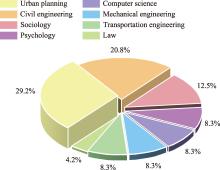
Fig. 1.
Professional background of respondents."

Table 1
Description of respondents."
| Type | Characteristic | Number | Percentage (%) |
|---|---|---|---|
| Age | 18-40 years old | 15 | 62.5 |
| 41-70 years old | 9 | 37.5 | |
| Residence | Hangzhou City | 16 | 66.7 |
| Jiaxing City | 8 | 33.3 | |
| Group | Resident | 12 | 50.0 |
| Expert | 12 | 50.0 | |
| Educational level | Bachelor’s degree | 8 | 33.0 |
| Master’s degree | 11 | 46.0 | |
| Doctoral degree | 5 | 21.0 |
Table 2
Description of core categories and sub-categories."
| Core category | Sub-category | Concept |
|---|---|---|
| Regional suitability | (1) Geographical factor | (1) Geological condition, climatic suitability, and topographical complexity |
| (2) Historical-cultural compatibility | (2) Historical-cultural preservation and cultural element representation | |
| (3) Technical adaptability | (3) Supporting facilities condition, technical proficiency, resident acceptance, and technological innovation capacity | |
| (4) Project economic viability | (4) Fiscal status, market vitality, and commercial development potential | |
| Human-centred philosophy | (5) Livelihood project | (5) Demand-oriented and regional optimization |
| (6) Resident quality of life | (6) Human settlement quality, accessibility, comfortability, and public open space | |
| (7) Inclusivity | (7) Resident participation level, technical barrier, and vulnerable group | |
| Innovative design | (8) Spatial utilization efficiency | (8) Functional diversification and spatial layer connectivity |
| (9) Eco-friendly design | (9) Low-carbon energy efficiency and environmental destructiveness | |
| (10) Specialised design | (10) Targeted design, personalised innovation, barrier-free design, and new technology empowerment | |
| Management capability | (11) Project resilience | (11) Operational cost, project efficiency, and emergency response capacity |
| (12) Management philosophy | (12) Multi-stakeholder collaboration and intelligent management | |
| Transformative technology | (13) Technological disruption | (13) Market disruption, lifestyle transformation, and frequent technology iteration |
| (14) Cost reduction | (14) Management efficiency enhancement, construction cost reduction, and design process optimisation | |
| (15) Holistic improvement | (15) Transportation improvement, environmental quality improvement, and spatial user experience |
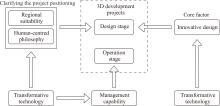
Fig. 2.
Sustainable development impact model for three-dimensional (3D) space development."

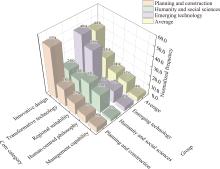
Fig. 3.
Results of word frequency analysis. “Average” refers to the average word frequency across all respondents, regardless of professional group. It is used as a benchmark to assess whether each group’s word frequency is above or below the average level."

Table 3
Five clusters and their keywords in the co-occurrence analysis of sustainable 3D space development."
| Cluster | Keyword |
|---|---|
| Cluster 1: technology-driven spatial optimization | Algorithm, artificial intelligence, autonomous driving, big data, challenge, decision-making, drones, information, Internet, network, optimization, region, safety, smart city, technology, traffic, urban design, and vehicle |
| Cluster 2: ecological resilience in high-density environment | Adaptation, air quality, air-pollution, climate change, green infrastructure, heat-island, impact, pollution, resilience, risk, temperature, urban planning, and vulnerability |
| Cluster 3: human-centric spatial experience | Accessibility, benefits, built environment, environment, green space, health, mental health, perception, physical activity, public health, restoration, space, and walking |
| Cluster 4: governance and policy frameworks | Dynamics, energy, Geographic Information System (GIS), governance, innovation, management, performance, policy, site selection, suitability, sustainability, and urban |
| Cluster 5: ecological systems and land use dynamics | Biodiversity, conservation, diversity, ecology, ecosystem services, infrastructure, land use, landscape, and urbanization |
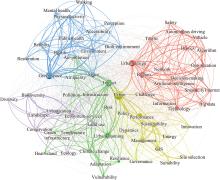
Fig. 4.
Co-occurrence analysis of keywords related to 3D space development or urban vertical space. GIS, Geographic Information System. Node represents the keyword, and node size reflects the total link strength. Line represents the relationship between keywords, and link thickness between nodes indicates pairwise link strength. Color represents the cluster of related keywords. Specially, red color corresponds to Cluster 1—technology-driven spatial optimization; green color corresponds to Cluster 2—ecological resilience in high-density environment; blue color corresponds to Cluster 3—human-centric spatial experience; yellow color corresponds to Cluster 4—governance and policy frameworks; and purple color corresponds to Cluster 5—ecological systems and land use dynamics."

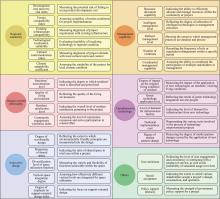
Fig. 5.
Key variable framework of the system dynamic model."

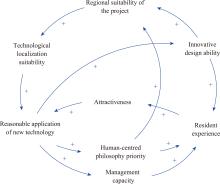
Fig. 6.
Core system structure depicting how five core factors synergistically interact to drive sustainable 3D space development. ‘+’ indicates a positive feedback relationship between variables. The arrow indicates the direction of causal influence."

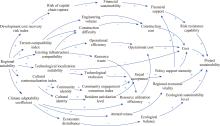
Fig. 7.
Causal relationship model of regional suitability. ‘+’ indicates a positive feedback relationship between variables and ‘−’ indicates a negative feedback relationship between variables. The arrow indicates the direction of causal influence."

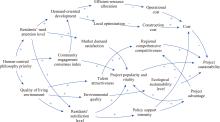
Fig. 8.
Causal relationship model of human-centred philosophy. ‘+’ indicates a positive feedback relationship between variables and ‘−’ indicates a negative feedback relationship between variables. The arrow indicates the direction of causal influence."

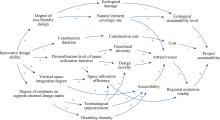
Fig. 9.
Causal relationship model of innovative design. ‘+’ indicates a positive feedback relationship between variables. ‘−’ indicates a negative feedback relationship between variables. The arrow indicates the direction of causal influence."

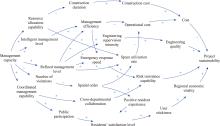
Fig. 10.
Causal relationship model of management capacity. ‘+’ indicates a positive feedback relationship between variables and ‘−’ indicates a negative feedback relationship between variables. The arrow indicates the direction of causal influence."

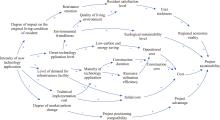
Fig. 11.
Causal relationship model of transformative technology. ‘+’ indicates a positive feedback relationship between variables and ‘−’ indicates a negative feedback relationship between variables. The arrow indicates the direction of causal influence."

| [1] | Abdelkarim, A., Abdelhafez, M.H., Elkhayat, K., et al., 2024. Spatial suitability index for sustainable urban development in desert hinterland using a geographical-information-system-based multicriteria decision-making approach. Land. 13(7), 986, doi: 10.3390/land13070986. |
| [2] | Aboagye, P.D., Sharifi, A., 2024. Urban climate adaptation and mitigation action plans: A critical review. Renewable and Sustainable Energy Reviews. 189, 113886, doi: 10.1016/j.rser.2023.113886. |
| [3] | Agudelo-Vera, C.M., Mels, A.R., Keesman, K.J., et al., 2011. Resource management as a key factor for sustainable urban planning. Journal of Environmental Management. 92(10), 2295-2303. |
| [4] | Arifuzzaman, M., Amin, S., 2025. Automated vehicles: are cities ready to adopt AVs as the sustainable transport solution? Sustainability. 17(5), 2236, doi: 10.3390/su17052236. |
| [5] | Bélanger, P., 2007. Underground landscape: the urbanism and infrastructure of Toronto’s downtown pedestrian network. Tunnelling and Underground Space Technology. 22(3), 272-292. |
| [6] | Besner, J., 2016. Underground space needs an interdisciplinary approach. Tunnelling and Underground Space Technology. 55, 224-228. |
| [7] | Bibri, S.E., Krogstie, J., Kärrholm, M., 2020. Compact city planning and development: Emerging practices and strategies for achieving the goals of sustainability. Developments in the Built Environment. 4, 100021, doi: 10.1016/j.dibe.2020.100021. |
| [8] | Bobylev, N., 2016. Underground space as an urban indicator: Measuring use of subsurface. Tunnelling and Underground Space Technology. 55, 40-51. |
| [9] | Bucher, B., Hein, C., Raines, D., et al., 2021. Towards culture-aware smart and sustainable cities: integrating historical sources in spatial information infrastructures. ISPRS International Journal of Geo-Information. 10(9), 588, doi: 10.3390/ijgi10090588. |
| [10] | Burton, E., 2000. The compact city: just or just compact? A preliminary analysis. Urban Studies. 37(11), 1969-2006. |
| [11] | Callon, M., Courtial, J.P., Laville, F., 1991. Co-word analysis as a tool for describing the network of interactions between basic and technological research: the case of polymer chemsitry. Scientometrics. 22, 155-205. |
| [12] | Chen, H.Y., Jia, B.S., Lau, S.S.Y., 2008. Sustainable urban form for Chinese compact cities: challenges of a rapid urbanized economy. Habitat International. 32(1), 28-40. |
| [13] | Chen, J.Y., Yan, Z.F., Fan, R., 2023. Elements of the core area transport system oriented to station-city integration. Computers and Electrical Engineering. 110, 108842, doi: 10.1016/j.compeleceng.2023.108842. |
| [14] | Cohen, A.P., Shaheen, S.A., Farrar, E.M., 2021. Urban air mobility: history, ecosystem, market potential, and challenges. IEEE Transactions on Intelligent Transportation Systems. 22(9), 6074-6087. |
| [15] | Cohen, M., 2017. A systematic review of urban sustainability assessment literature. Sustainability. 9(11), 2048, doi: 10.3390/su9112048. |
| [16] | Corbin, J., Strauss, A.L., 2008. Basics of Qualitative Research: Techniques and Procedures for Developing Grounded Theory (3rd edition). Thousand Oaks: Sage Publications, 43-71. |
| [17] | Cordero-Vinueza, V.A., Niekerk, F., van Dijk, T., 2023. Making child-friendly cities: a socio-spatial literature review. Cities. 137, 104248, doi: 10.1016/j.cities.2023.104248. |
| [18] | Cuce, P.M., Cuce, E., Santamouris, M., 2025. Towards sustainable and climate-resilient cities: mitigating urban heat islands through green infrastructure. Sustainability. 17(3), 1303, doi: 10.3390/su17031303. |
| [19] | Cui, J.Q., Allan, A., Lin, D., 2013. The development of grade separation pedestrian system: a review. Tunnelling and Underground Space Technology. 38, 151-160. |
| [20] | Cui, J.Q., Lin, D., 2016. Utilisation of underground pedestrian systems for urban sustainability. Tunnelling and Underground Space Technology. 55, 194-204. |
| [21] | Cui, J.Q., Allan, A., Lin, D., 2019. SWOT analysis and development strategies for underground pedestrian systems. Tunnelling and Underground Space Technology. 87, 127-133. |
| [22] | Cui, J.Q., 2021. Building three-dimensional pedestrian networks in cities. Underground Space. 6(2), 217-224. |
| [23] | Debrock, S., Van Acker, M., Admiraal, H., 2023. Design recommendations for sustainable urban underground spaces. Tunnelling and Underground Space Technology. 140, 105332, doi: 10.1016/j.tust.2023.105332. |
| [24] | Dong, J., Guo, R.N., Lin, M.X., et al., 2024a. Multi-objective optimization of green roof spatial layout in high-density urban areas-a case study of Xiamen Island, China. Sustainable Cities and Society. 115, 105827, doi: 10.1016/j.scs.2024.105827. |
| [25] | Dong, X.Y., Zhang, X.Y., Jing, Y., et al., 2024b. Does every public open space (POS) contribute to sustainable city development? An assessment of inefficient POS in Beijing. Sustainable Cities and Society. 117, 105980, doi: 10.1016/j.scs.2024.105980. |
| [26] | Dong, Y., Jin, G., Deng, X.Z., 2020. Dynamic interactive effects of urban land-use efficiency, industrial transformation, and carbon emissions. Journal of Cleaner Production. 270, 122547, doi: 10.1016/j.jclepro.2020.122547. |
| [27] | Elmqvist, T., Andersson, E., Frantzeskaki, N., et al., 2019. Sustainability and resilience for transformation in the urban century. Natural Sustainability. 2, 267-273. |
| [28] | Engler, J.O., Abson, D.J., von Wehrden, H., 2019. Navigating cognition biases in the search of sustainability. Ambio. 48, 605-618. |
| [29] | Fan, Y.C., Tjiputra, J., Muri, H., et al., 2021. Solar geoengineering can alleviate climate change pressures on crop yields. Nature Food. 2, 373-381. |
| [30] | Ferré-Bigorra, J., Casals, M., Gangolells, M., 2022. The adoption of urban digital twins. Cities. 131, 103905, doi: 10.1016/j.cities.2022.103905. |
| [31] | Flyvbjerg, B., Skamris, H.M., Buhl, S., 2002. Underestimating costs in public works projects: error or lie? Journal of the American Planning Association. 68(3), 279-295. |
| [32] | Glaser, B.G., Strauss, A.L., 1967. The Discovery of Grounded Theory:Strategies for Qualitative Research. Chicago: Aldine Publishing Company, 44-77. |
| [33] | Gu, Q.H., Sing, M.C.P., Jefferies, M., et al., 2025. Bridging the gap between smart cities and sustainability: current practices and future trends. Cities. 159, 105799, doi: 10.1016/j.cities.2025.105799. |
| [34] | Guo, B.S., Yu, H., Jin, G., 2024. Urban green total factor productivity in China: a generalized Luenberger productivity indicator and its parametric decomposition. Sustainable Cities and Society. 106, 105365, doi: 10.1016/j.scs.2024.105365. |
| [35] | Huang, C.Q., Fang, S.F., Wu, H., et al., 2024. Low-altitude intelligent transportation: system architecture, infrastructure, and key technologies. Journal of Industrial Information Integration. 42, 100694, doi: 10.1016/j.jii.2024.100694. |
| [36] | Jia, J.J., Zhu, M.S., Wei, C., 2022. Household cooking in the context of carbon neutrality: a machine-learning-based review. Renewable and Sustainable Energy Reviews. 168, 112856, doi: 10.1016/j.rser.2022.112856. |
| [37] | Jiang, B., 2024. The status quo of architecture and its impact on urban management: Christopher Alexander’s insights. Journal of Urban Management. 13(4), 557-564. |
| [38] | Kaiser, Z.R.M.A., Deb, A., 2025. Sustainable smart city and Sustainable Development Goals (SDGs): a review. Regional Sustainability. 6(1), 100193, doi: 10.1016/j.regsus.2025.100193. |
| [39] | Kim, S., 2017. Common spaces of multi-commercial complexes from urban sustainability. Sustainability. 9(8), 1336, doi: 10.3390/su9081336. |
| [40] | Kishii, T., 2016. Utilization of underground space in Japan. Tunnelling and Underground Space Technology. 55, 320-323. |
| [41] | Lai, Y.N., Wang, Y.L., Cheng, J., et al., 2023. Review of constraints and critical success factors of developing urban underground space. Underground Space. 12, 137-155. |
| [42] | Li, K.Y., Shao, J.Z., Lin, R.Z., et al., 2025a. The research on the evaluation framework and application of urban three-dimensional (aboveground and underground) regeneration sensitivity—Taking Kunshan Old City in China as an example. Tunnelling and Underground Space Technology. 159, 106428, doi: 10.1016/j.tust.2025.106428. |
| [43] | Li, Y.M., Guo, T., Chen, J., et al., 2025b. Urban air mobility: a review and challenges. IEEE Intelligent Transportation Systems Magazine. 17(3), 67-87. |
| [44] | Liu, Y.F., 2022. Space reproduction in urban China: toward a theoretical framework of urban regeneration. Land. 11(10), 1704, doi: 10.3390/land11101704. |
| [45] | Lotfi, Y.A., Refaat, M., El Attar, M., et al., 2020. Vertical gardens as a restorative tool in urban spaces of New Cairo. Ain Shams Engineering Journal. 11(3), 839-848. |
| [46] | Lu, R.J., Wu, L., Chu, D.P., 2023. Portraying the influence factor of urban vibrancy at street level using multisource urban data. ISPRS International Journal of Geo-Information. 12(10), 402, doi: 10.3390/ijgi12100402. |
| [47] | Manjón-Antolín, M., Crutzen, N., 2024. Smart city factors targeted by local governments: evidence from Belgian municipalities. IEEE Transactions on Engineering Management. 71, 7566-7585. |
| [48] | Menouar, H., Güvenc, I., Akkaya, K., et al., 2017. UAV-enabled intelligent transportation systems for the smart city: applications and challenges. IEEE Communications Magazine. 55(3), 22-28. |
| [49] | Morales-Flores, P., Marmolejo-Duarte, C., 2025. Understanding the relationship between public space social capital expressions and pedestrian-oriented design. A case study within the superblock action plan in Barcelona. Cities. 162, 105968, doi: 10.1016/j.cities.2025.105968. |
| [50] | Munn, K., Dragićević, S., 2021. Spatial multi-criteria evaluation in 3D context: suitability analysis of urban vertical development. Cartography and Geographic Information Science. 48(2), 105-123. |
| [51] | Naveen, P., Antony, M.P., Ramasamy, B.V., et al., 2024. Unlocking the potential: how flying taxis will shape the future of transportation. Sustainability. 16(24), 10795, doi: 10.3390/su162410795. |
| [52] | Niu, X.J., Zhao, X.M., Xie, D.F., et al., 2022. Impact of large-scale activities on macroscopic fundamental diagram: field data analysis and modeling. Transportation Research Part A: Policy and Practice. 161, 241-268. |
| [53] | Perini, K., Magliocco, A., 2014. Effects of vegetation, urban density, building height, and atmospheric conditions on local temperatures and thermal comfort. Urban Forestry & Urban Greening. 13(3), 495-506. |
| [54] | Pia, N.A., Bezboruah, K., 2025. Urban design strategies for creating child-friendly neighborhoods: a systematic literature review. Cities. 162, 105919, doi: 10.1016/j.cities.2025.105919. |
| [55] | Plouffe, L., Kalache, A., 2010. Towards global age-friendly cities: determining urban features that promote active aging. Journal of Urban Health. 87(5), 733-739. |
| [56] | Purvis, B., Mao, Y., Robinson, D., 2019. Three pillars of sustainability: in search of conceptual origins. Sustainability Science. 14, 681-695. |
| [57] | Qian, Q.H., 2016. Present state, problems and development trends of urban underground space in China. Tunnelling and Underground Space Technology. 55, 280-289. |
| [58] | Qin, Y.C., Yao, M.F., Shen, L., et al., 2022. Comprehensive evaluation of functional diversity of urban commercial complexes based on dissipative structure theory and synergy theory: a case of SM city Plaza in Xiamen, China. Sustainability. 14(1), 67, doi: 10.3390/su14010067. |
| [59] | Rajaee, F., Vaziri Rad, M.A., Aliyon, K., et al., 2023. Techno-economic evaluation of an organic rankine cycle-based multi-source energy system for 100%-renewable power supply: a rural case study. Sustainable Cities and Society. 89, 104290, doi: 10.1016/j.scs.2022.104290. |
| [60] | Song, M.J., Cai, J., Xue, Y.S., 2023. From technological sustainability to social sustainability: an analysis of hotspots and trends in residential design evaluation. Sustainability. 15(13), 10088, doi: 10.3390/su151310088. |
| [61] | Sorensen, A., 2000. Land readjustment and metropolitan growth: an examination of suburban land development and urban sprawl in the Tokyo metropolitan area. Progress in Planning. 53(4), 217-330. |
| [62] | Swanson, J., 2002. Business dynamics—systems thinking and modeling for a complex world. Journal of the Operational Research Society. 53, 472-473. |
| [63] | Tian, Y.H., Jim, C.Y., 2011. Factors influencing the spatial pattern of sky gardens in the compact city of Hong Kong. Landscape and Urban Planning. 101(4), 299-309. |
| [64] | Tian, Y.H., Jim, C.Y., 2012. Development potential of sky gardens in the compact city of Hong Kong. Urban Forestry & Urban Greening. 11(3), 223-233. |
| [65] | Van Hoof, J., Marston, H.R., Kazak, J.K., et al., 2021. Ten questions concerning age-friendly cities and communities and the built environment. Building and Environment. 199, 107922, doi: 10.1016/j.buildenv.2021.107922. |
| [66] | Wan, C., Shen, G.Q., 2015. Salient attributes of urban green spaces in high density cities: the case of Hong Kong. Habitat International. 49, 92-99. |
| [67] | Wang, H., He, P., Wong, M.S., et al., 2025. Optimizing vertical urban development: The role of a multidimensional assessment framework for balancing vertical growth and habitability. Habitat International. 161, 103424, doi: 10.1016/j.habitatint.2025.103424. |
| [68] | Wang, W.T., Yang, H.X., Xiang, C.Y., 2023. Green roofs and facades with integrated photovoltaic system for zero energy eco-friendly building-A review. Sustainable Energy Technologies and Assessments. 60, 103426, doi: 10.1016/j.seta.2023.103426. |
| [69] | Wang, Y., Shaw, D., 2018. The complexity of high-density neighbourhood development in China: intensification, deregulation and social sustainability challenges. Sustainable Cities and Society. 43, 578-586. |
| [70] | Wen, Y.M., Zhang, P.Y., Wei, J.X., et al., 2025. Sustainable urban designs integrating aboveground microclimates and underground heat islands: a systematic review and design strategies. Renewable and Sustainable Energy Reviews. 212, 115445, doi: 10.1016/j.rser.2025.115445. |
| [71] | Xue, X.L., Zhang, R.X., Zhang, X.L., et al., 2015. Environmental and social challenges for urban subway construction: an empirical study in China. International Journal of Project Management. 33(3), 576-588. |
| [72] | Yang, Z.S., Yang, H., Wang, H., 2020. Evaluating urban sustainability under different development pathways: a case study of the Beijing-Tianjin-Hebei region. Sustainable Cities and Society. 61, 102226, doi: 10.1016/j.scs.2020.102226. |
| [73] | Zhang, Y.B., Chen, Y.H., Jiang, F.S., et al., 2023. A comprehensive study of the suitability of urban underground spaces for connection development: a case study of the Erhai Lake basin, China. Sustainability. 15(9), 7344, doi: 10.3390/su15097433. |
| [74] | Zhao, N.N., Liu, Y.T., Wang, J.N., 2023. “Co-production” as an alternative in post-political China? Conceptualizing the legitimate power over participation in neighborhood regeneration practices. Cities. 141, 104462, doi: 10.1016/j.cities.2023.104462. |
| [75] | Zhao, X.X., Chen, Y.L., Wu, Y.H., et al., 2024. Enhancing urban landscapes through underground space utilization: public perceptions. Sustainability. 16(11), 4501, doi: 10.3390/su16114501. |
| [76] | Zhao, X.X., Guo, D.J., Chen, Y.L., et al., 2025. Sustainable comfort design in underground shopping malls: a user-centric analysis of spatial features. Sustainability. 17(6), 2717, doi: 10.3390/su17062717. |
| [77] | Zhou, Y.K., 2025. Unmanned aerial vehicles based low-altitude economy with lifecycle techno-economic-environmental analysis for sustainable and smart cities. Journal of Cleaner Production. 499, 145050, doi: 10.1016/j.jclepro.2025.145050. |
| [78] | Zhu, H.Y., Shen, L.Y., Ren, Y.T., 2022. How can smart city shape a happier life? The mechanism for developing a happiness driven smart city. Sustainable Cities and Society. 80, 103791, doi: 10.1016/j.scs.2022.103791. |
| [1] | Z. R. M. Abdullah KAISER, Apu DEB. Sustainable smart city and Sustainable Development Goals (SDGs): A review [J]. Regional Sustainability, 2025, 6(1): 100193-. |
| [2] | Muhammad Ali Khan BURKI, Umar BURKI, Usama NAJAM. Environmental degradation and poverty: A bibliometric review [J]. Regional Sustainability, 2021, 2(4): 324-336. |
| Viewed | ||||||
|
Full text |
|
|||||
|
Abstract |
|
|||||
 REGSUS Wechat
 新公网安备 65010402001202号