
Regional Sustainability ›› 2026, Vol. 7 ›› Issue (3): 100347.doi: 10.1016/j.regsus.2026.100347
• Research article • Next Articles
Herdis HERDIANSYAH*( ), Randi MAMOLA
Received:2024-12-18
Revised:2025-11-26
Accepted:2026-04-29
Published:2026-06-30
Online:2026-05-22
Contact:
*E-mail address: herdis@ui.ac.id (Herdis HERDIANSYAH).
Herdis HERDIANSYAH, Randi MAMOLA. Oil palm land expansion and sustainable agriculture challenges in rural areas of Indonesia[J]. Regional Sustainability, 2026, 7(3): 100347.
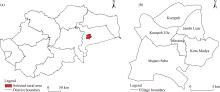
Fig. 1.
Overview of the study area. (a), Jambi Province; (b), selected rural area."

Table 1
Driving factors of land connectivity defense."
| Variable | Unit | Variable | Unit |
|---|---|---|---|
| Total population (X1) | persons | Gross agricultural output value (X12) | USD |
| Number of year-end social farmers (X2) | persons | Quantity of commodity transported by the distributor (X13) | t/month |
| Gross domestic product (GDP) (X3) | USD/person | Road freight volume (X14) | t/month |
| Primary palm oil output value (X4) | t/month | Primary commodity land yield (X15) | USD/km2 |
| Secondary palm oil output value (X5) | t/month | Secondary commodity land yield (X16) | USD/km2 |
| Tertiary palm oil output value (X6) | t/month | Tertiary commodity land yield (X17) | USD/km2 |
| Total fixed asset investment of palm oil (X7) | USD | Capacity of primary and secondary school facility (X18) | - |
| Total distribution retail of Crude Palm Oil (CPO) (X8) | USD/t | Capacity of students attending school (X19) | persons |
| Financial revenue (X9) | USD/person | Capacity of village hospital (X20) | - |
| Financial expenditure for household (X10) | USD/person | Health technician (X21) | persons |
| Gross village output value (X11) | USD/person | Agricultural scheme (X22) | USD |
Table 2
Staged and continuity indices."
| Index | Driving factor | Variable |
|---|---|---|
| Staged index | Economic growth | X3, X8, and X9 |
| Financial development | X7 and X10 | |
| Technology and education | X1, X19, and X21 | |
| Oil palm agriculture | X4 and X12 | |
| Population flow | X16 and X1 | |
| Medical and health infrastructure | X20 | |
| Commodity land | X15 | |
| Continuity index | Socio-economic level and infrastructure | X3, X11, X18, and X22 |
| Investment development | X7 and X10 | |
| Oil palm agriculture | X4 and X12 | |
| Transportation | X13 and X14 |
Table 3
Dasymetric intensity of oil palm land expansion in the six villages of Jambi Province during 2016-2022."
| Village | 2016-2017 | 2017-2018 | 2018-2019 | 2019-2020 | 2020-2021 | 2021-2022 |
|---|---|---|---|---|---|---|
| Kumpeh | 0.255 | 0.221 | 0.081 | 0.051 | 0.301 | 0.141 |
| Kumpeh Ulu | 0.143 | 0.008 | 0.034 | 0.084 | 0.076 | 0.168 |
| Mujaro Sebo | 0.125 | 0.006 | 0.014 | 0.157 | 0.034 | 0.099 |
| Kota Madya | 0.184 | 0.046 | 0.012 | 0.058 | 0.019 | 0.083 |
| Jambi Luar | 0.403 | 0.033 | 0.067 | 0.148 | 0.021 | 0.274 |
| Mestong | 0.231 | 0.370 | 0.301 | 0.410 | 0.604 | 0.512 |
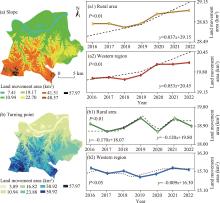
Fig. 2.
Spatiotemporal dynamics of slope (a) and turning point (b) in the oil palm land movement during 2016-2022."

Table 4
GTWR model parameter measurement results."
| Statistic parameter | Value | Statistic parameter | Value |
|---|---|---|---|
| Bandwidth | 0.126 | Coefficient of determination (R2) | 0.732 |
| Residual square | 14.500 | Adjusted R2 | 0.731 |
| Sigma | 0.622 | Spatiotemporal distance ratio | 1.281 |
| Corrected (weighted) Akaike Information Criterion (AIC) | 69.500 |
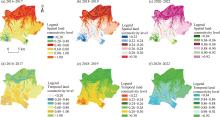
Fig. 3.
Spatial heterogeneity of interconnected barycenter in the movement of oil palm land during 2016-2017 (a), 2018-2019 (b), and 2020-2022 (c), and temporal heterogeneity of interconnected barycenter in the movement of oil palm land during 2016-2017 (d), 2018-2019 (e), and 2020-2022 (f)."

Table 5
Spatial autocorrelation of factors driving oil palm land movement in the six villages of Jambi Province during 2016-2022."
| 2016 | 2017 | 2018 | 2019 | 2020 | 2021 | 2022 | |
|---|---|---|---|---|---|---|---|
| Local Moran’s I | 0.28 | 0.31 | 0.37 | 0.32 | 0.36 | 0.47 | 0.55 |
| Z-value | 6.45 | 7.10 | 8.19 | 7.71 | 8.09 | 10.48 | 12.36 |
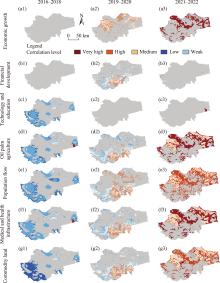
Fig. 4.
Spatial correlation between oil palm land expansion and economic growth during 2016-2018 (a1), 2019-2020 (a2), and 2021-2022 (a3), spatial correlation between oil palm land expansion and financial development during 2016-2018 (b1), 2019-2020 (b2), and 2021-2022 (b3), spatial correlation between oil palm land expansion and technology and education during 2016-2018 (c1), 2019-2020 (c2), and 2021-2022 (c3), spatial correlation between oil palm land expansion and oil palm agriculture during 2016-2018 (d1), 2019-2020 (d2), and 2021-2022 (d3), spatial correlation between oil palm land expansion and population flow during 2016-2018 (e1), 2019-2020 (e2), and 2021-2022 (e3), spatial correlation between oil palm land expansion and medical and health infrastructure during 2016-2018 (f1), 2019-2020 (f2), and 2021-2022 (f3), and spatial correlation between oil palm land expansion and commodity land during 2016-2018 (g1), 2019-2020 (g2), and 2021-2022 (g3)."

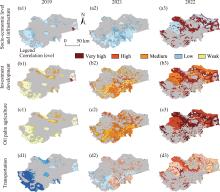
Fig. 5.
Spatial correlation between oil palm land expansion and socio-economic level and infrastructure in 2019 (a1), 2021 (a2), and 2022 (a3), spatial correlation between oil palm land expansion and investment development in 2019 (b1), 2021 (b2), and 2022 (b3), spatial correlation between oil palm land expansion and oil palm agriculture in 2019 (c1), 2021 (c2), and 2022 (c3), and spatial correlation between oil palm land expansion and transportation in 2019 (d1), 2021 (d2), and 2022 (d3)."

Table 6
Correlation between oil palm land movement and staged index using the GTWR model."
| Year | Economic growth | Financial development | Technology and education | Oil palm agriculture | Population flow | Medical and health infrastructure | Commodity land | |||||||
|---|---|---|---|---|---|---|---|---|---|---|---|---|---|---|
| + | - | + | - | + | - | + | - | + | - | + | - | + | - | |
| 2016 | 49.23 | 6.45 | 67.31 | 6.34 | 67.25 | 10.17 | 71.02 | 6.67 | 26.91 | 43.71 | 89.37 | 46.51 | 16.39 | 5.20 |
| 2017 | 53.12 | 6.51 | 52.40 | 28.17 | 68.82 | 13.08 | 71.18 | 13.02 | 24.30 | 41.09 | 89.63 | 50.32 | 42.13 | 38.26 |
| 2018 | 56.20 | 7.23 | 54.39 | 29.61 | 70.41 | 14.52 | 73.20 | 15.60 | 25.28 | 34.66 | 74.62 | 66.27 | 25.18 | 45.90 |
| 2019 | 67.34 | 7.45 | 42.16 | 47.90 | 88.90 | 14.60 | 75.58 | 13.58 | 19.06 | 27.69 | 79.15 | 64.90 | 9.06 | 11.71 |
| 2020 | 68.02 | 8.29 | 37.20 | 48.23 | 91.67 | 15.56 | 86.23 | 19.22 | 18.93 | 14.19 | 92.44 | 74.14 | 8.39 | 24.81 |
| 2021 | 84.73 | 9.13 | 13.25 | 50.37 | 92.14 | 16.02 | 89.91 | 20.14 | 16.42 | 12.08 | 92.63 | 91.10 | 6.24 | 37.10 |
| 2022 | 91.10 | 9.29 | 8.74 | 51.71 | 93.73 | 16.18 | 90.07 | 21.33 | 16.85 | 11.90 | 93.74 | 93.53 | 10.52 | 4.87 |
Table 7
Correlation between oil palm land expansion and continuity index using the GTWR model."
| Year | Socio-economic level and infrastructure | Investment development | Oil palm agriculture | Transportation | ||||
|---|---|---|---|---|---|---|---|---|
| + | - | + | - | + | - | + | - | |
| 2016 | 13.38 | 0.20 | 98.17 | 4.05 | 60.00 | 5.20 | 18.38 | 8.46 |
| 2017 | 15.39 | 5.42 | 96.51 | 6.71 | 59.16 | 27.62 | 20.39 | 9.47 |
| 2018 | 31.27 | 0.47 | 97.23 | 6.84 | 63.27 | 48.31 | 30.27 | 10.54 |
| 2019 | 29.13 | 8.13 | 98.44 | 7.34 | 74.11 | 52.36 | 40.18 | 10.37 |
| 2020 | 34.31 | 62.34 | 98.48 | 18.04 | 82.63 | 54.12 | 36.13 | 11.26 |
| 2021 | 21.97 | 56.37 | 99.40 | 18.38 | 92.05 | 55.19 | 44.35 | 13.49 |
| 2022 | 40.26 | 13.36 | 99.40 | 19.05 | 93.17 | 64.90 | 53.37 | 13.58 |
| [1] | Abidin, J.Z., 2023. Sustainable palm oil industry governance in supporting national energy security. Journal of Agrosociology and Sustainability. 1(1), 136, doi: 10.61511/jassu.v1i1.2023.136(InIndonesia). |
| [2] | Abubakar, A., Ishak, M.Y., Bakar, A.A., et al., 2023. Geospatial simulation and mapping of climate suitability for oil palm (Elaeis Guineensis) production in Peninsular Malaysia using GIS/remote sensing techniques and analytic hierarchy process. Modeling Earth Systems and Environment. 9(1), 73-96. |
| [3] | Aguiar, S., Texeira, M., Garibaldi, L.A., et al., 2020. Global changes in crop diversity: Trade rather than production enriches supply. Global Food Security. 26(11), 100385, doi: 10.1016/j.gfs.2020.100385. |
| [4] | Anwar, K., 2019. The pattern of interaction political actors on situations of tenurial conflict in watershed: Case of palm oil in Kampung Dosan. Journal of Science and Technology Policy Management. 10(5), 1098-1120. |
| [5] | Berenschot, W., Dhiaulhaq, A., Afrizal, A., et al., 2022. Anti-corporate activism and collusion: The contentious politics of palm oil expansion in Indonesia. Geoforum. 131, 39-49. |
| [6] | Comyns, B., Meschi, P.X., Norheim‐Hansen, A., 2023. Firms’ responses to environmental misconduct accusations under the condition of contested practice complexity: Evidence from the palm oil production industry. Business Strategy and the Environment. 32(8), 5332-5348. |
| [7] | Córdoba, D., Moreno, R., Sombra, D., 2022. Making sustainable palm oil? Developmentalist and environmental assemblages in the Brazilian Amazon. The Journal of Environment & Development. 31(3), 253-274. |
| [8] | de la Torre, J.A., Lechner, A.M., Wong, E.P., et al. 2019. Using elephant movements to assess landscape connectivity under Peninsular Malaysia’s central forest spine land use policy. Conservation Science and Practice. 1(12), e133, doi: 10.1111/csp2.133. |
| [9] | Degli Innocenti, E., Oosterveer, P., 2020. Opportunities and bottlenecks for upstream learning within RSPO certified palm oil value chains: A comparative analysis between Indonesia and Thailand. Journal of Rural Studies. 78, 426-437. |
| [10] | Deng, O.P., Ran, J.Y., Huang, S., et al., 2024. Managing fragmented croplands for environmental and economic benefits in China. Nature Food. 5(3), 230-240. |
| [11] | Dharmawan, A.H., Mardiyaningsih, D.I., Komarudin, H., et al., 2020. Dynamics of rural economy: A socio-economic understanding of oil palm expansion and landscape changes in East Kalimantan, Indonesia. Land. 9(7), 213, doi: 10.3390/land9070213. |
| [12] | Dib, J.B., Krishna, V.V., Alamsyah, Z., et al., 2018. Land-use change and livelihoods of non-farm households: The role of income from employment in oil palm and rubber in rural Indonesia. Land Use Policy. 76, 828-838. |
| [13] | Gibson, K., Song, H.Y., Chen, N.S., 2022. Metabarcoding analysis of microbiome dynamics during a Phaeocystis globosa bloom in the Beibu Gulf, China. Harmful Algae. 114, 102217, doi: 10.1016/j.hal.2022.102217. |
| [14] | Grinnell, N.A., van der Linden, A., Azhar, B., et al., 2022. Cattle-oil palm integration—a viable strategy to increase Malaysian beef self-sufficiency and palm oil sustainability. Livestock Science. 259, 104902, doi: 10.1016/j.livsci.2022.104902. |
| [15] | Häberle, M., Werner, M., Zhu, X.X., 2019. Geo-spatial text-mining from twitter: A feature space analysis with a view toward building classification in urban regions. European Journal of Remote Sensing. 52(S2), 2-11. |
| [16] | Hasan, M.F., Fadhil, I., Fahmid, M.M., et al., 2022. Impact of the European Union regulations on Indonesian oil palm smallholder farmers. International Journal of Oil Palm. 5(1), 1-15. |
| [17] | Herdiansyah, H., Mamola, R., Rokhim, R., 2023. Palm oil cluster resilience to enhance indigenous welfare by innovative ability to address land conflicts: Evidence of disaster hierarchy. Open Agriculture. 8(1), 20220206, doi: 10.1515/opag-2022-0206. |
| [18] | Hervas, A., 2019. Land, development and contract farming on the Guatemalan oil palm frontier. Journal Peasant Studies. 46(1), 115-141. |
| [19] | Hidayat, N.K., Offermans, A., Glasbergen, P., 2018. Sustainable palm oil as a public responsibility? On the governance capacity of Indonesian Standard for Sustainable Palm Oil (ISPO). Agriculture and Human Values. 35(1), 223-242. |
| [20] | Jambi Provincial Statistics Agency, 2021. Statistics on the Potential of Villages (PODES) in Jambi Province 2021. [2024-10-22]. https://jambi.bps.go.id/id/publication/2022/06/30/867fad0a7e0f66eb6a9dd654/statistik-potensi-desa-provinsi-jambi-2021.html. |
| [21] | Jiang, L.L., Bao, A.M., Jiapaer, G., et al., 2019. Monitoring land sensitivity to desertification in Central Asia: Convergence or divergence. Science of The Total Environment. 658(30), 669-683. |
| [22] | Krishna, V.V., Kubitza, C., 2021. Impact of oil palm expansion on the provision of private and community goods in rural Indonesia. Ecological Economics. 179, 106829, doi: 10.1016/j.ecolecon.2020.106829. |
| [23] | Kubitza, C., Krishna, V.V., Alamsyah, Z., et al., 2018. The economics behind an ecological crisis: Livelihood effects of oil palm expansion in Sumatra, Indonesia. Human Ecology. 46(1), 107-116. |
| [24] | Lam, W.Y., Kulak, M., Sim, S., et al., 2019. Greenhouse gas footprints of palm oil production in Indonesia over space and time. Science of The Total Environment. 688(2), 827-837. |
| [25] | Li, K., Zhang, B.Y., Xiao, W.D., et al., 2022. Land use transformation based on production-living-ecological space and associated eco-environment effects: A case study in the Yangtze River Delta urban agglomeration. Land. 11(7), 1076, doi: 10.3390/land11071076. |
| [26] | Manley, R., Van Leynseele, Y., 2019. Peasant agency in Ghana’s oil palm sector: The impact of multiple markets on food sovereignty. Journal of Agrarian Change. 19(4), 654-670. |
| [27] | Ministry of Agriculture of the Republic of Indonesia, 2022. National Leading Plantation Statistics 2020-2022. [2024-10-22]. https://ditjenbun.pertanian.go.id/template/uploads/2022/08/STATISTIK-UNGGULAN-2020-2022.pdf. |
| [28] | Nahriyah, M., 2024. Sustainable management in oil palm plantations. Peatland Agriculture and Climate Change Journal. 1(1), 725, doi: 10.61511/pacc.v1i1.2024.725(InIndonesia). |
| [29] | Nicholas, K., Fanzo, J., MacManus, K., 2018. Palm oil in Myanmar: A spatiotemporal analysis of the effects of industrial farming on biodiversity loss. Global Health: Science and Practice. 6(1), 210-222. |
| [30] | Nurfatriani, F., Ramawati, R., Sari, G.K., et al., 2022. Oil palm economic benefit distribution to regions for environmental sustainability: Indonesia’s revenue-sharing scheme. Land. 11(9), 1452, doi: 10.3390/land11091452. |
| [31] | Ocampo-Peñuela, N., Garcia-Ulloa, J., Ghazoul, J., et al., 2018. Quantifying impacts of oil palm expansion on Colombia’s threatened biodiversity. Biological Conservation. 224, 117-121. |
| [32] | Oechslin, M., Rodriguez, M., 2021. Fiscal weakness, the (under-) provision of public services, and institutional reform. Conflict Management and Peace Science. 38(1), 20-44. |
| [33] | Pardo, L.E., Campbell, M.J., Cove, M.V., et al., 2019. Land management strategies can increase oil palm plantation use by some terrestrial mammals in Colombia. Scientific Reports. 9(1), 7812, doi: 10.1038/s41598-019-44288-y. |
| [34] | Pasaribu, S.I., Vanclay, F., Zhao, Y.J., 2020. Challenges to implementing socially-sustainable community development in oil palm and forestry operations in Indonesia. Land. 9(3), 61, doi: 10.3390/land9030061. |
| [35] | Paterson, R.R.M., Lima, N., 2018. Climate change affecting oil palm agronomy, and oil palm cultivation increasing climate change, require amelioration. Ecology and Evolution. 8(1), 452-461. |
| [36] | Potapov, A., Schaefer, I., Jochum, M., et al., 2021. Oil palm and rubber expansion facilitates earthworm invasion in Indonesia. Biological Invasions. 23(9), 2783-2795. |
| [37] | Purnomo, H., Okarda, B., Dewayani, A.A., et al., 2018. Reducing forest and land fires through good palm oil value chain governance. Forest Policy and Economics. 91(10), 94-106. |
| [38] | Purnomo, H., Okarda, B., Dermawan, A., et al., 2020. Reconciling oil palm economic development and environmental conservation in Indonesia: A value chain dynamic approach. Forest Policy and Economics. 111, 102089, doi: 10.1016/j.forpol.2020.102089. |
| [39] | Rivadeneyra, P., Scaccia, L., Salvati, L., 2023. A spatial regression analysis of Colombia’s narcodeforestation with factor decomposition of multiple predictors. Scientific Reports. 13(1), 13485, doi: 10.1038/s41598-023-40119-3. |
| [40] | Rizal, S., Abdullah, C.K., Olaiya, N.G., et al., 2020. Preparation of palm oil ash nanoparticles: Taguchi optimization method by particle size distribution and morphological studies. Applied Sciences. 10(3), 985, doi: 10.3390/app10030985. |
| [41] | Rokhim, R., Januari, A.D., Atik, U., et al., 2020. Palm oil social conflict resolution and mediation in Jambi. Cogent Social Sciences. 6(1), 1812831, doi: 10.1080/23311886.2020.1812831. |
| [42] | Rulli, M.C., Casirati, S., Dell’Angelo, J., et al., 2019. Interdependencies and telecoupling of oil palm expansion at the expense of Indonesian rainforest. Renewable and Sustainable Energy Reviews. 105, 499-512. |
| [43] | Sakai, K., Hassan, M.A., Vairappan, C.S., et al., 2022. Promotion of a green economy with the palm oil industry for biodiversity conservation: A touchstone toward a sustainable bioindustry. Journal of Bioscience and Bioengineering. 133(5), 414-424. |
| [44] | Santika, T., Wilson, K.A., Law, E.A., et al., 2020. Impact of palm oil sustainability certification on village well-being and poverty in Indonesia. Nature Sustainability. 4(2), 109-119. |
| [45] | Sarkar, M.S.K., Begum, R.A., Pereira, J.J., 2020. Impacts of climate change on oil palm production in Malaysia. Environmental Science and Pollution Research. 27(9), 9760-9770. |
| [46] | Sharma, P., Daugbjerg, C., 2021. Politicisation and coalition magnets in policy making: A comparative study of food sovereignty and agricultural reform in Nepal and Ecuador. Journal of Comparative Policy Analysis: Research and Practice. 23(5-6), 592-606. |
| [47] | Sorsa, V.P., Fougère, M., 2021. Toward political explanation of change in corporate responsibility: Political scholarship on CSR and the case of palm oil biofuels. Business and Society. 60(8), 1895-1923. |
| [48] | Srinivasan, U., Velho, N., Lee, J.S.H., et al., 2021. Oil palm cultivation can be expanded while sparing biodiversity in India. Nature Food. 2(6), 442-447. |
| [49] | Tabe-Ojong, M.P.J., Ordway, E.M., Nkongho, R.N., et al., 2022. Oil palm expansion among non-industrial producers in Cameroon: Potentials for synergy between agro-economic gains and ecological safeguards. Forest Policy and Economics. 135, 102645, doi: 10.1016/j.forpol.2021.102645. |
| [50] | Urano, M., 2020. Why the principle of informed self-determination does not help local farmers facing land loss: A case study from oil palm development in East Kalimantan, Indonesia. Globalizations. 17(4), 593-607. |
| [51] | Wang, L.Y., Zhang, S.Y., Xiong, Q.Q., et al., 2022. Spatiotemporal dynamics of cropland expansion and its driving factors in the Yangtze River Economic Belt: A nuanced analysis at the county scale. Land Use Policy. 119, 106168, doi: 10.1016/j.landusepol.2022.106168. |
| [52] | Wang, Q., Xiao, Y.H., 2022. Has urban construction land achieved low-carbon sustainable development? A case study of North China Plain, China. Sustainability. 14(15), 9434, doi: 10.3390/su14159434. |
| No related articles found! |
| Viewed | ||||||
|
Full text |
|
|||||
|
Abstract |
|
|||||
 REGSUS Wechat
 新公网安备 65010402001202号