

Production of Railwayscape in urban environment: Analysing railway heritage tourism potential in Siliguri City, India
Received date: 2022-09-07
Accepted date: 2023-02-03
Online published: 2023-04-14
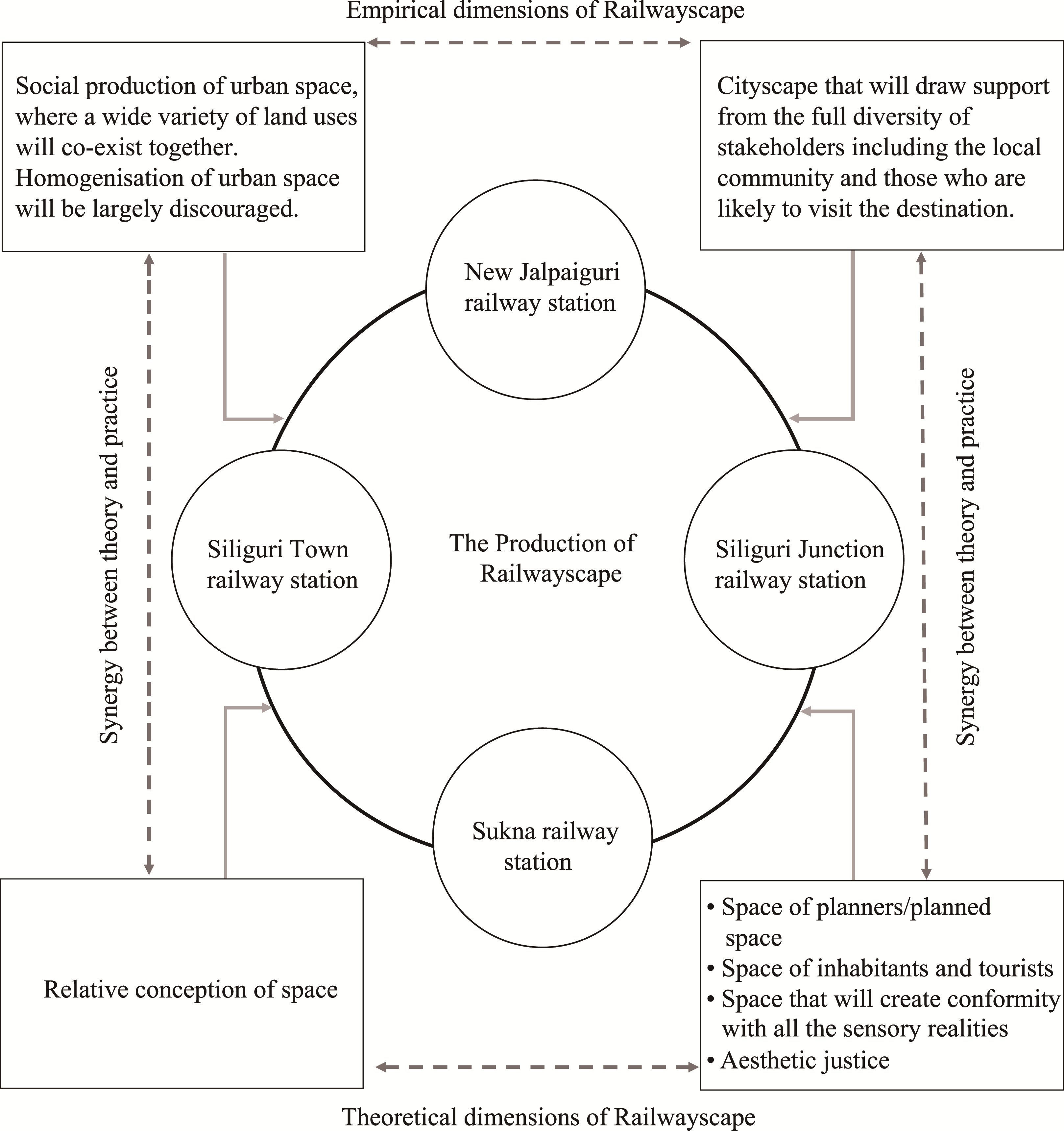
For a long time, it has been argued that the theories and practices devoted to urban planning and management should conform to the fundamental role of planning policies in the production of urban space, but not merely the spatial distribution of the produced services. Towards this wider connotation, this study introduces the notion of Railwayscape, grounded on the theory of ‘The Production of Space’, to examine the role of railway station districts as catalysts of urban development through the social production of urban space. The present research sets out to establish the notion of Railwayscape and apply it in a railway heritage, i.e., the Darjeeling Himalayan Railway (DHR) and its point of inception, Siliguri City, India. Accordingly, a criteria-based evaluation of four railway station districts (New Jalpaiguri, Siliguri Town, Siliguri Junction, and Sukna) in Siliguri and its surroundings was performed. The information regarding the selected four railway station districts is obtained through field observation and key informant consultation, supplemented by published literature and remote sensing data. This evaluation is succeeded by the strengths, weaknesses, opportunities and threats (SWOT) analysis accentuating the potential strengths, weaknesses, opportunities and threats associated with the selected four railway station districts and their prospects to become the potential Railwayscape. The results of this research show that there is no railway station district in Siliguri that can fully meet the demands of the locals and tourists, therefore, relfecting a lack of awareness of the historical values of these districts. The results also indicate that there are significant differences in the relative potentials of railway station districts to become the Railwayscape in urban environment. The outcomes of this research, therefore, are expected to encourage policy-making insitutions and practitioners to realise the ‘place value’ of some railway station districts and their potentials to yield better economic, social and structural virtue for a wide range of actors.
Iman BANERJEE . Production of Railwayscape in urban environment: Analysing railway heritage tourism potential in Siliguri City, India[J]. Regional Sustainability, 2023 , 4(1) : 1 -12 . DOI: 10.1016/j.regsus.2023.02.001
| [1] | Adams D., Watkins C., 2008. Greenfields, Brownfields and Housing Development. New York: Wiley, 136. |
| [2] | Albu R.G., C?mpean R., 2017. Opinions on the main elements to be considered in potential assessment models in tourism. Bulletin of the Transilvania University of Bra?ov Series V: Economic Sciences. 10(1), 69-78. |
| [3] | Alfrey J., Putnam T. 2004. The Industrial Heritage: Managing Resources and Uses. London: Routledge. |
| [4] | Baker J.C.T., 2014. Mobility, tropicality and landscape: the Darjeeling Himalayan Railway, 1881-1939. J. Hist. Geogr. 44, 133-144. |
| [5] | Banerjee I., 2022. Railopolis: City within a city. Journal of Urbanism: International Research on Placemaking and Urban Sustainability. 1-21. |
| [6] | Banerjee I., Saha A., 2022. Mobility centre-oriented urban regeneration: examining place value of railway stations. GeoJournal. 87(4), 567-581. |
| [7] | Bertolini L., Spit T., 1998. Cities on Rails: The Redevelopment of Railway Station Areas. London: Routledge, 9. |
| [8] | Bertolini L., 1999. Spatial development patterns and public transport: The application of an analytical model in the Netherlands. Plan. Pract. Res. 14(2), 199-210. |
| [9] | Bhati A., Pryce J., Chaiechi T., 2014. Industrial railway heritage trains: the evolution of a heritage tourism genre and its attributes. J. Herit. Tour. 9(2), 114-133. |
| [10] | Buser M., 2012. The production of space in metropolitan regions: A Lefebvrian analysis of governance and spatial change. Plan. Theory. 11(3), 279-298. |
| [11] | Census of India, 2011. District Census Handbook, Darjiling: Village and Town Directory. [2022-05-16].https://darjeeling.gov.in/census-department/. |
| [12] | Coulls A., 1999. Railways as World Heritage Sites. Paper Presented at the World Heritage Convention, International Council on Monuments and Sites (ICOMOS), Paris. [2022-05-22].https://www.icomos.org/studies/railways.pdf. |
| [13] | Dann G.M.S., 1994. Global Tourism: The Next Decade. Oxford: Butterworth-Heinemann. |
| [14] | Das A.J., 1947. Bengal District Gazetteers:Darjeeling. Alipore: Bengal Government Press, 55. |
| [15] | Degen M.M., 2008. Sensing Cities:Regenerating Public Life in Barcelona and Manchester. New York: Routledge, 18. |
| [16] | Edwards J.A., Llurde′s i Coit J.C., 1996. Mines and quarries: Industrial heritage tourism. Ann. Tour. Res. 23(2), 341-363. |
| [17] | Ghosh P., 2021. Mining tourism potential assessment of Raniganj Coalfield, India. Adv. Hosp. Tour. Res. 9(2), 341-367. |
| [18] | Ha I.S., Grunwell S.S., 2011. The economic impact of a heritage tourism attraction on a rural economy: The great smoky mountains railroad. Tour. Anal. 16(5), 629-636. |
| [19] | Hall D.R., 1999. Conceptualising tourism transport: Inequality and externality issues. J. Transp. Geogr. 7(3), 181-188. |
| [20] | Henderson J.C., 2002. Heritage attractions and tourism development in Asia: A comparative study of Hong Kong and Singapore. Int. J. Tour. Sci. 4(5), 337-344. |
| [21] | Kubalíková L., 2017. Mining landforms: An integrated approach for assessing the geotourism and geoeducational potential. Czech J. Tour. 6(2), 131-154. |
| [22] | Leary M., 2009. The production of space through a shrine and vendetta in Manchester: Lefebvre’s spatial triad and the regeneration of a place renamed Castlefield. Plan. Theory Pract. 10(2), 189-212. |
| [23] | Lefebvre H., 1991. The Production of Space. Oxford: Basil Blackwell Limited, 36-40. |
| [24] | Mattila H., 2002. Aesthetic justice and urban planning: Who ought to have the right to design cities? GeoJournal. 58, 131-138. |
| [25] | Monajem S., Nosratian F.E., 2015. The evaluation of the spatial integration of station areas via the node place model; an application to subway station areas in Tehran. Transportation Research Part D: Transport and Environment. 40, 14-27. |
| [26] | Phadermroda B., Crowder R.M., Wills G.B., 2019. Importance-performance analysis based SWOT analysis. Int. J. Inf. Manage. 44, 194-203. |
| [27] | Reihanian A., Mahmood N.Z.B., Kahrom E., et al., 2012. Sustainable tourism development strategy by SWOT analysis: Boujagh National Park, Iran. Tour. Manag. Perspect. 4, 223-228. |
| [28] | Reusser D.E., Loukopoulos P., Stauffacher M., et al., 2008. Classifying railway stations for sustainable transitions: Balancing node and place functions. J. Transp. Geogr. 16(3), 191-202. |
| [29] | Rowland M., 2006. Menendez versus Mickey: A study of heritage tourism in Florida. MSc Thesis. Petersburg: University of South Florida, 18-20. |
| [30] | Roy S., 2010. A cultural politics of mobilities and post-colonial heritage:A critical analysis of the Darjeeling Himalayan Railway (DHR). PhD Dissertation. Sunderland: University of Sunderland, 7-199. |
| [31] | Roy S., Hannam K., 2013. Embodying the mobilities of the Darjeeling Himalayan Railway. Mobilities. 8(4), 580-594. |
| [32] | Sang K., Lin G., 2021. A system for measuring the satisfaction of railway heritage tourism: the case of Yunnan-Vietnam Railway. Environment Research: Infrastructure and Sustainability. 1(1), 1-10. |
| [33] | Singh R.S., Ghosh P., 2021. Geotourism potential of coal mines: An appraisal of Sonepur-Bazari open cast project, India. International Journal of Geoheritage and Parks. 9(2), 172-181. |
| [34] | Smith N., 2008. Uneven Development:Nature, Capital, and the Production of Space(3rd edition). Georgia: The University of Georgia Press, 93. |
| [35] | UNESCO(United Nations Educational, Scientific, and Cultural Organization), 2009. World Heritage Sites. [2022-04-16].https://www.unesco.org/whc/sites/944.html. |
| [36] | Xie P.F., 2006. Developing industrial heritage tourism: A case study of the proposed Jeep museum in Toledo, Ohio. Tour. Manag. 27(6), 1321-1330. |
| [37] | Zieleniec A., 2018. Lefebvre’s politics of space: Planning the urban as oeuvre. Urban Plan. 3(3), 5-15. |
/
| 〈 |
|
〉 |
 REGSUS Wechat
 新公网安备 65010402001202号