

Material dependence of cities and implications for regional sustainability
Received date: 2019-12-31
Revised date: 2020-06-02
Accepted date: 2020-06-28
Online published: 2020-09-30
Cities rely on massive amounts of physical, chemical, and biological resources to support their growth and metabolism. These ‘metabolic inputs’ are accumulated in cities to form material stocks in buildings, infrastructures, transportation facilities, and household appliances. This study takes China’s urbanization as an example to illustrate the characteristics of material stock changes in developing countries and compare them with those in developed countries. Results show that (1) material stocks have been growing in China, but have saturated in developed countries, and (2) the major components of urban metabolism are construction and industrial materials (e.g., steel) in developing countries but biomass (e.g., food) in developed countries. The changes in the magnitude and types of material stocks can not only measure urban development but also directly link city and its residents, offering advantages in representing urbanization over the existing indices such as population, land use, or gross domestic product (GDP). Given the new insights provided by material stock, we recommend to embrace it as a critical index of urbanization for guiding urban planning and policy-making.
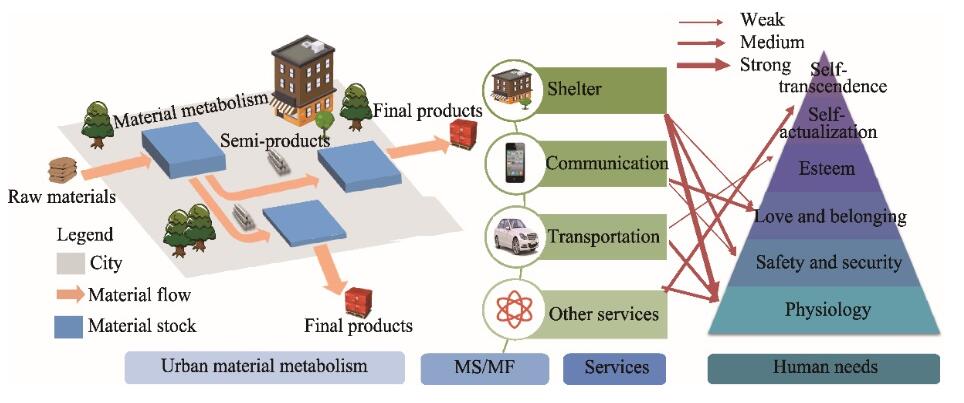
Yupeng Liu , Jiajia Li , Linlin Duan , Min Dai , Wei-qiang Chen . Material dependence of cities and implications for regional sustainability[J]. Regional Sustainability, 2020 , 1(1) : 31 -36 . DOI: 10.1016/j.regsus.2020.07.001
| [1] | Alberti, M ., 1996. Measuring urban sustainability. Environ. Impact. Asses. 16(4-6), 381-424. |
| [2] | Bai, X., Surveyer, A., Elmqvist, T ., et al., 2016. Defining and advancing a systems approach for sustainable cities. Curr. Opin. Env. Sust. 23, 69-78. |
| [3] | Braungart, M., McDonough, W. , 2002. Cradle to Cradle: Remaking the Way We Make Things. New York: North Point Press, 1-193. |
| [4] | Bren d’Amour, C., Reitsma, F., Baiocchi, G ., et al., 2017. Future urban land expansion and implications for global croplands. P. Natl. Acad. Sci. USA. 114(34), 8939-8944. |
| [5] | Canning, D ., 1998. A database of world stocks of infrastructure, 1950-95. The World Bank Economic Review. 12(3), 529-547. |
| [6] | Chen, W.Q., Graedel, T.E ., 2015. In-use product stocks link manufactured capital to natural capital. P. Natl. Acad. Sci. USA. 112(20), 6265-6270. |
| [7] | Chini, C.M., Stillwell, A.S ., 2019. The metabolism of U.S. cities 2.0. J. Ind. Ecol. 23(6), 1353-1362. |
| [8] | Costanza, R., d’Arge, R., de Groot, R ., et al., 1997. The value of the world’s ecosystem services and natural capital. Ecol. Econ. 387(15), 253-260. |
| [9] | Forman, R.T.T ., 2008. The urban region: natural systems in our place, our nourishment, our home range, our future. Landscape Ecol. 23, 251-253. |
| [10] | Gong, P., Liang, S., Carlton, E.J ., et al., 2012. Urbanisation and health in China. The Lancet. 379(9818), 843-852. |
| [11] | Grimm, N.B., Faeth, S.H., Golubiewski, N.E ., et al., 2008. Global change and the ecology of cities. Science. 319(5864), 756-760. |
| [12] | Haberl, H., Wiedenhofer, D., Pauliuk, S ., et al., 2019. Contributions of sociometabolic research to sustainability science. Nat. Sustain. 2, 173-184. |
| [13] | Jacobs, J ., 1969. The Economy of Cities. New York: Random House, 1-288. |
| [14] | Kates, R.W., Clark, W.C., Corell, R ., et al., 2001. Sustainability science. Science. 292, 641-642. |
| [15] | Krausmann, F., Wiedenhofer, D., Lauk, C ., et al., 2017. Global socioeconomic material stocks rise 23-fold over the 20 th century and require half of annual resource use. P. Natl. Acad. Sci. USA. 114(8), 1880-1885. |
| [16] | Leon, D.A ., 2008. Cities, urbanization and health. Int. J. of Epidemiol. 37(1), 4-8. |
| [17] | Li, J.J., Liu, Y.P., Han, J ., et al., 2018. Creating land by materials? An important feature of China’s urbanization. Acta. Ecol. Sin. 39, 9246-9256. (in Chinese) |
| [18] | Liu, Y.P., Wu, J.G., Yu, D.Y ., 2018a. Disentangling the complex effects of socioeconomic, climatic, and urban form factors on air pollution: a case study of China. Sustainability. 10(3), 776. |
| [19] | Liu, Y.P., Wu, J.G., Yu, D.Y ., et al., 2018b. The relationship between urban form and air pollution depends on seasonality and city size. Environ. Sci. Pollut. R. 25(16), 15554-15567. |
| [20] | Liu, Z.F., He, C.Y., Zhou, Y.Y ., et al., 2014. How much of the world’s land has been urbanized, really? A hierarchical framework for avoiding confusion. Landscape Ecol. 29, 763-771. |
| [21] | Ma, Q., Wu, J.G., He, C.Y ., 2016. A hierarchical analysis of the relationship between urban impervious surfaces and land surface temperatures: spatial scale dependence, temporal variations, and bioclimatic modulation. Landscape Ecol. 31, 1139-1153. |
| [22] | Maslow, A ., 1954. Motivation and Personality. New York: Harper and Row, 1-336. |
| [23] | Millennium Ecosystem Assessment (MEA). 2005. Ecosystems and Human Well-being: Synthesis. Washington DC: Island Press, 1-160. |
| [24] | Montgomery, M.R ., 2008. The urban transformation of the developing world. Science. 319(5864), 761-764. |
| [25] | Moran, D., Kanemoto, K., Jiborn, M ., et al., 2018. Carbon footprints of 13,000 cities. Environ. Res. Lett. 13(6), 064041. doi: 10.1088/1748-9326/aac72a. |
| [26] | Pauliuk, S., Wang, T., Müller, D.B ., 2013. Steel all over the world: Estimating in-use stocks of iron for 200 countries. Resour. Conserv. Recy. 71, 22-30. |
| [27] | Pauliuk, S., Müller, D.B ., 2014. The role of in-use stocks in the social metabolism and in climate change mitigation. Global Environ. Change. 24, 132-142. |
| [28] | Pickett, S.T.A., Cadenasso, M.L., Grove, J.M ., et al., 2011. Urban ecological systems: Scientific foundations and a decade of progress. J. Environ. Manage. 92, 331-362. |
| [29] | Ramaswami, A., Weible, C., Main, D ., et al., 2012. A social-ecological-infrastructural systems framework for interdisciplinary study of sustainable city systems. J. Ind. Ecol. 16, 801-813. |
| [30] | Rao, N.D., Baer, P ., 2012. “Decent living” emissions: A conceptual framework. Sustainability. 4(4), 656-681. |
| [31] | Rauch, J.N ., 2009. Global mapping of Al, Cu, Fe, and Zn in-use stocks and in-ground resources. P. Natl. Acad. Sci. USA. 106(45), 18920-18925. |
| [32] | Schneider, A., Friedl, M.A., Potere, D ., 2010. Mapping global urban areas using MODIS 500-m data: New methods and datasets based on ‘urban ecoregions’. Remote Sens. Environ. 114(8), 1733-1746. |
| [33] | Seto, K.C., Sánchez-Rodríguez, R., Fragkias, M ., 2010. The new geography of contemporary urbanization and the environment. Annu. Rev. Environ. Resour. 35, 167-194. |
| [34] | Seto, K.C., Güneralp, B., Hutyra, L.R ., 2012. Global forecasts of urban expansion to 2030 and direct impacts on biodiversity and carbon pools. P. Natl. Acad. Sci. USA. 109(40), 16083-16088. |
| [35] | Solecki, W., Seto, K.C., Marcotullio, P.J ., 2013. It’s time for an urbanization science. Environment: Science and Policy for Sustainable Development. 55(1), 12-17. |
| [36] | Tanikawa, H., Hashimoto, S ., 2009. Urban stock over time: spatial material stock analysis using 4d-GIS. Build. Res. Informat. 37(5-6), 483-502. |
| [37] | Tanikawa, H., Fishman, T., Okuoka, K ., et al., 2015. The weight of society over time and space: A comprehensive account of the construction material stock of Japan, 1945-2010. J. Ind. Ecol. 19(5), 778-791. |
| [38] | Thacker, S., Adshead, D., Fay, M ., et al., 2019. Infrastructure for sustainable development. Nat. Sustain. 2, 324-331. |
| [39] | Verburg, P.H., Overmars, K.P ., 2009. Combining top-down and bottom-up dynamics in land use modeling: exploring the future of abandoned farmlands in Europe with the Dyna-CLUE model. Landscape Ecol. 24, 1167. doi: 10.1007/s10980-009-9355-7. |
| [40] | Wiedenhofer, D., Steinberger, J.K., Eisenmenger, N ., et al., 2015. Maintenance and expansion: Modeling material stocks and flows for residential buildings and transportation networks in the EU25. J. Ind. Ecol. 19(5), 538-551. |
| [41] | Wu, J.G., Xiang, W.N., Zhao, J.Z ., 2014. Urban ecology in China: Historical developments and future directions. Landsc. Urban Plan. 125, 222-233. |
| [42] | Yang, Y., Heijungs, R ., 2018. On the use of different models for consequential life cycle assessment. Int. J. of Life Cycle Assess. 23, 751-758. |
| [43] | Ye, J.A., Xu, J., Yi, H ., 2006. The fourth wave of urbanization in China. City Planning Reviews. 30, 13-18. (in Chinese) |
| [44] | Yu, D., Shao, H.B., Shi, P.J ., et al., 2009. How does the conversion of land cover to urban use affect net primary productivity? A case study in Shenzhen City, China. Agr. Forest Meteorol. 149(11), 2054-2060. |
| [45] | Zhang, Q., Seto, K.C ., 2013. Can night-time light data identify typologies of urbanization? a global assessment of successes and failures. Remote Sens. 5, 3476-3494. |
| [46] | Zhao, J.Z., Liu, X., Dong, R.C ., et al., 2016. Landsenses ecology and ecological planning toward sustainable development. Int. J. Sustain. Dev. World Ecol. 23(4), 293-297. |
| [47] | Zhou, L., Dickinson, R.E., Tian, Y ., et al., 2004. Evidence for a significant urbanization effect on climate in China. P. Natl. Acad. Sci. USA. 101(26), 9540-9544. |
| [48] | Zhu, Y.G., Ioannidis, J.P., Li, H ., et al., 2011. Understanding and harnessing the health effects of rapid urbanization in China. Environ. Sci. Technol. 45(12), 5099-5104. |
| [49] | Zhu, Y.G., Gillings, M., Simonet, P ., et al., 2017. Microbial mass movements. Science. 357, 1099. |
/
| 〈 |
|
〉 |
 REGSUS Wechat
 新公网安备 65010402001202号