

Environmental degradation and poverty: A bibliometric review
Received date: 2021-08-06
Revised date: 2021-11-06
Accepted date: 2022-01-15
Online published: 2022-03-18
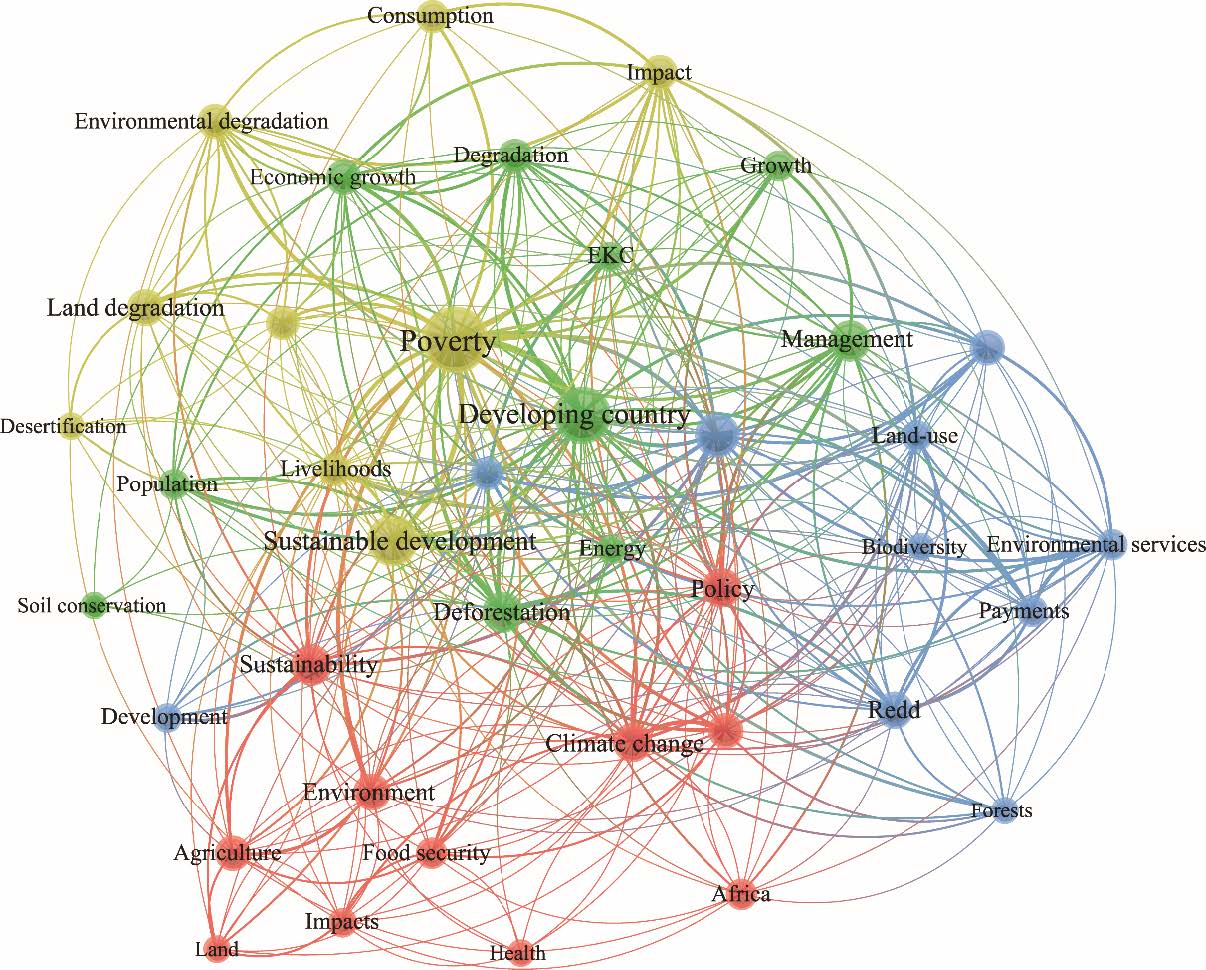
Understanding the mutual logic between environment and poverty mitigation is vital for achieving the United Nations Sustainable Development Goals (SDGs). This study conducts a bibliometric review of the available literature on environmental degradation and poverty and summarizes the existing researches. By applying suitable keywords, we retrieved 175 peer-reviewed articles from the Web of Science published between 1993 and 2020. We utilized the visualization of similarity viewer (VOSviewer) for this bibliometric study and classified the leading publications, prominent journals, and institutions. Furthermore, our bibliometric review found a phenomenon in investigation that people are indifference about the impact of environmental degradation on rising poverty levels in poor and developing countries. In terms of contributions, this study classifies 4 leading thematic clusters that identify how environmental degradation increases poverty. By employing text mining analysis, this research connects specific environmental terms accountable for the recent rise in global poverty. We finally recommend that including other databases to strengthen the findings of environmental degradation and poverty is one of the future research directions.
Muhammad Ali Khan BURKI , Umar BURKI , Usama NAJAM . Environmental degradation and poverty: A bibliometric review[J]. Regional Sustainability, 2021 , 2(4) : 324 -336 . DOI: 10.1016/j.regsus.2022.01.001
| [1] | Agten, S., 2021. “Made in China” No longer means cheap. In: Adventures in the Chinese Economy: 16 Years from the Inside. Singapore: Palgrave Macmillan, 1-18. |
| [2] | Ahluwalia, M.S., Carter, N.G., Chenery, H.B., 1979. Growth and poverty in developing countries. J.Dev. Econ. 6(3), 299-341. |
| [3] | Akinlo, T., Dada, J.T., 2021. The moderating effect of foreign direct investment on environmental degradation-poverty reduction nexus: evidence from sub-Saharan African countries. Environ. Dev. Sustain. 23, 15764-15784. |
| [4] | Al-Mulali, U., Binti Che Sab, C.N., 2012. The impact of energy consumption and CO2 emission on the economic growth and financial development in the Sub Saharan African countries. Energy. 39(1), 180-186. |
| [5] | Ananda, J., Herath, G., 2003. Soil erosion in developing countries: a socio-economic appraisal. J.Environ. Manage. 68, 343-353. |
| [6] | Asongu, S.A., Roux, L.S., Biekpe, N., 2017. Environmental degradation, ICT and inclusive development in Sub-Saharan Africa. Energy Policy. 111, 353-361. |
| [7] | Baland, J.M., Bardhan, P., Das, S., et al., 2010. The environmental impact of poverty: Evidence from firewood collection in rural Nepal. Econ. Dev. Cult. Change. 1, 23-61. |
| [8] | Barbier, E.B., 1997. The economic determinants of land degradation in developing countries. Philos. Trans. R. Soc. B-Biol. Sci. 352(1356), 891-899. |
| [9] | Barbier, E.B., 2010. Poverty, development, and environment. Environ. Dev. Econ. 15(6), 635-660. |
| [10] | Bhattacharya, S., Basu, P.K., 1998. Mapping a research area at the micro level using co-word analysis. Scientometrics. 43(3), 359-372. |
| [11] | Capps, K.A., Bentsen, C.N., Ramirez, A., 2016. Poverty, urbanization, and environmental degradation: Urban streams in the developing world. Freshw. Sci. 35(1), doi: 10.1086/684945. |
| [12] | Chakravarty, D., Mandal, S.K., 2020. Is economic growth a cause or cure for environmental degradation? Empirical evidences from selected developing economies. Environmental and Sustainability Indicators. 7, 100045, doi: 10.1016/j.indic.2020.100045. |
| [13] | Clayton, E., 1983. Agriculture, Poverty and Freedom in Developing Countries. London: Palgrave. |
| [14] | Darkoh, M.B.K., 1998. The nature, causes and consequences of desertification in the drylands of Africa. Land Degrad. Dev. 9, 1-20. |
| [15] | Dorin, M., Maier, A., Aschilean, I., et al., 2020. The relationship between innovation and sustainability: A bibliometric review of the literature. Sustainability. 12(10), 4083, doi: 10.3390/su12104083. |
| [16] | Duraiappah, A.K., 1998. Poverty and environmental degradation: A review and analysis of the nexus. World Dev. 26(12), 2169-2179. |
| [17] | Ekholm, T., Kery, V., Pachauri, S., et al., 2010. Determinants of household energy consumption in India. Energy Policy. 38(10), 5696-5707. |
| [18] | Gray, L.C., Moseley, W.G., 2005. A geographical perspective on poverty-environment interactions. Geogr. J. 171(1), 9-23. |
| [19] | Hanjra, M.A., Blackwell, J., Carr, G., et al., 2012. Wastewater irrigation and environmental health: Implications for water governance and public policy . Int. J.Hyg. Environ. Health. 215(3), 255-269. |
| [20] | IPCC (Intergovernmental Panel on Climate Change), 2018. Global Warming of 1. 5°C. An IPCC Special Report on the Impacts of Global Warming of 1.5°C above Pre-industrial Levels and Related Global Greenhouse Gas Emission Pathways, in the Context of Strengthening the Global Response to the Threat of Climate Change, Sustainable Development, and Efforts to Eradicate Poverty. [2021-02-10]. https://www.ipcc.ch/site/assets/uploads/sites/2/2019/06/SR15_Full_Report_High_Res.pdf. |
| [21] | Jain, L.C., 1988. Poverty, environment, development: A view from Gandhi’s window. Econ. Polit. Week. 23(7), 311-320. |
| [22] | Jian, J.H., Fan, X.J., He, P.L., et al., 2019. The effects of energy consumption, economic growth and financial development on CO2 emissions in China: A VECM Approach. Sustainability. 11(18), 4850, doi: 10.3390/su11184850. |
| [23] | Johnson, D.L., Ambrose, S.H., Bassett, T.J., et al., 1997. Meanings of environmental terms. J.Environ. Qual. 26(3), 581-589. |
| [24] | Kassie, M., Pender, J., Yesuf, M., et al., 2008. Estimating returns to soil conservation adoption in the northern Ethiopian highlands. Agricultural Economists. 38(2), 213-232. |
| [25] | Kates, R.W., 2000. Cautionary tales: Adaptation and the global poor. In: Kane, S.M., Yohe, G.W., (eds.). Societal Adaptation to Climate Variability and Change. Dordrecht:Springer, 5-17. |
| [26] | Kemp, D.R., Han, G.D., Hou, X.Y., et al., 2013. Innovative grassland management systems for environmental and livelihood benefits. Proc. Natl. Acad. Sci. U. S. A. 110(21), 8369-8374. |
| [27] | Khavul, S., Bruton, G.D., 2013. Harnessing innovation for change: Sustainability and poverty in developing countries. J.Manage. Stud. 50(2), 285-306. |
| [28] | Kousar, S., Shabbir, A., 2021. Analysis of environmental degradation mechanism in the nexus among energy consumption and poverty in Pakistan. Environ. Sci. Pollut. Res. 28, 27528-27541. |
| [29] | Kumar, S.K., Hotchkiss, D., 1988. Consequences of deforestation for women’s time allocation, agricultural production and nutrition in hill areas of Nepal. In: Research Report. International Food Policy Research Institute. Washington, D.C.,USA, 69-72. |
| [30] | Lawlor, K., Madeira, E.M., Blockhus, J., et al., 2013. Community participation and benefits in REDD+: A review of initial outcomes and lessons. Forests. 4, 296-318. |
| [31] | Malerba, D., 2020. Poverty alleviation and local environmental degradation: An empirical analysis in Colombia. World Dev. 127, 104776, doi: 10.1016/j.worlddev.2019.104776. |
| [32] | Martinelli, L.A., Naylor, R., Vitousek, P.M., et al., 2010. Agriculture in Brazil: impacts, costs, and opportunities for a sustainable future. Curr. Opin. Environ. Sustain. 2(5-6), 431-438. |
| [33] | Masron, T.A., Subramaniam, Y., 2019. Does poverty cause environmental degradation? Evidence from developing countries. J.Poverty. 23(1), 44-64. |
| [34] | McElwee, P.D., 2012. Payments for environmental services as neoliberal market-based forest conservation in Vietnam: Panacea or problem? Geoforum. 43(3), 412-426. |
| [35] | Minang, P.A., van Noordwijk, M., 2013. Design challenges for achieving reduced emissions from deforestation and forest degradation through conservation: Leveraging multiple paradigms at the tropical forest margins. Land Use Pol. 31, 61-70. |
| [36] | Moore, M., Gould, P., Keary, B.S., 2003. Global urbanization and impact on health. Int. J.Hyg. Environ. Health. 206(4-5), 269-278. |
| [37] | Moral-Muñoz, J.A., Herrera-Viedma, E., Santisteban-Espejo, A., et al., 2020. Software tools for conducting bibliometric analysis in science: An up-to-date review. El profesional de la informaci ón. 29(1), e290103, doi: 10.3145/epi.2020.ene.03. |
| [38] | Nyssen, J., Poesen, J., Moeyersons, J., et al., 2004. Human impact on the environment in the Ethiopian and Eritrean highlands—a state of the art. Earth-Sci. Rev. 64(3-4), 273-320. |
| [39] | Pandey, S., Dogan, E., Taskin, D., 2020. Production-based and consumption-based approaches for the energy-growth-environment nexus: Evidence from Asian countries. Sustain. Prod. Consump. 23, 274-281. |
| [40] | Pattanayak, S.K., Wunder, S., Ferraro, P.J., 2010. Show me the money: Do payments supply environmental services in developing countries? Rev. Env. Econ. Policy. 4(2), 254-274. |
| [41] | Perianes-Rodriguez, A., Waltman, L., van Eck, N.J., 2016. Constructing bibliometric networks: A comparison between full and fractional counting. J.Informetr. 10(4), 1178-1195. |
| [42] | Ravnborg, H.M., 2003. Poverty and environmental degradation in the Nicaraguan hillsides. World Dev. 31(11), 1933-1946. |
| [43] | Reardon, T., Vosti, S.A., 1995. Links between rural poverty and the environment in developing countries: Asset categories and investment poverty. World Dev. 23(9), 1495-1506. |
| [44] | Sanchez, P.A., 2000. Linking climate change research with food security and poverty reduction in the tropics. Agric. Ecosyst. Environ. 82(1-3), 371-383. |
| [45] | Sarkodie, S.A., Strezov, V., 2019. A review on Environmental Kuznets Curve hypothesis using bibliometric and meta-analysis. Sci. Total Environ. 649, 128-145. |
| [46] | Scherr, S.J., 2000. A downward spiral? Research evidence on the relationship between poverty and natural resource degradation . Food Policy. 25(4), 479-498. |
| [47] | Shaista, A., 2010. Globalization, poverty and environmental degradation: Sustainable development in Pakistan. Journal of Sustainable Development. 3(3), 103-114. |
| [48] | Sovacool, B.K., 2012. The political economy of energy poverty: A review of key challenges. Energy Sustain Dev. 16(3), 272-282. |
| [49] | United, Nations., 2021. The 17 Sustainable Development Goals. [2021-02-10]. https://sdgs.un.org/goals. |
| [50] | van Eck, N.J., Waltman, L., 2010. Software survey: VOSviewer, a computer program for bibliometric mapping. Scientometrics. 84(2), 523-538. |
| [51] | van Eck, N.J., Waltman, L., Dekker, R., et al., 2010. A comparison of two techniques for bibliometric mapping: Multidimensional scaling and VOS. J.Am. Soc. Inf. Sci. Technol. 61(12), 2405-2416. |
| [52] | van Eck, N.J., Waltman, L., 2020. VOSviewer Manual. [2021-02-20]. https://www.vosviewer.com/documentation/Manual_VOSviewer_1.6.16.pdf. |
| [53] | World, Bank, 1992. World Development Report 1992: Development and the Environment. New York: Oxford University Press. |
| [54] | Zhang, X.Q., 2016. The trends, promises and challenges of urbanization in the world. Habitat Int. 54(3), 241-252. |
| [55] | Zhong, S.Z., Geng, Y., Liu, W.J., et al., 2016. A bibliometric review on natural resource accounting during 1995-2014. J.Clean. Prod. 139, 122-132. |
| [56] | Zupic, I., Čater, T., 2015. Bibliometric Methods in Management and Organization. Organ. Res. Methods. 18(3), 429-472. |
/
| 〈 |
|
〉 |
 REGSUS Wechat
 新公网安备 65010402001202号