

Exploring the nexus between Indian forestry and the Sustainable Development Goals
Received date: 2021-05-10
Revised date: 2021-10-26
Accepted date: 2022-01-16
Online published: 2022-03-18
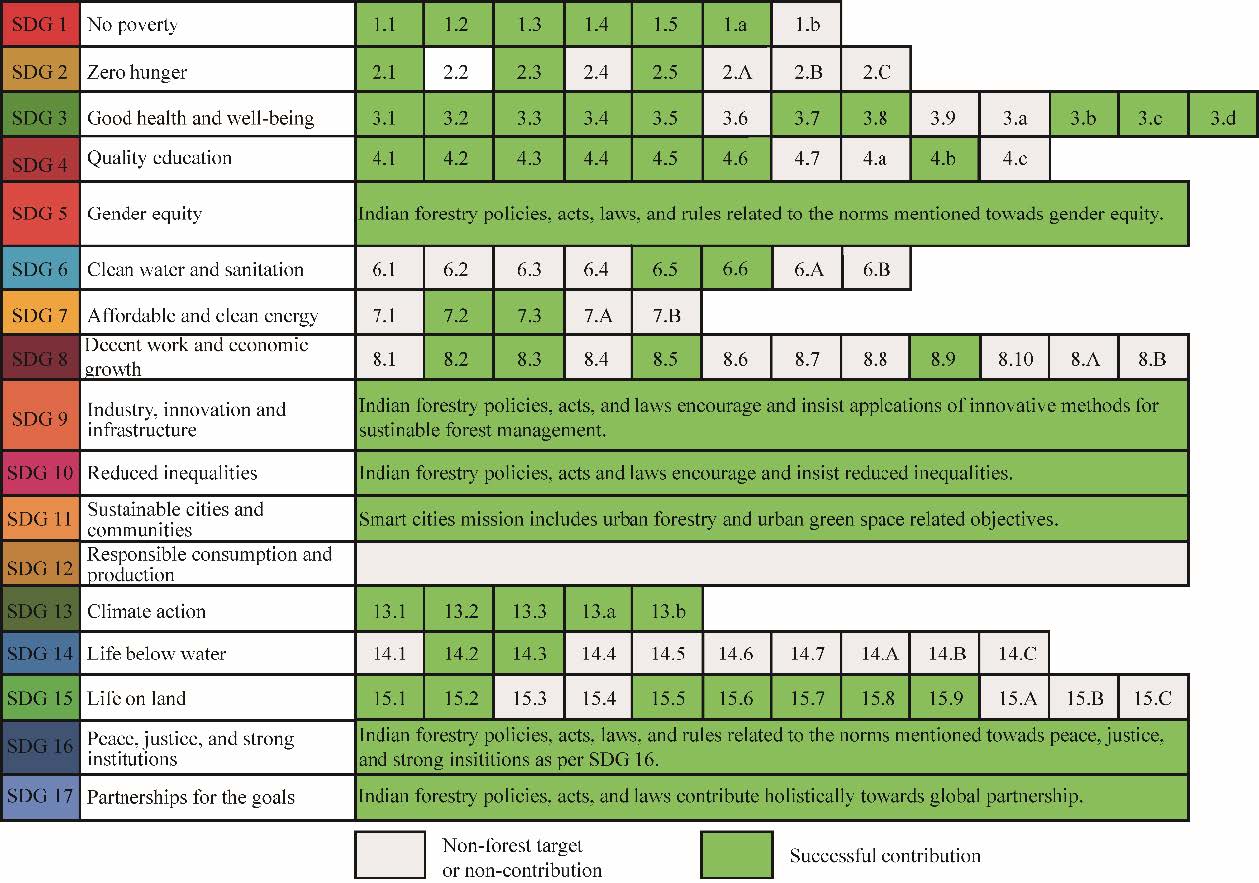
Forests are considered as a sacred asset in India and have guided the way of living throughout its history. Indian forests not only accommodate the myriad species but also act as a survival support system to the communities that depended on them. The 2030 Agenda for Sustainable Development proposed by the United Nations (UN) has gained momentum and becomes an integral part of the recent efforts of Indian governance. In this investigation, we examined the potential nexus between Indian forestry system (biodiversity-enriched assets, ecosystem services, constitutional mechanisms, and governances) and Sustainable Development Goals (SDGs) through theoretical underpinnings from literature that selected from database like Google Scholar, Indian forest survey reports, and information retrieved from Indian government websites. The significance of this review is that it presents comprehensive information about Indian forestry, biodiversity-rich assets, and sustainable forest management practices. The results show that Indian forestry as a whole is an integral part of the food-energy-water cycle and contributes to all dimensions of sustainable development, i.e., economic sustainability, social sustainability, and environmental sustainability. The investigation confirms that besides partly contributing to the economy and life support systems to many dependent species, forests also act as boosters in the areas of food security and health. Targets related to the climate action, peace, and partnership goals are well in place through various forestry interventions and environmental commitments by the Government of India.
Giribabu DANDABATHULA , Sudhakar Reddy CHINTALA , Sonali GHOSH , Padmapriya BALAKRISHNAN , Chandra Shekhar JHA . Exploring the nexus between Indian forestry and the Sustainable Development Goals[J]. Regional Sustainability, 2021 , 2(4) : 308 -323 . DOI: 10.1016/j.regsus.2022.01.002
| [1] | Ahmad, F., 2011. Managing the Forest for Sustainable Development: A Study of Indian States. Munich: GRIN Verlag, 1-13. |
| [2] | Akinyi, D.P., Karanja, N.S., Hartunian, G.E., 2021. Trade-offs and synergies of climate change adaptation strategies among smallholder farmers in sub-Saharan Africa: A systematic review. Reg. Sustain. 2(2), 130-143. |
| [3] | Amezaga, J., Bathurst, J., Iroumé, A., et al., 2019. SDG 6: Clean water and sanitation-forest-related targets and their impacts on forests and people. In: Katila, P., Colfer, C.J., De Jong, W., et al., (eds.). Sustainable Development Goals: Their Impacts on Forests and People. United Kingdom: Cambridge University Press, 178-205. |
| [4] | Andersson, L., 2018. Achieving the Global Goals through Agroforestry. Stockholm: Agroforestry Network and VI-Skogen. |
| [5] | Anthwal, A., Gupta, N., Sharma, A., et al., 2010. Conserving biodiversity through traditional beliefs in sacred groves in Uttarakhand Himalaya, India. Resour. Conserv. Recycl. 54(11), 962-971. |
| [6] | Arora-Jonsson, S., Agarwal, S Pierce Colfer,, C.J., et al., 2019. SDG 5: Gender equality-A precondition for sustainable forestry. In: Katila, P., Colfer, C.J., De Jong, W., et al., (eds.). Sustainable Development Goals: Their Impacts on Forests and People. United Kingdom: Cambridge University Press, 146-177. |
| [7] | Ashutosh, S., Roy, P.S., 2021. Three decades of nationwide forest cover mapping using Indian remote sensing satellite data: A success story of monitoring forests for conservation in India. J.Indian Soc. Remote Sens. 49(1), 61-70. |
| [8] | Asprilla-Perea, J., Díaz-Puente, J.M., 2019. Importance of wild foods to household food security in tropical forest areas. Food Secur. 11(1), 15-22. |
| [9] | Barik, S.K., Mishra, S.K., 2008. Assessment of the contribution of forests to the economy of the northeastern states of India. Int. Forest. Rev. 10(2), 349-361. |
| [10] | Baumgartner, R.J., 2019. Sustainable development goals and the forest sector—a complex relationship. Forests. 10(2), 152, doi: 10.3390/f10020152. |
| [11] | Bettinger, P., Boston, K., Siry, J.P., et al., 2016. Forest Management and Planning. New York: Academic press. |
| [12] | Bhattacharya, P., Pradhan, L., Yadav, G., 2010. Joint forest management in India: experiences of two decades. Resour. Conserv. Recycl. 54(8), 469-480. |
| [13] | Bhattacharya, S., 2014. Forest and biodiversity conservation in ancient Indian culture: A review based on old texts and archaeological evidences. Int. Lett. Soc. Humanist. Sci. 30, 35-46. |
| [14] | Bhullar, L., 2008. The Indian forest rights act 2006: a critical appraisal. Law Environ. Dev. J. 4(1), 20-28. |
| [15] | Bisht, A.S., Thakur, N.S., 2020. Pine needles biomass gasification based electricity generation for Indian Himalayan region: drivers and barriers. In: Drück, H., Pillai, R.G., Tharian, M.G., et al., (eds.). Green Buildings and Sustainable Engineering. Singapore:Springer, 47-59. |
| [16] | Biswas, S., Rawat, M.S., Tantray, F.A., et al., 2017. Medicinal plants conservation and development areas (MPCDAs)-An initiative towards conservation of medicinal plants. Medicinal Plants-International Journal of Phytomedicines and Related Industries. 9(3), 143-149. |
| [17] | Borah, B., Bhattacharjee, A., Ishwar, N.M., 2018. Bonn Challenge and India: Progress on Restoration Efforts across States and Landscapes. New Delhi: International Union for Conservation of Nature. |
| [18] | Bose, P., 2020. Forest foods for tribals in selected regions of India and their sustainability. In: Jamnua, P., Viduranga, W., Vishweshwariah, P., (eds.). Nutritional and Health Aspects of Food in South Asian Countries. London: Academic Press, 51-59. |
| [19] | Calder, I., Hofer, T., Vermont, S., et al., 2008. Towards a New Understanding of Forests and Water. [2021-07-01]. http://www.fao.org/3/a1598e/a1598e02.pdf. |
| [20] | Cheng, S.H., Ahlroth, S., Onder, S., et al., 2017. What is the evidence for the contribution of forests to poverty alleviation? A systematic map protocol. Environ. Evid. 6(1), 10, doi: 10.1186/s13750-017-0088-9. |
| [21] | Clearing-House Mechanism of the Convention on Biological Diversity, 2018. Sixth National Report. [2021-04-21]. https://chm.cbd.int/database/record?documentID=241351. |
| [22] | Cudworth, D., Lumber, R., 2021. The importance of forest school and the pathways to nature connection. J.Outdoor Environ. Educ. 24(1), 71-85. |
| [23] | Damania, R., Joshi, A., Russ, J., 2020. India’s forests-stepping stone or millstone for the poor? World Dev. 125, 104451, doi: 10.1016/j.worlddev.2018.11.007. |
| [24] | Dar, J.A., Kareem, M., Zargar, S.M., et al., 2020. Strategies for conservation of genetic resources. In: Zargar, S.M., Salgotra, R.K., (eds.). Rediscovery of Genetic and Genomic Resources for Future Food Security. Singapore:Springer,315-334. |
| [25] | Das, C., Sanskar, S., 2021. Adequacy of Indian Constitution in Protection of Tribal Rights. [2021-04-24]. http://dx.doi.org/10.2139/ssrn.3911449. |
| [26] | De Jong, W., Pokorny, B., Katila, P., et al., 2018. Community forestry and the sustainable development goals: A two way street. Forests. 9(6), 331, doi: 10.3390/f9060331. |
| [27] | Devisscher, T., Konijnendijk, C., Nesbitt, L., et al., 2019. SDG 11: Sustainable cities and communities-impacts on forests and forest based livelihoods. In: Katila, P., Colfer, C.J., De Jong, W., et al., (eds.). Sustainable Development Goals: Their Impacts on Forests and People. United Kingdom: Cambridge University Press, 349-385. |
| [28] | Dhaka, R.K., Choudhari, C., 2018. Forestry education in India: Objectives, needs, current status and recommendations. Pharm. Innov. J. 7(12), 320-324. |
| [29] | Diduck, A.P., Patel, K., Malik, A.K., 2021. Advancing Environmental Justice for Marginalized Communities in India: Progress, Challenges and Opportunities . New York:Routledge. |
| [30] | Dlamini, C.S., 2020. Contribution of forest ecosystem services toward food security and nutrition. In: Leal Filho, W., Azul, A., Brandli, L., et al., (eds.). Zero Hunger. Cham:Springer,179-196. |
| [31] | Elias, M., Grosse, A., Campbell, N., 2020. Unpacking ‘gender’ in joint forest management: Lessons from two Indian states. Geoforum. 111, 218-228. |
| [32] | Food and Agriculture Organization, 1995. State of World’s Forests 1995. [2021-04-21]. http://www.fao.org/3/X6953E/X6953E00.htm. |
| [33] | Food and Agriculture Organization, 2003. The State of India’s Biodiversity for Food and Agriculture. [2021-04-21]. http://www.fao.org/3/CA3444EN/ca3444en.pdf. |
| [34] | Food and Agriculture Organization, 2010. Global Forest Resources Assessment 2010. [2021-04-21]. http://www.fao.org/3/i1757e/i1757e.pdf. |
| [35] | Food and Agriculture Organization, 2020. Global Forest Resources Assessment 2020.. [2021-04-21]. http://www.fao.org/documents/card/en/c/ca9825en. |
| [36] | Food and Agriculture Organization-United Nations Environment Programme, 2020. The State of the World’s Forests 2020. Forests, biodiversity and people. [2021-04-21]. https://doi.org/10.4060/ca8642en. |
| [37] | Forest Research Institute, 2015. Committees and Forest Area under JFM. [2021-04-21]. http://www.frienvis.nic.in/Database/JFM-Committees-and-Forest_Area_2243.aspx. |
| [38] | Forest Research Institute, 2019. Edible Forest Products. [2021-04-21]. http://www.frienvis.nic.in/Database/Edible-Forest-Products_2459.aspx. |
| [39] | Forest Stewardship Council, 2018. Life below water. [2021-04-21]. https://marketingtoolkit.fsc.org/campaign/sdg-14-life-below-water. |
| [40] | Forest Survey of India (FSI), 1999. India State of Forest Report-1999. [2021-04-21]. https://www.fsi.nic.in/documents/sfr_1999_hindi.pdf. |
| [41] | Forest Survey of India (FSI), 2019. India State of Forest Report-2019. [2021-04-21]. https://www.fsi.nic.in/forest-report-2019. |
| [42] | Forsell, N., Turkovska, O., Gusti, M., et al., 2016. Assessing the INDCs’ land use, land use change, and forest emission projections. Carbon Balance Manag. 11(1), 1-17. |
| [43] | Friess, D.A., Aung, T.T., Huxham, M., et al., 2019. SDG 14: Life below water-Impacts on mangroves. In: Katila, P., Colfer, C.J., De Jong, W., et al., (eds.). Sustainable Development Goals: Their Impacts on Forests and People. United Kingdom: Cambridge University Press, 445-481. |
| [44] | Gajurel, P.R., Doni, T., 2020. Diversity of wild edible plants traditionally used by the Galo tribe of Indian eastern Himalayan state of Arunachal Pradesh. Plant Sci. Today. 7(4), 523-533. |
| [45] | Ghosh, N., 2020. Promoting a ‘GDP of the poor’: The Imperative of Integrating Ecosystems Valuation in Development Policy. [2021-04-21]. https://www.orfonline.org/research/promoting-a-gdp-of-the-poor-the-imperative-of-integrating-ecosystems- valuation-in-development-policy-63412/. |
| [46] | Ghosh-Jerath, S., Kapoor, R., Barman, S., et al., 2021. Traditional food environment and factors affecting indigenous food consumption in Munda tribal community of Jharkhand, India. Front. Nutr. 7, 600470, doi: 10.3389/fnut.2020.600470. |
| [47] | Gill, G., 2016. Environmental Justice in India. London: Routledge. |
| [48] | Giribabu, D., Mohapatra, C., Reddy, C.S., et al., 2019. Holistic correlation of world’s largest social safety net and its outcomes with sustainable development goals. Int. J.Sustain. Dev. World Ecol. 26(2), 113-128. |
| [49] | Godbole, G., 2002. Joint Forest Management and Gender. [2021-04-21]. https://assets.publishing.service.gov.uk/media/57a08d44e5274a27b2001741/R7640-fm-gender.pdf. |
| [50] | Gorain, S., Malakar, A., 2020. Status, trends and valuation methodologies of forestry sector in India. Curr. J.Appl. Sci. Technol. 39(39), 49-56. |
| [51] | Government of India, Department of Agriculture & Cooperation Ministry of Agriculture, 2014. National Agroforestry Policy. [2021-07-01]. https://agricoop.nic.in/sites/default/files/National%20Agroforestry%20Policy%202014.pdf. |
| [52] | Hazarika, R., Jandl, R., 2019. The nexus between the Austrian forestry sector and the sustainable development goals: A review of the interlinkages. Forests. 10(3), 205, doi: 10.3390/f10030205. |
| [53] | Holley, J., Cherla, K., 1998. The Medicinal Plants Sector in India: A Review. New Delhi: International Development Research Centre for Medicinal and Aromatic Plants Program in Asia. |
| [54] | Humphreys, D., Singer, B., McGinley, K, et al., 2019. SDG 17: Partnerships for the Goals-Focus on Forest Finance and Partnerships. In: Katila, P., Colfer, C.J., De Jong, W., et al., (eds.). Sustainable Development Goals: Their Impacts on Forests and People. United Kingdom: Cambridge University Press, 541-576. |
| [55] | Indian Forest Service, 2020. Indian Forest Service-Ministry of Environment, Forest and Climate Change. [2021-04-21]. http://ifs.nic.in. |
| [56] | International Centre for Environment Audit and Sustainable, Development, 2019. Major Environmental Policies and Legislations. [2021-04-21]. http://iced.cag.gov.in. |
| [57] | Jagger, P., Bailis, R., Dermawan, A., et al., 2019. SDG 7: Affordable and clean energy-How access to affordable and clean energy affects forests and forest-based livelihoods. In: Katila, P., Colfer, C.J., De Jong, W., et al., (eds.). Sustainable Development Goals: Their Impacts on Forests and People. United Kingdom: Cambridge University Press, 206-236. |
| [58] | Jattan, P.S., 2003. Gender Issues in Participatory Forest Management in India. [2021-04-21]. https://www.fao.org/3/XII/0799-C1.htm. |
| [59] | Javedekar, 2020. Government Plans to Establish 200 Urban Forest for Cities to Breathe Easy. [2021-04-21]. http://delhincrnews.in/2020/06/05/govt-plans-to-establish-200-urban-forests-for-cities-to-breathe-easy/. |
| [60] | Joshi, K.K., 2020. Historical and contemporary laws related to forest and environment with the perspective of the role of the Indian media in environmental conservation: A review. J.Media Manag. 2(2), 1-5. |
| [61] | Kanowski, P., Yao, D., Wyatt, S., 2019. SDG 4: Quality education and forests-‘The Golden Thread’. In: Katila, P., Colfer, C.J., De Jong, W., et al., (eds.). Sustainable Development Goals: Their Impacts on Forests and People. United Kingdom: Cambridge University Press, 108-145. |
| [62] | Karanth, K.K., DeFries, R., 2010. Nature-based tourism in Indian protected areas: New challenges for park management. Conserv. Lett. 4(2), 137-149. |
| [63] | Kathiresan, K., 2018. Mangrove forests of India. Curr Sci. 114(5), 976-981. |
| [64] | Katila, P., Colfer, C.J., De Jong, W., et al. (eds.).. 2019. Sustainable Development Goals: Their Impacts on Forests and People. United Kingdom: Cambridge University Press. |
| [65] | Khare, A., Sarin, M., Saxena, N.C., et al., 2000. Joint Forest Management: Policy, Practice and Prospects. [2021-04-21]. https://pubs.iied.org/7535iied. |
| [66] | Khare, V.R., Vajpai, A., Gupta, D., 2021. A big picture of urban heat island mitigation strategies and recommendation for India. Urban Clim. 37, 100845, doi: 10.1016/j.uclim.2021.100845. |
| [67] | Kishwan, J., Pandey, R., Dadhwal, V.K., 2009. India’s Forest and Tree Cover: Contribution as a Carbon Sink. Dehradun: Indian Council of Forestry Research and Education. |
| [68] | Kollmuss, A., Agyeman, J., 2002. Mind the gap: why do people act environmentally and what are the barriers to pro-environmental behavior? Environ. Educ. Res. 8(3), 239-260. |
| [69] | Koskela, J., Vinceti, B., Dvorak, W., et al. 2014. Utilization and transfer of forest genetic resources: A global review. Forest Ecol. Manag. 333, 22-34. |
| [70] | Krause, T., Tilker, A., 2021. How the Loss of Forest Fauna Undermines the Achievement of the SDGs. https://link.springer.com/content/pdf/10.1007%2Fs13280-021-01547-5.pdf. |
| [71] | Krishnaswamy, J., 2017. Forest management and water in India. In: García-Chevesich, P.A., Neary, D.G., Scott, D.F., et al., (eds.). Forest Management and the Impact on Water Resources: A Review of 13 Countries. France: United Nations Educational, Scientific and Cultural Organization. |
| [72] | Kumar, B.M., 2008. Forestry in ancient India: some literary evidences on productive and protective aspects. Asian Agrihist. 12(4), 299-306. |
| [73] | Kumar, N., Saxena, N., Alagh, Y., et al., 2000. India: Alleviating Poverty through Forest Development. Washington, D.C.: The World Bank. |
| [74] | Kumar, R., Saikia, P., 2020. Forest resources of Jharkhand, eastern India: Socio-economic and bio-ecological perspectives. In: Roy, N., Roychoudhury, S., Nautiyal, S., et al., (eds.). Socio-Economic and Eco-Biological Dimensions in Resource use and Conservation. Cham:Springer,61-101. |
| [75] | Lal, A.K., Singh, P.P., 2003. Economic worth of carbon stored in aboveground biomass of India’s forests. Indian For. 129(7), 874-880. |
| [76] | Larson, A.M., Dokken, T., Duchelle, A.E., et al., 2016. Gender gaps in REDD+: women’s participation is not enough. In: Colfer, C.J.P., Basnett, B.S., Elias, M., (eds.). Gender and Forests: Climate Change, Tenure, Value Chains and Emerging Issues. New York: Routledge. |
| [77] | Lele, Y., Sharma, J.V., Yadav, S.P., et al., 2020. Economic valuation of ecosystem services of national zoological park, New Delhi. Indian For. 146(10), 883-889. |
| [78] | Liu, C., Li, X., 2012. Carbon storage and sequestration by urban forests in Shenyang, China. Urban For. Urban Green. 11(2), 121-128. |
| [79] | Liu, W.Y., Lin, Y.Z., Hsieh, C.M., 2021. Assessing the ecological value of an urban forest park: A case study of Sinhua forest park in Taiwan. Forests. 12(6), 806, doi: 10.3390/f12060806. |
| [80] | Louman, B., Keenan, R.J., Kleinschmit, D., et al., 2019. SDG 13: climate action-Impacts on forests and people. In: Katila, P., Colfer, C.J., De Jong, W., et al., (eds.). Sustainable Development Goals: Their Impacts on Forests and People. United Kingdom: Cambridge University Press, 419-444. |
| [81] | Mahatma Gandhi National Rural Employment Guarantee Act, 2005. United Cities and Local Governments, India. [2021-04-21]. https://www.uclg-cisdp.org/sites/default/files/observatory/files/2021-06/IndiaMGNREA_EN.pdf. |
| [82] | Malik, D.P., Dhanda, S., 2003. Status, trends and demand for forest products in India. Fuel. 241, 1-81. |
| [83] | Malik, P., Awasthi, M., Sinha, S., 2020. Study of grid integrated biomass-based hybrid renewable energy systems for Himalayan terrain. Int. J.Sustain. Energy Plan. Manag. 28, 71-88. |
| [84] | Mallick, S.N., Sahoo, T., Naik, S.K., et al., 2020. Ethnobotanical study of wild edible food plants used by the tribals and rural populations of Odisha, India for food and livelihood security. Plant Arch. 20(1), 661-669. |
| [85] | Malyadri, P., 2020. Income generation schemes for sustainable development of tribal women Hman. Soc. Sci. Rev. 8(1), 634-641. |
| [86] | Martin, D.A., 2019. Linking fire and the United Nations sustainable development goals. Sci. Total Environ. 662, 547-558. |
| [87] | McDermott, C.L., Acheampong, E., Arora-Jonsson, S., et al., 2019. SDG 16: Peace, justice and strong institutions-a political ecology perspective. In: Katila, P., Colfer, C.J., De Jong, W., et al., (eds.). Sustainable Development Goals: Their Impacts on Forests and People. United Kingdom: Cambridge University Press, 510-540. |
| [88] | McFarlane, R.A., Barry, J., Cissé, G., et al., 2019. Good health and well-being-framing targets to maximise co-benefits for forests and people. In: Katila, P., Colfer, C.J., De Jong, W., et al., (eds.). Sustainable Development Goals: Their Impacts on Forests and People. United Kingdom: Cambridge University Press, 72-107. |
| [89] | Miller, D.C., Mansourian, S., Cheek, J.Z., 2020. Forests, Trees and the Eradication of Poverty: Potential and Limitations. Vienna: International Union of Forest Research Organizations. |
| [90] | Minakshi, K., 2019. Tribal culture and religion impacting women empowerment: A study on the Khasis of Meghalaya. PhD Dissertation. Sendai: Tohoku University. |
| [91] | Ministry of, Environment, Forest and Climate, Change, 2021. Ministry of Environment, Forest and Climate Change. [2021-04-21]. http://moef.gov.in/. |
| [92] | Mishra, T.K., Maiti, S.K., Banerjee, S., et al., 2021. From Genesis to Awaited Success of Joint Forest Management in India. In: Shit, P.K., Pourghasemi, H.R., Das, P., et al., (eds.). Spatial Modeling in Forest Resources Management. Cham:Springer,607-627. |
| [93] | Mitra, A., 2020. Mangrove Forests in India. Cham: Springer. |
| [94] | Moher, D., Liberati, A., Tetzlaff, J., et al., 2009. Preferred reporting items for systematic reviews and meta-analyses: the PRISMA statement. PLoS Med. 6(7), e1000097, doi: 10.7326/0003-4819-151-4-200908180-00135 |
| [95] | Moomaw, W.R., Law, B.E., Goetz, S.J., 2020. Focus on the role of forests and soils in meeting climate change mitigation goals: Summary. Environ. Res. Lett. 15(4), 045009, doi: 10.1088/1748-9326/ab6b38. |
| [96] | Mundial, B., 2006. Unlocking Opportunities for Forest-Dependent People in India. [2021-04-21]. https://openknowledge.worldbank.org/bitstream/handle/10986/8416/3448110vol01.pdf. |
| [97] | Namami, Ganga, 2018. National Mission for Clean Ganga. [2021-04-21]. https://www.nmcg.nic.in/writereaddata/fileupload/27_Namami%20Gange%20Patrika-Volume-VII.pdf. |
| [98] | Nanda, N., 2016. Sustainable Consumption and Production. [2021-04-21]. http://ris.org.in/pdf/SDGs_Report_Chapter_12.pdf. |
| [99] | National Health Mission, 2016. National Health Mission. [2021-04-21]. https://nhm.gov.in/index1.php?lang=1&level=2&sublinkid=1221&lid=188. |
| [100] | National Health Mission, 2018. Tribal health in India: Bridging the Gap and a Roadmap for the Future. [2021-04-21]. http://nhm.gov.in/nhm_components/tribal_report/Executive_Summary.pdf. |
| [101] | National Mission for Clean Ganga, 2016. Namami Ganga Programme. [2021-04-21]. https://nmcg.nic.in/NamamiGanga.aspx. |
| [102] | National Water Development Agency, 2016. National Water Development Agency, Ministry of Jal Shakti. Government of India. [2021-04-21]. http://nwda.gov.in. |
| [103] | Nautiyal, S., Smitha, K.C., Kaechele, H., 2020. Medicinal plant biodiversity in India: Harnessing opportunities for promoting livelihood and food security. In: Roy, N., Roychoudhury, S., Nautiyal, S., et al., (eds.). Socio-Economic and Eco-Biological Dimensions in Resource use and Conservation. Cham:Springer 135-169. |
| [104] | Neelakantan, A., DeFries, R., Sterling, E., et al., 2020. Contributions of financial, social and natural capital to food security around Kanha National Park in central India. Reg. Environ. Change. 20(1), 26, doi: 10.1007/s10113-020-01589-7. |
| [105] | Pahuja, N., Pruthi, A., Raj, A., et al., 2020. Mainstreaming Sustainable Development and Enhancing Climate Resilience: New Opportunities for States in India. New Delhi: The Energy and Resources Institute. |
| [106] | Pali, H., Sharma, A., Singh, Y., et al., 2020. Sal biodiesel production using Indian abundant forest feedstock. Fuel. 273, 117781, doi: 10.1016/j.fuel.2020.117781. |
| [107] | Panda, R., 2018. Water in Forests: Finding the Blue in the Greens. [2021-04-21]. https://www.downtoearth.org.in/blog/forests/water-in-forests-finding-the-blue-in-the-greens-62585. |
| [108] | Parliament of India-Lok Sabha, 2019. Lok Sabha-Starred Question No. 393. [2021-04-21]. http://loksabhaph.nic.in/questions/QResult15.aspx?qref=4730&lsno=17. . |
| [109] | Patel, S.K., Sharma, A., Singh, G.S., 2020. Traditional agricultural practices in India: an approach for environmental sustainability and food security. Energy Ecol. Environ. 5(4), 253-271. |
| [110] | Prakash, K.B., Reddy, M.P.S., 2020. Eco-Tourism-The Enabler and Enhancer of Sustainable Growth. Innov. Econ. Policy Res. 1(1), 16-23. |
| [111] | Prasad, D., Alizadeh, T., 2020. What Makes Indian Cities Smart? A Policy Analysis of Smart Cities Mission. Telemat. Inform. 55, 101466, doi: 10.1016/j.tele.2020.101466. |
| [112] | Press Information Bureau Government of India Ministry of Commerce & Industry, 2019. Export of Herbs and Herbal Products. [2021-04-21]. https://pib.gov.in/Pressreleaseshare.aspx?PRID=1558955. |
| [113] | Press Information Bureau Government of India Ministry of Tribal Affairs, 2019. New Schemes for Tribals. [2021-04-21]. https://pib.gov.in/Pressreleaseshare.aspx?PRID=1575524. |
| [114] | Press Information Bureau, 2018. Contribution of Various Sectors to GDP. [2021-04-21]. https//pib.gov.in/PressReleasePage.aspx?PRID=1555994.Ministry of Finance |
| [115] | Press Information Bureau, Government of India, Ministry of Environment, Forest and Climate Change, 2016. Schemes for Increasing Forest Resources. [2021-04-21]. https://pib.gov.in/newsite/PrintRelease.aspx?relid=148508. |
| [116] | Programme for the Endorsement of Forest Certification, 2020. Standards and Implementation of Forest Certification. [2021-04-21]. https://pefc.org/. |
| [117] | Pullanikkatil, D., Shackleton, C.M., 2019. Poverty reduction strategies and non-timber forest products. In: Pullanikkatil, D., Shackleton, C.M., (eds.). Poverty Reduction through Non-Timber Forest Products. Cham:Springer,3-13. |
| [118] | Ramaiah, M., Avtar, R., 2019. Urban green spaces and their need in cities of rapidly urbanizing India: A review. Urban Sci. 3(3), 94, doi: 10.3390/urbansci3030094. |
| [119] | Ravindranath, N.H., Chaturvedi, R.K., Murthy, I.K., 2008. Forest conservation, afforestation and reforestation in India: Implications for forest carbon stocks. Curr. Sci. 95(2), 216-222. |
| [120] | Rawat, T.S., Menaria, B.L., Dugaya, D., et al., 2008. Sustainable forest management in India. Curr. Sci. 94(8), 996-1002. |
| [121] | Reddy, C.S., Jha, C.S., Diwakar, P.G., et al., 2015. Nationwide classification of forest types of India using remote sensing and GIS. Environ. Monit. Assess. 187(12), 1-30. |
| [122] | Rockström, J., Sukhdev, P., 2016. How Food Connects All the SDGs. [2021-04-21]. http://www.stockholmresilience.org/research/research-news/2016-06-14-how-food-connects-all-the-sdgs.html. |
| [123] | Rout, S., 2018. Gendered participation in community forest governance in India. Contemp. Soc. Sci. 13(1), 72-84. |
| [124] | Roy, A., 2020. Harnessing the Power of India’s Forests for Climate Change Mitigation. New Delhi: Observer Research Foundation. |
| [125] | Saigal, S., Green, G., Kindberg, L., 2016. Sustainable Forest Ecosystem Management: A Strategy for India. [2021-04-21]. https://www.climatelinks.org/sites/default/files/asset/document/2016_Tetra-Tech_USAID-India-Forest-Plus_Sustainable-Forest-Ecosystem-Management.pdf. |
| [126] | Santhan, P., 2020. A field study on Indian medicinal plants. J.Medicinal Plants. 8(4), 198-205. |
| [127] | Sayer, J., Sheil, D., Galloway, G., et al., 2019. SDG 15 Life on land-The central role of forests in sustainable development. In: Katila, P., Colfer, C.J., De Jong, W., et al., (eds.). Sustainable Development Goals: Their Impacts on Forests and People. United Kingdom: Cambridge University Press, 482-509. |
| [128] | Schröder, P., Antonarakis, A.S., Brauer, J., et al., 2019. SDG 12: Responsible consumption and production-potential benefits and impacts on forests and livelihoods. In: Katila, P., Colfer, C.J., De Jong, W., et al., (eds.). Sustainable Development Goals: Their Impacts on Forests and People. United Kingdom: Cambridge University Press, 386-418. |
| [129] | Sengar, A., Sharma, V., Agrawal, R., et al., 2020. Prioritization of barriers to energy generation using pine needles to mitigate climate change: Evidence from India. J.Clean. Prod. 275, 123840, doi: 10.1016/j.jclepro.2020.123840. |
| [130] | Sengupta, M., 2021. Conserving and commercialising forests: tribal women and subjectivity in Bagafa forest of Tripura (Northeast India). Gend. Place Cult. 28(3), 420-441. |
| [131] | Shackleton, C.M., Pullanikkatil, D., 2019. Considering the links between non-timber forest products and poverty alleviation. In: Pullanikkatil, D., Shackleton, C.M., (eds.). Poverty Reduction through Non-Timber Forest Products. Cham:Springer,15-28. |
| [132] | Shah, A., 2020. Modern Technology for Sustainable Forest Management in India. New Delhi: Observer Research Foundation. |
| [133] | Sharma, S., Sood, S., Chaudhry, P., 2019. Protected areas, tourism economy and employment generation: A case study from India. Ecol. Quest. 31(1), 1, doi: 10.12775/EQ.2020.004. |
| [134] | Sharma, T.V.R.S., Abirami, K., Venkatesan, K., et al., 2020. Evaluation of wild edible plants of Andaman and Nicobar Islands for food and nutritional security. Curr. Hort. 8(2), 57, doi: 10.5958/2455-7560.2020.00024.2. |
| [135] | Singh, B.K., 2018. Degradation of Forests Destroys Perennial Nature of Rivers. [2021-04-21]. https://www.deccanherald.com/opinion/panorama/degradation-forests-destroys-perennial-nature-rivers-666474.html. https://www.deccanherald.com/opinion/panorama/degradation-forests-destroys-perennial-nature-rivers-666474.html |
| [136] | Singh, L., 2020. Environment and its laws in India. Research. J. Philosophy Soc. Sciences. 46(1), 16-21. |
| [137] | Singh, M.K., 2005. JFM and poverty alleviation: An analysis. In: Proceedings of the workshop in Dehradun, India. FAO Regional Office for Asia and the Pacific, Bangkok: RAP Publication, 31-37. |
| [138] | Singh, V.S., Pandey, D.N., Prakash, N.P., 2011. What determines the success of joint forest management? Science-based lessons on sustainable governance of forests in India. Resour. Conserv. Recycl. 56(1), 126-133. |
| [139] | Smart Cities Mission, 2019. [2021-04-21]. http://smartcities.gov.in/content/innerpage/what-is-smart-city.php. |
| [140] | Sreedharan, C.K., Matta, J.R., 2010. Poverty alleviation as a pathway to sustainable forest management. Environ. Dev. Sustain. 12(6), 877-888. |
| [141] | Srivastava, A.R., Barman, N., 2019. Forest laws in India-Policy and assessment. Intl. J.Legal Dev. Allied Issues. 5(2), 151-182. |
| [142] | Stoian, D., Monterroso, I., Current, D., 2019. SDG 8: Decent work and economic growth-Potential impacts on forests and forest-dependent livelihoods. In: Katila, P., Colfer, C.J., De Jong, W., et al., (eds.). Sustainable Development Goals: Their Impacts on Forests and People. United Kingdom: Cambridge University Press, 237-278. |
| [143] | Sunderland, T., Powell, B., Ickowitz, A., et al., 2013. Food Security and Nutrition: The Role of forests. Bogor, Indonesia: Center for International Forestry Research. |
| [144] | Tambe, S., Patnaik, S., Upadhyay, A.P., et al., 2020. Research Trends: Evidence-based policy for bamboo development in India: From “supply push” to “demand pull”. For. Policy Econ. 116, 102187, doi: 10.1016/j.forpol.2020.102187. |
| [145] | Tewari, V.P., Kumar, R., Gadow, K.V., 2020. National forest inventory in India: Developments towards a new design to meet emerging challenges. In: Chandra, G., Nautiyal, R., Chandra, H., (eds.). Statistical Methods and Applications in Forestry and Environmental Sciences. Singapore:Springer,13-33. |
| [146] | Thakur, A., 2020. Green Gold and the Himalayas. Biot. Res. Today. 2(6), 480-483. |
| [147] | Thakur, A.K., Kumar, R., Verma, R.K., 2018. Analysing India’s current national forest inventory for biodiversity information. Biodivers. Conserv. 27(12), 3049-3069. |
| [148] | Tomaselli, M.F., Timko, J., Kozak, R., et al., 2019. SDG 9: Industry, innovation and infrastructure-Anticipating the potential impacts on forests and forest-based livelihoods. In: Katila, P., Colfer, C.J., De Jong, W., et al., (eds.). Sustainable Development Goals: Their Impacts on Forests and People. United Kingdom: Cambridge University Press, 279-314. |
| [149] | TRIFED (Tribal Co-operative Marketing Development Federation of India), 2020. TRIFED Is Committed to Transform the Lives of Tribals in India. [2021-04-21]. https://trifed.tribal.gov.in/. |
| [150] | Ujjwala-Yojana, 2016. Pradham Mantri Ujjwala Yojana. [2021-04-21]. https://www.india.gov.in/spotlight/pradhan-mantri-ujjwala-yojana#tab=tab-1. |
| [151] | United Nations Forum on Forests, 2019. Forests, Peaceful and Inclusive Societies, Reduced Inequality, Education, and Inclusive Institutions at all Levels. [2021-04-21]. https://static.un.org/esa/forests/wp-content/uploads/2019/05/UNFF14-brief-Forests-SDGs4-10-16.pdf. |
| [152] | United Nations Sustainable Development Knowledge Platform, 2016. Sustainable Development Knowledge Platform. [2021-04-21]. https://sustainabledevelopment.un.org/index.html. |
| [153] | United Nations-Department of, Economic and Social, Affairs, 2015. Transforming Our World: the 2030 Agenda for Sustainable Development. [2021-04-21]. https://sdgs.un.org/2030agenda. |
| [154] | United Nations-Sustainable Developmen. 2015. 17 Goals to Transform Our World. https://www.un.org/sustainabledevelopment/. [2021-04-21]. |
| [155] | Uttarakhand Renewable Energy Development Agency, 2019. Schemes for Development of Renewable Energy Sector. [2021-04-21]. https://ureda.uk.gov.in.valuation-in-development-policy-63412/. |
| [156] | Verma, M., Negandhi, D., Khanna, C., et al., 2017. Making the hidden visible: Economic valuation of tiger reserves in India. Ecosyst. Serv. 26, 236-244. |
| [157] | Wetlands Conservation and Management, 2017. Guidelines for Implementing Wetlands (Conservation and Management) Rules, 2017.. [2021-04-21]. http://moef.gov.in/wp-content/uploads/2020/01/final-version-and-printed-wetland-guidelines-rules-2017-03.01.20.pdf. |
| [158] | Williams, P.A., Crespo, O., Abu, M., et al., 2018. A systematic review of how vulnerability of smallholder agricultural systems to changing climate is assessed in Africa. Environ. Res. Lett. 13(10), 103004, doi: 10.1088/1748-9326/aae026. |
| [159] | Wolfslehner, B., Linser, S., Pülzl, H., et al., 2016. Forest Bioeconomy-A New Scope for Sustainability Indicators. [2021-04-21]. https://efi.int/sites/default/files/files/publication-bank/2018/efi_fstp_4_2016.pdf. |
| [160] | World, Agroforestry, 2021. Agroforestry News from around the Work. [2021-04-21]. https://www.worldagroforestry.org/news/india-leads-way-agroforestry-policy. |
| [161] | Xiao, Y., Watson, M., 2019. Guidance on conducting a systematic literature review. J.Plan. Edu. Res. 39(1), 93-112. |
/
| 〈 |
|
〉 |
 REGSUS Wechat
 新公网安备 65010402001202号