

Spatio-temporal characteristics of regional sustainable economic growth drivers of China
Received date: 2021-03-07
Revised date: 2021-09-07
Accepted date: 2021-11-06
Online published: 2021-12-24
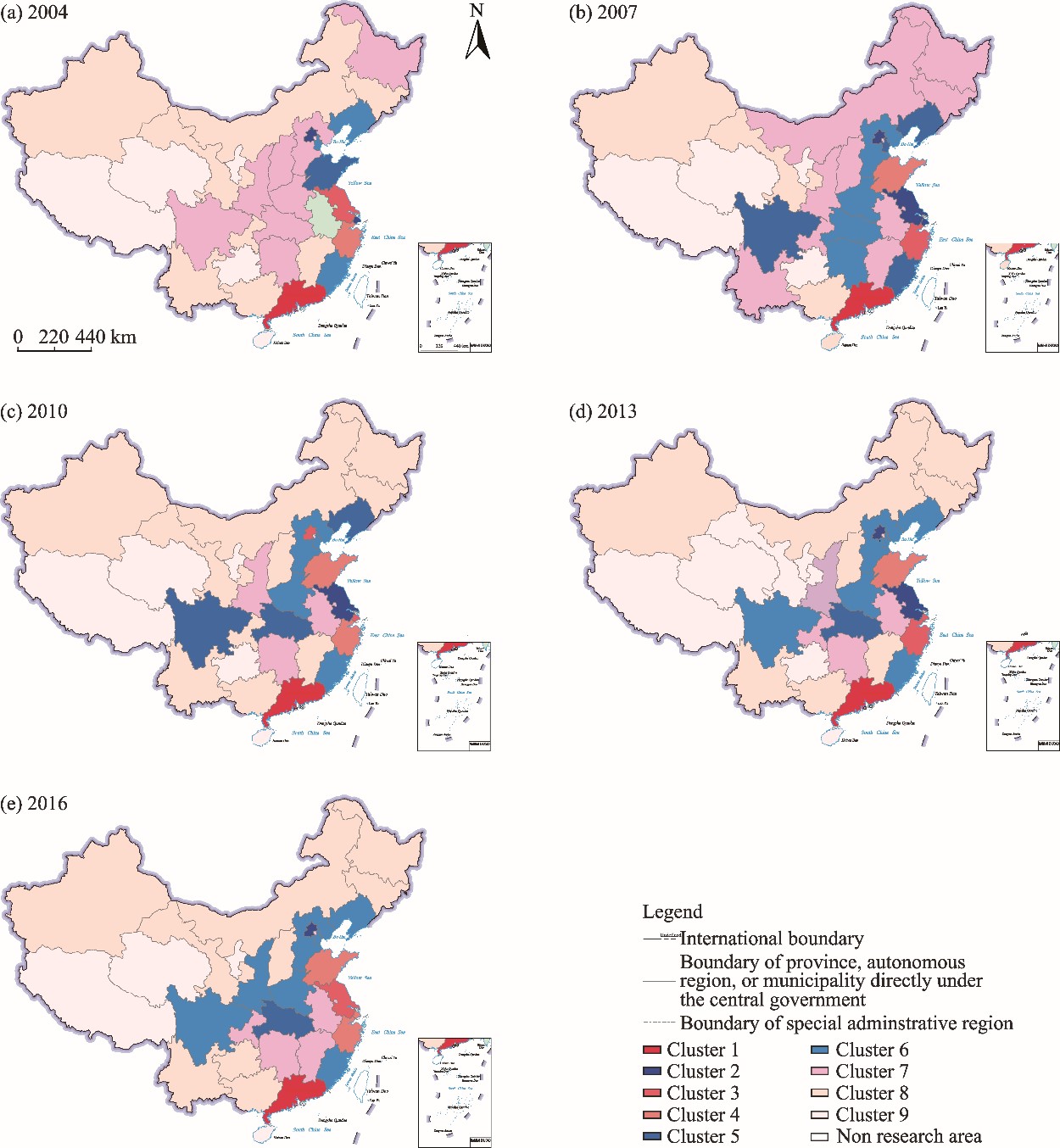
Intellectual capital (IC) has become a universal performance indicator for the socioeconomic development of countries and regions. Based on a review of national intellectual capital (NIC) and regional intellectual capital (RIC) evaluation literature, we used the regional intellectual capital indicator (RICI) as a model for China’s RIC evaluation to indirectly understand China’s potential economic growth drivers. Specifically, we collected statistical data of 31 provinces (including municipalities and autonomous regions) in China from 2004 to 2016 to measure RICI and analyze its dynamic characteristics from temporal and spatial perspectives. In this paper, Delphi analysis was used to construct RICI model, and cluster analysis and exploratory spatial data analysis were used to analyze the temporal and spatial characteristics of RICI in China. The results showed that RICI, which represents China’s overall economic growth drivers, increases annually and is consistent with economic development level during the study period. Regarding the geo-spatial space, RICI follows the trend of “high in the east and low in the west”, gradually decreasing from eastern to western China. For RIC structure, the shape of the radar chart of IC structure located in the eastern coastal areas is usually biased towards strong external relational capital, while that in western China is generally biased towards structural capital. For spatial correlation, China’s RICI has dependence on geographical adjacent space and economic space. Our research can provide policy suggestions for the sustainable development of regional economy from an IC perspective.
WANG Linchuan , WU Cisheng , ZHAO Xuyang , LIU Duanyong , ZHANG Tao . Spatio-temporal characteristics of regional sustainable economic growth drivers of China[J]. Regional Sustainability, 2021 , 2(3) : 239 -255 . DOI: 10.1016/j.regsus.2021.11.004
| [1] | Aghion, P., Howitt, P., 1992. A model of growth through creative destruction. Econometrica. 60(2), 323-351. |
| [2] | Andriessen, D., Stam, C., 2005. Intellectual capital of the European Union. In: Serenko, A., Bonits, N., Grant, J. (eds.). Proceedings of the 7th Mcmaster World Congress on the Management of Intellectual Capital and Innovation. Hamilton, Ontario: McMaster University, 1-24. |
| [3] | Atkinson, R., Wu, J.J., 2017. The 2017 state new economy index: benchmarking economic transformation in the states. SSRN Electronic Journal. doi: 10.2139/ssrn.3066923. |
| [4] | Bloom, N., Jones, C.I., van Reenen, J., et al., 2020. Are ideas getting harder to find? Am. Econ. Rev. 110(4), 1104-1144. |
| [5] | Bontis, N., 2004. National intellectual capital index: A United Nations initiative for the Arab region. J. Intellect. Cap. 5(1), 13-39. |
| [6] | Bounfour, A., 2003. The IC-dVAL approach. J. Intellect. Cap. 4(3), 396-413. |
| [7] | Bradley, K., 1997. Intellectual capital and the new wealth of nations. Bus. Strategy Rev. 8(1), 53-62. |
| [8] | Chen, Y.F., 2006. Constructing system of indicators of measure regional intelligence capitals. Stat. Res. 23(2), 24-29 (in Chinese). |
| [9] | Cheng, M.W., Jia, X.J., Qiu, H.G., 2019. China’s economic growth (1978-2015): inspiration or perspiration? Economic Research Journal. 54(7), 30-46 (in Chinese). |
| [10] | Drucker, P.F., 1993. Post-Capitalist Society. Oxford: Butterworth-Heinemann. |
| [11] | Edvinsson, L., Sullivan, P., 1996. Developing a model for managing intellectual capital. Eur. Manag. J. 14(4), 356-364. |
| [12] | Edvinsson, L., Malone, M.S., 1997. Intellectual capital: realizing your company’s true value by finding its hidden brainpower. New York: Harper Business. |
| [13] | Edvinsson, L., Stenfelt, C., 1999. Intellectual capital of nations—for future wealth creation. J. Hum. Resour. Costing Account. 4(1), 21-33. |
| [14] | Grossman, G.M., Helpman, E., 1991. Quality ladders in the theory of growth. Rev. Econ. Stud. 58(1), 43-61. |
| [15] | Human Capital, Research, Research, Group, 2012. The coordination between human and physical capital and its effects on economic efficiency. Statistical Research. 29(4), 32-38 (in Chinese). |
| [16] | Jones, C.I., 1995. R & D-based models of economic growth. J. Political Econ. 103(4), 759-784. |
| [17] | Käpylä, J., Kujansivu, P., Lönnqvist, A., 2012. National intellectual capital performance: a strategic approach. J. Intellect. Cap. 13(3), 343-362. |
| [18] | Krugman, P., 1994. The myth of Asia’s miracle. Foreign Aff. 73(6), 62-78. |
| [19] | Labra, R., Sánchez, M.P., 2013. National intellectual capital assessment models: a literature review. J. Intellect. Cap. 14(4), 582-607. |
| [20] | Li, H.B., Loyalka, P., Rozelle, S., et al., 2017. Human capital and China’s future growth. J. Econ. Perspect. 31(1), 25-48. |
| [21] | Li, Z.J., Hu, M.J., Yin, S.G., et al., 2019. Spatio-temporal variation and influencing factors of knowledge capital in China. Scientia Geographica Sinica. 39(1), 80-88 (in Chinese). |
| [22] | Lin, C.Y.Y., Edvinsson, L., 2008. National intellectual capital: comparison of the Nordic countries. J. Intellect. Cap. 9(4), 525-545. |
| [23] | Lin, C.Y.Y., Edvinsson, L., 2011. National intellectual capital: a comparison of 40 countries. New York: Springer. |
| [24] | Lin, C.Y.Y., 2018. Intellectual capital of South Africa: a comparison with Poland and Romania. J. Intellect. Cap. 19(3), 498-518. |
| [25] | Liu, Y., Li, L., Zheng, F.T., 2019. Regional synergy and economic growth: evidence from total effect and regional effect in China. Int. Reg. Sci. Rev. 42(5-6), 431-458. |
| [26] | Lucas Jr, R.E., 1988. On the mechanics of economic development. J. Monet. Econ. 22(1), 3-42. |
| [27] | Malhotra, Y., 2000. Knowledge assets in the global economy: assessment of national intellectual capital. J. Glob. Inf. Manag. 8(3), 5-15. |
| [28] | Markhaichuk, M., Zhuckovskaya, I., 2019. The spread of the regional intellectual capital: the case of the Russian Federation. Oeconomia Copernicana. 10(1), 89-111. |
| [29] | National Bureau of Statistics of China, 2005- 2017. National Bureau of Statistics of China. China Statistical Yearbook. Beijing: China Statistic Press (in Chinese). |
| [30] | National Bureau of Statistics of China, Ministry of Science and Technology of the People’s Republic of China, 2005- 2017. China Statistical Yearbook on Science and Technology. Beijing: China Statistic Press (in Chinese). |
| [31] | Navarro, J.L.A., Ruiz, V.R.L., Peña, D.N., 2011. An alternative to measure national intellectual capital adapted from business level. Afr. J. Bus. Manag. 5(16), 6707-6716. |
| [32] | Nitkiewicz, T., Pachura, P., Reid, N., 2014. An appraisal of regional intellectual capital performance using data envelopment analysis. Appl. Geogr. 53, 246-257. |
| [33] | Pan, W.Q., 2018. Knowledge spatial spillover and regional productivity in China. China Journal of Economics. 5(3), 38-60 (in Chinese). |
| [34] | Pedro, E., Leitão, J., Alves, H., 2018. Back to the future of intellectual capital research: a systematic literature review. Manag. Decis. 56(11), 2502-2583. |
| [35] | Romer, P.M., 1983. Dynamic competitive equilibria with externalities, increasing returns and unbounded growth. PhD Dissertation. Chicago: University of Chicago. |
| [36] | Romer, P.M., 1986. Increasing returns and long-run growth. J. Political Econ. 94(5), 1002-1037. |
| [37] | Romer, P.M., 1990. Endogenous technological change. J. Political Econ. 98(5), 71-102. |
| [38] | Schiuma, G., Lerro, A., Carlucci, D., 2008. The knoware tree and the regional intellectual capital index: an assessment within Italy. J. Intellect. Cap. 9(2), 283-300. |
| [39] | Ståhle, P., Ståhle, S., Lin, C.Y.Y., 2015. Intangibles and national economic wealth-a new perspective on how they are linked. J. Intellect. Cap. 16(1), 20-57. |
| [40] | Suciu, M.C., Năsulea, D.F., 2019. Intellectual capital and creative economy as key drivers for competitiveness towards a smart and sustainable development: challenges and opportunities for cultural and creative communities. Intellectual Capital Management as a Driver of Sustainability. Cham: Springer, 67-97. |
| [41] | Vairinhos, V., Matos, F., Matos, A.J., 2019. National intellectual capital influence on innovation and sustainability. In: Matos F., Vairinhos V., Selig P.M., et al. (eds.). Intellectual Capital Management as a Driver of Sustainability. Cham: Springer, 221-237. |
| [42] | Wang, X.L., Fan, G., Liu, P., 2009. Transformation of growth pattern and growth sustainability in China. Economic Research Journal. 44(1), 4-16 (in Chinese). |
| [43] | Weziak-Bialowolaska, D., 2007. Measurement of national intellectual capital-application to EU countries. In: IRISS (Integrated Research Infrastructure in the Socio-economic Science) Working Paper. Warsaw, Poland. |
| [44] | Wu, C.S., Li, X.G., 2014. Regional Intellectual Capital Index Development Report. Hefei: Hefei University of Technology Publishing House (in Chinese). |
| [45] | Wu, J., Zhuo, S.H., Wu, Z.F., 2017. National innovation system, social entrepreneurship, and rural economic growth in China. Technol. Forecast. Soc. Change. 121, 238-250. |
| [46] | Young, A., 2003. Gold into base metals: productivity growth in the People’s Republic of China during the reform period. J. Political. Econ. 111(6), 1220-1261. |
| [47] | Zhang, J., Wang, H.W., 2017. The empirical analysis of promotion effect of Chinese intellectual capital on economic growth. Studies in Science of Science. 35(8), 1156-1166 (in Chinese). |
| [48] | Zhao, S.M., Wu, S.W., 2018. The influencing factors of capital return and its promotion path in China based on the perspective of spatial economics. Management World. 34(2), 68-79 (in Chinese). |
/
| 〈 |
|
〉 |
 REGSUS Wechat
 新公网安备 65010402001202号