

Incremental adaptation strategies for agricultural water management under water scarcity condition in Northeast Iran
Received date: 2020-04-28
Revised date: 2021-08-05
Accepted date: 2021-11-05
Online published: 2021-12-24
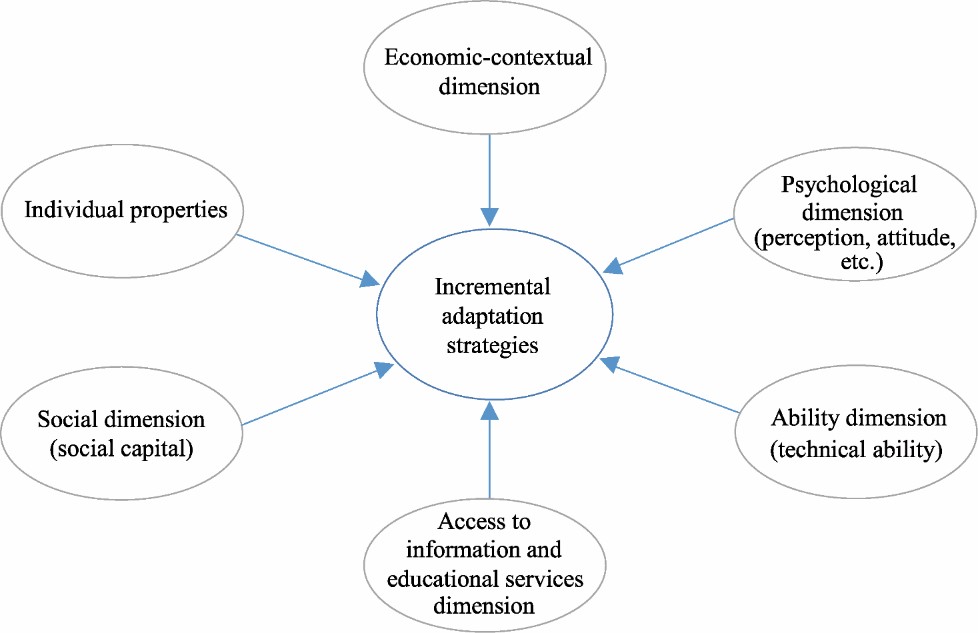
Population growth and climate changes as two synergistic phenomena have damaged water resources nationwide and worldwide. The water resources available for agriculture is one of the most critical limiting factors in food production enhancement in Iran. Agriculture must tackle the challenge of supplying the increasing demands for food due to population growth. For this purpose, we must get acquainted with how farmers make decisions and their adaptations to water scarcity conditions by studying their adaptation strategies. In this case, we can predict the farmers’ behaviors by recognizing the optimal adaptation strategies under water scarcity crisis. This study aims to provide a model to examine and analyze the farmers’ behaviors in the realm of water scarcity and the contributing factors to it, facilitating a better understanding of the potential implications of such scarcity, introducing the adaptation changeability procedures for agricultural water management and assistance to farmers to adapt, and developing the actions for mitigating the vulnerability of agriculture sector in Iran. In this study, 175 farmers in Northeast Iran were interviewed to conduct an applied research by questionnaire survey. The research tool was a researcher-made questionnaire designed based on the theoretical literature and designed model. According to the research, the model of incremental adaptation strategies could determine the effects of a set of psychological and socioeconomic factors and the formation of adaptation decisions in water resources management under water scarcity conditions. The results indicated that the concern and attitude, farmers’ knowledge and technical skill, self-efficiency and risk-taking level, social capital and information availability for farmers, and the internal norm are significantly and positively correlated in this model. The results provide a proper understanding of farmers’ sustainable decision-making and a perspective on contributing factors to the strategy framework and improved policies in the form of incremental adaptation strategies when facing water scarcity in agricultural water resources management. Thus, this study will respond to deal with water scarcity by changing farmers’ behaviors in dry lands and water scarce regions.
Morteza SALMANI SABZEVAR , Amirreza REZAEI , Bagher KHALEGHI . Incremental adaptation strategies for agricultural water management under water scarcity condition in Northeast Iran[J]. Regional Sustainability, 2021 , 2(3) : 224 -238 . DOI: 10.1016/j.regsus.2021.11.003
| [1] | Adger, W.N., Dessai, S., Goulden, M., et al., 2009. Are there social limits to adaptation to climate change? Clim. Change. 93(3-4), 335-354. |
| [2] | Alimohamadi, R., 2002. Water crisis and the ways to cope with it in Iranian ggriculture. Agricultural Aridity and Drought Journal. 6, 58-66. |
| [3] | American Public Health Association, 2008. Annual Meeting Program Highlights.[2020-11-14]. http://www.apha.org/meetings/highlights. |
| [4] | Arbuckle, J.G., Morton, L.W., Hobbs, J., 2013. Farmer beliefs and concerns about climate change and attitudes toward adaptation and mitigation: evidence from Iowa. Clim. Change. 118(3-4), 551-563. |
| [5] | Asante, S.K., 2012. Empowering farming communities in northern Ghana with strategic innovations and productive resources in dryland farming. In: Technical Progress Report of Project 6 of the Challenge Program on Water and Food, 2004-2005. Burkina Faso. |
| [6] | Babran, S., Honarbakhsh, N., 2008. Water crisis in the world and Iran. Strategy. 48, 193-212 (in Persian). |
| [7] | Barnett, J., 2001. Adapting to climate change in Pacific Island countries: the problem of uncertainty. World Dev. 29(6), 977-993. |
| [8] | Below, T.B., Mutabazi, K.D., Kirschke, D., et al., 2012. Can farmers’ adaptation to climate change be explained by socio-economic household-level variables? Glob. Environ. Change. 22(1), 223-235. |
| [9] | Bryan, E., Deressa, T.T., Gbetibouo, G.A., et al., 2009. Adaptation to climate change in Ethiopia and South Africa: options and constraints. Environ. Sci. Policy. 12(4), 413-426. |
| [10] | Bryan, E., Ringler, C., Okoba, B., et al., 2013. Adapting agriculture to climate change in Kenya: household strategies and determinants. J. Environ. Manag. 114, 26-35. |
| [11] | Campbell, D., Barker, D., McGregor, D., 2011. Dealing with drought: Small farmers and environmental hazards in southern St. Elizabeth, Jamaica. Appl. Geogr. 31(1), 146-158. |
| [12] | Cochran, W.G., 1963. Methodological problems in the study of human populations. Ann. N Y Acad. Sci. 107(2), 476-489. |
| [13] | Cronbach, L.J., 1951. Coefficient alpha and the internal structure of tests. Psychometrika. 16(3), 297-334. |
| [14] | Dang, H.L., Li, E., Nuberg, I., et al., 2014. Understanding farmers’ adaptation intention to climate change: A structural equation modelling study in the Mekong Delta, Vietnam. Environ. Sci. Policy. 41, 11-22. |
| [15] | de la Riva, M.V., Lindner, A., Pretzsch, J., 2013. Assessing adaptation-Climate change and indigenous livelihood in the Andes of Bolivia. Journal of Agriculture and Rural Development in the Tropics and Subtropics. 114(2), 109-122. |
| [16] | Deressa, T.T., Hassan, R.M., Ringler, C., et al., 2009. Determinants of farmers’ choice of adaptation methods to climate change in the Nile Basin of Ethiopia. Glob. Environ. Change. 19(2), 248-255. |
| [17] | Gandure, S., Walker, S., Botha, J.J., 2013. Farmers’ perceptions of adaptation to climate change and water stress in a South African rural community. Environ. Dev. 5, 39-53. |
| [18] | Ghobadi, S., Chizari, M., Sedeghi, H., 2016. The analysis of farmer’s behaviour and strategies in dealing with drought (the case study: Kermanshah Township). Regional Planning. 6(21), 143-154. |
| [19] | Giordano, M., 2007. Agricultural water policy in China: challenges, issues, and options. Water Policy. 9(Suppl. 1), 1-9. |
| [20] | Grothmann, T., Patt, A., 2005. Adaptive capacity and human cognition: the process of individual adaptation to climate change. Glob. Environ. Change. 15(3), 199-213. |
| [21] | Hassan, R., Nhemachena, C., 2008. Determinants of African farmers’ strategies for adapting to climate change: Multinomial choice analysis. Afr. J. Agric. Resour. Econ.-AFJARE. 2(1), 83-104. |
| [22] | Howden, S.M., Soussana, J.F., Tubiello, F.N., et al., 2007. Adapting agriculture to climate change. Proc. Natl. Acad. Sci. U. S. A. 104(50), 19691-19696. |
| [23] | Iglesias, A., Avis, K., Benzie, M., et al., 2007. Adaptation to climate change in the agricultural sector AGRI-2006-G4-05. In: AEA Energy & Environment and Universidad de Politécnica de Madrid. |
| [24] | International Water Management Institute (IWMI), 1993. Annual Report 1992. Colombo: International Water Management Institute. |
| [25] | Jones, L., Boyd, E., 2011. Exploring social barriers to adaptation: insights from Western Nepal. Glob. Environ. Change. 21(4), 1262-1274. |
| [26] | Karimi, A., Ebadzadeh, H., Hatami, F., et al., 2019. Iranian Agricultural Statistics Yearbook. Tehran: Iranian Agricultural Ministry Publication (in Persian). |
| [27] | Keshavarz, M., Karami, E., 2008. Factors affecting on drought management by farmers and its consequences: application of structural equation modelling. Journal of Water and Soil Science. 12(43), 267-283 (in Persian). |
| [28] | Maponya, P., Mpandeli, S., 2012. Climate change and agricultural production in South Africa: Impacts and adaptation options. J. Agric. Sci. 4(10), 48. |
| [29] | Ngigi, S.N., 2009. Climate Change Adaptation Strategies: Water Resources Management Options for Smallholder Farming Systems in Sub-Saharan Africa. New York: The Earth Institute at Columbia University. |
| [30] | Nielsen, J.Ø., Reenberg, A., 2010. Cultural barriers to climate change adaptation: A case study from Northern Burkina Faso. Glob. Environ. Change. 20(1), 142-152. |
| [31] | Niles, M., Lubell, M., Brown, M., et al., 2012. Hawks Bay, New Zealand Farmers Climate Change Perceptions and Concerns. [2020-03-15]. https://environmentalpolicy.ucdavis.edu/sites/g/files/dgvnsk6866/files/2019-02/Hawkes%20Bay_Climate_Attitudes_Policy_Brief_FINAL_3.pdf. |
| [32] | O’Brien, K., Eriksen, S., Sygna, L., et al., 2006. Questioning complacency: climate change impacts, vulnerability, and adaptation in Norway. AMBIO A J. Hum. Environ. 35(2), 50-56. |
| [33] | Orlove, B., 2005. Human adaptation to climate change: a review of three historical cases and some general perspectives. Environ. Sci. Policy. 8(6), 589-600. |
| [34] | Patt, A., Gwata, C., 2002. Effective seasonal climate forecast applications: examining constraints for subsistence farmers in Zimbabwe. Glob. Environ. Change. 12(3), 185-195. |
| [35] | Pelling, M., High, C., 2005. Understanding adaptation: what can social capital offer assessments of adaptive capacity? Glob. Environ. Change. 15(4), 308-319. |
| [36] | Pezeshkirad, G.R., Boldaji, E.M., Feli, S., 2007. Factors affecting adoption of mitigation technologies for wheat losses during the drought and low rainfall period of 2001-2005: a case study of wheat cultivators in Khorasan-e Razavi Province of Iran. Village and Development. 10(3), 103-113 (in Persian). |
| [37] | Poortaheri, M., Eftekhari, A., Kazemi, N., 2013. The role of drought risk management approach in reducing social-economic vulnerability of farmers and rural regions case study: Sulduz rural district, Azarbaijan Gharbi. Rural Res. 4(1):1-12 (in Persian). |
| [38] | Pour Gholamhossein, E., Ba’aghideh, M., Salmani Moghaddam, M., 2015. The impact of climate on the architecture of different urban textures. Urban Regional Studies and Research. 7(26), 105-126 (in Persian). |
| [39] | Rejesus, R.M., 2012. Farmers perceptions and beliefs about climate change: A North Carolina Perspective. Agriculture and Life Services. 2(3), 34-54. |
| [40] | Reser, J.P., Swim, J.K., 2011. Adapting to and coping with the threat and impacts of climate change. Am. Psychol. 66(4), 277-289. |
| [41] | Rezaei, A., Salmani, M., Razaghi, F., et al., 2017. An empirical analysis of effective factors on farmers adaptation behavior in water scarcity conditions in rural communities. Int. Soil Water Conserv. Res. 5(4), 265-272. |
| [42] | Ribot, J.C., 2002. Democratic Decentralization of Natural Resources: Institutionalizing Popular Participation. Washington DC: World Resources Institute. |
| [43] | Saleh, I., Mokhtari, D., 2007. Economic and social effects and consequences of drought on rural households in Sistan region. Iranian Agricultural Extension and Education Journal. 3(1), 99-114 (in Persian). |
| [44] | Salehi, S., Pazokinejad, Z., 2014. An analysis of social factors influencing students’ environmental attitudes and performance. Journal of Applied Sociology. 25(3), 71-88 (in Persian). |
| [45] | Save Cambodia's Wildlife (SCW). 2011. Level of Knowledge and Awareness on Climate Change and its Impact on Agriculture and Water Resources. Research Project. Cambodia: Ministry of Agriculture, Forestry and Fishery. |
| [46] | Silakhori, E., Ownegh, M., Mosaedi, A., et al., 2019. Application of reanalysis and observational data for comparison of drought indices (case study: Esfarayen Sabzevar Region). Iran-Water Resources Research. 14(5), 278-290. |
| [47] | Statistics Center of Iran, 2016. Population and Housing Censuses Report in 2016. [2020-04-25]. https://www.amar.org.ir/english/Population-and-Housing-Censuses. |
| [48] | Suryavanshi, S., Joshi, N., Maurya, H.K., et al., 2021. Understanding precipitation characteristics of Afghanistan at provincial scale. doi: 10.21203/rs.3.rs-365073/v1. |
| [49] | Sutherland, K., Smit, B., Wulf, V., et al., 2005. Vulnerability in Samoa. Tiempo. 54, 11-15. |
| [50] | Vincent, K., 2007. Uncertainty in adaptive capacity and the importance of scale. Glob. Environ. Change. 17(1), 12-24. |
| [51] | Ward, C., Dargought, S., Minasyan, G., et al., 2005. Reneging in Agricultural Water Management: Challenges, Opportunities and Trade-offs. Washington DC: Agriculture and Rural Development (ARD), The World Bank. |
| [52] | Wens, M.L.K., Mwangi, M.N., van Loon, A.F., et al., 2021. Complexities of drought adaptive behaviour: linking theory to data on smallholder farmer adaptation decisions. Int. J. Disaster Risk Reduct. 63, 102435. |
| [53] | Wheeler, S., Zuo, A., Bjornlund, H., 2013. Farmers’ climate change beliefs and adaptation strategies for a water scarce future in Australia. Glob. Environ. Change. 23(2), 537-547. |
| [54] | Wiles, E., 2012. Farmers’ Perception of Climate Change and Climate Solutions. [2020-08-15]. www.anglia.ac.uk/gsi. |
| [55] | Yang, Y.C.E., Son, K., Hung, F., et al., 2020. Impact of climate change on adaptive management decisions in the face of water scarcity. J. Hydrol. 588, 125015. |
| [56] | Yazdani, S., Haghsheno, M., 2008. Drought management and recommended solutions on how to deal with droughts. American-Eurasian Journal of Agricultural & Environmental Science. (2), 64-68. |
| [57] | Zhang, B., Fu, Z.T., Wang, J.Q., et al., 2019. Farmers’ adoption of water-saving irrigation technology alleviates water scarcity in metropolis suburbs: A case study of Beijing, China. Agric. Water Manag. 212, 349-357. |
| [58] | Zobeidi, T., Yazdanpanah, M., Forouzani, M., et al., 2016. Typology of wheat and vegetable farmers’ perception towards climate change through of Q-methodology. J. Rural. Res. 7(2), 374-391 (in Persian). |
/
| 〈 |
|
〉 |
 REGSUS Wechat
 新公网安备 65010402001202号