

Measurement and influencing factors of urban traffic ecological resilience in developing countries: A case study of 31 Chinese cities
Received date: 2021-03-24
Revised date: 2021-10-24
Accepted date: 2021-10-24
Online published: 2021-12-24
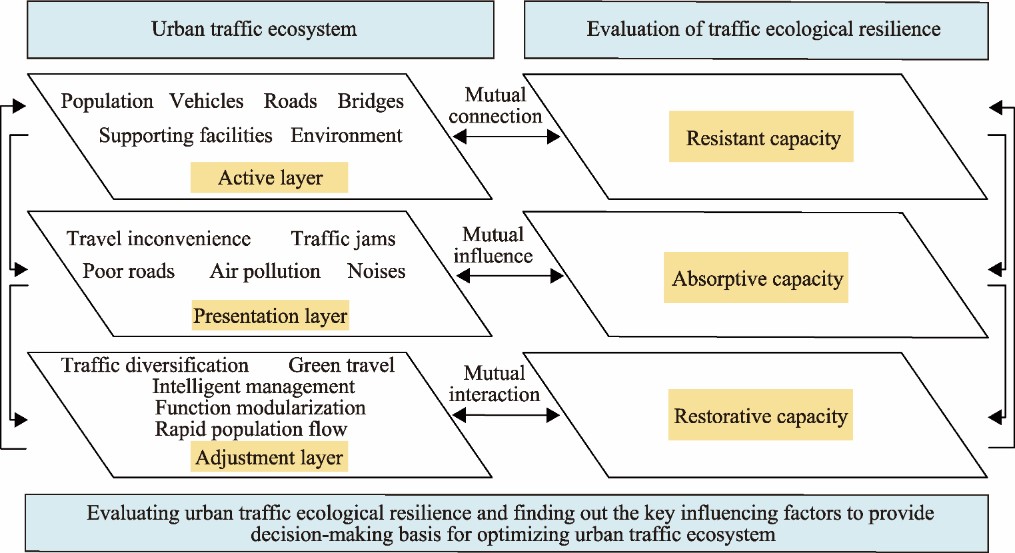
An urban traffic ecosystem is a spatial structure composed of air, population, vehicles, roads, green spaces, and regions. Traffic ecological resilience is a critical issue in high-quality urban development. From the perspective of system optimization, it is important to study the level of urban traffic ecological resilience and analyze its influencing factors. In this study, we evaluated traffic ecological resilience, characterized its spatio-temporal differentiation, and explored its influencing factors by constructing a system of urban traffic ecological resilience and by analyzing the environmental protection and urban construction data in 31 Chinese cities during 2011-2018. By conducting Kernel density analysis, standard deviation ellipse, comprehensive weight determination, panel data regression analysis, and χ2 test, we found that traffic ecological resilience was low on the whole and exhibited the temporal trend of “decreasing first and then increasing” and the spatial characteristic of “high in the east, second in the middle, and low in the west”. The cities with high traffic ecological resilience density values were located in Southeast China and tended to move from northwest to southeast. Governance capability, market activity, technological innovation capability, opening degree, and financial resources had significant effects on urban traffic ecological resilience. Finally, we gave some suggestions for improving the urban traffic ecological resilience in Chinese cities as well as other developing countries in the world.
HU Xiwu , SU Yunqing , REN Kefeng , SONG Fang , XUE Ruixiang . Measurement and influencing factors of urban traffic ecological resilience in developing countries: A case study of 31 Chinese cities[J]. Regional Sustainability, 2021 , 2(3) : 211 -223 . DOI: 10.1016/j.regsus.2021.10.001
| [1] | Arabindoo, P., 2016. Unprecedented natures? An anatomy of the Chennai floods. City. 20(6), 800-821. |
| [2] | Bai, L.M., Xiu, C.L., Feng, X.H., et al., 2019. Comprehensive assessment of urban resilience in China and its temporal and spatial differentiation characteristics. World Regional Studies. 28(6), 77-87 (in Chinese). |
| [3] | Burton, C.G., 2015. A validation of metrics for community resilience to natural hazards and disasters using the recovery from Hurricane Katrina as a case study. Ann. Assoc. Am. Geogr. 105(1), 67-86. |
| [4] | Cambi, M., Certini, G., Neri, F., et al., 2015. The impact of heavy traffic on forest soils: A review. For. Ecol. Manage. 338, 124-138. |
| [5] | Chen, L., Zhu, X.G., Sun, J., 2017. The basic concept, mechanism and planning ideas of resilient cities. Modern Urban Research. 32(9), 18-24 (in Chinese). |
| [6] | Chen, T., Li, Y.L., 2019. Urban water environment-oriented urban design strategy from the perspective of ecological resilience. Science and Technology Review. 37(8), 26-36 (in Chinese). |
| [7] | Chen, Y.L., Xie, B.G., Yang, Y., 2015. Spatial distribution and influencing factors analysis of air quality in major urban agglomerations across the country. Journal of Arid Land Resources and Environment. 29(11), 99-103 (in Chinese). |
| [8] | Chen, Y.M., Li, K.C., 2017. Overseas studies progress and practice exploration on resilient city—based on the perspective of public administration. Chinese Public Administration. (1), 137-143 (in Chinese). |
| [9] | Cheng, H., Yang, G., Ji, X., 2019. A Study on decoupling relationship between urban toughness and environmental pressure in China’s top ten city agglomerations. Statistics and Decision. 523(7), 79-83 (in Chinese). |
| [10] | Cutter, S.L., Ash, K.D., Emrich, C.T., 2014. The geographies of community disaster resilience. Global Environmental Change. 29, 65-77. |
| [11] | Desouza, K.C., Flanery, T.H., 2013. Designing, planning, and managing resilient cities: a conceptual framework. Cities. 35, 89-99. |
| [12] | Ding, L., Liu, C., Huang, Y.L., et al., 2016. Spatial and temporal characteristics of urban ambient air quality and its main influence factors in Hubei Province. Economic Geography. 36(3), 170-178 (in Chinese). |
| [13] | Fahrig, L., Rytwinski, T., 2009. Effects of roads on animal abundance: An empirical review and synthesis. Ecology and Society. 14(1), 21-40. |
| [14] | Fainstein, S.S., 2018. Resilience and justice: Planning for New York City. Urban Geography. 39(8), 1268-1275. |
| [15] | Forman, R.T.T., Alexander, L.E., 1998. Roads and their major ecological effects. Annual Review of Ecology Systematics. 29, 207-231. |
| [16] | Francis, R., Bekera, B., 2014. A metric and frameworks for resilience analysis of engineered and infrastructure systems. Reliability Engineering and System Safety. 121, 90-103. |
| [17] | Hadri, K., 2000. Testing for stationarity in heterogeneous panel data. The Econometrics Journal. 3(2), 148-161. |
| [18] | Harris, R.D.F., Tzavalis, E., 1999. Inference for unit roots in dynamic panels where the time dimension is fixed. Journal of econometrics. 91(2), 201-226. |
| [19] | Holling, C.S., 1973. Resilience and stability of ecological systems. Annual Review of Ecology Systematics. 4, 1-23. |
| [20] | Hu, X.W., Huang, Y., Wan, J.P., et al., 2018. Spatial distribution and evolution of foreign trade volume between each province in China and all countries of the New Silk Road Economic Zone. Economic Geography. 38(10), 5-12 (in Chinese). |
| [21] | Im, K.S., Pesaran, M.H., Shin, Y., 2003. Testing for unit roots in heterogeneous panels. Journal of econometrics. 115(1), 53-74. |
| [22] | IPCC, 2007. Climate Change 2007: Synthesis Report. Contribution of Working Groups I, II and III to the Fourth Assessment Report of the Intergovernmental Panel on Climate Change. In: Pachauri, R.K, Reisinger, A. (eds.). IPCC, Geneva, Switzerland, 1-104. |
| [23] | Jiang, Y.M., Guo, H.C., Yu, Y.J., et al., 2007. Analysis on the framework of comprehensive evaluation method of urban ecological transportation system. Urban Problems. (4), 27-30 (in Chinese). |
| [24] | Joerin, J., Shaw, R., Takeuchi, Y., et al., 2012. Action-oriented resilience assessment of communities in Chennai, India. Environmental Hazards. 11(3), 226-241. |
| [25] | Karlson, M., Mörtberg, U., Balfors, B., 2014. Road ecology in environmental impact assessment. Environ. Impact Assess. Rev. 48, 10-19. |
| [26] | Levin, A., Lin, C.F., James Chu, C.S., Unit root tests in panel data: asymptotic and finite-sample properties. J. Econom. 108(1), 1-24. |
| [27] | Li, G.D., Fang, C.L., 2016. Quantitative identification and analysis of urban ecological-production-living space functions. Acta Geographica Sinica. 71(1), 49-65 (in Chinese). |
| [28] | Li, T.Y., 2017. New progress in the study of resilient cities. International Urban Planning. 32(5), 15-25 (in Chinese). |
| [29] | Li, X., 2020. Preventing major risks and building resilient cities. Urban Development Research. 27(3), 1 (in Chinese). |
| [30] | Li, Y., Zhai, G.F., Gu, F.M., 2016. Research review on quantitative assessment methods of urban infrastructure resilience. Urban Development Research. 23(6), 113-122 (in Chinese). |
| [31] | Liao, G.X., Lin, H.J., Wang, Y., 2015. The theory of urban resilience and flood bearing: Another foundation for planning practice. International Urban Planning. 30(2), 36-47 (in Chinese). |
| [32] | Liu, D., Hua, C., 2014. The evolution of the concept of flexibility and its enlightenment to urban planning innovation. Urban Development Research. 21(11), 111-117 (in Chinese). |
| [33] | Liu, Y.F., Li, H.M., Ma, H.Y., 2021. Evaluation of agricultural modernization of state farms: based on entropy weight method and TOPSIS method. Issues in Agricultural Economy. (2), 107-116 (in Chinese). |
| [34] | Ma, Y., Li, L.X., Ren, J., 2017. Research on the coordinated development of tourism economy-transportation-eco-environment in Shennongjia forest area. Economic Geography. 10, 215-227 (in Chinese). |
| [35] | Ministry of Ecology and Environment of the People’s Republic of China, 2011- 2019a. China Vehicle Environmental Management Annual Report. [2021-03-01]. http://www.mee.gov.cn (in Chinese). |
| [36] | Ministry of Ecology and Environment of the People’s Republic of China, 2011- 2019b. China Statistical Yearbook on Environment. Beijing: China Statistic Press (in Chinese). |
| [37] | Ministry of Ecology and Environment of the People’s Republic of China, 2011- 2019c. China Ecological Environmental Bulletin. Beijing: China Ocean Press (in Chinese). |
| [38] | Ministry of Housing and Urban-Rural Development of the People’s Republic of China, 2011- 2019. China Urban Construction Yearbook. Beijing: China Planning Press (in Chinese). |
| [39] | Ministry of Transport of the People’s Republic of China, 2011- 2019. China Traffic Yearbook. Beijing: China Transportation Press (in Chinese). |
| [40] | National Bureau of Statistics of China, 2011- 2019. China Statistical Yearbook. Beijing: China Statistic Press (in Chinese). |
| [41] | Ni, X.L., Li, X.Q., 2021. Three types of resilient city evaluation systems and their new development direction. International Urban Planning. 3, 76-82 (in Chinese). |
| [42] | Ouyang, H.B., Ye, Q., 2016. A review on the evolution of resilient city theory: concept, context and tendency. City Planning Review. 40(3), 34-42 (in Chinese). |
| [43] | Pan, X.J., Li, Z.R., 2019. Exploration on the concept of administrative resilience. Chinese Public Administration. (2), 98-101, 151 (in Chinese). |
| [44] | Polemis, B., 1959. Nonparametric statistics for the behavioral sciences. Soc. Serv. Rev. 33(1), 99-100. |
| [45] | Qian, F., 2008. Comparison of research hotspots of knowledge management at home and abroad based on Chi square test. Journal of information. 9, 56-58 (in Chinese). |
| [46] | Qiu, B.X., 2017. Five criteria for building resilient urban traffic. Urban Development Research. 11, 1-7 (in Chinese). |
| [47] | Resilience Alliance, 2017. Urban Resilience Research Prospectus. [2021-09-07]. http://www.resalliance.or/1610.php. |
| [48] | Shao, Y.W., Xu, J., 2015. Understanding urban resilience: a conceptual analysis based on integrated international literature review. Urban Planning International. 30(2), 48-54 (in Chinese). |
| [49] | van der Ree, R., Jaeger, J.A.G., van der Grift, E.A., et al., 2011. Effects of roads and traffic on wildlife populations and landscape function: Road ecology is moving toward larger scales. Ecol. Soc. 16(1), 48-58. |
| [50] | van der Ree, R., Smith, D.J., Grilo, C., 2015. The ecological effects of linear infrastructure and traffic: challenges and opportunities of rapid global growth. In: van der Ree, R., Smith, D.J., Grilo, C. (eds.). Handbook of Road Ecology. Chichester: John Wiley & Sons, Ltd. |
| [51] | von Rozycki, C., Koeser, H., Schwarz, H., 2003. Ecology profile of the German high-speed rail passenger transport system, ICE. Int. J. Life Cycle Assess. 8(2), 83-91. |
| [52] | Wang, G.H., Wang, Y.Q., 2021. Evaluation of urban resilience in China based on risk matrix: a case study of 284 cities. Guizhou Social Sciences. (1), 126-134 (in Chinese). |
| [53] | Wang, H.X., 2016. Urban eco transportation system theory and its realization path. Science and Technology Management Research. (1), 246-251 (in Chinese). |
| [54] | Wang, J.S., Yan, Y., Hu, S.H., 2017. The spatial characteristics and influencing factors of the technological innovation capabilities of Chinese cities: A study based on the spatial panel data model. Geographical Sciences. 37(1), 11-18 (in Chinese). |
| [55] | Wang, J.T., Zhao, Y.F., 2016. Measurement of urban traffic congestion level in China: An empirical study based on 35 large and medium cities. Learning and Practice. 6, 19-27 (in Chinese). |
| [56] | Wei, Y., Xiu, C.L., Sun, P.J., 2013. Analysis of the dynamic mechanism of China’s urbanization since the 21st century. Geographical Research. 32(9), 1679-1687 (in Chinese). |
| [57] | Wei, Y., 2019. Research on the adaptive construction of rural community living space from the perspective of “resilience”. Urban Development Research. 26(11), 50-57 (in Chinese). |
| [58] | Wu, Y., 2021. Can smart city construction improve urban resilience? A quasi-natural experiment. Journal of Public Administration. 4, 25-44 (in Chinese). |
| [59] | Xiao, W.T., Wang, L., 2020. Research on the overall risk prevention and control of modern cities from the perspective of resilience. Chinese Public Administration. 2, 123-128 (in Chinese). |
| [60] | Xiu, C.L., Wei, Y., Wang, Q., 2018. Evaluation of urban resilience in Dalian based on “scale-density-shape”. Acta Geographica Sinica. 73(12), 2315-2328 (in Chinese). |
| [61] | Xu, J.P., Lin, X.Y., 2015. Calculation on the ecological footprint of urban passenger traffic in China: taking Beijing City for example. Urban Problems. (9), 74-80 (in Chinese). |
| [62] | Xu, K., Fang, Y.G., 2019. Spatial differentiation and type identification of rural territorial multi-functions in Liaoning Province. Geographical Research. 38(3), 482-495 (in Chinese). |
| [63] | Xu, W.Z., Xie, H.J., 2013. Research on the improvement of urban road ecological quality. Urban Development Research. 20(8), 54-59 (in Chinese). |
| [64] | Xu, Z.Y., Han, Y., Pang, Y., 2012. Reflections on Beijing urban traffic congestion management from the perspective of comparison between China and foreign countries. Urban Development Research. 19(10), 148-150 (in Chinese). |
| [65] | Yang, J.Z., 2013. Atmospheric environmental quality analysis and countermeasures in the main urban area. Resources Economization and Environment Protection. 11, 167-168 (in Chinese). |
| [66] | Yanitsky, O., 1984. Towards Creating a Socio-Ecological Conception of a City. In: Cities and Ecology: The International Expert Meeting. Suzdal, Russia. |
| [67] | Zhang, M.D., Feng, X.Q., 2018a. Comprehensive evaluation on Chinese cities’ resilience. Urban Problems. (10), 27-36 (in Chinese). |
| [68] | Zhang, M.D., Feng, X.Q., 2018b. Resilient city: A new model for sustainable urban development. Journal of Zhengzhou University (Philosophy and Social Sciences Edition). 2, 59-63 (in Chinese). |
| [69] | Zhang, M.D., Feng, X.Q., 2019. A comparative study of urban resilience and economic development level of cities in Yangtze River Delta urban agglomeration. Urban Development Studies. 26(1), 82-91 (in Chinese). |
| [70] | Zhang, P., Yu, W., Zhang, Y.W., 2018. The temporal and spatial differentiation of urban resilience in Shandong Province and its influencing factors. Urban Problems. 278(9), 29-36 (in Chinese). |
| [71] | Zhang, Y.B., Yan, H.J., 2015. Analysis of influencing factor of air quality in Urumqi. Journal of Mathematics in Practice and Theory. 45(10), 149-154 (in Chinese). |
| [72] | Zhao, D.Y., Shi, B., Chen, Y.Q., et al., 2016. Effect of collaborative management on enhancement mechanism of urban resilience. Management Review. 28(8), 207-214 (in Chinese). |
| [73] | Zhao, K., Jiang, F.X., 2013. Economic agglomeration, urban location and urban land productivity—data from Jiangsu Province. East China Economic Management. 27(2), 1-6 (in Chinese). |
| [74] | Zheng, Z.D., 2016. The spillover effect of financial agglomeration in the context of the coordinated development of Beijing-Tianjin-Hebei: A comparative analysis based on the spatial panels of the Yangtze River Delta and the Pearl River Delta. Economic Management. 38(3), 33-44 (in Chinese). |
| [75] | Zhu, J.H., Sun, H.X., 2020. Research on spatial-temporal evolution and influencing factors of urban resilience of China’s three metropolitan agglomerations. Soft Science. 34(2), 72-79 (in Chinese). |
/
| 〈 |
|
〉 |
 REGSUS Wechat
 新公网安备 65010402001202号