

Eco-environmental effects and driving factors of spatiotemporal change in production-living-ecological space in the source region of the Yellow River, China
Received date: 2025-04-21
Revised date: 2025-10-18
Accepted date: 2026-03-04
Online published: 2026-03-17
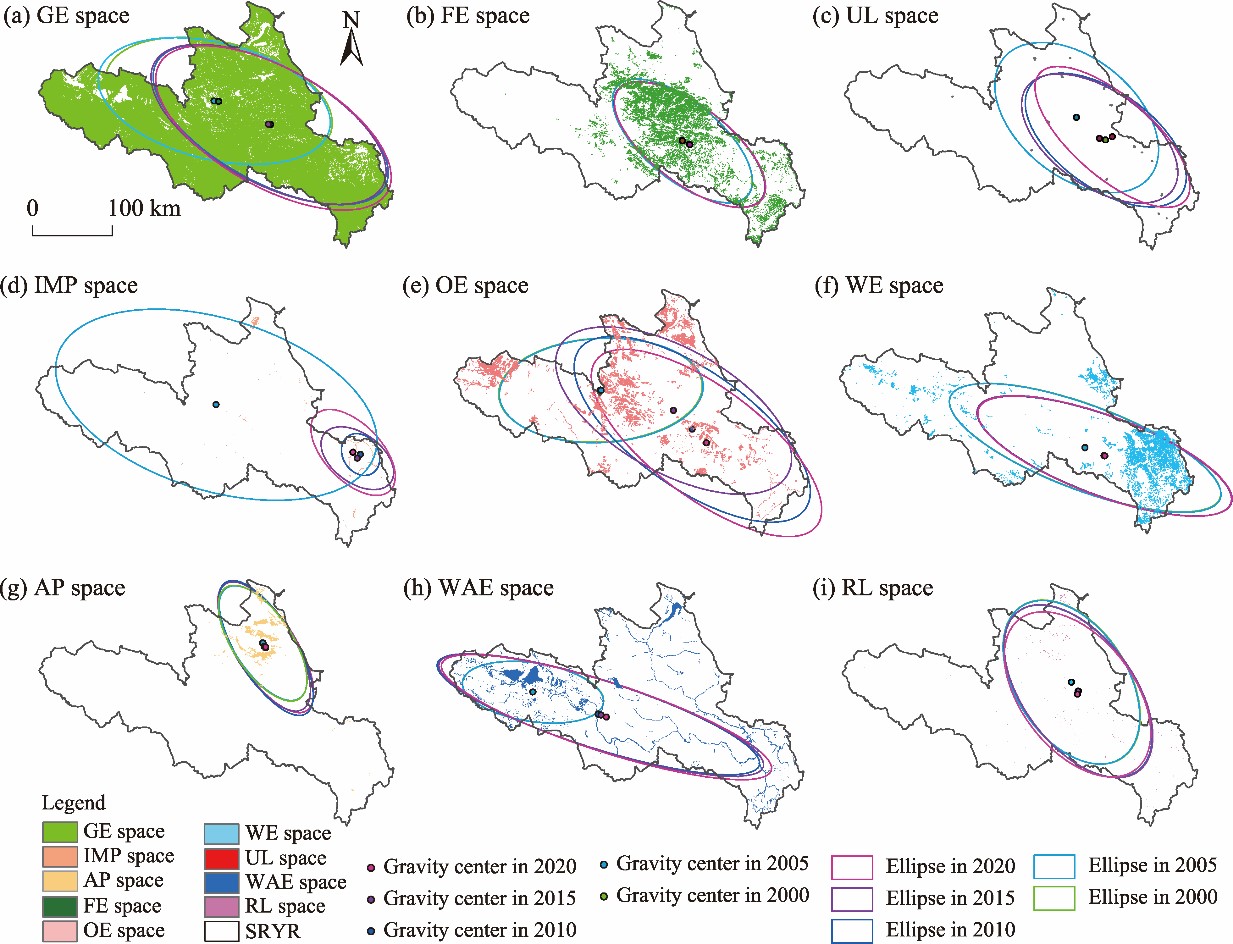
As one of China’s most important ecological conservation regions, the source region of the Yellow River (SRYR) has a fragile ecological environment. Investigating land use transformations and their ecological consequences in this region is of great significance for optimizing territorial spatial structure and promoting regional sustainable development. Based on the dominant functions of production-living-ecological space (PLES), we employed the land use transfer matrix and the standard deviational ellipse method to elucidate the spatiotemporal evolution characteristics of PLES in the SRYR from 2000 to 2020. Furthermore, the mechanism underlying the differentiation of eco-environmental effects in this region was explored using the optimal parameter-based geographical detector (OPGD) model. Results indicated that ecological space predominated within the PLES of the SRYR, accounting for approximately 98.74% of the total area. Living space was sparsely distributed in township areas with a proportion below 1.00%. Production space was mainly distributed in Guinan County and Gonghe County, accounting for about 1.16% of the area. In terms of the temporal scale, during 2000-2020, the overall eco-environmental quality of the SRYR exhibited an improving trend, primarily driven by the conversion of other ecological spaces into grassland ecological space. Interaction detection results revealed that the interaction between normalized difference vegetation index and gross domestic product was the strongest. In addition, the interaction between precipitation and temperature showed a significant bilinear enhancement effect. This finding suggests that the variations in eco-environmental quality in the SRYR during 2000-2020 have been jointly influenced by natural, climatic, and human factors. This study helps to provide a scientific basis for the rational layout of PLES and guiding ecological restoration efforts in the SRYR.
WANG Shiru , SONG Qian , ZHANG Haoxiang , TANG Man , Gao Wenming . Eco-environmental effects and driving factors of spatiotemporal change in production-living-ecological space in the source region of the Yellow River, China[J]. Regional Sustainability, 2026 , 7(2) : 100335 . DOI: 10.1016/j.regsus.2026.100335
| [1] | Bai R., Shi Y., Pan Y., 2022. Land-use classifying and identification of the production-living-ecological space of island villages—A case study of islands in the western sea area of Guangdong Province. Land. 11(5), 705, doi: 10.3390/land11050705. |
| [2] | Basu T., Das A., 2021. Systematic review of how eco-environmental transformation due to urbanization can be investigated in the sustainable development of Indian cities. Environmental Challenges. 4, 100099, doi: 10.1016/j.envc.2021.100099. |
| [3] | Borrelli P., Alewell C., Alvarez P., et al., 2021. Soil erosion modelling: A global review and statistical analysis. Science of The Total Environment. 780, 146494, doi: 10.1016/j.scitotenv.2021.146494. |
| [4] | Chen X., He L., Luo F., et al., 2023. Dynamic characteristics and impacts of ecosystem service values under land use change: A case study on the Zoigê plateau, China. Ecological Informatics. 78, 102350, doi: 10.1016/j.ecoinf.2023.102350. |
| [5] | Dong S.K., Shang Z.H., Gao J.X., et al., 2020. Enhancing sustainability of grassland ecosystems through ecological restoration and grazing management in an era of climate change on Qinghai-Tibetan Plateau. Agriculture, Ecosystems & Environment. 287, 106684, doi: 10.1016/j.agee.2019.106684. |
| [6] | Duan Y.M., Wang H., Huang A., et al., 2021. Identification and spatial-temporal evolution of rural “production-living-ecological” space from the perspective of villagers’ behavior—A case study of Ertai Town, Zhangjiakou City. Land Use Policy. 106, 105457, doi: 10.1016/j.landusepol.2021.105457. |
| [7] | Fan Y.T., Jin X.B., Gan L., et al., 2022. Dynamics of spatial associations among multiple land use functions and their driving mechanisms: A case study of the Yangtze River Delta region, China. Environmental Impact Assessment Review. 97, 106858, doi: 10.1016/j.eiar.2022.106858. |
| [8] | Fu J.C., Zhang S.L., 2021. Functional assessment and coordination characteristics of production, living, ecological function—A case study of Henan Province, China. Environmental Research and Public Health. 18(15), 8051, doi: 10.3390/ijerph18158051. |
| [9] | Fu J.Y., Bu Z.Q., Jiang D., et al., 2022a. Sustainable land use diagnosis based on the perspective of production-living-ecological spaces in China. Land Use Policy. 122, 106386, doi: 10.1016/j.landusepol.2022.106386. |
| [10] | Fu J.Y., Bu Z.Q., Jiang D., et al., 2022b. Identification and classification of urban PLES spatial functions based on multisource data and machine learning. Land. 11(10), 1824, doi: 10.3390/land11101824. |
| [11] | Ge S.J., Ma Y.J., 2025. Quantifying the spatio-temporal dynamics and coupling coordination of PLE spaces in Heilongjiang’s Grain Belt: a grid-based geospatial analysis. Frontiers in Ecology and Evolution. 13, 1635979, doi: 10.3389/fevo.2025.1635979. |
| [12] | Han L.J., Zhang X.Y., Zhou W.Q., et al., 2021. Transformation of China’s urbanization and eco-environment dynamics: An insight with location-based population-weighted indicators. Environmental Science and Pollution Research. 28, 16558-16567. |
| [13] | Hasan S.S., Zhen L., Miah M.G., et al., 2020. Impact of land use change on ecosystem services: A review. Environmental Development. 34, 100527, doi: 10.1016/j.envdev.2020.100527. |
| [14] | Hou L.G., Liu T., He X.Q., 2023. The evolution of land spatial pattern in Chengdu during the period of rapid urbanization from the perspective of land function. Journal of Resources and Ecology. 14(2), 410-422. |
| [15] | Hu Z.Q., Wu Z.L., Yuan X.M., et al., 2023. Spatial-temporal evolution of production-living-ecological space and layout optimization strategy in eco-sensitive areas: A case study of typical area on the Qinghai-Tibetan Plateau, China. Environmental Science and Pollution Research. 30, 79807-79820. |
| [16] | Jiang R., Wu P., Song Y.Z., et al., 2022. Factors influencing the adoption of renewable energy in the U.S. residential sector: An optimal parameters-based geographical detector approach. Renewable Energy. 201, 450-461. |
| [17] | Jin X.Y., Jin H.J., Luo D.L., et al., 2022. Impacts of permafrost degradation on hydrology and vegetation in the Source Area of the Yellow River on Northeastern Qinghai-Tibet Plateau, Southwest China. Frontiers in Earth Science. 10, 845824, doi: 10.3389/feart.2022.845824. |
| [18] | Ju X.L., Wang S.B., 2020. Dynamic city land use changes of Jinan City based on the transfer matrix from 2014 to 2019. In:Proceedings of the 2020 4th International Conference on Big Data and Internet of Things. Singapore: Association for Computing Machinery, 29-32. |
| [19] | Kong X.S., Fu M.G., Zhao X., et al., 2022. Ecological effects of land-use change on two sides of the Hu Huanyong Line in China. Land Use Policy. 113, 105895, doi: 10.1016/j.landusepol.2021.105895. |
| [20] | Lee C.Y., Lee S.G., 2023. Analyzing spatiotemporal land use change using an urban growth model based on multilevel logistic regression and future land demand scenarios. Applied Geography. 160, 103099, doi: 10.1016/j.apgeog.2023.103099. |
| [21] | Li J.S., Sun W., Li M.Y., et al., 2021a. Coupling coordination degree of production, living and ecological spaces and its influencing factors in the Yellow River Basin. Journal of Cleaner Production. 298, 126803, doi: 10.1016/j.jclepro.2021.126803. |
| [22] | Li M.Q., Liu S.L., Wang F.F., et al., 2022a. Cost-benefit analysis of ecological restoration based on land use scenario simulation and ecosystem service on the Qinghai-Tibet Plateau. Global Ecology and Conservation. 34, e02006, doi: 10.1016/j.gecco.2022.e02006. |
| [23] | Li M.R., Abuduwaili J., Liu W., et al., 2024. Application of geographical detector and geographically weighted regression for assessing landscape ecological risk in the Irtysh River Basin, Central Asia. Ecological Indicators. 158, 111540, doi: 10.1016/j.ecolind.2023.111540. |
| [24] | Li Q., Chen W., Li M., et al., 2022b. Identifying the effects of industrial land expansion on PM2.5 concentrations: A spatiotemporal analysis in China. Ecological Indicators. 141, 109069, doi: 10.1016/j.ecolind.2022.109069. |
| [25] | Li W.W., Weng B.S., Yan D.H., et al., 2023. Underestimated permafrost degradation: improving the TTOP model based on soil thermal conductivity. Science of The Total Environment. 854, 158564, doi: 10.1016/j.scitotenv.2022.158564. |
| [26] | Li Z.X., Qi F., Li Z.J., et al., 2021b. Reversing conflict between humans and the environment: The experience in the Qilian Mountains. Renewable and Sustainable Energy Reviews. 148, 111333, doi: 10.1016/j.rser.2021.111333. |
| [27] | Liu Y.Y., Liu X.Y., Zhao C.Y., et al., 2023. The trade-offs and synergies of the ecological-production-living functions of grassland in the Qilian Mountains by ecological priority. Journal of Environmental Management. 327, 116883, doi: 10.1016/j.jenvman.2022.116883. |
| [28] | Niu L.N., Shao Q.N., Ning J., et al., 2023. The assessment of ecological restoration effects on Beijing-Tianjin sandstorm source control project area during 2000-2019. Ecological Engineering. 186, 106831, doi: 10.1016/j.ecoleng.2022.106831. |
| [29] | Qu S., Wang L.C., Lin A.W., et al., 2018. What drives the vegetation restoration in Yangtze River basin, China: Climate change or anthropogenic factors? Ecological Indicators. 90, 438-450. |
| [30] | Ren D.F., Cao A.H., 2022. Analysis of the heterogeneity of landscape risk evolution and driving factors based on a combined GeoDa and Geodetector model. Ecological Indicators. 144, 109568, doi: 10.1016/j.ecolind.2022.109568. |
| [31] | Song J.Z., Lei J., Wang P.J., 2025. Evolution of the “Production-Living-Ecological” space of urban trituration and its prediction of carbon mitigation potential—The case of Xi’an. Ecological Indicators. 171, 113137, doi: 10.1016/j.ecolind.2025.113137. |
| [32] | Song W., Cao S.S., Du M.Y., et al., 2024. Aligning territorial spatial planning with sustainable development goals: A comprehensive analysis of production, living, and ecological spaces in China. Ecological Indicators. 160, 111816, doi: 10.1016/j.ecolind.2024.111816. |
| [33] | Song Y., Zhang M., 2019. Study on the gravity movement and decoupling state of global energy-related CO2 emissions. Journal of Environmental Management. 245, 302-310. |
| [34] | Song Y.Z., Wang J.F., Ge Y., et al., 2020. An optimal parameters-based geographical detector model enhances geographic characteristics of explanatory variables for spatial heterogeneity analysis: Cases with different types of spatial data. GIScience & Remote Sensing. 57, 593-610. |
| [35] | Stephens L., Fuller D., Boivin N., et al., 2019. Archaeological assessment reveals Earth’s early transformation through land use. Science. 365(6456), 897-902. |
| [36] | Tian F.H., Li M.Y., Han X.L., et al., 2020. A production-living-ecological space model for land-use optimisation: A case study of the core Tumen River region in China. Ecological Modelling. 437, 109310, doi: 10.1016/j.ecolmodel.2020.109310. |
| [37] | Wang J.T, Peng J., Zhao M.Y., et al., 2017. Significant trade-off for the impact of Grain-for-Green Programme on ecosystem services in North-western Yunnan, China. Science of The Total Environment. 574, 57-64. |
| [38] | Wang Y., Wang Y., Xu W.Z., et al., 2023a. Eco-environmental effect and driving factors of changing “production-living-ecological space” in northern Xinjiang, China. Frontiers in Ecology and Evolution. 11, 1248702, doi: 10.3389/fevo.2023.1248702. |
| [39] | Wang Z.L., Dong C., Dai L.D., et al., 2023b. Spatiotemporal evolution and attribution analysis of grassland NPP in the Yellow River source region, China. Ecological Informatics. 76, 102135, doi: 10.1016/j.ecoinf.2023.102135. |
| [40] | Wei Y.N., Zhang Y., Chen L.F., et al., 2022. Production-living-ecological space transition and its eco-environmental effects based on an improved area-weighted method: A case study of Gangcheng District, a typical industrial base in China. Frontiers in Environmental Science. 10, 972786, doi: 10.3389/fenvs.2022.972786. |
| [41] | Wu L., Yang Y.J., Yang H.L, et al., 2023. A comparative study on land use/land cover change and topographic gradient effect between mountains and flatlands of southwest China. Land. 12(6), 1242, doi: 10.3390/land12061242. |
| [42] | Xia N., Hai W.Y., Tang M.Y., et al., 2023. Spatiotemporal evolution law and driving mechanism of production-living-ecological space from 2000 to 2020 in Xinjiang, China. Ecological Indicators. 154, 110807, doi: 10.1016/j.ecolind.2023.110807. |
| [43] | Xiao Y., Huang M.D., Xie G.D., et al., 2022. Evaluating the impacts of land use change on ecosystem service values under multiple scenarios in the Hunshandake region of China. Science of The Total Environment. 850, 158067, doi: 10.1016/j.scitotenv.2022.158067. |
| [44] | Xie L., Wang H.G., Liu S.H., 2022. The ecosystem service values simulation and driving force analysis based on land use/land cover: A case study in inland rivers in arid areas of the Aksu River Basin, China. Ecological Indicators. 138, 108828, doi: 10.1016/j.ecolind.2022.108828. |
| [45] | Yang F.S., Yang X.M., Wang Z.H., et al., 2023. Spatiotemporal evolution of production-living-ecological land and its eco-environmental response in China’s coastal zone. Remote Sensing. 15(12), 3039, doi: 10.3390/rs15123039. |
| [46] | Yang H., Xing Y.Q., Chang X.Q., et al., 2024a. Internal response of vegetation growth to degrees of permafrost degradation in Northeast China from 2001 to 2020. Geo-Spatial Information Science. 28(1), 265-283. |
| [47] | Yang Y.H., Qin T.L., Yan D.H., et al., 2024b. Analysis of the evolution of ecosystem service value and its driving factors in the Yellow River Source Area, China. Ecological Indicators. 158, 111344, doi: 10.1016/j.ecolind.2023.111344. |
| [48] | Yang Y.J., Li H.Y., 2022. Monitoring spatiotemporal characteristics of land-use carbon emissions and their driving mechanisms in the Yellow River Delta: A grid-scale analysis. Environmental Research. 214, 114151, doi: 10.1016/j.envres.2022.114151. |
| [49] | Yu D.Y., Mu H., Chen S.J., 2025a. The “Production-Living-Ecological Spaces” and human-land relationship in poverty alleviation and relocation areas—An example of Zhaotong City, Yunnan Province. Ecological Indicators. 178, 114034, doi: 10.1016/j.ecolind.2025.114034. |
| [50] | Yu T.H., Jia S.S., Zhang Y., et al., 2025b. How can urban expansion and ecological preservation be balanced? A simulation of the spatial dynamics of production-living-ecological spaces in the Huaihe River eco-economic belt. Ecological Indicators. 171, 113192, doi: 10.1016/j.ecolind.2025.113192. |
| [51] | Yu Y., Hua T., Chen L.D., et al., 2024. Divergent changes in vegetation greenness, productivity, and rainfall use efficiency are characteristic of ecological restoration towards high-quality development in the Yellow River Basin, China. Engineering. 34, 109-119. |
| [52] | Zhao Y., Li Y.H., Liu Y.S., et al., 2025. Evolution of rural human-Earth system in midstream of China’s Yellow River and its implications for land use planning: A study of Lingbao County, Henan Province. Land Use Policy. 150, 107475, doi: 10.1016/j.landusepol.2025.107475. |
| [53] | Zhang L.L., Hu B.Q., Zhang Z., et al., 2023. Research on the spatiotemporal evolution and mechanism of ecosystem service value in the mountain-river-sea transition zone based on “production-living-ecological space”—Taking the Karst-Beibu Gulf in Southwest Guangxi, China as an example. Ecological Indicators. 148, 109889, doi: 10.1016/j.ecolind.2023.109889. |
| [54] | Zhang Y., Quan J., Kong Y.Q., et al., 2024. Research on the fine-scale spatial-temporal evolution characteristics of carbon emissions based on nighttime light data: A case study of Xi’an City. Ecological Informatics. 79, 102454, doi: 10.1016/j.ecoinf.2023.102454. |
| [55] | Zhang Z., Li J.M., 2022. Spatial suitability and multi-scenarios for land use: Simulation and policy insights from the production-living-ecological perspective. Land Use Policy. 119, 106219, doi: 10.1016/j.landusepol.2022.106219. |
| [56] | Zhao X.Y., Tan S.C., Li Y.P., et al., 2024. Quantitative analysis of fractional vegetation cover in southern Sichuan urban agglomeration using optimal parameter geographic detector model, China. Ecological Indicators. 158, 111529, doi: 10.1016/j.ecolind.2023.111529. |
| [57] | Zhou H.T., Wu X.D., Nie H.X., et al., 2024. Coupling coordination analysis and obstacle factors identification of rural living-production-ecological functions in a farming-pastoral ecotone. Ecological Indicators. 158, 111398, doi: 10.1016/j.ecolind.2023.111398. |
| [58] | Zhou Y., Guo L.Y., Liu Y.S., 2019. Land consolidation boosting poverty alleviation in China: theory and practice. Land Use Policy. 82, 339-348. |
| [59] | Zhu X.Y., Gao J.L., 2024. Characteristics and influencing mechanisms of production-living-ecological space dynamics in the three gorges reservoir area (TGRA), Chongqing, China. Regional Sustainability. 5(2), 100139, doi: 10.1016/j.regsus.2024.100139. |
| [60] | Zhu Z.Y., Peng S.Y., Ma X.L., et al., 2024. Identification of potential conflicts in the production-living-ecological spaces of the central Yunnan urban agglomeration from a multi-scale perspective. Ecological Indicators. 165, 112206, doi: 10.1016/j.ecolind.2024.112206. |
/
| 〈 |
|
〉 |
 REGSUS Wechat
 新公网安备 65010402001202号