

Current status and recent changes of glaciers in Tajikistan
Received date: 2025-08-27
Accepted date: 2025-12-31
Online published: 2026-01-21
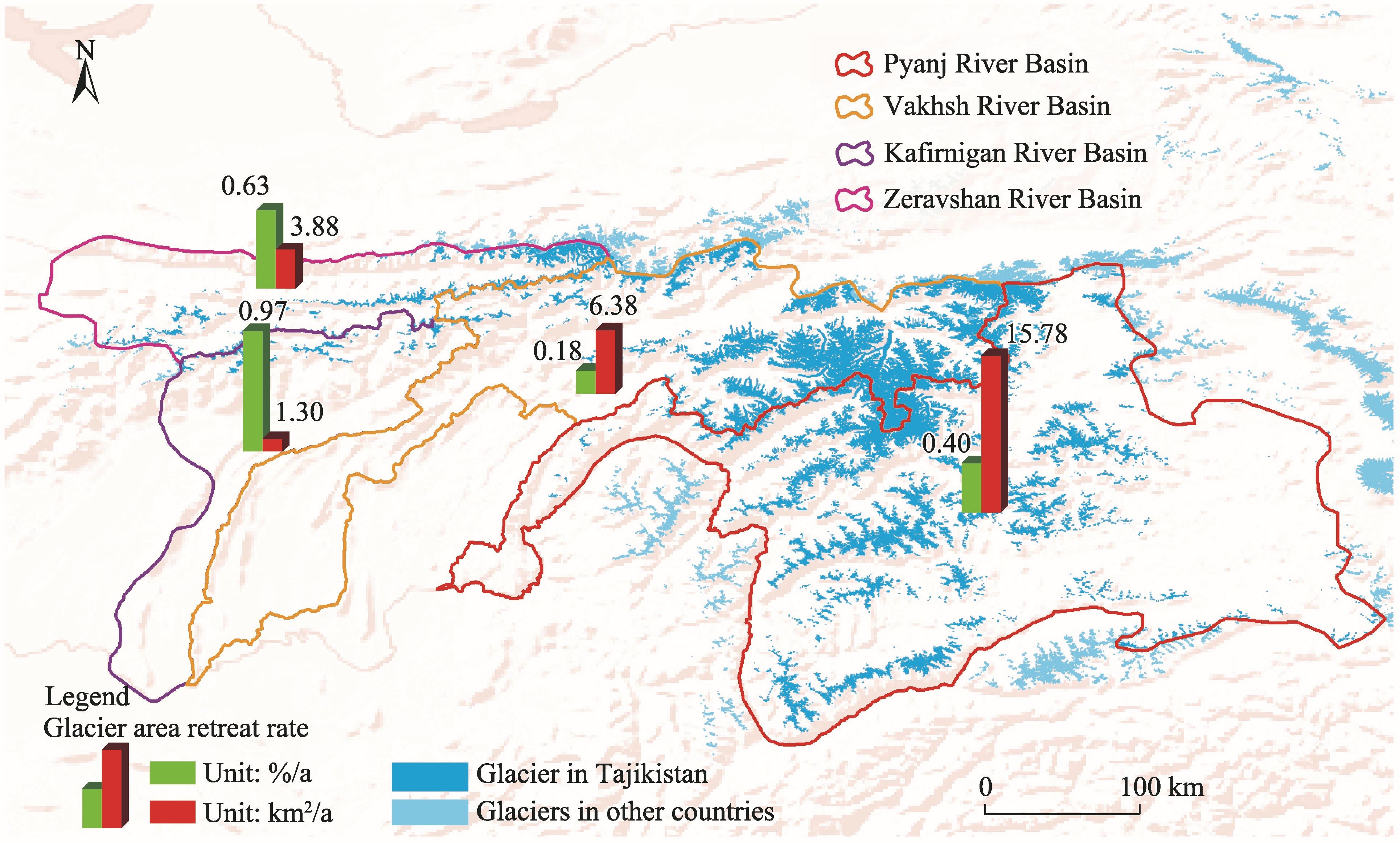
Tajikistan contains the majority of Central Asia’s glaciers, which cover about 6.00% of the national territory; their rapid shrinkage poses a significant threat to regional water resource security. However, glacier monitoring in Tajikistan was interrupted after 1991, creating a substantial gap in understanding the current state and temporal evolution of these glaciers. Based on glacier inventory data, in situ measurements, and published literature, this study examined the present status and recent variations of glaciers in Tajikistan through data integration and validation, literature collation and comparative analysis, and the application of Geographic Information System (GIS) spatial analysis techniques. As of 2023, Tajikistan possesses a total of 11,528 glaciers, encompassing an area of 7624.48 (±305.58) km2. Small glaciers dominate in number, whereas large glaciers account for the majority of the total area. Over the past two decades, the glacier count has decreased by 2014, and the total area has decreased by 628.98 km2, corresponding to an average annual reduction rate of 0.33%. Regional shrinkage rates range from 4.10% to 22.28%. Glaciers have undergone accelerated mass loss during the past 20 a; only those on the northeastern Pamir Plateau exhibit a weak positive mass balance. Observations of typical monitored glaciers also reveal intensified melting and retreat, consistent with regional trends. In light of the recent acceleration of glacier shrinkage in Tajikistan, focused measures should be implemented to strengthen glacier monitoring, enhance public awareness of glacier preservation, and promote the sustainable development and utilization of glacier tourism. These findings bridge the knowledge gap regarding the spatiotemporal dynamics of Tajikistan’s glaciers over recent decades and provide essential data support for regional water resource management.
Key words: Glacier inventory; Glacier change; Glacier mass balance; Climate change; Tajikistan
XU Chunhai , LI Zhongqin , HE Zhonghua , WANG Feiteng , MU Jianxin , CHEN Yaning , Sheralizoda NAZRIALO , Farhod NASRULLOEV , Aminjon GULAHMADZODA . Current status and recent changes of glaciers in Tajikistan[J]. Regional Sustainability, 2026 , 7(1) : 100296 . DOI: 10.1016/j.regsus.2026.100296
| [1] | Ambinakudige S., Joshi K., 2015. Multi-decadal changes in glacial parameters of the Fedchenko Glacier in Tajikistan. International Journal of Advanced Remote Sensing and GIS. 4(1), 911-919. |
| [2] | Barandun M., Pohl E., Naegeli K., et al., 2021. Hot spots of glacier mass balance variability in Central Asia. Geophysical Research Letter. 48(11), e2020GL092084, doi: 1029/2020GL092084. |
| [3] | Beniston M., Farinotti D., Stoffel M., et al., 2018. The European mountain cryosphere: a review of its current state, trends, and future challenges. The Cryosphere. 12(2), 759-794. |
| [4] | Braun L.N., Hagg W., Severskiy I.V., et al., 2009. Assessment of snow, glacier and water resources in Asia. In: International Hydrological Programme - Hydrology and Water Resources Programme. Koblenz, Germany. |
| [5] | Brun F., Berthier E., Wagnon P., et al., 2017. A spatially resolved estimate of High Mountain Asia glacier mass balances from 2000 to 2016. Nature Geoscience. 10(9), 668-673. |
| [6] | Brun F., Lambrecht A., Mayer C., et al., 2025. Multi-temporal elevation changes of Fedchenko Glacier, Tajikistan, from 1928 to 2021. Journal of Glaciology. 71, e45, doi: 10.1029/2020GL092084. |
| [7] | Chen Y.N., Li Y.P., Li Z., et al., 2022. Analysis of the impact of global climate change on dryland areas. Advances in Earth Science. 37(2), 111-119 (in Chinese). |
| [8] | Christmann S., Aw-Hassan A.A., 2015. A participatory method to enhance the collective ability to adapt to rapid glacier loss: The case of mountain communities in Tajikistan. Climatic Change. 133(2), 267-282. |
| [9] | Cogley J.G., 2009. A more complete version of the World Glacier Inventory. Annals of Glaciology. 50(53), 32-38. |
| [10] | Davaze L., Rabatel A., Dufour A., et al., 2020. Region-wide annual glacier surface mass balance for the European Alps from 2000 to 2016. Frontiers in Earth Science. 8, 149, doi: 10.3389/feart.2020.00149. |
| [11] | Deng M.J., 2013. Water resources in Tajikistan and prospect analysis on Sino-Tajikistan cooperative development of its hydropower. Water Power. 39(9), 1-4 (in Chinese). |
| [12] | Ding Y.J., Zhang S.Q., Chen R.S., et al., 2025. A review of the impacts of climate change on cryospheric hydrological processes. Climate Change Research. 21(1), 1-21 (in Chinese). |
| [13] | Dussaillant I., Hugonnet R., Huss M., et al., 2025. Annual mass change of the world’s glaciers from 1976 to 2024 by temporal downscaling of satellite data with in situ observations. Earth System Science Data. 17(5), 1977-2006. |
| [14] | Fan Y.B., Ke C.Q., Zhou X.B., et al., 2023. Glacier mass-balance estimates over High Mountain Asia from 2000 to 2021 based on ICESat-2 and NASADEM. Journal of Glaciology. 69(275), 500-512. |
| [15] | Fischer M., Huss M., Kummert M., et al., 2016. Application and validation of long-range terrestrial laser scanning to monitor the mass balance of very small glaciers in the Swiss Alps. The Cryosphere. 10(3), 1279-1295. |
| [16] | Gardelle J., Berthier E., Arnaud Y., et al., 2013. Region-wide glacier mass balances over the Pamir-Karakoram-Himalaya during 1999-2011. The Cryosphere. 7(4), 1263-1286. |
| [17] | Guo Z.Y., Yao X.J., Chen Y.S., et al., 2024. A dataset of glacier inventory in four Central Asian countries during 2022-2023. China Scientific Data. 9(4), 384-395 (in Chinese). |
| [18] | Hock R., Jensen H., 1999. Application of Kriging interpolation for glacier mass balance computations. Geografiska Annaler: Series A, Physical Geography. 81(4), 611-619. |
| [19] | Hoelzle M., Azisov E., Barandun M., et al., 2017. Re-establishing glacier monitoring in Kyrgyzstan and Uzbekistan, Central Asia. Geoscientific Instrumentation, Methods and Data Systems. 6(2), 397-418. |
| [20] | Hugonnet R., McNabb R., Berthier E., et al., 2021. Accelerated global glacier mass loss in the early twenty-first century. Nature. 592(7856), 726-731. |
| [21] | Huss M., Bauder A., Funk M., 2009. Homogenization of long-term mass-balance time series. Annals of Glaciology. 50(50), 198-206. |
| [22] | Huss M., Hock R., 2018. Global-scale hydrological response to future glacier mass loss. Nature Climate Change. 8(2), 135-140. |
| [23] | Iwata S., 2009. Mapping features of Fedchenko Glacier, the Pamirs, Central Asia from space. Geographical Studies. 84(1), 33-43. |
| [24] | Kaser G., Cogley J.G., Dyurgerov M.B., et al., 2006. Mass balance of glaciers and ice caps: consensus estimates for 1961-2004. Geophysical Research Letters. 33(19), L19501, doi: 10.1029/2006GL027511. |
| [25] | Khusrav K., Hofiz N., Aziz H., 2023. The impact of glacial degradation on the state of the agricultural sector in the high-mountain territories of Tajikistan. International Journal of Trend in Scientific Research and Development. 7(3), 1-8. |
| [26] | Lambrecht A., Mayer C., Aizen V., et al., 2014. The evolution of Fedchenko glacier in the Pamir, Tajikistan, during the past eight decades. Journal of Glaciology. 60(220), 233-244. |
| [27] | Li Z.J., 2021. Research on glacier changes in the Pamir from 2000 to 2017 based on remote sensing and GIS. MSc Thesis. Xi’an: Northwest University (in Chinese). |
| [28] | Li Z.J., Wang N.L., Chen A.A., et al., 2022. Slight change of glaciers in the Pamir over the period 2000-2017. Arctic, Antarctic, and Alpine Research. 54(1), 13-24. |
| [29] | Li Z.Q., Li K.M., Wang L., 2010. Study on recent glacier changes and their impact on water resources in Xinjiang, North Western China. Quaternary Sciences. 30(1), 96-106 (in Chinese). |
| [30] | Li Z.Q., Li H.L., Chen Y.N., 2011. Mechanisms and simulation of accelerated shrinkage of continental glaciers: a case study of Urumqi Glacier No. 1 in eastern Tianshan, Central Asia. Journal of Earth Science. 22(4), 423-430. |
| [31] | Liu S.Y., 2012. Field Observations in Glaciological Research. Beijing: Science Press, 99-115 (in Chinese). |
| [32] | Liu S.Y., Yao X.J., Guo W.Q., et al., 2015. The contemporary glaciers in China based on the Second Chinese Glacier Inventory. Acta Geographica Sinica. 70(1), 3-16 (in Chinese). |
| [33] | Muccione V., Cassara M., 2019. The climate-cryosphere-water nexus in central Asia. In: Swiss Agency for Development and Cooperation (SDC) Climate& Environment Network. Bern, Switzerland. |
| [34] | Mukhabbatov H.М., Zhiltsov S.S., Markova E.A., 2020. Tajikistan water resources and water management issues.In: Zonn, I.S., Zhiltsov, S.S., Kostianoy, A.G., et al., (eds.). Water Resources Management in Ventral Asia. Cham: Springer International Publishing, 111-124. |
| [35] | Oerlemans J., 2005. Extracting a climate signal from 169 glacier records. Science. 308(5722), 675-677. |
| [36] | Paul F., Rastner P., Azzoni R.S., et al., 2019. Glacier shrinkage in the Alps continues unabated as revealed by a new glacier inventory from Sentinel-2. Earth System Science Data. 12(3), 1805-1821. |
| [37] | RGI (Randolph Glacier Inventory) 7.0 Consortium, 2023. Randolph Glacier Inventory-Dataset of Global Glacier Outlines: Version 7.0. Boulder, Colorado USA. NSIDC: National Snow and Ice Data Center. [2025-07-20]. https://doi.org/10.5067/f6jmovy5navz. |
| [38] | Shiklomanov N.I., 2005. From exploration to systematic investigation: development of geocryology in 19th-and Early—20th-Century Russia. Physical Geography. 26(4), 249-263. |
| [39] | Shokirov Q., Abdykadyrova A., Dear C., et al., 2014. Mountain tourism and sustainability in Kyrgyzstan and Tajikistan: a research review. Mountain Societies Research Institute (MSRI) Background Paper. Bishkek, Kyrgyz Republic. |
| [40] | Siegfried T., Bernauer T., Guiennet R., et al., 2012. Will climate change exacerbate water stress in Central Asia? Climatic Change. 112(3), 881-899. |
| [41] | Su B., Xiao C.D., Chen D.L., et al., 2022. Glacier change in China over past decades: Spatiotemporal patterns and influencing factors. Earth-Science Reviews. 226, 103926, doi: 10.1016/j.scib.2022.12.004. |
| [42] | Tielidze L.G., Jomelli V., Nosenko G.A., 2022. Analysis of regional changes in geodetic mass balance for all Caucasus glaciers over the past two decades. Atmosphere. 13(2), 256, doi: 10.3390/atmos13020256. |
| [43] | Wang S.J., Chen F., Chen Y.P., et al., 2025. Greening of Eurasia’s center driven by low-latitude climate warming. Forest Ecosystems. 13, 100330, doi: 10.1016/j.fecs.2025.100330. |
| [44] | WBG(World Bank Group) CCKP (Climate Change Knowledge Portal), 2021. Climate Data: Historical. [2025-07-30]. https://climateknowledgeportal.worldbank.org/country/tajikistan/climate-data-historical. |
| [45] | WGMS(World Glacier Monitoring Service), 2025. Fluctuations of Glaciers (FoG) Database. Zurich, Switzerland. [2025-07-30]. https://doi.org/10.5904/wgms-fog-2025-02. |
| [46] | Wu W.H., 2013. The water resources of Tajikistan and runoff response to climate change. MSc Thesis. Urumqi: Xinjiang Agricultural University (in Chinese). |
| [47] | Wu X.F., Tang W.H., Chen F., et al., 2025. Attribution and risk projections of hydrological drought over water-scarce Central Asia. Earth’s Future. 13(1), e2024EF005243, doi: 10.1029/2024EF005243. |
| [48] | Xie Z.C., Liu C.H., 2010. Introduction to Glaciology. Shanghai: Shanghai Popular Science Press, 66-98 (in Chinese). |
| [49] | Xiao Y., 2025. Monthly glacier albedo dataset worldwide (2000-2023). National Tibetan Plateau/Third Pole Environment Data Center. [2025-07-10]. https://doi.org/10.11888/Cryos.tpdc.302665. |
| [50] | Xiaoai X., 2013. A feasibility study on sustainable mountain tourism development in the Republic of Tajikistan. In: Asia Pacific Conference 2013. Oita, Japan. |
| [51] | Xu C.H., Li H.L., Wang F.T, et al., 2024. Heatwaves in summer 2022 forces substantial mass loss for Urumqi Glacier No. 1, China. Journal of Glaciology. 70, e77, doi: 10.1017/jog.2024.4. |
| [52] | Zemp M., Huss M., Thibert E., et al., 2019. Global glacier mass changes and their contributions to sea-level rise from 1961 to 2016. Nature. 568(7752), 382-386. |
| [53] | Zemp M., Jakob L., Dussaillant I., et al., 2025. Community estimate of global glacier mass changes from 2000 to 2023. Nature. 639(8054), 382-388. |
| [54] | Zhou Y., Li Z., Li J., et al., 2019. Geodetic glacier mass balance (1975-1999) in the central Pamir using the SRTM DEM and KH-9 imagery. Journal of Glaciology. 65(250), 309-320. |
| [55] | Zhu M.L., Yao T.D., Yang W., et al., 2018. Reconstruction of the mass balance of Muztag Ata No. 15 glacier, eastern Pamir, and its climatic drivers. Journal of Glaciology. 64(244), 259-274. |
| [56] | Zhuang L.C., Ke C.Q., Cai Y., et al., 2023. Measuring glacier changes in the Tianshan Mountains over the past 20 years using Google Earth Engine and machine learning. Journal of Geographical Sciences. 33(9). 1939-1964. |
/
| 〈 |
|
〉 |
 REGSUS Wechat
 新公网安备 65010402001202号