

Coupling dynamics of SDGs in Tajikistan from 2001 to 2023
Received date: 2025-08-29
Revised date: 2025-10-25
Accepted date: 2026-01-06
Online published: 2026-01-21
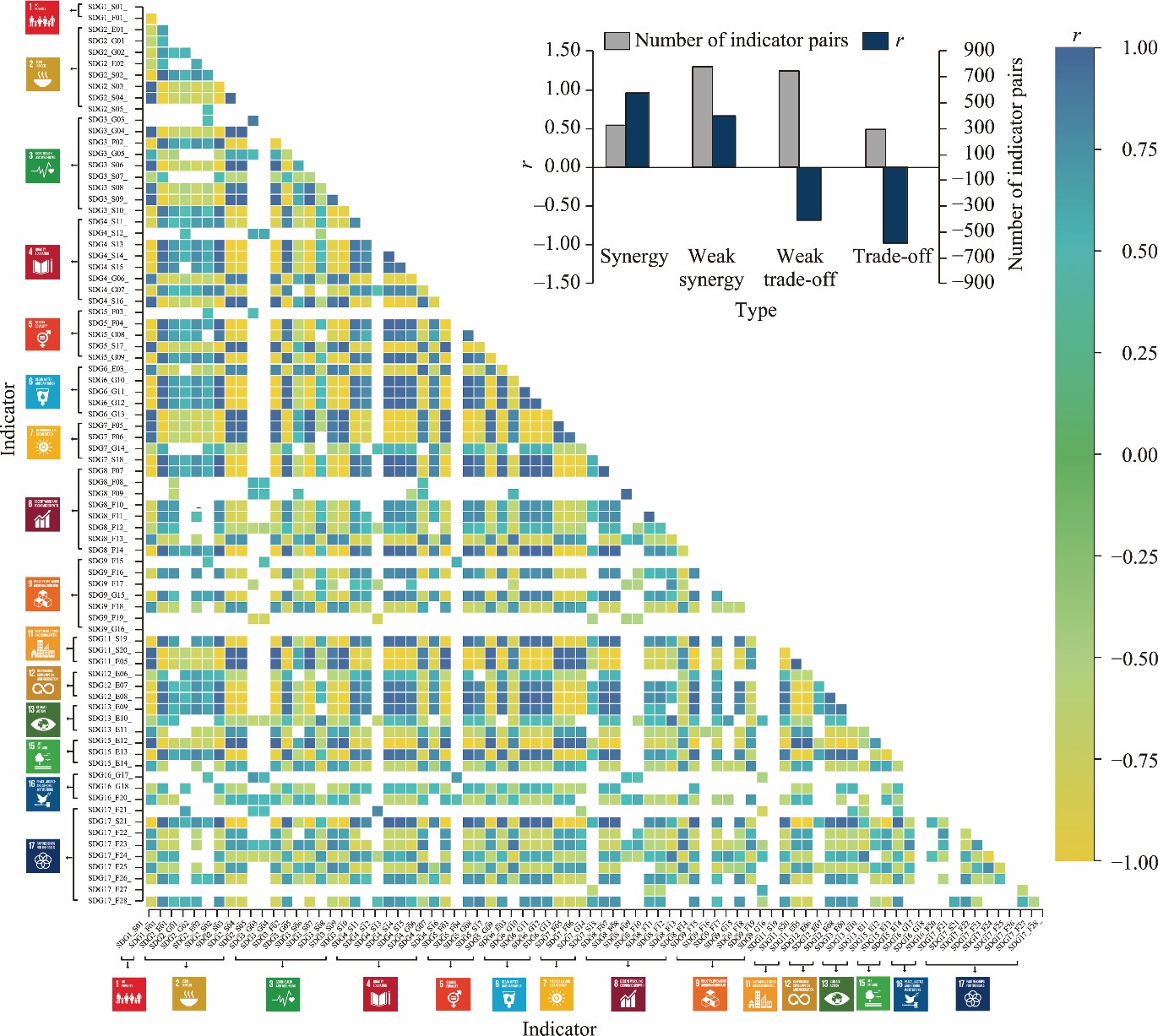
Since the United Nations launched the Sustainable Development Goals (SDGs) in 2015, global implementation has steadily advanced, yet prominent challenges persist. Progress has been uneven across regions and countries, with Tajikistan representing a typical example of such disparities. Based on 81 SDG indicators for Tajikistan from 2001 to 2023, this study applied a three-level coupling network framework: at the microscale, it identified synergies and trade-offs between indicators; at the mesoscale, it examined the strength and direction of linkages within four SDG-related components (society, finance, governance, and environment); and at the global level, it focused on the overall SDG interlinkages. Spearman’s rank correlation, sliding window method, and topological properties were employed to analyze the coupling dynamics of SDGs. Results showed that over 70.00% of associations in the global SDG network were of medium-to-low intensity, alongside extremely strong ones (|r| value approached 1.00, where r is the correlation coefficient). SDG interactions were generally limited, with stable local synergy clusters in core livelihood sectors. Network modularity fluctuated, reflecting a cycle of differentiation, integration, and fragmentation, while coupling efficiency varied with the external environment. Each component exhibited distinct functional characteristics. The social component maintained high connectivity through the “poverty alleviation-education-healthcare” loop. The environmental component shifted toward coordinated eco-economic governance. The governance-related component broke interdepartmental barriers, while the financial component showed weak links between resource-based indicators and consumption/employment indicators. Tajikistan’s SDG coupling evolved through three phases: survival-oriented (2001-2012), policy integration (2013-2018), and shock adaptation (2019-2023). These phases were driven by policy changes, resource industries, governance optimization, and external factors. This study enriches the analytical framework for understanding the dynamic coupling of SDGs in mountainous resource-dependent countries and provides empirical evidence to support similar countries in formulating phase-specific SDG promotion strategies.
Ranna HAZIHAN , DU Hongru , HE Chuanchuan , Kobiljon Khushvakht KHUSHVAKHTZODA , Bobozoda KOMIL . Coupling dynamics of SDGs in Tajikistan from 2001 to 2023[J]. Regional Sustainability, 2026 , 7(1) : 100295 . DOI: 10.1016/j.regsus.2026.100295
| [1] | Abdulla K., Serikbayeva B., 2024. Gender gaps in labor market outcomes in a resource-dependent country. Resources Policy. 90, 104685, doi: 10.1016/j.resourpol.2024.104685. |
| [2] | Abdullozoda J., Yusufi S., Nandi S., et al., 2024. Informing policy with health labour market analysis to improve availability of family doctors in Tajikistan. Human Resources for Health. 22(1), 63, doi: 10.1186/s12960-024-00946-5. |
| [3] | Alayza N., Caldwell M., 2021. Financing climate action and the COVID-19 pandemic: An analysis of 17 developing countries. In: World Resources Institute. Working Paper.Washington, USA,36-42. |
| [4] | Balata E.E., Pinto H., da Silva M.M., 2022. Latent dimensions between water use and socio-economic development: A global exploratory statistical analysis. Regional Sustainability. 3(3), 269-280. |
| [5] | Blanc D.L., 2015. Towards integration at last? The Sustainable Development Goals as a network of targets. Sustainable Development. 23(3), 176-187. |
| [6] | Bongaarts J., 2021. FAO, IFAD, UNICEF, WFP and WHO the state of food security and nutrition in the world 2020. Transforming food systems for affordable healthy diets FAO, 2020, 320 p. Population and Development Review. 47, 558-558. |
| [7] | Cernev T., Fenner R., 2020. The importance of achieving foundational Sustainable Development Goals in reducing global risk. Futures. 115, 102492, doi: 10.1016/j.futures.2019.102492. |
| [8] | Cutting E., Jones M., White E., 2024. We put the “UN” in FUN: The mathematical guide to saving the world. University of Colorado Honors Journal. 1-22, doi: 10.33011/cuhj20242839. |
| [9] | Dai M., Huang S.Z., Huang Q., et al., 2022. Propagation characteristics and mechanism from meteorological to agricultural drought in various seasons. Journal of Hydrology. 610, 127897, doi: 10.1016/j.jhydrol.2022.127897. |
| [10] | Damanik F.H.S., 2025. Gender and education in the context of Sustainable Development Goals. Entita: Jurnal Pendidikan Ilmu Pengetahuan Sosial dan Ilmu-Ilmu Sosial. 1, 251-266. |
| [11] | Dawes J.H.P., 2022. SDG interlinkage networks: Analysis, robustness, sensitivities, and hierarchies. World Development. 149, 105693, doi: 10.1016/j.worlddev.2021.105693. |
| [12] | Eisenmenger N., Pichler M., Krenmayr N., et al., 2020. The Sustainable Development Goals prioritize economic growth over sustainable resource use: a critical reflection on the SDGs from a socio-ecological perspective. Sustainability Science. 15(4), 1101-1110. |
| [13] | Fu B.J., Wang S., Zhang J.Z., et al., 2019. Unravelling the complexity in achieving the 17 Sustainable Development Goals. National Science Review. 6(3), 386-388. |
| [14] | Gaforzoda B., Yuldashev R., 2023. Irrigation and drainage in the Republic of Tajikistan. Irrigation and Drainage. 72(5), 1230-1240. |
| [15] | Ghimire T., Harou A.P., Balasubramanya S., 2023. Migration, gender labor division and food insecurity in Tajikistan. Food Policy. 116, 102438, doi: 10.1016/j.foodpol.2023.102438. |
| [16] | Hagberg A., Swart P.J., Schult D.A., 2008. Exploring network structure, dynamics, and function using NetworkX. In: Los Alamos National Laboratory. No. LA-UR-08-05495. Los Alamos, the USA. |
| [17] | Hickel J., 2019. The contradiction of the sustainable development goals: Growth versus ecology on a finite planet. Sustainable Development. 27(5), 873-884. |
| [18] | Holden E., Linnerud K., Banister D., 2017. The imperatives of sustainable development. Sustainable Development. 25(3), 213-226. |
| [19] | Horvath S.M., Muhr M.M., Kirchner M., et al., 2022. Handling a complex agenda: A review and assessment of methods to analyse SDG entity interactions. Environmental Science & Policy. 131, 160-176. |
| [20] | Hu B.A., Li Z.Z., Wu H.F., et al., 2023. Coupling strength of human- natural systems mediates the response of ecosystem services to land use change. Journal of Environmental Management. 344, 118521, doi: 10.1016/J.Jenvman.2023.118521. |
| [21] | Kojo N.C., Sattar S., 2018. Tajikistan - Systematic Country Diagnostic: Making the National Development Strategy 2030 a Success - Building the Foundation for Shared Prosperity. [2025-05-01]. https://documents.worldbank.org/en/publication/documents-reports/documentdetail/430741528356150691. |
| [22] | Leal Filho W., Trevisan L.V., Rampasso I.S., et al., 2023. When the alarm bells ring: Why the UN sustainable development goals may not be achieved by 2030. Journal of Cleaner Production. 407, 137108, doi: 10.1016/j.jclepro.2023.137108. |
| [23] | Mackey A., Saalismaa N., Simonett O., 2024. Leave no mountains behind:the sustainable development agenda and mountain areas. In: SchneiderbauerS., PisaP.F., ShroderJ.F., (eds.). Safeguarding Mountain Social-Ecological Systems. Amsterdam: Elsevier, 133-136. |
| [24] | Mensah J., 2019. Sustainable development: Meaning, history, principles, pillars, and implications for human action: Literature review. Cogent Social Sciences. 5(1), 1653531, doi: 10.1080/23311886.2019.1653531. |
| [25] | Migranyan A.A., Krishtal I.S., 2024. Economy of Tajikistan: Growth factors against the background of law standards of living. Russian New States and Eurasia. 10(4), 120-132 (in Russian). |
| [26] | Ministry of Defence of the Republic of Tajikistan, 2016. National Development Strategy of the Republic of Tajikistan for the Period until 2030. [2025-06-01]. https://leap.unep.org/en/countries/tj/national-legislation/national-development-strategy-republic-tajikistan-period-until (in Russian). |
| [27] | Mishra M., Desul S., Santos C.A.G., et al., 2024. A bibliometric analysis of sustainable development goals (SDGs): a review of progress, challenges, and opportunities. Environmental, Development and Sustainability. 26(5), 11101-11143. |
| [28] | Mrowinski M.J., Orzechowski K.P., Fronczak A., et al., 2024. Interplay between tie strength and neighbourhood topology in complex networks. Scientific Reports. 14, 7811, doi: 10.1038/s41598-024-58357-4. |
| [29] | Naveed A., Ahmad N., Naz A., et al., 2023. Economic development through women’s economic rights: a panel data analysis. International Economics and Economic Policy. 20, 257-278. |
| [30] | Nilsson M., Griggs D., Visbeck M., 2016. Policy: Map the interactions between Sustainable Development Goals. Nature. 534, 320-322. |
| [31] | Pham-Truffert M., Metz F., Fischer M., et al., 2020. Interactions among Sustainable Development Goals: Knowledge for identifying multipliers and virtuous cycles. Sustainable Development. 28(5), 1236-1250. |
| [32] | Pickering J., Jotzo F., Wood P.J., 2015. Sharing the global climate finance effort fairly with limited coordination. Global Environmental Politics. 15(4), 39-62. |
| [33] | Pradhan P., Costa L., Rybski D., et al., 2017. A systematic study of Sustainable Development Goal (SDG) interactions. Earth’s Future. 5(11), 1169-1179. |
| [34] | Republic of Tajikistan, 2007. National Development Strategy of the Republic of Tajikistan for the Period to 2015. [2025-07-01]. https://leap.unep.org/en/countries/tj/national-legislation/national-development-strategy-republic-tajikistan-period-2015. |
| [35] | Republic of Tajikistan, 2008. Concept of Environmental Protection in the Republic of Tajikistan (Decree No. 645). [2025-04-03].http://fp7.cawater-info.net/library/rus/tj_env_concept_2008.pdf (in Russian). |
| [36] | Republic of Tajikistan, 2013a. Living Standards Improvement Strategy of Tajikistan for 2013-2015. [2025-04-26]. https://leap.unep.org/en/countries/tj/national-legislation/living-standards-improvement-strategy-tajikistan-2013-2015. |
| [37] | Republic of Tajikistan, 2013b. Strategy for Countering Corruption in the Republic of Tajikistan for the Period of 2013 - 2020. [2025-04-30]. https://www.informea.org/en/content/legislation/strategy-countering-corruption-republic-tajikistan-period-2013-2020 (in Russian). |
| [38] | Resolution of the Government of Tajikistan, 2007. Poverty Reduction Strategy of the Republic of Tajikistan for 2007-2009 . [2025-04-03]. https://www.informea.org/en/content/legislation/poverty-reduction-strategy-republic-tajikistan-2007-2009. |
| [39] | Roy A., Pramanick K., 2018. Analysing progress of Sustainable Development Goal 6 in India: Past, present, and future. Journal of Environmental Management. 232, 1049-1065. |
| [40] | Sachs J.D., LaFortune G., Fuller G., 2024. The SDGs and the UN Summit of the Future. Sustainable Development Report 2024. Dublin: Dublin University Press. |
| [41] | Sebestyén V., Bulla M., Rédey á., et al., 2019. Network model-based analysis of the goals, targets and indicators of sustainable development for strategic environmental assessment. Journal of Environmental Management. 238, 126-135. |
| [42] | Soto G.H., 2024. Falling behind: Evaluating projected sustainable development goals progress across varied income countries. Sustainable Development. 32(3), 2194-2207. |
| [43] | Strokova V., Ajwad M.I., 2017. Tajikistan Jobs Diagnostic: Strategic Framework for Jobs. [2025-05-01]. https://documents.worldbank.org/en/publication/documents-reports/documentdetail/611141486546993528. |
| [44] | United Nations, 2015. Transforming Our World: The 2030Agenda for Sustainable Development. New York: United Nations. |
| [45] | Weitz N., Carlsen H., Nilsson M., et al., 2018. Towards systemic and contextual priority setting for implementing the 2030 Agenda. Sustainability Science. 13(2), 531-548. |
| [46] | World Bank, 2005. Republic of Tajikistan Poverty Assessment Update (Report No.30853-TJ). Washington: World Bank. |
| [47] | Wu X.T., Fu B.J., Wang S., et al., 2022. Decoupling of SDGs followed by re-coupling as sustainable development progresses. Nature Sustainability. 5, 452-459. |
| [48] | Wu X.T., Fu B.J., Wang S., et al., 2023. Three main dimensions reflected by national SDG performance. The Innovation. 4(6), 100507, doi: 10.1016/j.xinn.2023.100507. |
| [49] | Yuan M.M., Guo X., Wu L.W., et al., 2021. Climate warming enhances microbial network complexity and stability. Nature Climate Change. 11, 343-348. |
| [50] | Zelinka D., Amadei B., 2019. Systems approach for modeling interactions among the Sustainable Development Goals part 1: Cross-impact network analysis. International Journal of System Dynamics Applications. 8(1), 23-40. |
| [51] | Zhang J.Z., Wang S., Zhao W.W., et al., 2022. Finding pathways to synergistic development of Sustainable Development Goals in China. Humanities and Social Sciences Communications. 9, doi: 10.1057/s41599-022-01036-4. |
| [52] | Zhao J.Q., 2022. We should all be feminists—The impact of the protection of women’s rights on economic growth. American Journal of Industrial and Business Management. 12, 1363-1373. |
/
| 〈 |
|
〉 |
 REGSUS Wechat
 新公网安备 65010402001202号