

Vascular plant diversity and distribution pattern in Tajikistan: A global hotspot of diversity
The first and second authors contributed equally to this work
Received date: 2025-08-31
Revised date: 2025-12-08
Accepted date: 2026-01-05
Online published: 2026-01-21
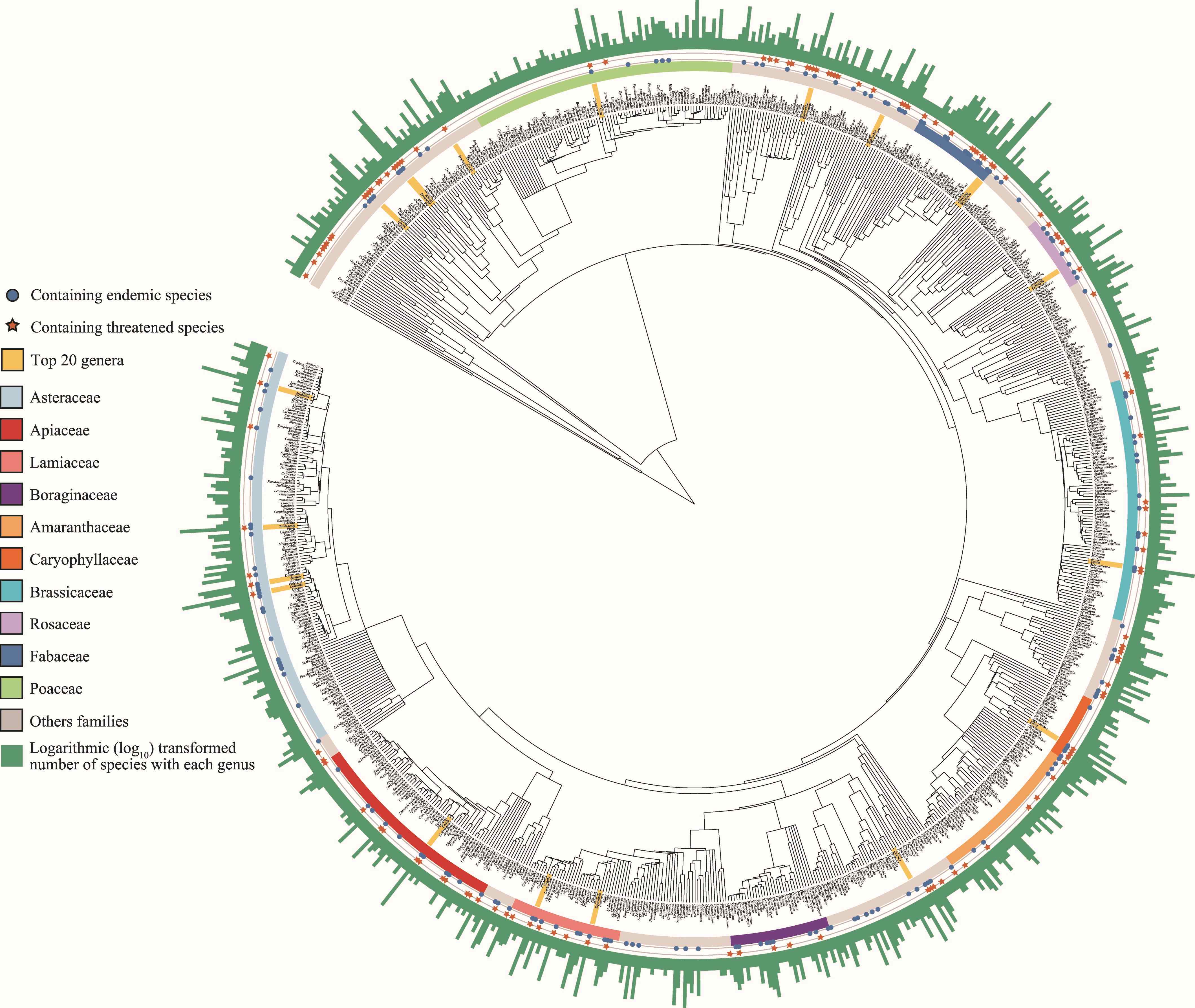
Tajikistan represents a core region of the biodiversity hotspot in Central Asian mountains and has exceptional vascular plant diversity. However, the species diversity of the country faces urgent conservation challenges. There has been a lack of a comprehensive and multidimensional assessment to inform strategic conservation planning. Therefore, this study integrated 4 key biodiversity indices including species richness (SR), phylogenetic diversity (PD), threatened species richness (TSR), and endemic species richness (ESR) to map species diversity distribution patterns, identify conservation gaps, and elucidate their effects of climatic factors. This study revealed that species diversity shows a clear trend of decreasing from the western region to the eastern region of Tajikistan. The central-western mountains (specifically the Gissar-Darvasian and Zeravshanian regions) emerge as irreplaceable biodiversity hotspots. However, we found a severe spatial mismatch between these priority areas and the existing protected areas (PAs). Protection coverage for all hotspots was alarmingly low, ranging from 31.00% to 38.00%. Consequently, a critical 64.80% of integrated priority areas fall outside of the current PAs, representing a major conservation gap. This study identified precipitation seasonality and isothermality as the principal drivers, collectively explaining over 50.00% of the diversity variation and suggesting high vulnerability to hydrological shifts. Furthermore, we detected significant geographic sampling bias in the public biodiversity databases, with the most critical hotspot being systematically under-sampled. This study provides a robust scientific basis for conservation action, highlighting the urgent need to strategically expand PAs in the under-protected southwestern region and to mitigate critical sampling gaps through targeted data digitization and field surveys. These measures are indispensable for securing Tajikistan’s unique biodiversity and achieving the Kunming-Montreal Global Biodiversity Framework Target 3 (“30×30 Protection”).
ZHOU Yixin , MA Suliya , LI Wenjun , Parvina KURBONOVA , Mariyo BOBOEV , LI Yufan , Hikmat HISORIEV , MA Keping , YANG Weikang , ZHANG Yuanming . Vascular plant diversity and distribution pattern in Tajikistan: A global hotspot of diversity[J]. Regional Sustainability, 2026 , 7(1) : 100294 . DOI: 10.1016/j.regsus.2026.100294
| [1] | Akhmadov K.M., Breckle S.W., Breckle U., 2006. Effects of grazing on biodiversity, productivity, and soil erosion of alpine pastures in Tajik mountains. In: SpehnE.M., LibermanM., K?rnerC., (eds.). Land Use Change and Mountain Biodiversity. Boca Raton: CRC Press, 239-248. |
| [2] | Ball A., Daru B.H., Lughadha E.M., et al., 2025. What ‘unexplored’ means: Mapping regions with digitized natural history records to look for ‘biodiversity blindspots’. PeerJ. 13, e18511, doi: 10.7717/peerj.18511. |
| [3] | Bartoń K., 2025. MuMIn: Multi-Model Inference. R Package Version 1.48.11. [2025-07-11]. https://CRAN.R-project.org/package=MuMIn. |
| [4] | Borsch T., Berendsohn W., Dalcin E., et al., 2020. World Flora Online: Placing taxonomists at the heart of a definitive and comprehensive global resource on the world’s plants. Taxon. 69(6), 1311-1341. |
| [5] | Boyle B., Hopkins N., Lu Z., et al., 2013. The taxonomic name resolution service: An online tool for automated standardization of plant names. BMC Bioinformatics. 14, 16, doi: 10.1186/1471-2105-14-16. |
| [6] | Brown M.J., Walker B.E., Black N., et al., 2023. rWCVP: A companion R package for the World Checklist of vascular plants. New Phytologist. 240, 1355-1365. |
| [7] | Chen Y.N., Li W.H., Deng H.J., et al., 2016. Changes in Central Asia’s water tower: Past, present and future. Scientific Reports. 6, 35458, doi: 10.1038/srep35458. |
| [8] | Coelho M.T.P., Barreto E., Rangel T.F., et al., 2023. The geography of climate and the global patterns of species diversity. Nature. 622(7983), 537-544. |
| [9] | Fallah B., Didovets I., Rostami M., et al., 2024. Climate change impacts on Central Asia: Trends, extremes and future projections. International Journal of Climatology. 44(10), 3191-3213. |
| [10] | Fattorini S., 2017. Endemism in historical biogeography and conservation biology: Concepts and implications. Biodiversity and Evolution. 32(1), 47-75. |
| [11] | Govaerts R., Nic Lughadha E., Black N., et al., 2021. The World Checklist of Vascular Plants, a continuously updated resource for exploring global plant diversity. Scientific Data. 8, 215, doi: 10.1038/s41597-021-00997-6. |
| [12] | Hawkins B.A., Field R., Cornell H.V., et al., 2003. Energy, water, and broad-scale geographic patterns of species richness. Ecology. 84(11), 3105-3117. |
| [13] | Hernangómez D., 2023. Using the tidyverse with terra objects: The tidyterra package. Journal of Open Source Software. 8(91), 5751, doi: 10.21105/joss.05751. |
| [14] | Hewitt G., 2000. The genetic legacy of the Quaternary ice ages. Nature. 405(6789), 907-913. |
| [15] | Hijmans R.J., 2025. terra: Spatial Data Analysis. R Package Version 1. [2025-07-11]. https://CRAN.R-project.org/package=terra. |
| [16] | Jin Y., Qian H., 2022. V.PhyloMaker2: An updated and enlarged R package that can generate very large phylogenies for vascular plants. Plant Diversity. 44(5), 335-339. |
| [17] | Kass J.M., Guénard B., Dudley K.L., et al., 2022. The global distribution of known and undiscovered ant biodiversity. Science Advances. 8(34), eabp9908, doi: 10.1126/sciadv.abp9908. |
| [18] | Knoche M., Merz R., Lindner M., et al., 2017. Bridging glaciological and hydrological trends in the Pamir Mountains, Central Asia. Water. 9(6), 422, doi: 10.3390/w9060422. |
| [19] | Kumar P., Sharma K., 2023. Snowfall shift and precipitation variability over Sikkim Himalaya attributed to elevation-dependent warming. Journal of Atmospheric Science Research. 6(4), 5854, doi: 10.30564/jasr.v6i4.5854. |
| [20] | Kusumoto B., Chao A., Eiserhardt W.L., et al., 2023. Occurrence-based diversity estimation reveals macroecological and conservation knowledge gaps for global woody plants. Science Advances. 9, eadh9719, doi: 10.1126/sciadv.adh9719. |
| [21] | Lai J.S., 2022. Generalizing hierarchical and variation partitioning in multiple regression and canonical analysis using the rdacca.hp R package. Methods in Ecology and Evolution. 13(4), 782-788. |
| [22] | Le?o T.C.C., Lughadha E.N., Reich P.B., 2020. Evolutionary patterns in the geographic range size of Atlantic Forest plants. Ecography. 43(10), 1510-1520. |
| [23] | Letunic I., Bork P., 2024. Interactive Tree of Life (iTOL) v6: recent updates to the phylogenetic tree display and annotation tool. Nucleic Acids Research. 52(W1), W78-W82. |
| [24] | Li W.J., Tojibaev K.S., Hisoriev H., et al., 2020. Mapping Asia Plants: Current status of floristic information for Central Asian flora. Global Ecology and Conservation. 24, e01220, doi: 10.1016/j.gecco.2020.e01220. |
| [25] | Li Y.F., Li W.J., Ma S.L.Y., et al., 2025. Diversity and conservation gaps of threatened vascular plant species in Tajikistan. Arid Land Geography. 48(1), 43-52 (in Chinese). |
| [26] | Liu J.Q., Li J.L., Lai Y.J., 2021. Plant diversity and ecology on the Qinghai-Tibet Plateau. Journal of Systematics and Evolution. 59(6), 1139-1141. |
| [27] | Ma S.L.Y., Li W.J., Tojibaev K.S., et al., 2024. Regionwide and nationwide floristic richness reveal vascular plant diversity in Central Asia. Plants. 13(16), 2275, doi: 10.3390/plants13162275. |
| [28] | Marchese C., 2015. Biodiversity hotspots: A shortcut for a more complicated concept. Global Ecology and Conservation. 3, 297-309. |
| [29] | Molina-Venegas R., Ramos-Gutiérrez I., Moreno-Saiz J.C., 2020. Phylogenetic patterns of extinction risk in the endemic flora of a Mediterranean hotspot as a guiding tool for preemptive conservation actions. Frontiers in Ecology and Evolution. 8, 571587, doi: 10.3389/fevo.2020.571587. |
| [30] | Naimi B., Hamm N.A.S., Groen T.A., et al., 2014. Where is positional uncertainty a problem for species distribution modelling. Ecography. 37(2), 191-203. |
| [31] | National Academy of Sciences of Tajikistan, 2024. The Red Book of the Republic of Tajikistan (3rd edition). Dushanbe: National Academy of Sciences of Tajikistan. |
| [32] | Noroozi J., Khalvati S., Nafisi H., et al., 2021. Endemics determine bioregionalization in the alpine zone of the Irano-Anatolian biodiversity hotspot (South-West Asia). Alpine Botany. 131(2), 177-186. |
| [33] | Noroozi J., Minaei M., Khalvati S., et al., 2023. Hotspots of (sub)alpine plants in the Irano‐Anatolian global biodiversity hotspot are insufficiently protected. Diversity and Distributions. 29(2), 244-253. |
| [34] | Nowak A., Nobis M., 2010. Tentative list of endemic vascular plants of the Zeravshan Mts in Tajikistan: Distribution, habitat preferences and conservation status of species. Biodiversity: Research and Conservation. 19, 65-80. |
| [35] | Nowak A., Nowak S., Nobis M., 2020a. The Pamir-Alai Mountains (Middle Asia:Tajikistan). In: Noroozi, J., (ed.). Plant Biogeography and Vegetation of High Mountains of Central and South-West Asia. Cham: Springer International Publishing, 1-42. |
| [36] | Nowak A., ?wierszcz S., Nowak S., et al., 2020b. Red List of vascular plants of Tajikistan—the core area of the Mountains of Central Asia global biodiversity hotspot. Scientific Reports. 10, 6235, doi: 10.1038/s41598-020-63333-9. |
| [37] | Ohdo T., Takahashi K., 2020. Plant species richness and community assembly along gradients of elevation and soil nitrogen availability. AoB Plants. 12(3), plaa014, doi: 10.1093/aobpla/plaa014. |
| [38] | Oksanen J., Simpson G.L., Blanchet F.G., et al., 2025. vegan: Community Ecology Package R Package Version 2.7-2. [2025-06-11]. https://CRAN.R-project.org/package=vegan. |
| [39] | Ondo I., Dhanjal-Adams K.L., Pironon S., et al., 2024. Plant diversity darkspots for global collection priorities. New Phytologist. 244(2), 719-733. |
| [40] | Ovchinnikov P.N., 1957-1991. Flora Tadzhikskoi SSR. Moscow & Leningrad: Izdatel’stvo Akademii Nauk SSSR (in Russian). |
| [41] | Pebesma E., Bivand R., 2023. Spatial Data Science:With Applications in R (1st edition). New York: Chapman and Hall/CRC Press. |
| [42] | Qian H., Kessler M., Qian S., et al., 2024. Patterns and drivers of taxonomic and phylogenetic endemism in regional fern floras across the world. Biological Conservation. 291, 110506, doi: 10.1016/j.biocon.2024.110506. |
| [43] | Radu?a M., ?wierszcz S., Nobis M., et al., 2021. Palaeoclimate has a major effect on the diversity of endemic species in the hotspot of mountain biodiversity in Tajikistan. Scientific Reports. 11, 18684, doi: 10.1038/s41598-021-98027-3. |
| [44] | Rahmonov O., Majgier L., Andrejczuk W., et al., 2013. Landscape diversity and biodiversity of Fann Mountains (Tajikistan). Ekológia. 32(4), 388-395. |
| [45] | Song S.L., Chen X., Zan C., et al., 2025. Integrated spatial priority assessment in Central Asia: Bridging biodiversity, ecosystem services, and human activities. Geography and Sustainability. 6, 100231, doi: 10.1016/j.geosus.2024.08.010. |
| [46] | Spengler R.N., 2019. Origins of the apple: The role of megafaunal mutualism in the domestication of Malus and rosaceous trees. Frontiers in Plant Science. 10, 617, doi: 10.3389/fpls.2019.00617. |
| [47] | Squires V.R., Safarov N., 2013. High-altitude ecosystems and biodiversity of Tajikistan:Conservation and management. In: Akhmadov, K.M., Khamidov, J.K., Razykov, M.R., (eds.). Rational Use of Natural Resources and Sustainable Development of the Pamir Mountain Region. Dushanbe: Donish, 15-21. |
| [48] | Squires V.R., Dengler J., Hua L., et al., 2018. Grasslands of the World:Diversity, Management and Conservation (1st edition). Boca Raton: CRC Press. |
| [49] | Sun L., Luo J., Qian L.L., et al., 2020. The relationship between elevation and seed-plant species richness in the Mt. Namjagbarwa region (Eastern Himalayas) and its underlying determinants. Global Ecology and Conservation. 23, e01053, doi: 10.1016/j.gecco.2020.e01053. |
| [50] | Thakur S., Dhyani R., Negi V.S., et al., 2022. Water-energy, climate, and habitat heterogeneity mutually drive spatial pattern of tree species richness in the Indian Western Himalaya. Frontiers in Forests and Global Change. 5, 1022082, doi: 10.3389/ffgc.2022.1022082. |
| [51] | Tucker C.M., Cadotte M.W., Carvalho S.B., et al., 2017. A guide to phylogenetic metrics for conservation, community ecology and macroecology. Biological Reviews. 92(2), 698-715. |
| [52] | Venables W.N., Ripley B.D., 2002. Modern Applied Statistics with S (4th edition). New York: Springer. |
| [53] | Volkova P.A., Ivanova M.O., Boboev M.T., et al., 2024. Are aquatic plants really endangered in Tajikistan (core area of the Mountains of Central Asia global biodiversity hotspot)? Journal of Asia-Pacific Biodiversity. 17(4), 769-779. |
| [54] | Wickham H., 2016. ggplot2: Elegant Graphics for Data Analysis (2nd edition). New York: Springer-Verlag. |
| [55] | Wilson B., Dolotbakov A., Burgess B.J., et al., 2021. Central Asian wild tulip conservation requires a regional approach, especially in the face of climate change. Biodiversity and Conservation. 30(6), 1705-1730. |
| [56] | Wu Y.L., Shen J.Q., Deane D.C., et al., 2025. Future extreme climate events threaten alpine and subalpine woody plants in China. Earth’s Future. 13(6), e2024EF005147, doi: 10.1029/2024EF005147. |
| [57] | Wyse Jackson P., Kennedy K., 2009. The global strategy for plant conservation: A challenge and opportunity for the international community. Trends in Plant Science. 14(11), 578-580. |
| [58] | Yao S.T., Akram M.A., Hu W.D., et al., 2021. Effects of water and energy on plant diversity along the aridity gradient across dryland in China. Plants. 10(4), 636, doi: 10.3390/plants10040636. |
| [59] | Zhang Y.M., Zhang D.Y., Li W.J., et al., 2020. Characteristics and utilization of plant diversity and resources in Central Asia. Regional Sustainability. 1(1), 1-10. |
/
| 〈 |
|
〉 |
 REGSUS Wechat
 新公网安备 65010402001202号