

Spatial-temporal characteristics of the coupling coordination of social security and economic development in China during 2002-2018
Received date: 2020-10-07
Revised date: 2021-03-23
Accepted date: 2021-04-29
Online published: 2021-08-13
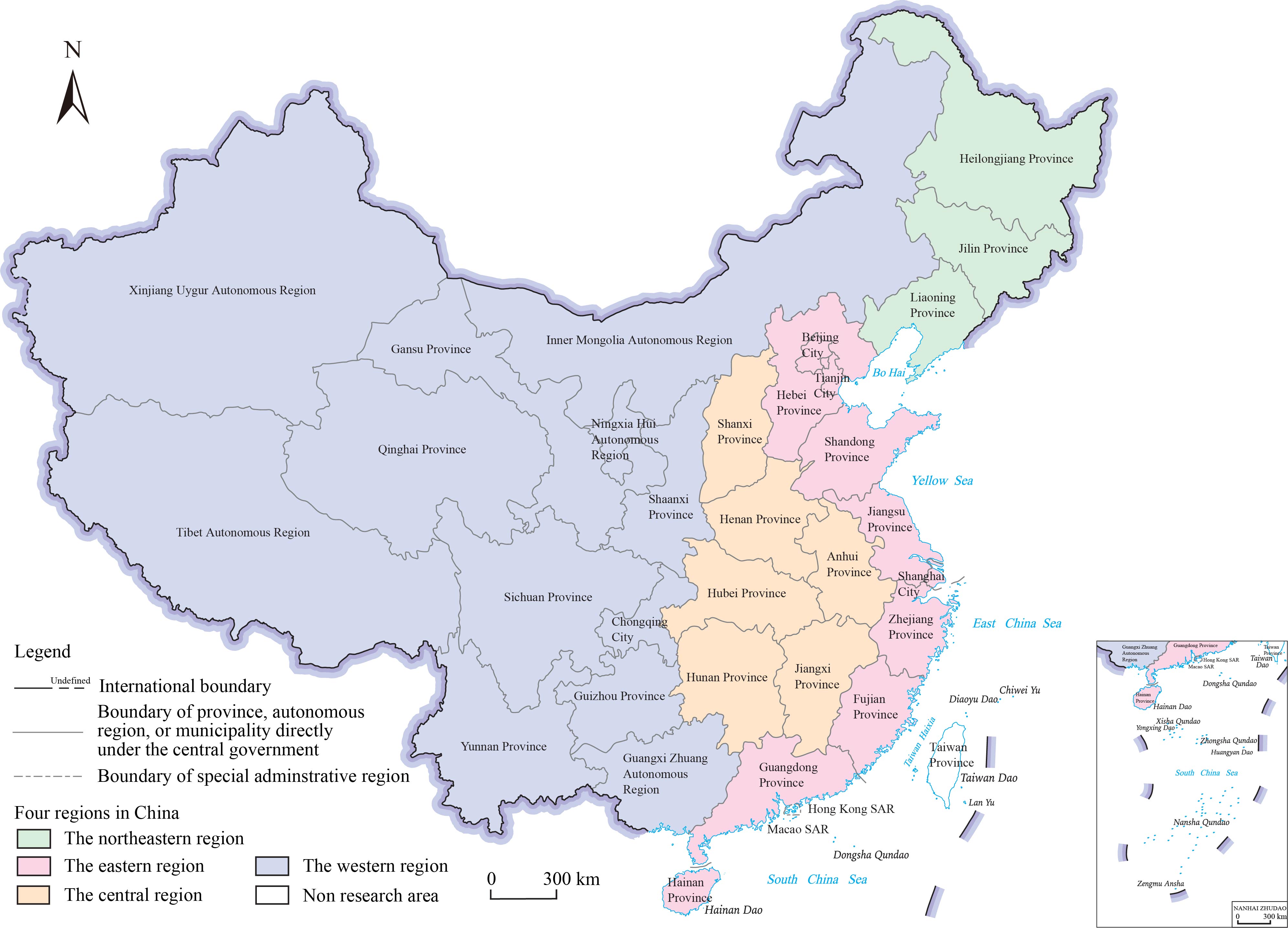
Clarifying the relationship between social security and economic development is helpful to realize the sustainable social security system and the stable function of sustainable economic development. In this paper, the entropy method, coupling coordination degree, standard deviation ellipse model, and spatial autocorrelation were used to study the spatial-temporal characteristics of coupling coordination of social security and economic development in China from 2002 to 2018. The results indicate that the relationship between social security and economic development in China has been gradually strengthened in the process of mutual adaptation and common development. The benign interaction between the two was unstable, though the coupling coordination degree gradually transitioned to the primary coupling coordination type. Besides, from a spatial perspective, first, the coupling coordination degree of social security and economic development in China contracted in the east-west and north-south directions, and the coupling coordination clustered in the central region in this period; second, the coupling coordination degree generally presented a positive spatial autocorrelation, and regions with similar coupling coordination degrees were in a state of agglomeration; finally, the hot spots clumped together to form a continuous area in the eastern coastal area while the cold spots expanded toward the northwest and northeast. Furthermore, the random distribution areas exhibited a trend of contraction.
Qiong LI , Yang ZHAO , Songlin LI , Lanlan ZHANG . Spatial-temporal characteristics of the coupling coordination of social security and economic development in China during 2002-2018[J]. Regional Sustainability, 2021 , 2(2) : 116 -129 . DOI: 10.1016/j.regsus.2021.04.001
| [1] | Almanac of China’s Finance and Banking Editorial Board,2003-2019. Almanac of China’s Finance and Banking. Beijing: Almanac of China’s Finance and Banking Magazine Co. Ltd. (in Chinese). |
| [2] | Chen Y.S., Zhang K., 2008. Spatial distribution analysis of Chinese American in New York State, USA. Northwest Population Journal. 29(5), 32-35, 40. |
| [3] | Cui D.H., 2008. Research on the relation between the expenditure of financial social security and the economic growth in China. Jianghuai Tribune. 6, 27-33 (in Chinese). |
| [4] | Deng X.Y., Tian J., Chen R., 2019. Effect of social security system on consumption through income and uncertainty: evidence from China. Sustainability. 11(7), 1828. |
| [5] | Department of Population and Employment Statistics, National Bureau of Statistics, Department of Planning and Finance, Ministry of Human Resources and Social Security of China,2003-2019. China Labor Statistical Yearbook. Beijing:China Statistic Press (in Chinese). |
| [6] | Department of Social, Science and Technology, and Cultural Statistics National Bureau of Statistics, Department of Strategy and Planning Ministry of Science and Technology,2003-2019. China Statistical Yearbook on Science and Technology. Beijing:China Statistic Press (in Chinese). |
| [7] | Dong K.Y., Ye X.F., 2003. Social security system reform in China. China Econ. Rev. 14(4), 417-425. |
| [8] | Dong Y.J., Qiu C.R., 2007. An empirical study on the relationship between social security expenditure and economic growth in China. Statistics and Decision. 8, 80-82 (in Chinese). |
| [9] | Editorial Board of China Financial Yearbook,2003-2019. Finance Yearbook of China. Beijing:China Stata Finance Magazine (in Chinese). |
| [10] | Feldstein M., 1974. Social security, induced retirement, and aggregate capital accumulation. J. Polit. Econ. 82(5), 905-926. |
| [11] | Hai A.L., 2017. Remittances, social security, and the crowding-out effect: evidence from Vietnam. J. Asian Econ. 49, 42-59. |
| [12] | Hong L., Zeng G.A., 2016. Empirical analysis on saving effect of social security system in China. Social Security Studies. (3), 17-22 (in Chinese). |
| [13] | Huang G., Chen Y.F., Liu M.Q., et al., 2016. An empirical study on the modification of China’s current urban social security system. Aust. J. Polit. Sci. 51(2), 198-212. |
| [14] | Hubbard R.G., Judd K.L., 1987. Social security and individual welfare: precautionary saving, borrowing constraints, and the payroll tax. Am. Econ. Rev. 77, 630-646. |
| [15] | İmrohoroğlu A., Kai Z., 2018. Intergenerational transfers and China’s social security reform. J. Econ. Ageing. 11, 62-70. |
| [16] | Jiang J.L., Xu J.G., Wu W.J., et al., 2014. Patterns and dynamics of China’s human-nature carbon source-sink system. Journal of Natural Resources. 29(5), 757-768 (in Chinese). |
| [17] | Justino P., 2007. Social security in developing countries: myth or necessity? Evidence from India. J. Int. Dev. 19(3), 367-382. |
| [18] | Li L.L., Qin Q., 2020. Population aging, social security expenditure and economic development. Inquiry into Economic Issues. 5, 40-52 (in Chinese). |
| [19] | Liang C.C., Zhang S.J., 2019. Social security expenditure efficiency corruption and economic growth: an empirical study based on China provincial data. Hubei Social Sciences. 1, 78-86 (in Chinese). |
| [20] | Lin M.G., 2020. The basic thought and strategic analysis of social security development during the 14th five-year plan period. Administration Reform. 12, 11-18 (in Chinese). |
| [21] | Lkels C., 2002. Socialist welfare with Chinese characteristics: the reform of the social security system in China. J. Asian Stud. 61(3), 1024-1025. |
| [22] | National Bureau of Statistics of China,2003-2019. China Statistical Yearbook. Beijing:China Statistic Press (in Chinese). |
| [23] | Ord J.K., Getis A., 2001. Testing for local spatial autocorrelation in the presence of global autocorrelation. J. Regional. Sci. 41(3), 411-432. |
| [24] | Tan W., 2011. Research on the relation between the expenditure of financial social security and the economic growth in China. Hubei Social Sciences. 2, 56-59 (in Chinese). |
| [25] | Zeng B., 2018. Regional Economic Analysis and ArcGIS Software Application (1st ed.).Nanchang:Jiangxi People’s Publishing House. |
| [26] | Zhao W.W., Yang Q.Y., 2011. The research of the relationship between the financial social security expenditure and economic growth - based on the public finance perspective. On Economic Problems. 8, 24-27 (in Chinese). |
| [27] | Zhuang R.L., Zhang P.P., Mi K., 2017. Research on the coupling and interactive relationship between social security and economic development. Statistics and Decision. 15, 133-136 (in Chinese). |
/
| 〈 |
|
〉 |
 REGSUS Wechat
 新公网安备 65010402001202号