

Quantifying desertification control efficiency in a hyper-arid region: Spatiotemporal dynamics and policy synergies in Hotan Prefecture of China during 2005-2023
Received date: 2025-07-01
Revised date: 2025-10-12
Accepted date: 2025-11-13
Online published: 2026-01-08
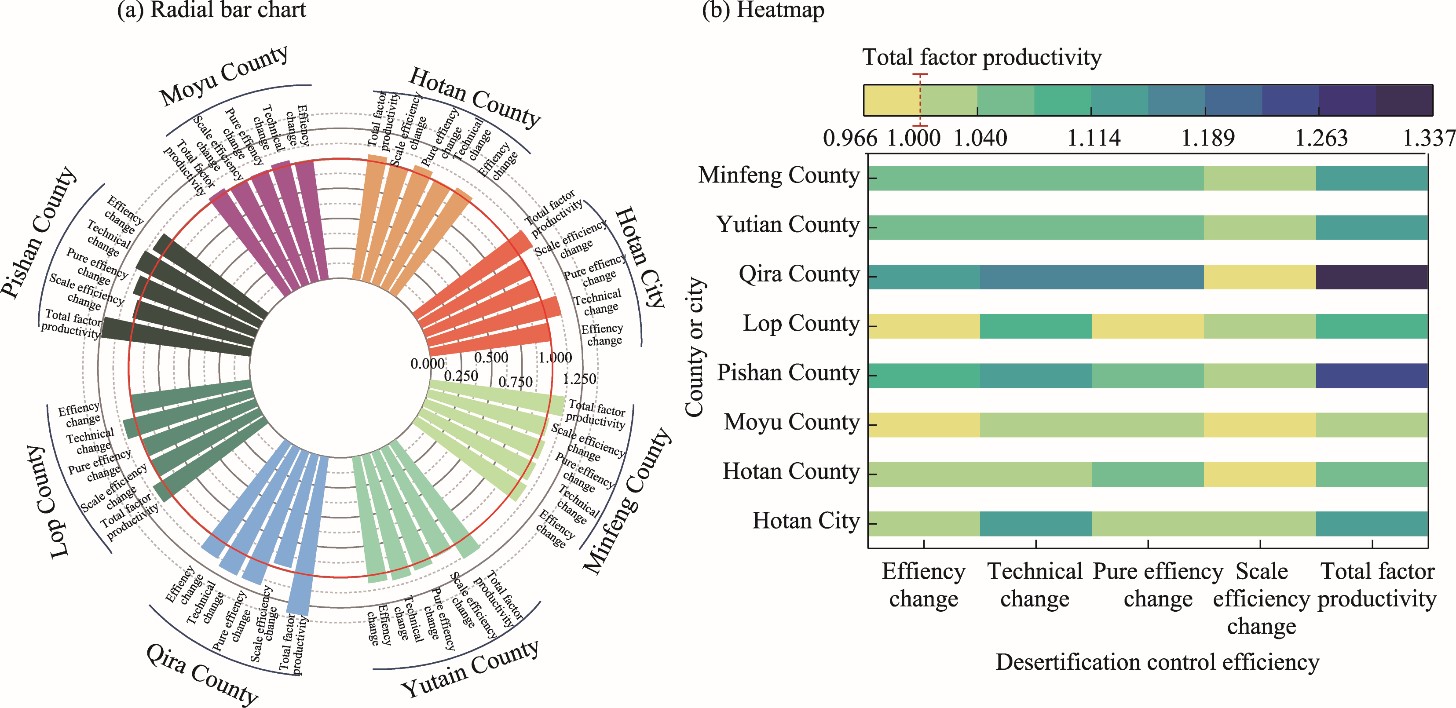
Desertification poses severe threats to socio-ecological resilience in arid regions, yet systematic quantification of desertification control efficiency remains limited. This study addressed this gap by developing an integrated Data Envelopment Analysis (DEA) Malmquist index to assess the spatiotemporal dynamics of desertification control efficiency in Hotan Prefecture (a hyper-arid region) of China from 2005 to 2023. To achieve this goal, we analyzed 5 indices spanning the total factor productivity, technical change, efficiency change, pure efficiency change, and scale efficiency change across 7 counties and 1 city in Hotan Prefecture. Results revealed that the growth rate of the total factor productivity is 12.0%, which is driven primarily by technical change and management optimization. However, significant spatiotemporal heterogeneity emerged. Temporally, rapid early gains during 2005-2010, with the total factor productivity value of 1.372, were dominated by technological progress, where technical change reached 1.291, while scale efficiency change helped sustain progress between 2010 and 2015. A recent decline in the total factor productivity to 0.987 during 2015-2023 underscored the risks associated with technological stagnation. Spatially, Qira County achieved the highest growth rate of the total factor productivity at 33.7% through dual advances in technology and management, which stands in sharp contrast to Moyu County’s stagnation, where the total factor productivity reached only 1.029, reflecting the minimal growth rate of 2.9%. Furthermore, scale expansion change proved beneficial in Pishan County but counterproductive in Qira County. Based on these findings, this study proposes targeted policy recommendations to enhance desertification control efficiency in hyper-arid regions like Hotan Prefecture. It emphasizes the importance of continuous technological innovation, particularly water-saving and adaptive techniques to counteract declining productivity. Differentiated spatial strategies are essential, with tailored interventions for high-risk northern areas and scaling successful models from higher-efficiency southern zones. Optimizing project scale based on ecological carrying capacity rather than uncontrolled expansion is urged, along with strengthening cross-regional water resource coordination. Finally, establishing a data-driven monitoring and decision-support system could enable dynamic efficiency evaluations and evidence-based policy planning. This study provides a critical methodological framework for systematically quantifying desertification control efficiency in hyper-arid regions, establishing an empirical foundation for targeted ecological governance.
SUN Lingxiao , LI Chunlan , YU Yang , HE Jing , YANG Meilin , WANG Qian , LIANG Xueqiong , Ireneusz MALIK , Ma?gorzata WISTUBA . Quantifying desertification control efficiency in a hyper-arid region: Spatiotemporal dynamics and policy synergies in Hotan Prefecture of China during 2005-2023[J]. Regional Sustainability, 2025 , 6(6) : 100275 . DOI: 10.1016/j.regsus.2025.100275
| [1] | Abbas, A., Jin, L.L., He, Q., et al., 2021. Temporal and spatial variations of the air temperature in the Taklamakan Desert and surrounding areas. Theor. Appl. Climatol. 144, 873-884. |
| [2] | Abuzaid, A.S., AbdelRahman, M.A.E., Fadl, M.E., et al., 2021. Land degradation vulnerability mapping in a newly-reclaimed desert oasis in a hyper-arid agro-ecosystem using AHP and geospatial techniques. Agronomy. 11(7), 1426, doi: 10.3390/agronomy11071426. |
| [3] | Araujo, A.S.F., Medeiros, E.V.D., Costa, D.P.D., et al., 2024. From desertification to restoration in the Brazilian semiarid region: Unveiling the potential of land restoration on soil microbial properties. J. Environ. Manage. 351, 119746, doi: 10.1016/j.jenvman.2023.119746. |
| [4] | Bai, J., Li, J.L., Bao, A.M., et al., 2021. Spatial-temporal variations of ecological vulnerability in the Tarim River Basin, Northwest China. J. Arid Land. 13(8), 814-834. |
| [5] | Becerril-Pi?a, R., Mastachi-Loza, C.A., 2021. Desertification:Causes and Countermeasures. Cham: Springer. |
| [6] | Bestelmeyer, B.T., 2005. Does desertification diminish biodiversity? Enhancement of ant diversity by shrub invasion in south-western USA. Divers. Distrib. 11(1), 45-55. |
| [7] | Cai, Y.M., Wu, J.X., Yimiti, T., et al., 2024. The landscape altered the interaction between vegetation and climate in the desert oasis of Hotan River Basin, Xinjiang, China. Ecol. Model. 491, 110687, doi: 10.1016/j.ecolmodel.2024.110687. |
| [8] | Cao, X., Cui, M., Xi, L., et al., 2024. Spatial-temporal process of land use/land cover and desertification in the Circum-Tarim Basin during 1990-2020. Land. 13(6), 735, doi: 10.3390/land13060735. |
| [9] | Chen, Y., Ali, A.I., 2004. DEA Malmquist productivity measure: New insights with an application to computer industry. Eur. J. Oper. Res. 159(1), 239-249. |
| [10] | Cheng, L.F., Song, S., Xie, Y.F., 2022. Evaluation of water resources utilization efficiency in Guangdong Province based on the DEA-Malmquist model. Front. Environ. Sci. 10, 819693, doi: 10.3389/fenvs.2022.819693. |
| [11] | D’Odorico, P., Bhattachan, A., Davis, K.F., et al., 2013. Global desertification: Drivers and feedbacks. Adv. Water Resour. 51, 326-344. |
| [12] | Fan, J.Q., Xu, Y., Zhang, Y.F., 2023. Evaluating land restoration based on the land cover in the Horqin Sandy Land, China. Environ. Sci. Pollut. Res. 30(38), 88417-88430. |
| [13] | Fare, R., Grosskopf, S., Lovell, C.K., et al., 1989. Multilateral productivity comparisons when some outputs are undesirable: a nonparametric approach. Rev. Econ. Stat. 71(1), doi: doi.org/10.2307/1928055. |
| [14] | Feng, D.D., Jiang, Y.F., Long, H.L., et al., 2024. Spatio-temporal patterns and correlation effects of regional rurality and poverty governance change: A case study of the rocky desertification area of Yunnan-Guangxi-Guizhou, China. Habitat Int. 146, 103044, doi: 10.1016/j.habitatint.2024.103044. |
| [15] | Feng, Q., Liu, W., Xi, H.Y., 2013. Comprehensive evaluation and indicator system of land desertification in the Heihe River Basin. Nat. Hazards. 65(3), 1573-1588. |
| [16] | Feuillette, S., Levrel, H., Boeuf, B., et al., 2016. The use of cost-benefit analysis in environmental policies: Some issues raised by the Water Framework Directive implementation in France. Environ. Sci. Policy. 57, 79-85. |
| [17] | Firsova, A., Chernyshova, G., 2020. Efficiency analysis of regional innovation development based on DEA Malmquist index. Information. 11(6), 294, doi: 10.3390/info11060294. |
| [18] | Gerami, J., Mozaffari, M.R., Wanke, P., et al., 2024. Fuzzy cost, revenue efficiency assessment and target setting in fuzzy DEA: a fuzzy directional distance function approach. J. Model. Manag. 19(1), 240-287. |
| [19] | Grilli, E., Carvalho, S.C.P., Chiti, T., et al., 2021. Critical range of soil organic carbon in southern Europe lands under desertification risk. J. Environ. Manage. 287, 112285, doi: 10.1016/j.jenvman.2021.112285. |
| [20] | Guo, H.W., Ling, H.B., Xu, H.L., et al., 2016. Study of suitable oasis scales based on water resource availability in an arid region of China: a case study of Hotan River Basin. Environ. Earth Sci. 75(11), 984, doi: 10.1007/s12665-016-5772-5. |
| [21] | Guo, Q., Fu, B.H., Shi, P.L., et al., 2017. Satellite monitoring the spatial-temporal dynamics of desertification in response to climate change and human activities across the Ordos Plateau, China. Remote Sens. 9(6), 525, doi: 10.3390/rs9060525. |
| [22] | Guo, R., Ye, M., 2025. Input-output efficiency, productivity dynamics, and determinants in western China’s higher education: A three-stage DEA, global Malmquist index, and Tobit model approach. PLoS One. 20(6), e0325901, doi: 10.1371/journal.pone.0325901. |
| [23] | Haj-Amor, Z., Araya, T., Kim, D.G., et al., 2022. Soil salinity and its associated effects on soil microorganisms, greenhouse gas emissions, crop yield, biodiversity and desertification: A review. Sci. Total Environ. 843, doi: 10.1016/j.scitotenv.2022.156946. |
| [24] | Hoekstra, A.Y., 2017. Water footprint assessment: Evolvement of a new research field. Water Resour. Manag. 31, 3061-3081. |
| [25] | Houérou, H.N.L., 1996. Climate change, drought and desertification. J. Arid. Environ. 34(2), 133-185. |
| [26] | HTBS (Hotan Bureau of Statistics), 2006. Hotan Statistical Yearbook. Beijing: China Statistics Press. |
| [27] | HTBS, 2011. Hotan Statistical Yearbook. Beijing: China Statistics Press. |
| [28] | HTBS, 2016. Hotan Statistical Yearbook. Beijing: China Statistics Press. |
| [29] | HTBS, 2024. Hotan Statistical Yearbook. Beijing: China Statistics Press. |
| [30] | Hu, Y.F., Jiang, S.L., Yuan, S., et al., 2017. Changes in soil organic carbon and its active fractions in different desertification stages of alpine-cold grassland in the eastern Qinghai-Tibet Plateau. Environ. Earth Sci. 76(9), 348, doi: 10.1007/s12665-017-6684-8. |
| [31] | Huang, M.T., Zhai, P.M., 2023. Desertification dynamics in China’s drylands under climate change. Adv. Clim. Chang. Res. 14(3), 429-436. |
| [32] | Karagiannis, G., Ravanos, P., 2024. Analyzing changes in EU social inclusion using the global Malmquist productivity index. Int. Trans. Oper. Res. 32(5), 2798-2818. |
| [33] | Kassas, M., 1995. Desertification: a general review. J. Arid. Environ. 30(2), 115-128. |
| [34] | Kelong, T., Wang, X.F., Gao, H.J., 2011. Analysis of ecological effects of comprehensive treatment in the Tarim River Basin using remote sensing data. Mining Science and Technology (China). 21(4), 519-524. |
| [35] | Khashtabeh, R., Akbari, M., Kolahi, M., et al., 2021. Assessing the effects of desertification control projects using socio-economic indicators in the arid regions of eastern Iran. Environ. Dev. Sustain. 23(7), 10455-10469. |
| [36] | Kong, M., Wang, X., Wu, Q., 2021. The development efficiency of China’s innovative industrial clusters-based on the DEA-Malmquist model. Arab. J. Geosci. 14(7), 638, doi: 10.1007/s12517-021-06927-5. |
| [37] | Lal, R., 2002. Soil carbon sequestration in China through agricultural intensification, and restoration of degraded and desertified ecosystems. Land Degrad. Dev. 13(6), 469-478. |
| [38] | Lal, R., Smith, P., Jungkunst, H.F., et al., 2018. The carbon sequestration potential of terrestrial ecosystems. J. Soil Water Conserv. 73(6), 145-152. |
| [39] | Lan, T.L., Lai, Y.M., Gao, J.Q., et al., 2024. The changing permafrost environment under desertification and the heat transfer mechanism in the Qinghai-Tibetan Plateau. J. Environ. Manage. 367, 122055, doi: 10.1016/j.jenvman.2024.122055. |
| [40] | Li, C., Zhang, S.Q., Cui, M.Y., et al., 2022a. Improved vegetation ecological quality of the Three-North Shelterbelt Project Region of China during 2000-2020 as evidenced from multiple remotely sensed indicators. Remote Sens. 14(22), 5708, doi: 10.3390/rs14225708. |
| [41] | Li, J., Sun, W.H., Lichtfouse, E., et al., 2024a. Life cycle assessment of biochar for sustainable agricultural application: A review. Sci. Total Environ. 951, 175448, doi: 10.1016/j.scitotenv.2024.175448. |
| [42] | Li, J., Wu, H.C., Zhu, C., et al., 2024b. Evaluating and analyzing renewable energy performance in OECD countries under uncertainty: A robust DEA approach with common weights. Appl. Energy. 375, 124115, doi: 10.1016/j.apenergy.2024.124115. |
| [43] | Li, M.Q., Liu, S.L., Wang, F.F., et al., 2022b. Cost-benefit analysis of ecological restoration based on land use scenario simulation and ecosystem service on the Qinghai-Tibet Plateau. Glob. Ecol. Conserv. 34, e02006, doi: 10.1016/j.gecco.2022.e02006. |
| [44] | Li, X.M., Zhang, X.L., Du, H.R., et al., 2012. Spatial effect of mineral resources exploitation on urbanization: A case study of Tarim River Basin, Xinjiang, China. Chin. Geogr. Sci. 22(5), 590-601. |
| [45] | Lin, Y.H., Chen, Q.M., Huang, F.M., et al., 2023. Identifying ecological risk and cost-benefit value for supporting habitat restoration: a case study from Sansha Bay, southeast China. Ecol. Process. 12, 20, doi: 10.1186/s13717-023-00432-1. |
| [46] | Liu, L., Xue, J., Mao, D.L., et al., 2024. An adaptive cycle framework for navigating sustainability of oasis socio-ecological system: The case of Hotan region in Xinjiang, China. Ecol. Indic. 167, 112556, doi: 10.1016/j.ecolind.2024.112556. |
| [47] | Liu, Q.F., Zhao, Y.Y., Zhang, X.F., et al., 2018. Spatiotemporal patterns of desertification dynamics and desertification effects on ecosystem services in the Mu Us Desert in China. Sustainability. 10(3), 589, doi: 10.3390/su10030589. |
| [48] | Lozano, S., Borrego-Marín, M.M., 2024. A metafrontier network DEA approach for water usage efficiency assessment in the light of SDG target 6.4. Environ. Sci. Policy. 160, 103857, doi: 10.1016/j.envsci.2024.103857. |
| [49] | Lu, H.T., Zhao, R.F., Zhao, L., et al., 2023. A contrarian growth: The spatiotemporal dynamics of open-surface water bodies on the northern slope of Kunlun Mountains. Ecol. Indic. 157, 111249, doi: 10.1016/j.ecolind.2023.111249. |
| [50] | Malmquist, S., 1953. Index numbers and indifference surfaces. Trabajos De Estadistica. 4, 209-242. |
| [51] | Mao, D.H., Wang, Z.M., Wu, B.F., et al., 2018. Land degradation and restoration in the arid and semiarid zones of China: Quantified evidence and implications from satellites. Land Degrad. Dev. 29(11), 3841-3851. |
| [52] | Matustik, J., Koci, V., 2021. What is a footprint? A conceptual analysis of environmental footprint indicators. J. Clean Prod. 285, 124833, doi: 10.1016/j.jclepro.2020.124833. |
| [53] | Mutti, P.R., Lúcio, P.S., Dubreuil, V., et al., 2019. NDVI time series stochastic models for the forecast of vegetation dynamics over desertification hotspots. Int. J. Remote Sens. 41(7), 2759-2788. |
| [54] | Niu, X.T., Tian, M.R., Feng, C.Y., et al., 2025. Soil quality changes in the Horqin sandy area under different ecological restoration patterns. Sci Rep. 15, 8949, doi: 10.1038/s41598-025-93405-7. |
| [55] | Ren, Y., Zhang, B., Chen, X.D., et al., 2024. Analysis of spatial-temporal patterns and driving mechanisms of land desertification in China. Sci. Total Environ. 909, 168429, doi: 10.1016/j.scitotenv.2023.168429. |
| [56] | Reynolds, J.F., Smith, D.M.S., Lambin, E.F., et al., 2007. Global desertification: Building a science for dryland development. Science. 316(5826), 847-851. |
| [57] | Rigamonti, L., Mancini, E., 2021. Life cycle assessment and circularity indicators. The International Journal of Life Cycle Assessment. 26(10), 1937-1942. |
| [58] | Saiko, T.A., Zonn, I.S., 2000. Irrigation expansion and dynamics of desertification in the Circum-Aral region of Central Asia. Appl. Geogr. 20(4), 349-367. |
| [59] | Santini, M., Caccamo, G., Laurenti, A., et al., 2010. A multi-component GIS framework for desertification risk assessment by an integrated index. Appl. Geogr. 30(3), 394-415. |
| [60] | Sanzheev, E.D., Mikheeva, A.S., Osodoev, P.V., et al., 2020. Theoretical approaches and practical assessment of socio-economic effects of desertification in Mongolia. Int. J. Environ. Res. Public Health. 17(11), 4068, doi: 10.3390/ijerph17114068. |
| [61] | Shakerian, N., Zehtabian, G., Chahooki, M.A.Z., et al., 2017. Determine the most important criteria and indicators that influence land degradation and desertification. Journal of Range and Watershed Management. 70(2), 385-398. |
| [62] | Shu, T.H., Liao, X., Yang, S., et al., 2024. Towards sustainability: Evaluating energy efficiency with a super-efficiency SBM-DEA model across 168 economies. Appl. Energy. 376, 124254, doi: 10.1016/j.apenergy.2024.124254. |
| [63] | Silva, B.F.D., Rodrigues, R.Z.D.S., Heiskanen, J., et al., 2023. Evaluating the temporal patterns of land use and precipitation under desertification in the semi-arid region of Brazil. Ecol. Inform. 77, 102192, doi: 10.1016/j.ecoinf.2023.102192. |
| [64] | Sun, L.X., Yu, Y., He, J., et al., 2025. Vulnerability assessment of social-ecological systems in arid regions: A cross-efficiency modified DEA model with entropy weight aggregation. Ecol. Indic. 179, 114149, doi: 10.1016/j.ecolind.2025.114149. |
| [65] | Suo, X.H., Cao, S.X., 2021. China’s Three North Shelter Forest Program: cost-benefit analysis and policy implications. Environment, Development and Sustainability. 23(10), 14605-14618. |
| [66] | Tang, Z.S., An, H., Deng, L., et al., 2016. Effect of desertification on productivity in a desert steppe. Sci Rep. 6, 27839, doi: 10.1038/srep27839. |
| [67] | Verón, S.R., Paruelo, J.M., Oesterheld, M., 2006. Assessing desertification. J. Arid. Environ. 66(4), 751-763. |
| [68] | Vinogradov, S., Langford, V.P.E., 2001. Managing transboundary water resources in the Aral Sea Basin: in search of a solution. International Journal of Global Environmental Issues. 1(3-4), 345-362. |
| [69] | Wang, D.Y., Li, Z.W., Zeng, G.M., et al., 2018. Evaluation of regionalization of soil and water conservation in China. Sustainability. 10(9), 3320, doi: 10.3390/su10093320. |
| [70] | Wang, L., Wu, X.Q., Guo, J.B., et al., 2022a. Spatial-temporal pattern of vegetation carbon sequestration and its response to rocky desertification control measures in a karst area, in Guangxi Province, China. Land Degrad. Dev. 34(3), 665-681. |
| [71] | Wang,, T., Chen, G.T., Zhao, H.L., et al., 2022b. Aeolian desertification status and its control in China. In: Li, R., Napier, T.L., El-Swaify, S.A., (eds.). Global Degradation of Soil and Water Resources. Singapore: Springer, 199-220. |
| [72] | Wang, X.Y., Li, Y.Q., Wang, X.Y., et al., 2021. Temporal and spatial variations in NDVI and analysis of the driving factors in the desertified areas of northern China from 1998 to 2015. Front. Environ. Sci. 9, 633020, doi: 10.3389/fenvs.2021.633020. |
| [73] | Wang, Y.F., Zhang, J.Q., Guo, E.L., et al., 2015. Fuzzy comprehensive evaluation-based disaster risk assessment of desertification in Horqin Sand Land, China. Int. J. Environ. Res. Public Health. 12(2), 1703-1725. |
| [74] | Wang, Y.Y., Xiao, Y., Xie, G.D., et al., 2022c. Evaluation of Qinghai-Tibet Plateau wind erosion prevention service based on RWEQ model. Sustainability. 14(8), 4635, doi: 10.3390/su14084635. |
| [75] | Wei, W., Guo, Z.C., Shi, P.J., et al., 2021. Spatiotemporal changes of land desertification sensitivity in northwest China from 2000 to 2017. J. Geogr. Sci. 31, 46-68. |
| [76] | Whitford, W.G., 1997. Desertification and animal biodiversity in the desert grasslands of North America. J. Arid. Environ. 37(4), 709-720. |
| [77] | Xu, D.Y., Li, C.L., Song, X., et al., 2014. The dynamics of desertification in the farming-pastoral region of North China over the past 10 years and their relationship to climate change and human activity. Catena. 123, 11-22. |
| [78] | Xu, X.L., 2018. Spatial Distribution Dataset of 1 km Vegetation Index (NDVI) during Growing Season in China. [2025-05-11]. http://www.resdata.com.cn/DataProduct/Detail/84 (in Chinese). |
| [79] | Xu, X.L., Liu, J.Y., Zhang, S.W., et al., 2018. China Multi-period Land Use Remote Sensing Monitoring Dataset (CNLUCC). [2025-05-11]. https://www.resdc.cn/DOI/doi.aspx?DOIid=54&WebShieldSessionVerify=93I3lejiItnkUs9jHTwS (in Chinese). |
| [80] | Yan, D., Kong, Y., Ye, B., et al., 2019. Spatial variation of energy efficiency based on a Super-Slack-Based Measure: Evidence from 104 resource-based cities. J. Clean Prod. 240, 117669, doi: 10.1016/j.jclepro.2019.117669. |
| [81] | Yang, T., Chen, W., Zhou, K.L., et al., 2018. Regional energy efficiency evaluation in China: A super efficiency slack-based measure model with undesirable outputs. J. Clean Prod. 198, 859-866. |
| [82] | Yang, Y.M., Long, A.H., Zhang, J., et al., 2021. An evapotranspiration model for arid land to estimate water loss in Hotan River Basin. In: 2021 IEEE International Geoscience and Remote Sensing Symposium IGARSS. Brussels: IEEE. |
| [83] | Yu, X., Lei, J.Q., Gao, X., 2022. An over review of desertification in Xinjiang, Northwest China. J. Arid Land. 14(11), 1181-1195. |
| [84] | Zhai, J.J., Wang, L., Liu, Y., et al., 2023. Assessing the effects of China’s Three-North Shelter Forest Program over 40 years. Sci. Total Environ. 857, 159354, doi: 10.1016/j.scitotenv.2022.159354. |
| [85] | Zhang, L.Y., Sun, L.X., Yu, Y., et al., 2025. Analyzing water footprint and water resources sustainability in China’s arid Northwest with Bayesian network. Ecol. Indic. 177, 113792, doi: 10.1016/j.ecolind.2025.113792. |
| [86] | Zhang, N., Choi, Y., 2014. A note on the evolution of directional distance function and its development in energy and environmental studies 1997-2013. Renew. Sust. Energ. Rev. 33, 50-59. |
| [87] | Zhao, H.L., He, Y.H., Zhou, R.L., et al., 2009. Effects of desertification on soil organic C and N content in sandy farmland and grassland of Inner Mongolia. Catena. 77(3), 187-191. |
| [88] | Zhao, Q., 2024. Evaluation and obstacle degree analysis of sustainable utilization of water resources in Hotan area. Pol. J. Environ. Stud. 33(2), 1925-1935. |
| [89] | Zheng, W., Guo, X.B., Zhou, P., et al., 2024. Vegetation restoration enhancing soil carbon sequestration in karst rocky desertification ecosystems: A meta-analysis. J. Environ. Manage. 370, 122530, doi: 10.1016/j.jenvman.2024.122530. |
| [90] | Zhiltsov,, S.S., Zonn, I.S., Grishin, O.E., et al., 2018. Transboundary rivers in central Asia:Cooperation and conflicts among countries. In: Zhiltsov, S.S., Zonn, I.S., Kostianoy, A.G., (eds.). Water Resources in Central Asia: International Context. Cham: Springer, 61-80. |
| [91] | Zhou, W., Gang, C.C., Zhou, F.C., et al., 2015. Quantitative assessment of the individual contribution of climate and human factors to desertification in northwest China using net primary productivity as an indicator. Ecol. Indic. 48, 560-569. |
/
| 〈 |
|
〉 |
 REGSUS Wechat
 新公网安备 65010402001202号