

Social-ecological indicators and framework for assessing the sustainability of shrimp farming in coastal Bangladesh
Received date: 2024-11-26
Revised date: 2025-07-31
Accepted date: 2025-10-15
Online published: 2025-11-06
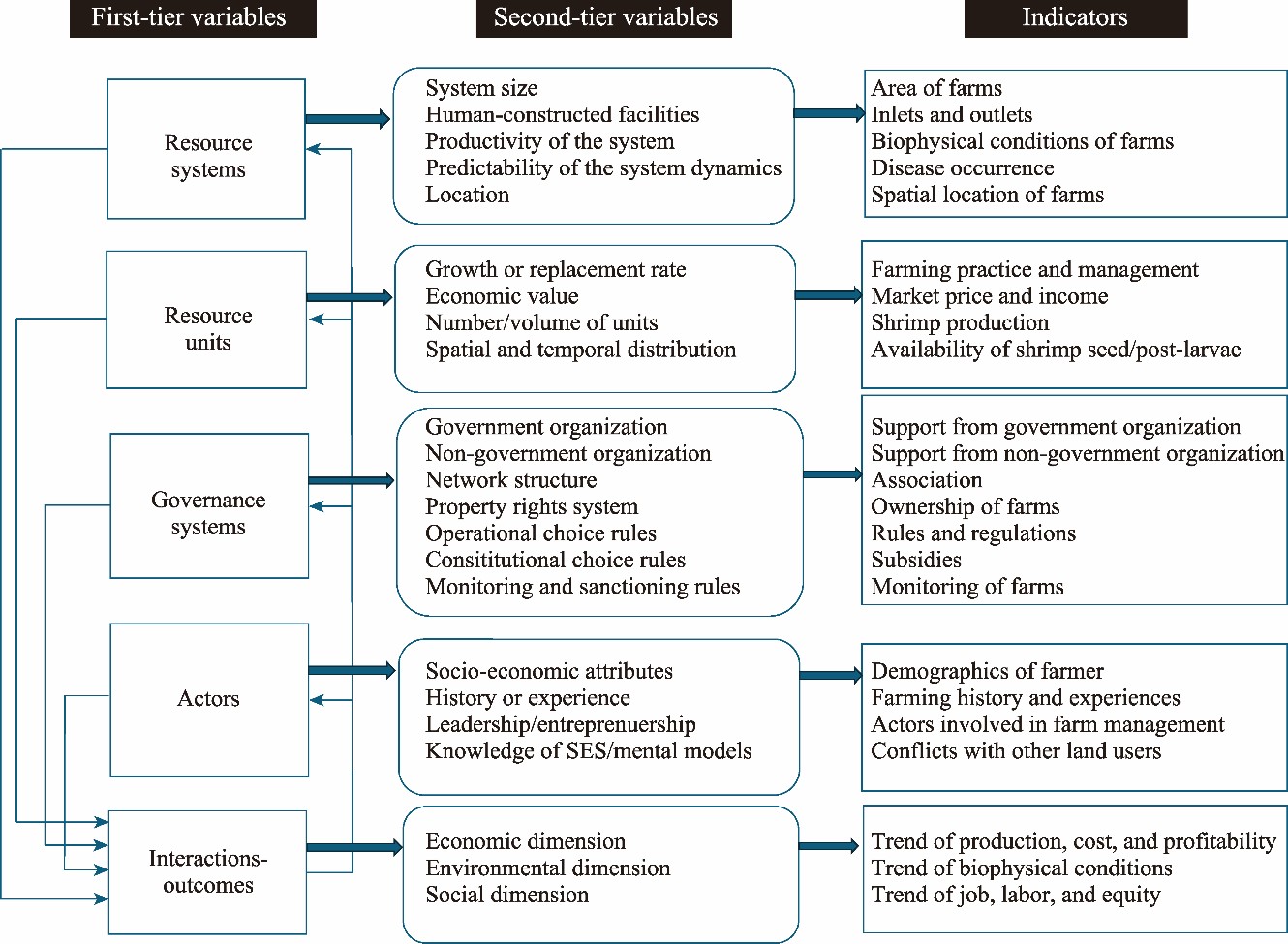
Shrimp farming is a major global aquaculture activity; however, its social and ecological impacts raise sustainability concerns. While previous research has focused on isolated social or environmental aspects of sustainability in shrimp farming, integrated assessments of these factors using a social-ecological systems (SES) approach are rare. A framework for assessing the sustainability of shrimp farming—comprising a set of social and ecological indicators—is developed and conceptualized in this study for the first time, using an integrated, interdisciplinary, and empirical SES approach. We first identified key social and ecological indicators and developed a conceptual framework based on SES approach, then surveyed 90 shrimp farms across 3 coastal regions (including Satkhira, Bagerhat, and Cox’s Bazar districts) in Bangladesh. Nearly all farmers in Satkhira (97%) and all in Bagerhat (100%) expressed dissatisfaction with the decreasing pattern of shrimp production and profitability over the last decade. In contrast, nearly all respondents in Cox’s Bazar (97%) reported satisfaction with increasing shrimp production. Except in Cox’s Bazar, equity in labor payment remained a concern for the social sustainability of the shrimp farming system. The changing pattern of shrimp production and profitability, which does not ensure equity, poses a threat to the sustainability of shrimp farming. Most of the surveyed farmers recognized the mutual benefits of mangrove forests and shrimp farming (97% in Satkhira and 77% in Cox’s Bazar), which suggests potential for the development of policy on integrated mangrove-shrimp farming with community-based management. This research could help assess the sustainability of the shrimp farming system and contribute to achieving Sustainable Development Goals 2 (zero hunger) and 8 (decent work and economic growth). By examining existing practices and developing a novel framework, this study highlights informed decision-making and guides methodological discussion on assessing the sustainability of shrimp farming using the SES approach in coastal regions and different aquaculture systems worldwide.
Kazi Atiah TAIYEBI , Natalie Ann Cooper WELDEN , Md Sarwar HOSSAIN . Social-ecological indicators and framework for assessing the sustainability of shrimp farming in coastal Bangladesh[J]. Regional Sustainability, 2025 , 6(5) : 100260 . DOI: 10.1016/j.regsus.2025.100260
| [1] | Abdullah, S., Barua, D., Hossain, M.S., 2019. Environmental impacts of commercial shrimp farming in coastal zone of Bangladesh and approaches for sustainable management. Int. J. Environ. Sci. Nat. Res. 20(3), 84-92. |
| [2] | Adduci, M., 2009. Neoliberal wave rocks Chilika Lake, India: Conflict over intensive aquaculture from a class perspective. J. Agrar. Chang. 9(4), 484-511. |
| [3] | Ahmed, M.U., Alam, M.I., Debnath, S., et al., 2023. The impact of mangroves in small-holder shrimp ponds in south-west Bangladesh on productivity and economic and environmental resilience. Aquaculture. 571, 739464, doi: 10.1016/j.aquaculture.2023.739464. |
| [4] | Akber, M.A., Islam, M.A., Ahmed, M., et al., 2017. Changes of shrimp farming in southwest coastal Bangladesh. Aquac. Int. 25, 1883-1899. |
| [5] | Al-Mamun, M.A.R., Ara, M.G., Azad, K.N., et al., 2020. Present status of shrimp farming in Satkhira, a southwestern district of Bangladesh. Research in Agriculture Livestock and Fisheries. 7(2), 311-320. |
| [6] | Alongi, D.M., 2002. Present state and future of the world’s mangrove forests. Environ. Conserv. 29(3), 331-349. |
| [7] | Amin, M.N., De Bruyn, L.L., Lawson, A., et al., 2023. Lessons learned from farmers’ experience of soil carbon management practices in grazing regimes of Australia. Agron. Sustain. Dev. 43(1), 5, doi: 10.1007/s13593-022-00863-8. |
| [8] | Azad, A.K., Jensen, K.R., Lin, C.K., 2009. Coastal aquaculture development in Bangladesh: Unsustainable and sustainable experiences. Environ. Manage. 44(4), 800-809. |
| [9] | Bann, C., 1997. Economic analysis of alternative mangrove management strategies in Koh Kong Province, Cambodia. In: Economy and Environment Program for Southeast Asia. EEPSEA Research Report Series 107388. Hanoi, Vietnam. |
| [10] | Begum, N.N., Khan, M.N.I., Rahman, S.S., et al., 2018. Livelihood status of women workers in shrimp sector at south western region in Bangladesh. Research in Agriculture Livestock and Fisheries. 5(3), 391-397. |
| [11] | Biggs, R., Schlüter, M., Schoon, M.L., 2015. An introduction to the resilience approach and principles to sustain ecosystem services in social-ecological systems. In: Biggs, R., Schlüter, M., Schoon, M.L., (eds.). Principles for Building Resilience: Sustaining Ecosystem Services in Social-ecological Systems. Cambridge: Cambridge University Press. |
| [12] | Biggs, R., Clements, H., de Vos, A., et al., 2021. What are social-ecological systems and social-ecological systems research? In: Biggs, R., de Vos, A., Preiser, R., (eds.). The Routledge Handbook of Research Methods for Social-Ecological Systems. London & New York: Routledge, 3-26. |
| [13] | Binder, C.R., Hinkel, J., Bots, P.W.G., et al., 2013. Comparison of frameworks for analyzing social-ecological systems. Ecol. Soc. 18(4), 26, doi: 10.5751/ES-05551-180426. |
| [14] | Binh, C.T., Phillips, M.J., Demaine, H., 1997. Integrated shrimp-mangrove farming systems in the Mekong delta of Vietnam. Aquac. Res. 28(8), 599-610. |
| [15] | Bosma, R.H., Nguyen, T.H., Siahainenia, A.J., et al., 2014. Shrimp-based livelihoods in mangrove silvo-aquaculture farming systems. Rev. Aquac. 8(1), 43-60. |
| [16] | Boyd, C.E., Davis, R.P., McNevin, A.A., 2021. Comparison of resource use for farmed shrimp in Ecuador, India, Indonesia, Thailand, and Vietnam. Aquac. Fish Fish. 1(1), 3-15. |
| [17] | Chowdhury, M.A., Khairun, Y., Salequzzaman, M., et al., 2011. Effect of combined shrimp and rice farming on water and soil quality in Bangladesh. Aquac. Int. 19(6), 1193-1206. |
| [18] | Chowdhury, M.A., Khairun, Y., Shivakoti, G.P., 2015. Indicator-based sustainability assessment of shrimp farming: A case for extensive culture methods in South-western coastal Bangladesh. International Journal of Sustainable Development. 18(4), 261-281. |
| [19] | Dang, H.D., 2020. Sustainability of the rice-shrimp farming system in Mekong Delta, Vietnam: A climate adaptive model. J. Econ. Dev. 22, 21-45. |
| [20] | Das, M.R., Ray, S., Kumar, U., et al., 2015. Livelihood assessment of the fishermen community in the southwest region of Bangladesh. Journal of Experimental Biology and Agricultural Sciences. 3, 353-361. |
| [21] | Davis, R.P., Boyd, C.E., Godumala, R., et al., 2022. Assessing the variability and discriminatory power of elemental fingerprints in whiteleg shrimp Litopenaeus vannamei from major shrimp production countries. Food Control. 133, 108589, doi: 10.1016/j.foodcont.2021.108589. |
| [22] | Dearing, J.A., Hossain, M.S., 2018. Recent trends in ecosystem services in coastal Bangladesh. In: Nicholls, R.J., Hutton, C.W., Adger, W.N., (eds.). Ecosystem Services for Well-Being in Deltas: Integrated Assessment for Policy Analysis. Cham: Springer International Publishing, 93-114. |
| [23] | Delgado-Serrano, M.D.M., Ramos, P., 2015. Making Ostrom’s framework applicable to characterise social ecological systems at the local level. Int. J. Commons. 9(2), 808-830. |
| [24] | Dhar, A.R., Uddin, M.T., Roy, M.K., 2020. Assessment of organic shrimp farming sustainability from economic and environmental viewpoints in Bangladesh. Environ. Res. 180, 108879, doi: 10.1016/j.envres.2019.108879. |
| [25] | Didar-UI Islam, S.M., Bhuiyan, M.A.H., 2016. Impact scenarios of shrimp farming in coastal region of Bangladesh: An approach of an ecological model for sustainable management. Aquac. Int. 24(4), 1163-1190. |
| [26] | DoF (Department of Fisheries), 2020. National Fish Week, 2020 Compendium. Department of Fisheries, Ministry of Fisheries and Livestock, Bangladesh (in Bengali). |
| [27] | EJF (Environmental Justice Foundation), 2003. Smash & Grab: Conflict, Corruption and Human Rights Abuses in the Shrimp Farming Industry. London: Environmental Justice Foundation. |
| [28] | FAO (Food and Agriculture Organization), 2018. The State of World Fisheries and Aquaculture 2018 - Meeting the Sustainable Development Goals. Rome: FAO. |
| [29] | FAO, 2020. Towards Sustainability in the Shrimp Industry. [2024-10-12]. https://www.fao.org/in-action/globefish/news-events/news/news-detail/Towards-sustainability-in-the-shrimp-industry/en. |
| [30] | FAO, 2022. The State of World Fisheries and Aquaculture 2022. Rome: FAO. |
| [31] | Fortuna, S.D., 2024. 7 Interesting Facts and Current Trends in Shrimp Export. [2024-10-28]. https://delosaqua.com/current-trends-in-shrimp-export/. |
| [32] | Gain, A.K., Ashik-Ur-Rahman, Md., Vafeidis, A., 2019. Exploring human-nature interaction on the coastal floodplain in the Ganges-Brahmaputra delta through the lens of Ostrom’s social-ecological systems framework. Environ. Res. Commun. 1, 051003, doi: 10.1088/2515-7620/ab2407. |
| [33] | Geetha, R., Ravisankar, T., Sairam, C.V., et al., 2019. Aquastat India 2019. ICAR-Central Institute of Brackishwater Aquaculture (CIBA), Chennai, 219. |
| [34] | Green, J.L., Manski, S.E., Hansen, T.A., et al., 2023. Descriptive statistics. International Encyclopedia of Education. 14, 723-733. |
| [35] | Haque, M.M., Islam, M.S., Hossain, M.I., et al., 2022. Conditions for participation of marginalized households in shrimp value chains of the coastal region of Bangladesh. Aquaculture. 555, 738258, doi: 10.1016/j.aquaculture.2022.738258. |
| [36] | Hinkel, J., Bots, P.W.G., Schlüter, M., 2014. Enhancing the Ostrom social-ecological system framework through formalization. Ecol. Soc. 19(3), doi: 10.5751/es-06475-190351. |
| [37] | Hossain, M.S., Dearing, J.A., Rahman, M.M., et al., 2016. Recent changes in ecosystem services and human well-being in the Bangladesh coastal zone. Reg. Envir. Chang. 16(2), 429-443. |
| [38] | Hossain, M.S., Szabo, S., 2017. Understanding the social-ecological system of wetlands. In: Prusty, B.A.K., Chandra, R., Azeez, P.A., (eds.). Wetland Science: Perspectives from South Asia. New Delhi: Springer, 285-300. |
| [39] | Hossain, M.S., Ramirez, J.A., Haisch, T., et al., 2020. A coupled human and landscape conceptual model of risk and resilience in Swiss Alpine communities. Sci. Total Environ. 730, 138322, doi: 10.1016/j.scitotenv.2020.138322. |
| [40] | Hossain, M.S., Basak, S.M., Amin, N., et al., 2023. Social‐ecological systems approach for adaptation to climate change. Sustain. Dev. 32(3), 2766-2778. |
| [41] | Jamal, M.R., Kristiansen, P., Kabir, M.J., et al., 2023. Risks and adaptation dynamics in shrimp and prawn-based farming systems in southwest coastal Bangladesh. Aquaculture. 562, 738819, doi: 10.1016/j.aquaculture.2022.738819. |
| [42] | Joffre, O.M., Bosma, R.H., Bregt, A.K., et al., 2015. What drives the adoption of integrated shrimp mangrove aquaculture in Vietnam? Ocean Coast. Manag. 114, 53-63. |
| [43] | Johnson, T.R., Beard, K., Brady, D.C., et al., 2019. A social-ecological system framework for marine aquaculture research. Sustainability. 11(9), 2522, doi: 10.3390/su11092522. |
| [44] | Kabir, A., Amin, M.N., Roy, K., et al., 2021. Determinants of climate change adaptation strategies in the coastal zone of Bangladesh: Implications for adaptation to climate change in developing countries. Mitig. Adapt. Strateg. Glob. Chang. 26(7), 30, doi: 10.1007/s11027-021-09968-z. |
| [45] | Kabir, M.H., Eva, I.J., 2014. Environmental impacts of shrimp aquaculture: The case of Chandipur village at Debhata upazila of Satkhira district, Bangladesh. Journal of the Asiatic Society of Bangladesh, Science. 40(1), 107-119. |
| [46] | Karim, M.F., Zhang, X., Li, R., 2019. Dynamics of shrimp farming in the southwestern coastal districts of Bangladesh using a shrimp yield dataset (SYD) and Landsat satellite archives. Sustainability. 11(17), 4635, doi: 10.3390/su11174635. |
| [47] | Kumar, G., Engle, C., Tucker, C., 2018. Factors driving aquaculture technology adoption. J. World Aquacult. Soc. 49(3), 447-476. |
| [48] | Kumaran, M., Geetha, R., Antony, J., et al., 2021. Prospective impact of Corona virus disease (COVID-19) related lockdown on shrimp aquaculture sector in India - a sectoral assessment. Aquaculture. 531, 735922, doi: 10.1016/j.aquaculture.2020.735922. |
| [49] | Lai, Q.T., Tuan, V.A., Thuy, N.T.B., et al., 2022. A closer look into shrimp yields and mangrove coverage ratio in integrated mangrove-shrimp farming systems in Ca Mau, Vietnam. Aquac. Int. 30, 863-882. |
| [50] | Leslie, H.M., Basurto, X., Nenadovic, M., et al., 2015. Operationalizing the social-ecological systems framework to assess sustainability. Proc. Natl. Acad. Sci. U.S.A. 112, 5979-5984. |
| [51] | Majid, M.A., Gupta, M.V., 1997. Research and information needs for fisheries and development and management. In: Khan, B.A., Ahmed, L., Ali, L., National Workshop on Fisheries Resources Development and Management in Bangladesh. Bangladesh: Dhaka, 157-178. |
| [52] | Matin, M.A., Chakraborty, S., AI Amin, M., et al., 2016. An assessment of shrimp aquaculture in selected coastal areas of Bangladesh. The Journal of NOAMI. 33, 103-116. |
| [53] | McGinnis, M.D., Ostrom, E., 2014. Social-ecological system framework: Initial changes and continuing challenges. Ecol. Soc. 19(2), doi: 10.5751/es-06387-190230. |
| [54] | Mialhe, F., Gunnell, Y., Mering, C., 2013. The impacts of shrimp farming on land use, employment and migration in Tumbes, northern Peru. Ocean Coastal Manage. 73, 1-12. |
| [55] | Ministry of Fisheries and Livestock, 1998. National Fisheries Policy. [2024-10-19]. https://faolex.fao.org/docs/pdf/bgd149571.pdf. |
| [56] | Ministry of Fisheries and Livestock, 2014. National Shrimp Policy. [2024-10-19]. http://mofl.portal.gov.bd/sites/%20default/files/files/mofl.portal.gov.bd/policies/15491d7e_4761_4375_a14e_2233f415169a/Chingri%20neetimala%022014%20final.pdf. |
| [57] | Morshed, M.M., Islam, M.S., Lohano, H.D., et al., 2020. Production externalities of shrimp aquaculture on paddy farming in coastal Bangladesh. Agric. Water Manage. 238, 106213, doi: 10.1016/j.agwat.2020.106213. |
| [58] | MPEDA (Marine Products Export Development Authority), 2019. The Marine Products Export Development Authority. [2024-10-23]. https://mpeda.gov.in/. |
| [59] | Naylor, R.L., Hardy, R.W., Buschmann, A.H., et al., 2021. A 20-year retrospective review of global aquaculture. Nature. 591, 551-563. |
| [60] | Nguyen, H.Q., Tran, D.D., Luan, P.D.M.H., et al., 2020. Socio-ecological resilience of mangrove-shrimp models under various threats exacerbated from salinity intrusion in coastal area of the Vietnamese Mekong Delta. Int. J. Sustain. Dev. World Ecol. 27(7), 638-651. |
| [61] | Nyangoko, B.P., Berg, H., Mangora, M.M., et al., 2022. Local perceptions of changes in mangrove ecosystem services and their implications for livelihoods and management in the Rufiji Delta, Tanzania. Ocean Coastal Manage. 219, 106065, doi: 10.1016/j.ocecoaman.2022.106065. |
| [62] | Ostrom, E., 2009. A general framework for analyzing sustainability of social-ecological systems. Science. 325(5939), 419-422. |
| [63] | Palomo, L.E., Hernández-Flores, A., 2019. Application of the Ostrom framework in the analysis of a social-ecological system with multiple resources in a marine protected area. PeerJ. 7, e7374, doi: 10.7717/peerj.7374. |
| [64] | Partelow, S., Senff, P., Buhari, N., et al., 2018. Operationalizing the social-ecological systems framework in pond aquaculture. Int. J. Commons. 12(1), 485-518. |
| [65] | Pinter, L., Hardi, P., Bartelmus, P., 2005. Sustainable development indicators:proposals for a way forward. In: United Nations Division for Sustainable Development. UNDSD Discussion Paper. New York, USA. |
| [66] | Pulver, S., Ulibarri, N., Sobocinski, K.L., et al., 2018. Frontiers in socio-environmental research: Components, connections, scale, and context. Ecol. Soc. 23(3), doi: 10.5751/ES-10280-230323. |
| [67] | Rahman, R., Ando, K., Takeda, S., 2014. Development of shrimp-based cropping systems in the coastal area of Bangladesh: A village-level study in Satkhira district. J. Land Use Sci. 9(2), 195-210. |
| [68] | Ray, S., Mondal, P., Paul, A.K., et al., 2021. Role of shrimp farming in socio-economic elevation and professional satisfaction in coastal communities. Aquacult. Rep. 20, 100708, doi: 10.1016/j.aqrep.2021.100708. |
| [69] | Rimi, R.H., Farzana, S., Sheikh, M.S., et al., 2013. Climate change impacts on shrimp production at the south-west coastal region of Bangladesh. World Environment. 3(3), 116-125. |
| [70] | Rocha, J., Malmborg, K., Gordon, L., et al., 2020. Mapping social-ecological systems archetypes. Environ. Res. Lett. 15(3), 034017, doi: 10.1088/1748-9326/ab666e. |
| [71] | Saengnore, A., Lebel, L., 2003. Experience Knowledge and the Technology Choices of Shrimp Farmers in Thailand and Vietnam. [2024-10-23]. https://citeseerx.ist.psu.edu/document?repid=rep1&type=pdf&doi=698211720c56b96215c678cb68e0dd888ff487a0. |
| [72] | Sass, C., 2022. 7 Health Benefits of Shrimp. [2024-10-13]. https://www.health.com/nutrition/calories-in-shrimp. |
| [73] | Schlüter, M., Hinkel, J., Bots, P.W.G., et al., 2014. Application of the SES framework for model-based analysis of the dynamics of social-ecological systems. Ecol. Soc. 19(1), doi: 10.5751/es-05782-190136. |
| [74] | Shameem, M.I.M., Momtaz, S., Rauscher, R., 2014. Vulnerability of rural livelihoods to multiple stressors: A case study from the southwest coastal region of Bangladesh. Ocean Coastal Manage. 102, 79-87. |
| [75] | Shinji, J., Nohara, S., Yagi, N., et al., 2019. Bio-economic analysis of super-intensive closed shrimp farming and improvement of management plans: A case study in Japan. Fish. Sci. 85, 1055-1065. |
| [76] | Stalin, S.J., Jothi, D.G., 2023. The Value-Added Shrimp-The Way Forward for the Indian Shrimp Industry to Sustain the Competition in the Global Market-Perspective Review. [2024-10-29]. https://businessmanagementeconomic.org/article/view-2023/02-850.html. |
| [77] | Suadi, S., Saksono, H., Triyatmo, B., 2019. Perception-based indicator for sustainability of shrimp culture in the less favourable areas at Southern Coast of Yogyakarta. Jurnal Perikanan Universitas Gadjah Mada. 21(2), 53, doi: 10.22146/jfs.50960. |
| [78] | Taher, T.B., Althaus, C.E., Tranter, P.J., et al., 2023. Impacts of shrimp aquaculture on the local communities and conservation of the world’s largest protected mangrove forest. Environ. Sci. Policy. 147, 351-360. |
| [79] | Taiyebi, K.A., Welden, N.A.C., Hossain, M.S., 2024. Exploring the application of the social-ecological system approach in Asian shrimp farming research and its implications for global sustainable shrimp farming: A systematic review. Aquaculture. 597, 741918, doi: 10.1016/j.aquaculture.2024.741918. |
| [80] | Tran, L.X., Fischer, A., 2017. Spatiotemporal changes and fragmentation of mangroves and its effects on fish diversity in Ca Mau Province (Vietnam). J. Coast. Conserv. 21(3), 355-368. |
| [81] | Valderrama, D., Hishamunda, N., Zhou, X.W., 2010. Estimating Employment in World Aquaculture. Rome: FAO. |
| [82] | Viera-Romero, A.M., Diemont, S.A.W., Selfa, T.L., et al., 2024. The sustainability of shrimp aquaculture: An energy-based case study in the Gulf of Guayaquil thirty years later. Renew. Sust. Energ. Rev. 194, 114326, doi: 10.1016/j.rser.2024.114326. |
| [83] | Vietnam Association of Seafood Exporters and Producers, 2018. Shrimp Sector Profiles. [2024-10-23]. http://mseafood.vasep.com.vn/669/onecontent/sector-profle.htm. |
| [84] | Westers, T., Ribble, C., Daniel, S., et al., 2017. Assessing and comparing relative farm-level sustainability of smallholder shrimp farms in two Sri Lankan provinces using indices developed from two methodological frameworks. Ecol. Indic. 83, 346-355. |
/
| 〈 |
|
〉 |
 REGSUS Wechat
 新公网安备 65010402001202号