

Spatial pattern and drivers of urbanization in China’s mid-level developing urban agglomeration: A case study of Chang-Zhu-Tan
Received date: 2020-06-26
Revised date: 2020-11-29
Accepted date: 2020-12-14
Online published: 2021-03-11
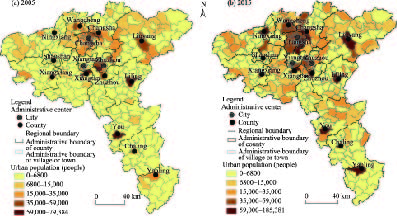
Urban agglomeration has become the main form of regional spatial organization in China. While most of the existing studies of urban agglomeration in China have focused on the eastern coastal areas, urban agglomeration with mid-level development in the rest of the country has been overlooked. To better understand the urbanization process of the mid-level developing urban agglomeration, this study investigated the clustering pattern and the drivers of both urban population and firm dynamics during 2005-2015 in the Changsha-Zhuzhou-Xiangtan (Chang-Zhu-Tan) urban agglomeration of China using the methods of kernel density estimation and geographic detection. Our results show that centralization was obvious, although decentralization also occurred in Chang-Zhu-Tan, and that the spatial agglomeration was promoted by several factors, such as administrative resources, location advantage, labor cost, and consumption capacity. Some problems hindering the development of this region were also discovered: administrative resources played a critical role in urbanization because small towns and villages did not receive enough attention, and the effect of local policy was not as beneficial as expected. These findings partly explain the relatively slow development of mid-level developing urban agglomerations and have important implications for promoting healthier urbanization.
Key words: Urbanization; Spatial pattern; Urban agglomeration; Firm clustering; Driving mechanism; China
Yanhua He , Yi Lin , Guohua Zhou , Yixuan Zhu , Kai Tang . Spatial pattern and drivers of urbanization in China’s mid-level developing urban agglomeration: A case study of Chang-Zhu-Tan[J]. Regional Sustainability, 2021 , 2(1) : 83 -97 . DOI: 10.1016/j.regsus.2020.12.001
| [1] | Antrop, M., 2004. Landscape change and the urbanization process in Europe. Landsc Urban Plan. 67, 9-26. |
| [2] | Chan, K.W., 2010. Fundamentals of China’s urbanization and policy. China Rev. 10(1), 63-93. |
| [3] | Chen, A.P., Partridge, M.D., 2013. When are cities engines of growth in China? Spread and backwash effects across the urban hierarchy. Reg. Stud. 47(8), 1313-1331. |
| [4] | Chen, E., Xie, S.Y., 2018. Analysis to the regional characteristics and influencing factors of central region’s new urbanization development. Northwest Population Journal. 39(3), 18-26 (in Chinese). |
| [5] | Chen, F.G., Zhang, H.O., Wu, Q.T., et al., 2010. A study on coordinate development between population urbanization and land urbanization in China. Human Geography. 25(5), 53-58 (in Chinese). |
| [6] | Chen, Q.Y., Song, Y.X., 2011. Analysis on the spacial relation of Circum-Chang-Zhu-Tan urban agglomeration based on urban flow. Economic Geography. 31(11), 1840-1844 (in Chinese). |
| [7] | Chen, W., Yan, D.S., Sun, W., 2015. Analyzing the patterns and processes of new urbanization development in the Yangtze River Delta. Geographical Research. 34(3), 397-406 (in Chinese). |
| [8] | Chen, W., Chang, L.L., Peng, C., 2016. Network development patterns and optimization strategies research of Chang-Zhu-Tan urban agglomeration. Economic Geography. 36(2), 74-79 (in Chinese). |
| [9] | Dai, L.Z., Zheng, Y.T., Xue, F.X., et al., 2014. The characteristics and dynamics of the extended metropolitan regions in Inland China: Case study of the Chang-Zhu-Tan. Urban Development Studies. 21(10), 4-11 (in Chinese). |
| [10] | Fang, C.L., Song, J.T., Zhang, Q., et al., 2005. The formation, development and spatial heterogeneity patterns for the structures system of urban agglomerations in China. J. Geogr. Sci. 60(5), 827-840. |
| [11] | Fang, C.L., Zhang, Y.J., 2014. Dynamic mechanism, spatial organization patterns and structure of integrated urbanization areas in China. Urban Planning Forum. (6), 5-12 (in Chinese). |
| [12] | Fang, C.L., Zhou, C.H., Wang, Z.B., 2015. Sustainable development strategy and priorities of spatially differentiated development of urban agglomerations along the Yangtze River Economic Belt. Progress in Geography. 34(11), 1398-1408 (in Chinese). |
| [13] | Fang, C.L., Yu, D.L., 2017. Urban agglomeration: An evolving concept of an emerging phenomenon. Landsc Urban Plan. 162, 126-136. |
| [14] | Fang, C.L., 2018. Important progress and prospects of China’s urbanization and urban agglomeration in the past 40 years of reform and opening-up. Economic Geography. 38(9), 1-9 (in Chinese). |
| [15] | Feng, Y.C., Wang, X.H., 2018. The influences of cooperative agglomeration of China’s manufacturing industry and productive service industry on new urbanization. Inquiry into Economic Issues. (11), 66-76 (in Chinese). |
| [16] | Gao, P., He, D., Ning, Y.M., et al., 2019. Community structure and proximity mechanism of city clusters in middle reach of the Yangtze River: Based on producer service firms’ network. Scientia Geographica Sinica. 39(4), 578-586 (in Chinese). |
| [17] | Gatrell, A.C., Bailey, T.C., Diggle, P.J., et al., 1996. Rowlings on spatial point pattern analysis and its application in geographical epidemiology. Trans. Inst. Br. Geogr. 21(1), 256-274 (in Chinese). |
| [18] | Gu, C.L., 2012. On the fundamental features of modern urbanization in China. Urban Insight. (3), 12-19 (in Chinese). |
| [19] | Gu, C.L., 2019. Urbanization: positive and negative effects. Sci. Bull. 64(5), 281-283 |
| [20] | He, Y.H., Zhou, G.H., Tang, C.L., et al., 2019. The spatial organization pattern of urban-rural integration in urban agglomerations in China: An agglomeration-diffusion analysis of the population and firms. Habitat Int. 87, 54-65. |
| [21] | Hu, X.W., 1998. On the spatial agglomeration and dispersion in coastal regions. City Planning Review. 22(6), 22-28 (in Chinese). |
| [22] | Huang, Z.X., 2014. Concept and characteristics of urban agglomerations. Regional Economic Review. (4), 141-146 (in Chinese). |
| [23] | Hunan Provincial Bureau of Statistics, 2006. Hunan Statistical Yearbook (in Chinese). |
| [24] | Hunan Provincial Bureau of Statistics, 2019. Hunan Statistical Yearbook (in Chinese). |
| [25] | Jiang, H., Wang, B., Li, C.R., et al., 2016. Spatial characteristics of construction land expansion in China: A comparison analysis regarding fixed capital and non-agricultural labor. China Land Sciences. 27(5), 63-70 (in Chinese). |
| [26] | Lai, Y.H., 2008. Discussion of Chang-Zhu-Tan demonstration pilot building a “two-type” society. Journal of Hunan Administration Institute. (2), 78-80 (in Chinese). |
| [27] | Li, C., Li, J.X., Wu, J.G., 2018. What drives urban growth in China? A multi-scale comparative analysis. Appl Geogr. 98, 43-51. |
| [28] | Li, H., Wei, Y.D., Liao, H.F., et al., 2015. Administrative hierarchy and urban land expansion in transitional China. Appl Geogr. 56, 177-186. |
| [29] | Li, K., Liu, T., Cao, G.Z., 2018. The spatial pattern and core driving force’s evolution of urbanization on provincial scale in China. Urban Development Studies. 25(6), 8-16 (in Chinese). |
| [30] | Li, L.N., Liu, Y.S., 2019. Spatial-temporal patterns and driving forces of sustainable urbanization in China since 2000. J. Urban Plann. Dev. 145(4), 05019014. |
| [31] | Li, P., Liu, R.Y., Li, J., 2016. Administrative hierarchy and resource allocation efficiency of Chinese city. Economic Geography. 36(10), 46-51, 59 (in Chinese). |
| [32] | Li, Y., Sun, Y., Yao, S.M., 2020. Urban network linkages of Chinese urban agglomerations based on an analysis of the fortune China top 500 enterprises. Geographical Research. 39(7), 1548-1564 (in Chinese). |
| [33] | Liu, M.S., 2008. Some thoughts on Chang-Zhu-Tan demonstration pilot of building a “two-type” society. Huxiang Forum. (2), 35-37 (in Chinese). |
| [34] | Liu, Y.S., Yan, B., Zhou, Y., 2016. Urbanization, economic growth, and carbon dioxide emissions in China: A panel cointegration and causality analysis. J. Geogr. Sci. 26(2), 131-152. |
| [35] | Long, H.L., Tang, G.P., Li, X.B., et al., 2007. Socio-economic driving forces of land-use change in Kunshan, the Yangtze River Delta economic area of China. J. Environ. Manage. 83(3), 351-364. |
| [36] | Long, H.L., Ge, D.Z., Zhang, Y.N., et al., 2018. Changing man-land interrelations in China’s farming area under urbanization and its implications for food security. J. Environ. Manage. 209, 440-451. |
| [37] | Lu, D.D., 2013. Geography research on the urbanization area content frame. Scientia Agricultura Sinica. 33(8), 897-901 (in Chinese). |
| [38] | Lu, D.D., 2015. Function orientation and coordinating development of subregions within the Jing-Jin-Ji Urban Agglomeration. Progress in Geography. 34(3), 265-270 (in Chinese). |
| [39] | Ma, L. J. C., 2002. Urban transformation in China, 1949-2000: A review and research agenda. Environ. Plan A. 34(9), 1545-1569. |
| [40] | Ma, Q., He, C.Y., Wu, J.G., 2016. Behind the rapid expansion of urban impervious surfaces in China: Major influencing factors revealed by a hierarchical multiscale analysis. Land Use Pol. 59(59), 434-445. |
| [41] | Ma, Y.L., Xu, R.S., 2010. Remote sensing monitoring and driving force analysis of urban expansion in Guangzhou city, China. Habitat Int. 34(2), 228-235. |
| [42] | Mao, Q.Z., Long, Y., Wu, K., 2015. Spatio-temporal changes of population density and exploration on urbanization pattern in China: 2000-2010. City Planning Review. 39(2), 38-43 (in Chinese). |
| [43] | Ning, Y.M., 2006. Redesign of the spatial structure for the metropolis of Shanghai. City Planning Review. 30, 44-45, 55 (in Chinese). |
| [44] | Ning, Y.M., 2011. Definition of Chinese metropolitan areas and large urban agglomerations: Role of large urban agglomerations in regional development. Geographical Science. 31(3), 257-263 (in Chinese). |
| [45] | Pannell, C., 2002. China’s continuing urban transition. Environ. Plan A. 34(9), 1571-1589. |
| [46] | Peng, C., Wang, J., 2015. The spatial evolution and its rationale of urban clusters in the central region. Planners. 31(5), 79-85 (in Chinese). |
| [47] | Peng, C., Lin, Y.Z., 2015. Spatial-temporal mechanism of internal correlation in Changsha-Zhuzhou-Xiangtan network cities. Economic Geography. 35(9), 72-78 (in Chinese). |
| [48] | Qin, C.L., Liu, P.T., 2016. Administrative hierarchy, public services and skew distribution of urban population. Research on Economics and Management. 37(11), 102-110 (in Chinese). |
| [49] | Sun, B.D., Hua, J.Y., Li, W.T., et al., 2017. Spatial structure change and influencing factors of city clusters in China: From monocentric to polycentric based on population distribution. Progress in Geography. 36(10), 1294-1303 (in Chinese). |
| [50] | Tan, Z., 2016. Urban planning. Beijing: China architecture & building press (in Chinese). |
| [51] | Tang, C.L., Wu, Y., Zhou, G., 2018. Interactive development of urban agglomeration, industrial cluster and development zone: A case study of Chang-Zhu-Tan urban agglomeration. Geographical Research. 37(2), 292-306 (in Chinese). |
| [52] | Tang, F.H., Su, W., 2010. Evolution tends and restructuring of spatial structure about urban agglomeration: By the case of Chang-Zhu-Tan agglomeration. Journal of Hunan Agricultural University (Natural Sciences). 36(4), 483-488 (in Chinese). |
| [53] | Tian, G.J., Liu, J.Y., Xie, Y.C., et al., 2005. Analysis of spatio-temporal dynamic pattern and driving forces of urban land in China in 1990s using TM images and GIS. Cities. 22(6), 400-410. |
| [54] | Tukey, J.W., 1977. Exploratory data analysis. Reading, MA: Addison-wesley. |
| [55] | Turner, B.L., Clark, W.C., Kates, R.W., et al., 1990. The earth as transformed by human action: Global and regional changes in the biosphere over the past 300 years. U.K: Cambridge University Press. |
| [56] | United Nations, 2018. Population division-world urbanization prospects: The 2018 revision, key facts. |
| [57] | Wang, F., Zhang, J.X., Luo, Z.D., 2014. Features and mechanism of the dilemma in urbanization in the less-developed regions of western China: Thoughts based on empirical studies in the southern mountain area of Ningxia. Economic Geography. 34(9), 40-47 (in Chinese). |
| [58] | Wang, F.Z., Cheng, L.L., 2010. The urbanization condition and its power mechanism in the Shandong peninsula, the Zhongyuan and the Guanzhong agglomeration areas. Economic Geography. 30(6), 918-925 (in Chinese). |
| [59] | Wang, J., Fang, C.L., 2011. New-type driving forces of urban agglomerations development in China. Geographical Research. 30(2), 335-347 (in Chinese). |
| [60] | Wang, J.F., Li, X.H., Christakos, G., et al., 2010. Geographical detectors-based health risk assessment and its application in the neural tube defects study of the Heshun region, China. Int J Geogr Inf Sci. 24(1), 107-127. |
| [61] | Wang, J.F., Xu, C.D., 2017. Geodetector: Principle and prospective. Acta Geographica Sinica. 72(1), 116-134 (in Chinese). |
| [62] | Wang, L. W., Feng, C.C., 2016. Spatial expansion pattern and its driving dynamics of Beijing-Tianjin-Hebei metropolitan region: Based on nighttime light data. Acta Geographica Sinica. 71(12), 2155-2169 (in Chinese). |
| [63] | Wang, S.J., Wang, D., Song, Y., 2008. Structural and functional optimization of urban agglomerations in the Northeast old industrial base of China. Scientia Geographica Sinica. 28(1), 15-21 (in Chinese). |
| [64] | Wang, Y., Wang, S.J., Qin, J., 2014. Spatial evaluation and driving force of land urbanization in Chinese cities. Geographical Research. 33(12), 2228-2238 (in Chinese). |
| [65] | Wei, H.K., 2014. Administrative hierarchy and growth of city scale in China. Urban and Environmental Studies. (1), 4-17 (in Chinese). |
| [66] | Wu, K., Fang, C.L., Zhao, M.S., 2015. The spatial organization and structure complexity of Chinese intercity networks. Geographical Research. 34(4), 711-728 (in Chinese). |
| [67] | Xu, J.B., Zhan, Q., Liu, C.H., et al., 2015. The analysis spatial heterogeneity of Changsha-Zhuzhou-Xiangtan urban Agglomeration based on economic relation and spatial flow. Economic Geography. 35(10), 36-43 (in Chinese). |
| [68] | Xu, Q.R., Zheng, X.Q., Zhang, C.X., 2018. Quantitative analysis of the determinants influencing urban expansion: A case study in Beijing, China. Sustainability. 10(5), 1630. |
| [69] | Xu, Y.J., Xu, X.Q., Yan, X.P, 2000. Discussion on the mechanism of typical extended metropolitan regions in China. Human Geography. 15(2), 19-23 (in Chinese). |
| [70] | Yao, S.M., Zhou, C.S., Wang, D., et al., 2017. New perspectives on urban agglomeration in China. Beijing: China science press (in Chinese). |
| [71] | You, H.Y., Yang, X.F., 2017. Urban expansion in 30 megacities of China: categorizing the driving force profiles to inform the urbanization policy. Land Use Pol. 68, 531-551. |
| [72] | Yu, T.F., Wu, Z.Q., 2006. The structure and restructuring of global region: A case study of Yangtze Delta region in China. Urban Planning Forum. (2), 4-11 (in Chinese). |
| [73] | Zhang, J.X., Luo, X.L., Yin, J., 2008. Polycentric Mega-city regions and multi-level governance of the Yangtze River delta. Urban Planning International. 23(1), 65-69 (in Chinese). |
| [74] | Zhang, L.L., Zhao, J.L., Song, J.P., 2019. Spatial evolution and influencing factors of logistics enterprises in Beijing-Tianjin-Hebei urban agglomeration. Economic Geography. 39(3), 125-133 (in Chinese). |
| [75] | Zhang, Z.H., Su, S.L., Xiao, R., et al., 2013. Identifying determinants of urban growth from a multi-scale perspective: A case study of the urban agglomeration around Hangzhou bay, China. Appl Geogr. 45, 193-202. |
| [76] | Zhao, M.X., Wei, J.M., Wu, K., 2014. Functional linkages in the Beijing-Tianjin-Hebei conurbation region and the evolution of complex networks. Urban Planning Forum. (1), 46-52 (in Chinese). |
| [77] | Zhao, X.F., Zhang, M.M., Li, Y., et al., 2019. Urban residential land expansion and agglomeration in China: a spatial analysis approach. Environ. Dev. Sustain. 1-19. |
| [78] | Zheng, Y.T., Ma, J.Y., Dai, L.Z., et al., 2016. Region-based urbanization and mechanism of Wuhan urban agglomeration. Resources Science. 38(10), 1948-1961 (in Chinese). |
| [79] | Zhou, C.S., Wang, Y.Q., Xu, Q.Y., et al., 2019. The new process of urbanization in the Pearl River delta. Geographical Research. 38(1), 45-63 (in Chinese). |
| [80] | Zhou, G.H., He, Y.H., 2007. The influencing factors of urban land expansion in Changsha. J. Geogr. Sci. 66(11), 487-499. |
| [81] | Zhou, G.H., Chen, L., Tang, C.L., et al., 2018. Research progress and prospects on Changsha-Zhuzhou-Xiangtan urban agglomeration. Economic Geography. 38(6), 52-61 (in Chinese). |
/
| 〈 |
|
〉 |
 REGSUS Wechat
 新公网安备 65010402001202号