

Innovation in two contrasting value chains: Constraints and opportunities for adopting alternative crop production in the Vietnamese Mekong River Delta
Received date: 2024-03-11
Accepted date: 2025-02-21
Online published: 2025-03-13
Copyright
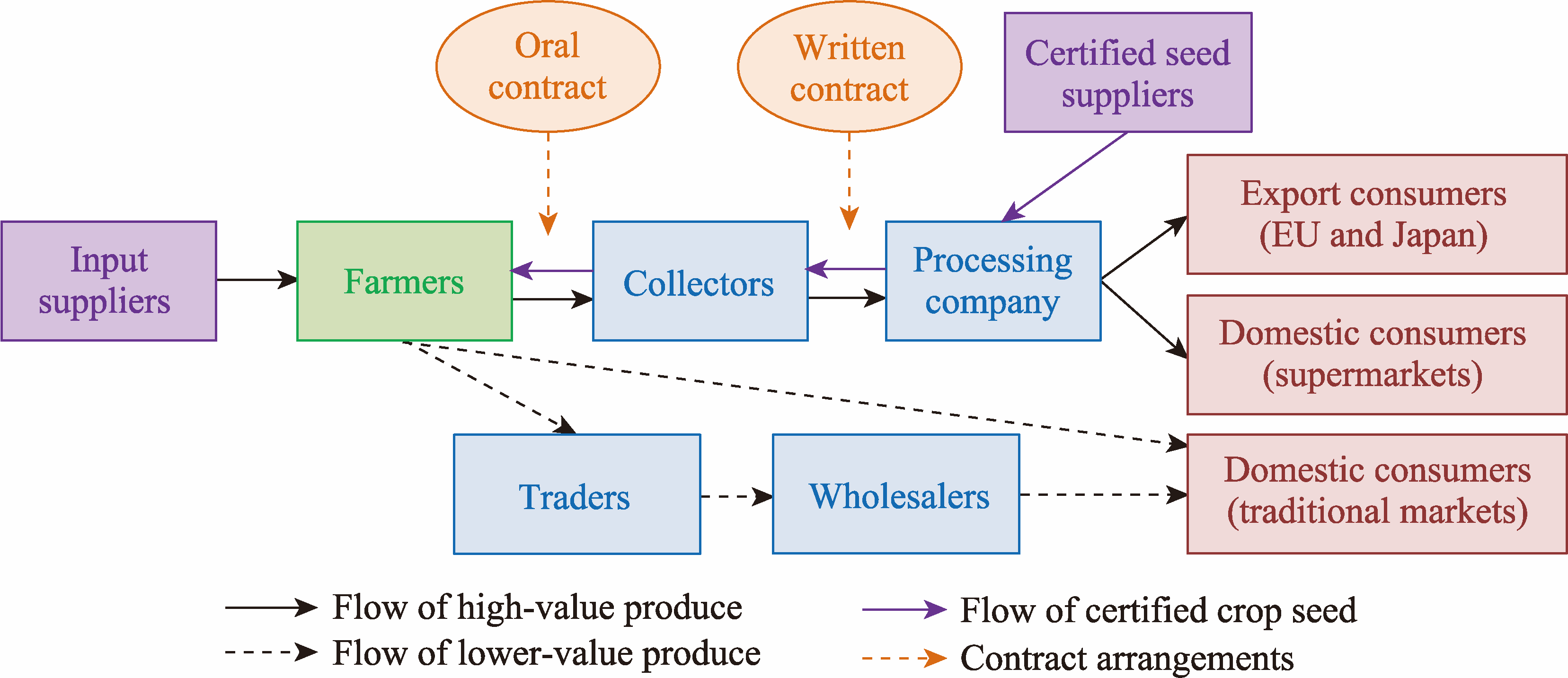
Agricultural production (especially intensive rice production) is a primary income source for over 2.0×10⁷ people in the Vietnamese Mekong River Delta. However, adverse climate change impacts, socio-economic change, and high dependence on farm inputs for intensive production constrain the longer-term sustainability of rice systems. Government and agribusiness actors are encouraging more farmers to grow non-rice crops and supporting the upscaling of alternative crops to paddy rice. We used a qualitative approach to investigate the value chain characteristics, as well as constraints and opportunities of alternative crops via two case studies (baby corn and honeydew melon) in An Giang and Hau Giang provinces, Vietnam. Data collection involved focus group discussions with local farmers and interviews with farmers and industry experts. Thematic analysis was used to compile the findings, and the results were validated with local government staff. The baby corn value chain featured on-going and stable market demand (including value-addition) and better vertical coordination (e.g., written contracts and financial support). The honeydew melon value chain featured positive relationships between farmers and traders despite less-developed vertical coordination. There are opportunities for value chain engagement through product quality certification, value-addition, and accessing high-value domestic and export markets. However, farmers require crop-specific and generic support from private and public sectors. Increased labour requirements and limited access to finance and credit limit value chain participation. Upscaling and marketing alternative crops can enhance farmer profitability and support non-farming agricultural business establishment, economic growth, and community development. Efficient value chains will be critical to ensure the adoption of alternative crops and development of crop-specific agribusiness models. These findings can inform policy-makers and change facilitators in designing targeted interventions to support the adoption of alternative crops in the study area as well as in Vietnam and globally.
Sang Thanh LE , Nhu Huynh MAO , Paul KRISTIANSEN , Michael COLEMAN . Innovation in two contrasting value chains: Constraints and opportunities for adopting alternative crop production in the Vietnamese Mekong River Delta[J]. Regional Sustainability, 2025 , 6(1) : 100198 . DOI: 10.1016/j.regsus.2025.100198
| [1] | Ackerl T., Weldemariam L.F., Nyasimi M., et al., 2023. Climate change risk, resilience, and adaptation among rural farmers in East Africa: A literature review. Reg. Sustain. 4(2), 185-193. |
| [2] | An Giang People’s Committee, 2021. Decision 1994 on the Approval of the Plan to Transition Crop Structures from Low-Effective Rice Land to Vegetables and Fruit for the 2021-2025 Period. [2024-02-20]. https://sonongnghiep.angiang.gov.vn/wps/portal/Home/2018/home/tin-chi-tiet/!ut/p/z0/fYwxD4IwFIR_DSPpe_VBy2hCooiLMTHQxSBpoEJakGL8-TYuxsXlcvfd5ZhiFVO2eZqu8cbZZgy5Vuk1y_ICSsKjLFKEE-V02Z1L2OecHZj6PwgP5j7PastU66zXL8-qxVlnO9v1Rk_xaG4R_JDFeB1QE3tj_dou62C0_YDvyD#gsc.tab=0. |
| [3] | Ba H.A., de Mey Y., Thoron S., et al., 2019. Inclusiveness of contract farming along the vertical coordination continuum: Evidence from the Vietnamese rice sector. Land Use Pol. 87, 104050, doi: 10.1016/j.landusepol.2019.104050. |
| [4] | Barrett C.B., Bachke M.E., Bellemare M.F., et al., 2012. Smallholder participation in contract farming: Comparative evidence from five countries. World Dev. 40(4), 715-730. |
| [5] | Bernzen A., Jenkins J.C., Braun B., 2019. Climate change-induced migration in coastal Bangladesh? A critical assessment of migration drivers in rural households under economic and environmental stress. Geosciences. 9(1), 51, doi: 10.3390/geosciences9010051. |
| [6] | Bogner A., Littig B., Menz W., 2009. Introduction:Expert interviews - An introduction to a new methodological debate. In: Bogner, A., Littig, B., Menz, W., (eds.). Interviewing Experts. Research Methods Series. London: Palgrave Macmillan, 1-13. |
| [7] | Braun V., Clarke V., 2006. Using thematic analysis in psychology. Qual. Res. Psychol. 3(2), 77-101. |
| [8] | Brown P.R., Hochman Z., Bridle K.L., et al., 2015. Participatory approaches to address climate change: perceived issues affecting the ability of South East Queensland graziers to adapt to future climates. Agric. Human Values. 32(4), 689-703. |
| [9] | Brown P.R., Tuan V.V., Nhan D.K., et al., 2018. Influence of livelihoods on climate change adaptation for smallholder farmers in the Mekong Delta Vietnam. Int. J. Agric. Sustain. 16(3), 255-271. |
| [10] | Bui B.B., Son N.H., Bo N.V., et al., 2018. Adaptation Options for Rice-Based Cropping Systems in Climate Risk-Prone Provinces in the Mekong River Delta:An Assessment Report. In: CGIAR Research Program on Climate Change, Agriculture and Food Security. Wageningen, Netherlands. |
| [11] | Collins R.C., Dent B., Bonney L.B., 2015. A Guide to Value-chain Analysis and Development for Overseas Development Assistance Projects. In: Australian Centre for International Agricultural Research. Canberra, Australia. |
| [12] | Datta P., Behera B., Rahut D.B., 2022. Climate change and Indian agriculture: A systematic review of farmers’ perception, adaptation, and transformation. Environental Challenges. 8, 100543, doi: 10.1016/j.envc.2022.100543. |
| [13] | Demont M., Rutsaert P., 2017. Restructuring the Vietnamese rice sector: Towards increasing sustainability. Sustainability. 9(2), 325, doi: 10.3390/su9020325. |
| [14] | Duyen T.N.L., Ra?ola R.F., Sander B.O., et al., 2021. A comparative analysis of gender and youth issues in rice production in North, Central, and South Vietnam. Clim. Dev. 13(2), 115-127. |
| [15] | Fankhauser S., McDermott T.K.J., 2014. Understanding the adaptation deficit: Why are poor countries more vulnerable to climate events than rich countries? Glob. Environ. Change-Human Policy Dimens. 27(1), 9-18. |
| [16] | Fedele G., Donatti C.I., Harvey C.A., et al., 2019. Transformative adaptation to climate change for sustainable social-ecological systems. Environ. Sci. Policy. 101, 116-125. |
| [17] | Global GAP (Good Agricultural Practices), 2023. Global GAP. [2024-02-11]. https://www.globalgap.org/. |
| [18] | GoV (Government of Vietnam), 2021. Decision 255 on Approval of Agricultural Restructure Plan for the 2021-2025 Period. [2024-02-22]. https://vanban.chinhphu.vn/default.aspx?pageid=27160&docid=202717. |
| [19] | GSO (General Statistics Office), 2021. Statistical Yearbook of Viet Nam 2020. [2024-02-20]. https://www.gso.gov.vn/du-lieu-va-so-lieu-thong-ke/2021/07/nien-giam-thong-ke-2021. |
| [20] | Guest G., Bunce A., Johnson L., 2006. How many interviews are enough: An experiment with data saturation and variability. Field Methods. 18(1), 59-82. |
| [21] | Guest G., Namey E., McKenna K., 2017. How many focus groups are enough? Building an evidence base for nonprobability sample sizes. Field Methods. 29(1), 3-22. |
| [22] | Harrell M.C., Bradley M.A., 2009. Data Collection Methods: Semi-Structured Interviews and Focus Groups. Santa Monica, USA: RAND Corporation. |
| [23] | Hau Giang DARD (Department of Agriculture and Rural Development), 2023. Plan 28 on Changing the Structure of Crops on Rice Land in 2023 in Hau Giang Province. [2024-02-22]. https://sonongnghiep.haugiang.gov.vn/xem-chi-tiet-tin/-/tin-tuc/Ve-Ke-hoach-Chuyen-oi-co-cau-cay-trong-tren-at-trong-lua-nam-2023-tren-ia-ban-tinh-Hau-Giang46217. |
| [24] | Hennink M., Kaiser B.N., 2022. Sample sizes for saturation in qualitative research: A systematic review of empirical tests. Soc. Sci. Med. 292, 114523, doi: 10.1016/j.socscimed.2021.114523. |
| [25] | Huong P.T.T., Everaarts A.P., Neeteson J.J., et al., 2013a. Vegetable production in the Red River Delta of Vietnam. I. Opportunities and constraints. NJAS-Wagen. J. Life Sci. 67(1), 27-36. |
| [26] | Huong P.T.T., Everaarts A.P., Neeteson J.J., et al., 2013b. Vegetable production in the Red River Delta of Vietnam. II. Profitability, labour requirement and pesticide use. NJAS-Wagen. J. Life Sci. 67(1), 37-46. |
| [27] | IFAD (International Fund of Agriculture Development), 2008. Climate change and the future of smallholder agriculture:How can rural poor people be a part of the solution on to climate change? In: United Nations Department of Economic and Social Affairs. New York, the USA. |
| [28] | Jamal M.R., Kristiansen P., Kabir M.J., et al., 2022. Cropping systems intensification and diversification: Risk, vulnerability and adaptation in southwest coastal Bangladesh. Int. J. Sustain. Dev. World Ecol. 29(8), 677-694. |
| [29] | Jiang Z., Raghavan S.V., Hur J., et al., 2019. Future changes in rice yields over the Mekong River Delta due to climate change - Alarming or alerting? Theor. Appl. Climatol. 137(1-2), 545-555. |
| [30] | Kabir M.J., Alauddin M., Crimp S., 2017. Farm-level adaptation to climate change in Western Bangladesh: An analysis of adaptation dynamics, profitability and risks. Land Use Pol. 64, 212-224. |
| [31] | Kaplinsky R., Morris M., 2001. A Handbook for Value Chain Research. Brighton: International Development Research Centre, University of Sussex. |
| [32] | Kates R.W., Travis W.R., Wilbanks T.J., 2012. Transformational adaptation when incremental adaptations to climate change are insufficient. Proc. Natl. Acad. Sci. U. S. A. 109(19), 7156-7161. |
| [33] | Kaveney B., Barrett-Lennard E., Minh K.C., et al., 2023. Inland dry season saline intrusion in the Vietnamese Mekong River Delta is driving the identification and implementation of alternative crops to rice. Agric. Syst. 207, 103632, doi: 10.1016/j.agsy.2023.103632. |
| [34] | Khan M.F., Nakano Y., Kurosaki T., 2019. Impact of contract farming on land productivity and income of maize and potato growers in Pakistan. Food Policy. 85, 28-39. |
| [35] | Khoi P.D., Gan C., Nartea G.V., et al., 2013. Formal and informal rural credit in the Mekong River Delta of Vietnam: Interaction and accessibility. J. Asian Econ. 26, 1-13. |
| [36] | Khong T.D., 2022. Vertical and horizontal coordination in developing countries’ agriculture: Evidence from Vietnam and implications. Asian Journal of Agriculture and Rural Development. 12(1), 40-52. |
| [37] | Kiger M.E., Varpio L., 2020. Thematic analysis of qualitative data: AMEE Guide No. 131. Med. Teach. 42(8), 846-854. |
| [38] | Klein R.J.T., Midgley G.F., Preston B.L., et al., 2014. Adaptation opportunities, constraints, and limits. In: Field, C.B., Barros, V.R., Dokken, D.J., et al., (eds.). Climate Change 2014: Impacts, Adaptation, and Vulnerability. Part A: Global and Sectoral Aspects. Contribution of Working Group II to the Fifth Assessment Report of the Intergovernmental Panel on Climate Change. Cambridge: Cambridge University Press, 889-943. |
| [39] | Le T.H.L., Kristiansen P., Vo B., et al., 2024. Understanding factors influencing farmers’ crop choice and agricultural transformation in the Upper Vietnamese Mekong Delta. Agric. Syst. 216, 103899, doi: 10.1016/j.agsy.2024.103899. |
| [40] | Linh T.N., Long H.T., Chi L.V., et al., 2019. Access to rural credit markets in developing countries, the case of Vietnam: A literature review. Sustainability. 11(5), 1468, doi: 10.3390/su11051468. |
| [41] | MARD (Ministry of Agriculture and Rural Development), 2016a. Atlas Vietnam Agriculture 2016, An Giang Province. Ha Noi: Ministry of Agriculture and Rural Development, Vietnam. |
| [42] | MARD, 2016b. Atlas Vietnam Agriculture 2016, Hau Giang Province. Ha Noi: Ministry of Agriculture and Rural Development, Vietnam. |
| [43] | MARD, 2023. Decision 470 about Promulgating the Plan to Change Cropping Patterns on Rice Land Nationwide in 2023. Ha Noi: Ministry of Agriculture and Rural Development, Vietnam. |
| [44] | Mariyono J., 2019. Microcredit and technology adoption: Sustained pathways to improve farmers’ prosperity in Indonesia. Agric. Finance Rev. 79(1), 85-106. |
| [45] | Miyata S., Minot N., Hu D.H., 2009. Impact of contract farming on income: Linking small farmers, packers, and supermarkets in China. World Dev. 37(11), 1781-1790. |
| [46] | Mushtaq S., Kath J., Stone R., et al., 2020. Creating positive synergies between risk management and transfer to accelerate food system climate resilience. Clim. Change. 161(3), 465-478. |
| [47] | Neil L., James A., Vicente B., et al., 2008. Climate Change and Adaptation. London: Earthscan. |
| [48] | NESC (National Extension Service Center of Vietnam), 2021. Agricultural Extension Activities. [2024-02-11]. https://khuyennongvn.gov.vn/hoat-dong-khuyen-nong. |
| [49] | Nguyen D.L., 2014. Migration and Rural Development in Vietnam. PhD Dissertation. Hannover: Gottfried Wilhelm Leibniz Universit?t Hannover. |
| [50] | Nguyen V.K., Nguyen H.H., Rob C., 2020. Trends in rice-based farming systems in the Mekong Delta. In: Rob, C., (ed.). White Gold:The Commercialisation of Rice Farming in the Lower Mekong Basin. Singapore: Springer, 347-373. |
| [51] | Nyumba T.O., Wilson K., Derrick C.J., et al., 2018. The use of focus group discussion methodology: Insights from two decades of application in conservation. Methods Ecol. Evol. 9(1), 20-32. |
| [52] | Paik S.Y., Le D.T.P., Nhu L.T., et al., 2020. Salt-tolerant rice variety adoption in the Mekong River Delta: Farmer adaptation to sea-level rise. PLoS One. 15(3), e0229464, doi: 10.1371/journal.pone.0229464. |
| [53] | Poole N., 2017. Smallholder Agriculture and Market Participation. Rome: Food and Agriculture Organization of the United Nations. |
| [54] | Phuong L.T.H., Biesbroek G.R., Wals A.E.J., 2018. Barriers and enablers to climate change adaptation in hierarchical governance systems: The case of Vietnam. J. Environ. Pol. Plan. 20(4), 518-532. |
| [55] | Sekaran U., Lai L.M., Ussiri D.A.N., et al., 2021. Role of integrated crop-livestock systems in improving agriculture production and addressing food security - A review. J. Agric. Food Res. 5, 100190, doi: 10.1016/j.jafr.2021.100190. |
| [56] | Seufert V., Ramankutty N., Foley J.A., 2012. Comparing the yields of organic and conventional agriculture. Nature. 485, 229-232. |
| [57] | Sivramkrishna S., Jyotishi A., 2008. Monopsonistic exploitation in contract farming: Articulating a strategy for grower cooperation. J. Int. Dev. 20(3), 280-296. |
| [58] | Swinnen J.F.M., Maertens M., 2007. Globalization, privatization, and vertical coordination in food value chains in developing and transition countries. Agric. Econ. 37(Suppl. 1), 89-102. |
| [59] | Tacconi F., Waha K., Ojeda J.J., et al., 2022. Drivers and constraints of on-farm diversity. A review. Agron. Sustain. Dev. 42(1), 2, doi: 10.1007/s13593-021-00736-6. |
| [60] | Tease F., Gaither C.J., Yembilah R., et al., 2023. When will the tree grow for me to benefit from it?: Tree tenure reform to counter mining in southwestern Ghana. Soc. Nat. Resour. 36(3), 269-287. |
| [61] | Thanh B.N., Thuy T.L.V., Anh M.N., et al., 2021. Drivers of agricultural transformation in the coastal areas of the Vietnamese Mekong delta. Environ. Sci. Policy. 122, 49-58. |
| [62] | Tran T.A., 2019. Land use change driven out-migration: Evidence from three flood-prone communities in the Vietnamese Mekong Delta. Land Use Pol. 88, 104157, doi: 10.1016/j.landusepol.2019.104157. |
| [63] | Tuyen M.C., Sirisupluxana P., Bunyasiri I., et al., 2021. Rice contract farming in Vietnam: insights from a qualitative study. Engineering Proceedings. 9(1), 6, doi: 10.3390/engproc2021009006. |
| [64] | van Aalst M.A., Koomen E., Tran D.D., et al., 2023. The economic sustainability of rice farming and its influence on farmer decision-making in the upper Mekong delta, Vietnam. Agric. Water Manage. 276, 108018, doi: 10.1016/j.agwat.2022.108018. |
| [65] | VCCI (Vietnam Chamber of Commerce and Industry), UNDP (United Nations Development Programme), 2022. Agricultural Transformation Model Adapting to Climate Change in the Mekong Delta. [2024-02-22]. https://www.undp.org/vietnam/publications/agricultural-transformation-model-adapting-climate-change-mekong-delta. |
| [66] | Vermeulen S.J., Dinesh D., Howden S.M., et al., 2018. Transformation in practice: A review of empirical cases of transformational adaptation in agriculture under climate change. Front. Sustain. Food Syst. 2, 65, doi: 10.3389/fsufs.2018.00065. |
| [67] | Weituschat C.S., Pascucci S., Materia V.C., et al., 2023. Understanding the role of value chain formation in the scaling of crop diversification. Agron. Sustain. Dev. 43(2), 25, doi: 10.1007/s13593-023-00866-z. |
| [68] | Widadie F., Bijman J., Trienekens J., 2022. Alignment between vertical and horizontal coordination for food quality and safety in Indonesian vegetable chains. Agric. Food Econ. 10(1), 8, doi: 10.1186/s40100-022-00215-w. |
| [69] | World Bank Group, 2015. Vietnam - Sustainable Agriculture Transformation Project. Washington: World Bank Group. |
| [70] | World Bank Group, 2016. Transforming Vietnamese Agriculture:Gaining More for Less. Ha Noi: Hong Duc Publishing House. |
| [71] | Yang Y., Pham M.H., Yang B., et al., 2022. Improving vegetable supply chain collaboration: a case study in Vietnam. Supply Chain Manag. 27(1), 54-65. |
/
| 〈 |
|
〉 |
 REGSUS Wechat
 新公网安备 65010402001202号