

Cost and benefit analysis of Climate-Smart Agriculture interventions in the dryland farming systems of northern Ghana
Received date: 2023-09-07
Accepted date: 2024-12-31
Online published: 2025-03-13
Copyright
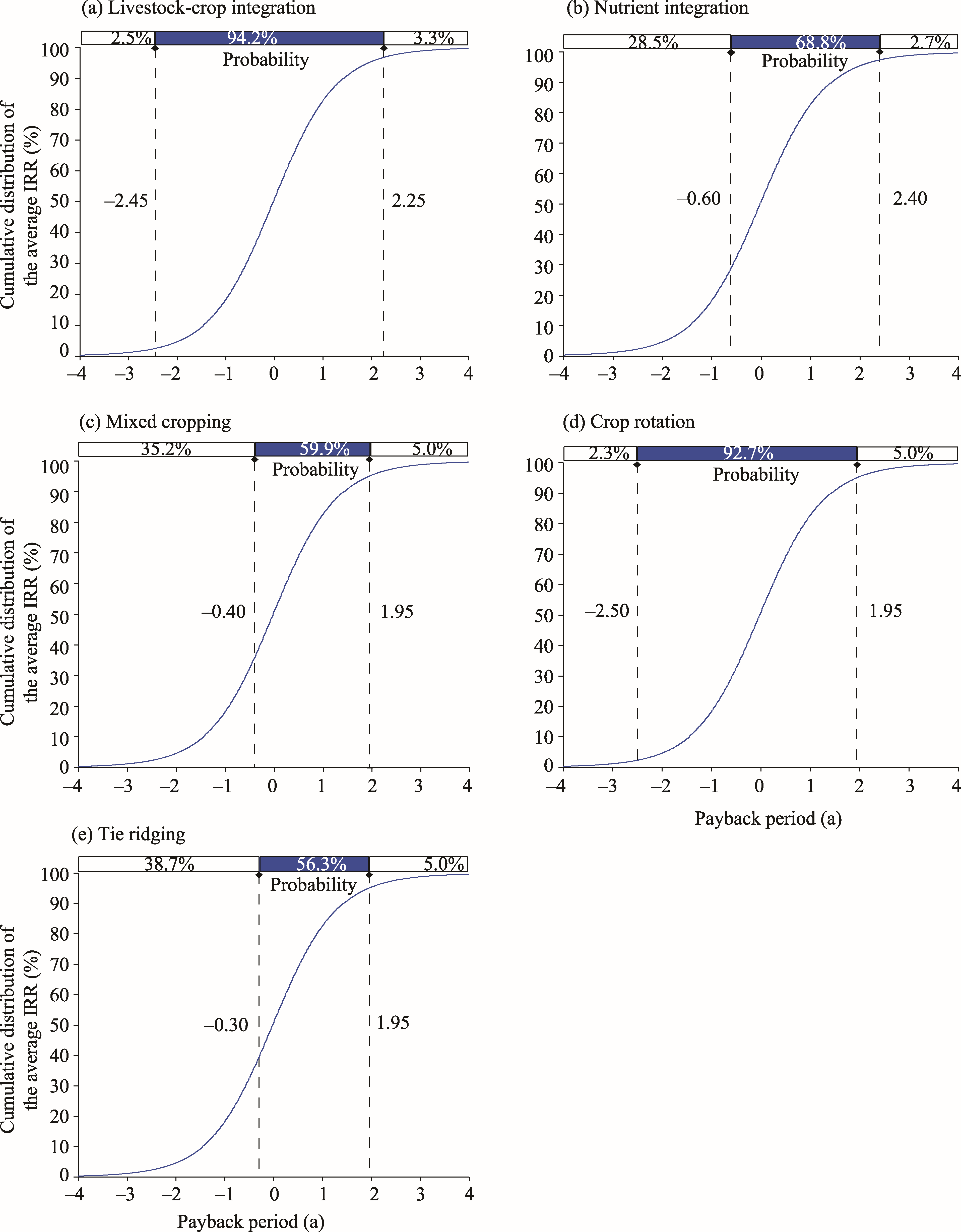
There is a need for more focus in understanding the economic benefits of Climate-Smart Agriculture (CSA) interventions, particularly in sub-Saharan Africa, where extreme climate events are significantly affecting agriculture and rural livelihoods. This study used the Net Present Value (NPV), Internal Rate of Return (IRR), Benefit-Cost Ratio (BCR), and payback period to evaluate the economic viability of the adopted CSA interventions in the three villages (Doggoh, Jeffiri, and Wulling) of the dryland farming systems of northern Ghana, where CSA interventions were mostly practiced. Data were collected from 161 farm households by the questionnaire survey. The results showed that CSA interventions including livestock-crop integration, mixed cropping, crop rotation, nutrient integration, and tie ridging enhanced crop yield and the household income of smallholder farmers. The five CSA interventions selected by smallholders were in the following order of priority: livestock-crop integration (BCR=2.87), mixed cropping (BCR=2.54), crop rotation (BCR=2.24), nutrient integration (BCR=1.98), and tie ridging (BCR=1.42). Results further showed that livestock-crop integration was the most profitable CSA intervention even under a pessimistic assumption with a long payback period of 5.00 a. Moreover, this study indicated that the implementation of CSA interventions, on average, was relatively profitable and had a nominal financial risk for smallholder farmers. Understanding the economic viability of CSA interventions will help in decision-making process toward selecting the right CSA interventions for resilience development.
Felix KPENEKUU , Philip ANTWI-AGYEI , Fred NIMOH , Andrew DOUGILL , Albert BANUNLE , Jonathan ATTA-AIDOO , Frank BAFFOUR-ATA , Thomas Peprah AGYEKUM , Godfred ADDAI , Lawrence GUODAAR . Cost and benefit analysis of Climate-Smart Agriculture interventions in the dryland farming systems of northern Ghana[J]. Regional Sustainability, 2025 , 6(1) : 100196 . DOI: 10.1016/j.regsus.2025.100196
| [1] | Abdul-Rahaman I., Owusu-Sekyere E., 2017. Climate variability and sustainable food production: Insights from North-Eastern Ghana. Ghana Journal of Geography. 9(2), 67-89. |
| [2] | Adego T., Simane B., Woldie G.A., 2019. The impact of adaptation practices on crop productivity in northwest Ethiopia?: An endogenous switching estimation. Development Studies Research. 6(1), 129-141. |
| [3] | Aggarwal P.K., Jarvis A., Campbell B.M., et al., 2018. The climate-smart village approach: Framework of an integrative strategy. Ecol. Soc. 23(1), 14, doi: 10.5751/ES-09844-230114. |
| [4] | Agula C., Mabe F.N., Akudugu M.A., et al., 2019. Enhancing healthy ecosystems in northern Ghana through eco-friendly farm-based practices: Insights from irrigation scheme-types. BMC Ecol. 19(1), 1-11. |
| [5] | Akinyi D.P., Ng’ang’a S.K., Ngigi M., et al., 2022. Cost-benefit analysis of prioritized climate-smart agricultural practices among smallholder farmers: Evidence from selected value chains across sub-Saharan Africa. Heliyon. 8(4), e09228, doi: 10.1016/j.heliyon.2022.e09228. |
| [6] | Akpan A.I., Zikos D., 2023. Rural agriculture and poverty trap: Can climate-smart innovations provide breakeven solutions to smallholder farmers? Environments. 10(4), 57, doi: 10.3390/environments10040057. |
| [7] | Akter A., Geng X.H., Mwalupasa G.E., 2022. Income and yield effects of Climate-Smart Agriculture (CSA) adoption in flood prone areas of Bangladesh: Farm level evidence. CLIM. RISK MANAG. 37, 100455, doi: 10.1016/j.crm.2022.100455. |
| [8] | Andrieu N., Sogoba B., Zougmore R., et al., 2017. Prioritizing investments for Climate-Smart Agriculture: Lessons learned from Mali. Agric. Syst. 154, 13-24. |
| [9] | Atanga R.A., Tankpa V., 2021. Climate change, flood disaster risk and food security nexus in Northern Ghana. Front. Sustain. Food Syst. 5, 706721, doi: 10.3389/fsufs.2021.706721. |
| [10] | Ayumah R., 2017. Climate variability and food crop production in the Bawku. MSc Thesis. Kumasi: Kwame Nkrumah University of Science and Technology. |
| [11] | Boatemaa A., Incoom M., Amaning K., et al., 2020. Rainfall variabilities and droughts in the Savannah zone of Ghana from 1960-2015. Sci. Afr. 10, e00571, doi: 10.1016/j.sciaf.2020.e00571. |
| [12] | BOG (Bank of Ghana), 2022. Monetary Policy Report. [2023-07-21]. https://www.bankofcanada.ca/publications/mpr/. |
| [13] | Chaudhury A.S., Helfgott A., Thornton T.F., et al., 2016. Participatory adaptation planning and costing. Applications in agricultural adaptation in western Kenya. Mitig. Adapt. Strateg. Glob. Chang. 21(3), 301-322. |
| [14] | Damba O.T., Ansah I.G.K., Donkoh S.A., et al., 2020. Effects of technology dissemination approaches on agricultural technology uptake and utilization in Northern Ghana. Technol. Soc. 62, 101294, doi: 10.1016/j.techsoc.2020.101294. |
| [15] | Debaeke P., Pellerin S., Scopel E., 2017. Climate-smart cropping systems for temperate and tropical agriculture: Mitigation, adaptation and trade-offs. Cah. Agric. 26(3), 12, doi: 10.1051/cagri/2017028. |
| [16] | Dillon E.J., Hennessy T., Buckley C., et al., 2016. Measuring progress in agricultural sustainability to support policy-making. Intern. Int. J. Agric. Sustain. 14(1), 31-44. |
| [17] | Dougill A.J., Hermans T.D.G., Eze S., et al., 2021. Evaluating Climate-Smart Agriculture as route to building climate resilience in African food systems. Sustainability. 13(17), 9909, doi: 10.3390/su13179909. |
| [18] | Dunnett A., Shirsath P.B., Aggarwal P.K., et al., 2018. Multi-objective land use allocation modelling for prioritizing climate-smart agricultural interventions. Ecol. Model. 381, 23-35. |
| [19] | EPA (Environmental Protection Agency), 2021. Ghana’s Fourth National Communication to the United Nations Framework Convention on Climate Change. [2023-08-01]. http://ww.epa.gov.gh. |
| [20] | Fadina A.M.R., Barjolle D., 2018. Farmers’ adaptation strategies to climate change and their implications in the Zou department of South Benin. Environments. 5(1), 1-17. |
| [21] | Farnworth C.R., Baudron F., Andersson J.A., et al., 2016. Gender and conservation agriculture in East and Southern Africa: Towards a research agenda. Int. J. Agric. Sustain. 14(2), 142-165. |
| [22] | Gbangou T., Ludwig F., van Slobbe E., et al., 2020. Rainfall and dry spell occurrence in Ghana: Trends and seasonal predictions with a dynamical and a statistical model. Theor. Appl. Climatol. 141(1-2), 371-387. |
| [23] | GSS (Ghana Statistical Service), 2018. Ghana-Ghana Living Standard Survey (GLSS 7) 2017. [2023-07-11]. https://www2.statsghana.gov.gh. |
| [24] | Guodaar L., 2021. Climate change, indigenous knowledge and food security in northern Ghana. PhD Dissertation. Adelaide: The University of Adelaide. |
| [25] | Guodaar L., Kabila A., Afriyie K., et al., 2023. Farmers’ perceptions of severe climate risks and adaptation interventions in indigenous communities in northern Ghana. Int. J. Disaster Risk Reduct. 95, 103891, doi: 10.1016/j.ijdrr.2023.103891. |
| [26] | Haile G.G., Tang Q.H., Sun S., et al., 2019. Droughts in East Africa: Causes, impacts and resilience. Earth-Sci. Rev. 193, 146-161. |
| [27] | IPCC (Intergovernmental Panel on Climate Change), 2021. Climate Change 2021: The Physical Science Basis. Cambridge: Cambridge University Press. |
| [28] | IPCC, 2022. Climate Change 2022: Impacts, Adaptation and Vulnerability. Cambridge: Cambridge University Press. |
| [29] | Jambo Y., Alemu A., Tasew W., 2021. Impact of small-scale irrigation on household food security: Evidence from Ethiopia. Agriculture & Food Security. 10(1), 1-16. |
| [30] | Jelagat J., 2019. Effects of climate-smart agricultural awareness on food security among smallholder farmers: The case of Kaptumo-Kaboi ward, Nandi County. MSc Thesis. Nairobi: University of Nairobi. |
| [31] | Kassa B.A., Abdi A.T., 2022. Factors influencing the adoption of climate-smart agricultural practice by small-scale farming households in wondo genet, southern Ethiopia. SAGE Open. 12(3), 1121604, doi: 10.1177/21582440221121604. |
| [32] | Klutse N.A.B., Owusu K., Boafo Y.A., 2020. Projected temperature increases over northern Ghana. SN Appl. Sci. 2(8), 1339, doi: 10.1007/s42452-020-3095-3. |
| [33] | Kpenekuu F., Antwi-Agyei P., Nimoh F., et al., 2024. Understanding drought risk management in vulnerable communities in dryland farming systems: Evidence from northwest Ghana. Int. J. Disaster Risk Reduct. 100, 104186, doi: 10.1016/j.ijdrr.2023.104186. |
| [34] | Laterra P., Nahuelhual L., Vallejos M., et al., 2018. Ecosystem services linking inequalities and ecosystem services in Latin America. Ecosyst. Serv. 36, 100875, doi: 10.1016/j.ecoser.2018.12.001. |
| [35] | Li M.J., Li R.H., Zhang J.E., et al., 2023. Mixed cropping with duck co-culture: An agroecological system to improve grain quality and farm profitability. J. Sci. Food Agric. 103(6), 3028-3040. |
| [36] | Martey E., Etwire P.M., Mockshell J., 2021. Climate-smart cowpea adoption and welfare effects of comprehensive agricultural training programs. Technol. Soc. 64, 101468, doi: 10.1016/j.techsoc.2020.101468. |
| [37] | Mulinde C., Majaliwa J.G.M., Twinomuhangi R., et al., 2019. Perceived climate risks and adaptation drivers in diverse coffee landscapes of Uganda. NJAS-Wagen. J. Life Sci. 88, 31-44. |
| [38] | Mumo L., Yu J.H., Fang K., 2018. Assessing impacts of seasonal climate variability on maize yield in Kenya. Int. J. Plant Prod. 12(4), 297-307. |
| [39] | Mutenje M.J., Farnworth C.R., Stirling C., et al., 2019. A cost-benefit analysis of Climate-Smart Agriculture options in Southern Africa: Balancing gender and technology. Ecol. Econ. 163, 126-137. |
| [40] | Ng’ang’a S.K., Miller V., Girvetz E., 2021. Is investment in Climate-Smart-agricultural practices the option for the future? Cost and benefit analysis evidence from Ghana. Heliyon. 7(4), e06653, doi: 10.1016/j.heliyon.2021.e06653. |
| [41] | Obayelu A.E., Afolami C.A., Agbonlahor M.U., 2013. Relative profitability of cassava-based mixed cropping systems among various production scale operators in Ogun and Oyo states Southwest Nigeria. Afr. Dev. Rev. 25, 513-525. |
| [42] | Pontes L.S., Porfírio-da-Silva V., Moletta J.L., et al., 2021. Long-term profitability of crop-livestock systems, with and without trees. Agric. Syst. 192, 103204, doi: 10.1016/j.agsy.2021.103204. |
| [43] | Redda A., Tana T., Elias B., 2022. Perceptions of Climate Change and Determinants of Adaptation Decisions of Smallholder Maize (Zea. mays L.) Farmers in Tigray, Northern Ethiopia. [2023-07-11]. https://doi.org/10.21203/rs.3.rs-1312735/v1. |
| [44] | Sain G., Loboguerrero A.M., Corner-Dolloff C., et al., 2017. Costs and benefits of Climate-Smart Agriculture: The case of the Dry Corridor in Guatemala. Agric. Syst. 151, 163-173. |
| [45] | Sam K.O., Botchway V.A., Karbo N., et al., 2020. Evaluating the utilisation of Climate-Smart Agriculture (CSA) technologies and practices among smallholder farmers in the Lawra, Jirapa and Nandom districts of Ghana. Ghana Journal of Agricultural Science. 55(2), 122-144. |
| [46] | Setsoafia E.D., Ma W.L., Renwick A., 2022. Effects of sustainable agricultural practices on farm income and food security in northern Ghana. Agric. Food Econ. 10(9), 1-15. |
| [47] | Smith E., Zentner R.P., Campbell C.A., et al., 2017. Long-term crop rotation effects on production, grain quality, profitability, and risk in the northern Great Plains. Agron. J. 19, 0420, doi: 10.2134/agronj2016.07.0420. |
| [48] | USAID (United States Agency for International Development), 2017. Climate-smart Agricultural Practices in the Coastal Savannah Agro-ecological Zone of Ghana. [2023-08-01]. https://www.usa.gov/outreach. |
| [49] | Volsi B., Bordin I., Higashi G.E., et al., 2020. Economic profitability of crop rotation systems in the Caiuá sandstone area. Cienc. Rural. 50(2), 1-11. |
| [50] | World Bank, 2022. Global Market Outlook. Trends in Global Agricultural Commodity Prices Food Price Inflation Dashboard. [2023-07-21]. http://www.worldbank.org. |
| [51] | Williams P.A., Ng’ang’a S.K., Crespo O., et al., 2020. Cost and benefit analysis of adopting climate adaptation practices among smallholders: The case of five selected practices in Ghana. Clim. Serv. 20, 100198, doi: 10.1016/j.cliser.2020.100198. |
| [52] | Zhao C.L., Yan Y., Wang C.X., et al., 2018. Adaptation and mitigation for combating climate change—from single to joint. Ecosyst. Health Sustain. 4(4), 85-94. |
| [53] | Zougmoré R.B., Partey S.T., Ouédraogo M., et al., 2018. Facing climate variability in Sub-Saharan Africa: Analysis of Climate-Smart Agriculture opportunities to manage climate-related risks. Cah. Agric. 27(3), 34001, doi: 10.1051/cagri/2018019. |
/
| 〈 |
|
〉 |
 REGSUS Wechat
 新公网安备 65010402001202号