

Employment and development levels in rural areas of the Russian Federation
Received date: 2023-07-25
Revised date: 2024-03-12
Accepted date: 2024-08-26
Online published: 2024-09-25
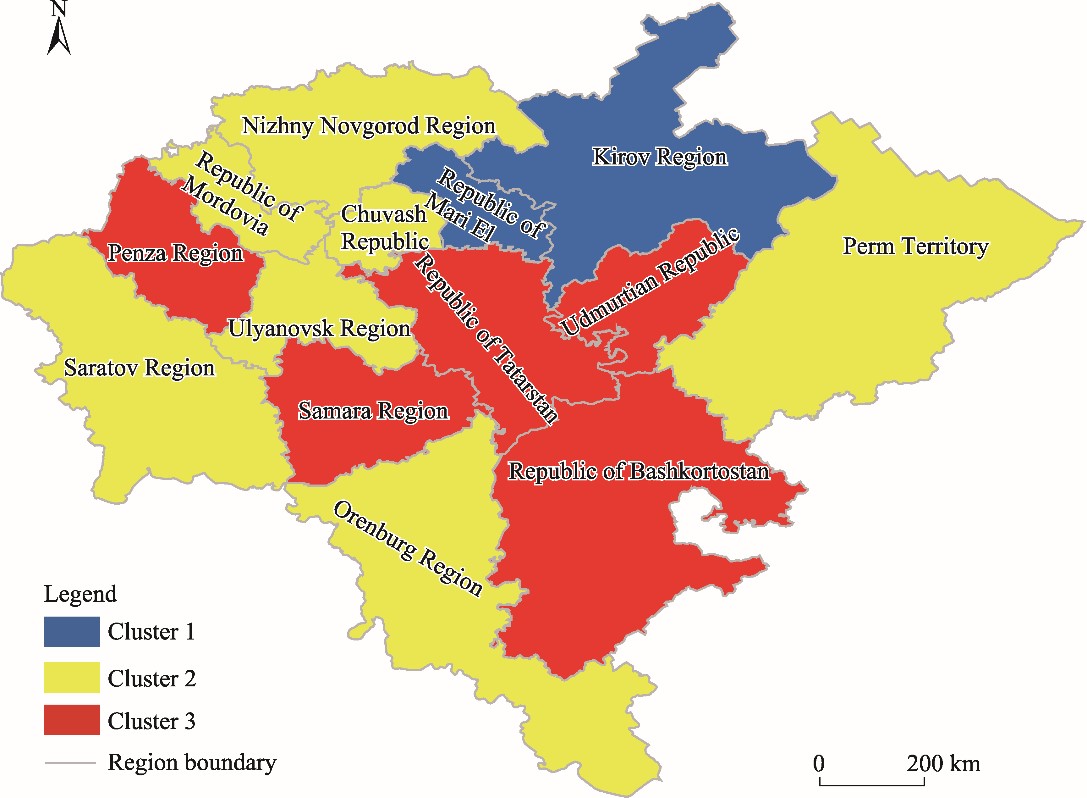
The development of agro-industrial complex is important for ensuring national food security and national health. The development of rural areas is subject to the development of agriculture and local infrastructure, as well as the availability of various services. This study selected 15 indicators in 2021 to analyze the employment and development levels in rural areas of 71 regions of the Russian Federation using the analytical grouping method. The results indicated that 20 regions (Group 1) had the highest percentage of rural population (33.10%). The percentage of population engaged in agriculture had the highest value (12.40%) in 31 regions (Group 2). Moreover, 20 regions (Group 3) had the highest investments in fixed assets at the expense of municipal budget (11.80 USD/person). Increasing the investments in fixed assets carried out from the budget of the municipality can improve the employment level in rural areas. Then, we used cluster analysis to divide 14 regions of the Volga Federal District in the Russian Federation into 3 clusters. Cluster 1 covered Kirov Region and Republic of Mari El; Cluster 2 included Ulyanovsk Region, Saratov Region, Nizhny Novgorod Region, Perm Territory, Orenburg Region, Chuvash Region, and Republic of Mordovia; and Cluster 3 contained Republic of Tatarstan, Samara Region, Udmurtian Republic, Penza Region, and Republic of Bashkortostan. Results indicated that the 2 regions of Cluster 1 need to increase the availability of resources and natural gas and improve the investment attractiveness of rural areas. The 7 regions of Cluster 2 needed to develop infrastructure, public services, and agricultural production. We found the highest employment level in rural areas, the largest investments in fixed assets at the expense of municipal budget, the largest residential building area per 10,000 persons, and the largest individual residential building area in the 5 regions of Cluster 3. This study makes it possible to draw up a comprehensive regional development program and proves the need for the development of rural areas, which is especially important for the sustainable development of the Russian Federation.
Guzel SALIMOVA , Gulnara NIGMATULLINA , Gamir HABIROV , Alisa ABLEEVA , Rasul GUSMANOV . Employment and development levels in rural areas of the Russian Federation[J]. Regional Sustainability, 2024 , 5(3) : 100164 . DOI: 10.1016/j.regsus.2024.100164
| [1] | Aldan A., 2021. The multiplier effect of public employment on formal employment in the private sector: Evidence from Turkey. Rev. Dev. Econ. 25(2), 1016-1031. |
| [2] | Alonso M.P., Gargallo P., Lopez-Escolano C., et al., 2023. Financial exclusion, depopulation, and ageing: An analysis based on panel data. J. Rural Stud. 103(1), 103105, doi: 10.1016/j.jrurstud.2023.103105. |
| [3] | Anichin V., Breslavetz A., Breslavets Y., et al., 2022. Assessment of the best project practices of integrated rural development. AIP Conference Proceedings. 2661(1), 020020, doi: 10.1063/5.0107326. |
| [4] | Behar A., Mok J., 2019. Does public-sector employment fully crowd out private-sector employment? Rev. Dev. Econ. 23(4), 1891-1925. |
| [5] | Bogoviz A., 2021. Complex Systems:Innovation and Sustainability in the Digital Age. Cham: Springer, 1-631. |
| [6] | Castillo C.P., van Heerden S., Barranco R., et al., 2023. Urban-rural continuum: An overview of their interactions and territorial disparities. Reg. Sci. Policy Pract. 15(4), 1019-1036. |
| [7] | Dillon B., Brummund P., Mwabu G., 2019. Asymmetric non-separation and rural labor markets. J. Dev. Econ. 139(1), 78-96. |
| [8] | Ding Y.Y., Li Z., Ge X., et al., 2020. Empirical analysis of the synergy of the three sectors’ development and labor employment. Technol. Forecast. Soc. Change. 160, 120223, doi: 10.1016/j.techfore.2020.120223. |
| [9] | Federal State Statistics Service of the Russian Federation. Socio-Economic indicators 2022. [2023-02-07]. https://www.rosstat.gov.ru/. |
| [10] | Gao X.S., Liu L., Ou D.H., et al., 2023. Using mobile phone data to probe the mobility-related well-being of rural residents: A case study of Chengdu, China. Reg. Sci. Policy Pract. 15(9), 1893-1906. |
| [11] | Henning M., Westlund H., Enflo K., 2023. Urban-rural population changes and spatial inequalities in Sweden. Reg. Sci. Policy Pract. 15(4), 878-892. |
| [12] | Hlavá?ek P., Kopá?ek M., Kopá?ková L., et al., 2023. Barriers for and standpoints of key actors in the implementation of smart village projects as a tool for the development of rural areas. J. Rural Stud. 103(1), 103098, doi: 10.1016/j.jrurstud.2023.103098. |
| [13] | Ingram J., Maye D., 2023. “How can we?” the need to direct research in digital agriculture towards capacities. J. Rural Stud. 100(1), 103003, doi: 10.1016/j.jrurstud.2023.03.011. |
| [14] | Káposzta J., Nagy H., 2022. The major relationships in the economic growth of the rural space. European Countryside. 14(1), 67-86. |
| [15] | Kaur S., Kaur P., 2019. Enhancing income and employment on marginal and small farms through dairying in Punjab. Ind. J. Dairy Sci. 72(4), 413-421. |
| [16] | Khasanov E., Gabitov I., Mudarisov S., et al., 2019. Justification of parameters of seed treater with an eccentrically fixed drum influencing the motion character and seed treatment modes. Bulg. J. Agric. Sci. 25(2), 119-128. |
| [17] | Khasanov E., Khamaletdinov R., Mudarisov S., et al., 2020. Optimization parameters of the spiral mixing chamber of the device for pre-sowing seed treatment with biological preparations. Comput. Electron. Agric. 173(1), 105437, doi: 10.1016/j.compag.2020.105437. |
| [18] | Klimanova O., Bukvareva E., Illarionova O., et al., 2022. Assessment of ecosystem services at the municipal level and its possible integration into spatial planning. Geographical Series. 86(4), 605-620. |
| [19] | Low S.A., Rahe M.L., Van Leuven A.J., 2023. Has COVID-19 made rural areas more attractive places to live? Survey evidence from Northwest Missouri. Reg. Sci. Policy Pract. 15(3), 520-540. |
| [20] | Magasumovna A.A., Anasovna S.G., Alfirovna Z.Z., 2017. Factors and reserves of increase of efficiency of agricultural production. Int. J. Appl. Eng. Res. 12(24), 15821-15829. |
| [21] | Mai C.N., Mai A.N., Nguyen H.N.T., et al., 2021. Factors affecting endogenous income of informal laborers suffering economically social exclusion in Vietnam’s Northern Mountainous Area. J. Organ. Behav. Res. 6(1), 59-70. |
| [22] | Mogila Z., Melo P.C., Gaspar J.M., 2022. Estimating labour-income-based inequality of opportunity for a selection of EU-SILC countries: National and urban-rural perspectives. Reg. Sci. Policy Pract. 14(5), 1158-1187. |
| [23] | Mondal S., Ghosh P., Rohatgi P., 2023. Village-level livelihood security: A case study on a wasteland-dominated forest fringe region of rural India. Reg. Sci. Policy Pract. 15(5), 1019-1036. |
| [24] | Moskaleva A., 2020. Effect of inclusion of assisted reproductive technologies in the state health insurance programme in Russia. Popul. Econ. 4(4), 19-42. |
| [25] | Popkova E., Sergi B.S., 2021. Smart Technologies for Society, State and Economy. Lecture Notes in Networks and Systems. Cham: Springer Nature, 1-1766. |
| [26] | Popkova E., 2022. Imitation Market Modeling in Digital Economy:Game Theoretic Approaches. Cham: Springer Nature, 1-840. |
| [27] | Rikalovi? G., Josipovi? S., Molnar D., 2020. Creative class and entrepreneurial potential of rural areas in Serbia: Concept and measurement. In:2nd Scientific Conference on Economics of Digital Transformation-Smart Governments, Regions and Cities. Rijeka, Croatian. |
| [28] | Rizov M., 2020. A vision of the farming sector’s future: What is in there for farmers in the time of the second machine age? Local Econ. 35(8), 717-722. |
| [29] | Santos J.L., Fernández Fernández M.T., 2022. The spread of urban-rural areas and rural depopulation in central Spain. Reg. Sci. Policy Pract. 15(4), 863-877. |
| [30] | Schafer S., Henn S., 2023. Recruiting and integrating international high-skilled migrants—Towards a typology of firms in rural regions in Germany. J. Rural Stud. 103, 103094, doi: 10.1016/j.jrurstud.2023.103094. |
| [31] | Shestak V.A., Savenkova P.G., 2023. Criminalization of illegal mining in Peru and Ecuador. Ugol. 2(1), 72-76. |
| [32] | Shestak V.A., Tsyplakova A.D., 2023. Icelandic prevention model. J. Sib. Fed. Univ. Humanit. Soc. Sci. 16(5), 764-774. |
| [33] | Tiwasing P., Gorton M., Phillipson J., et al., 2023. Rural businesses and levelling up: A rural-urban analysis of business innovation and exporting in England’s north and midlands. J. Rural Stud. 100(1), 103007, doi: 10.1016/j.jrurstud.2023.103007. |
| [34] | United Nations, 2015. Transforming Our World: The 2030 Agenda for Sustainable Development. [2023-02-07]. https://sdgs.un.org/2030agenda. |
| [35] | Wu L., Li C.J., Gao Y., 2022. Regional agricultural cooperatives and subjective wellbeing of rural households in China. Reg. Sci. Policy Pract. 14(S2), 138-158. |
| [36] | Wuth J., 2023. (Why) Do digital startups move to rural regions? Reg. Sci. Policy Pract. 15(4), 845-862. |
| [37] | Zarifa D., Seward B., Milian R.P., 2019. Location, location, location: Examining the rural-urban skills gap in Canada. J. Rural Stud. 72(1), 252-263. |
/
| 〈 |
|
〉 |
 REGSUS Wechat
 新公网安备 65010402001202号