

What are the underlying causes and dynamics of land use conflicts in metropolitan junction areas? A case study of the central Chengdu- Chongqing region in China
Received date: 2024-01-31
Revised date: 2024-06-30
Accepted date: 2024-08-22
Online published: 2024-09-25
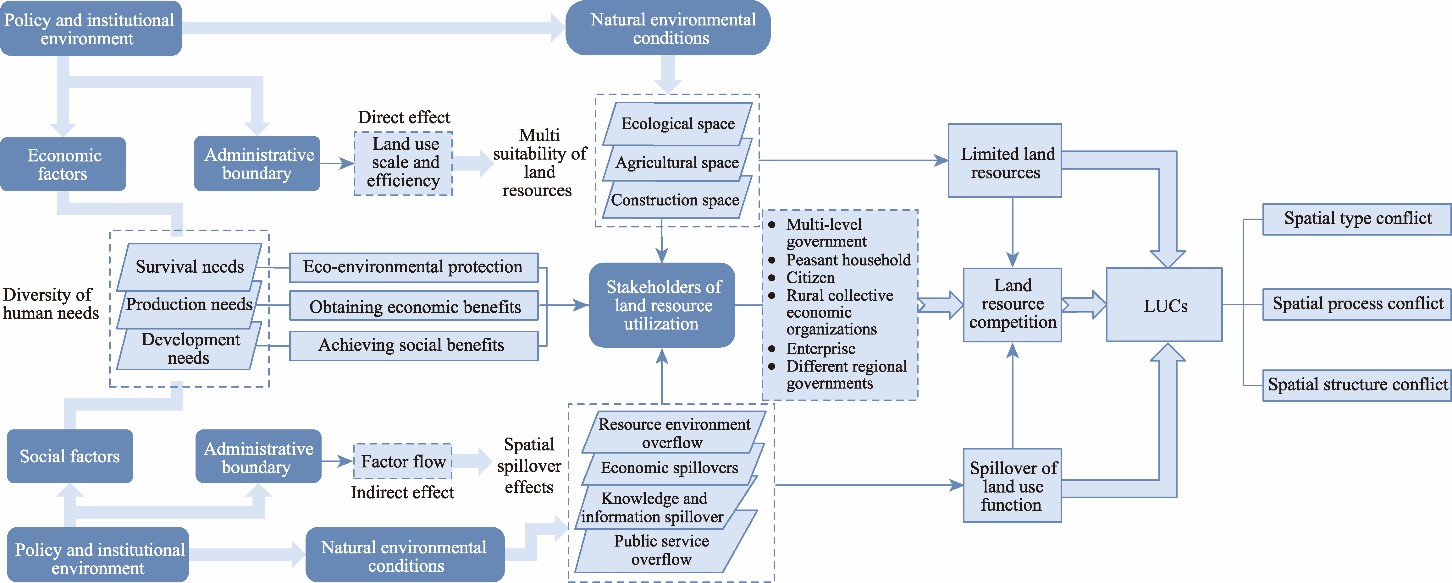
Land use conflicts (LUCs), as a spatial manifestation of the conflicts in the human-land relationships, have a profound impact on regional sustainable development. For China’s metropolitan junction areas (MJAs), the existence of “administrative district economies” has made the issue of LUCs more prominent. Based on a case study of the central Chengdu-Chongqing region, we conducted an exploratory spatial data analysis of the evolutionary process of regional LUCs. Furthermore, structural equation modeling was utilized to analyze the dynamic mechanism of LUCs in MJAs, with a particular emphasis on exploring the influences of administrative boundary. The results showed that from 2010 to 2020, LUCs in the central Chengdu-Chongqing region continued to worsen, and the spatial process conflict and spatial structure conflict indices increased by more than 30.0%. The intensification of LUCs in the central Chengdu-Chongqing region from 2010 to 2020 was mainly the result of the deterioration of conflicts in evaluation units with low conflict levels. LUCs in China’s metropolitan areas generally presented a circular gradient distribution, weakening from the core to the periphery, but there were some strong isolated conflict zones in the outer regions. LUCs in China’s MJAs were the result of interactions among multiple factors, e.g., natural environment, socio-economic development, policy and institutional processes, and administrative boundary effects. Administrative boundary affected the flow of socio-economic elements, changing the supply-and-demand competition of stakeholders for land resources, consequently exerting an indirect influence on LUCs. This study advances the theory of the dynamic mechanism of LUCs, and provides theoretical support for the governance of these conflicts in transboundary areas.
TIAN Junfeng , WANG Binyan , QIU Cheng , WANG Shijun . What are the underlying causes and dynamics of land use conflicts in metropolitan junction areas? A case study of the central Chengdu- Chongqing region in China[J]. Regional Sustainability, 2024 , 5(3) : 100161 . DOI: 10.1016/j.regsus.2024.100161
| [1] | Adhami M., Sadeghi S.H., Sheikhmohammady M., 2018. Making competent land use policy using a co-management framework. Land Use Pol. 72, 171-180. |
| [2] | Aghmashhadi A.H., Zahedi S., Kazemi A., et al., 2022. Conflict analysis of physical industrial land development policy using game theory and graph model for conflict resolution in Markazi Province. Land. 11(4), 501, doi: 10.3390/land11040501. |
| [3] | Bao W.K., Yang Y.Y., Zou L.L., 2021. How to reconcile land use conflicts in mega urban agglomeration? A scenario-based study in the Beijing-Tianjin-Hebei region, China. J. Environ. Manage. 296, 113168, doi: 10.1016/j.jenvman.2021.113168. |
| [4] | Bekele A.E., Drabik D., Dries L., et al., 2022. Large-scale land investments and land-use conflicts in the agro-pastoral areas of Ethiopia. Land Use Pol. 119, 106166, doi: 10.1016/j.landusepol.2022.106166. |
| [5] | Brown G., Raymond C.M., 2014. Methods for identifying land use conflict potential using participatory mapping. Landsc. Urban Plan. 122, 196-208. |
| [6] | Campbell D.J., Gichohi H., Mwangi A., et al., 2000. Land use conflict in Kajiado District, Kenya. Land Use Pol. 17(4), 337-348. |
| [7] | Chen X.H., Wu S.Q., Wu J., 2024. Characteristics and formation mechanism of Land use conflicts in northern Anhui: A Case study of Funan county. Heliyon. 10(1), e22923, doi: 10.1016/j.heliyon.2023.e22923. |
| [8] | Cheng C., Liu Y.L., Liu Y.F., et al., 2020. Cropland use sustainability in Cheng-Yu urban agglomeration, China: Evaluation framework, driving factors and development paths. J. Cleaner Prod. 256, 120692, doi: 10.1016/j.jclepro.2020.120692. |
| [9] | Chongqing Municipal Bureau of Statistics, 2022. Chongqing Statistical Yearbook. Beijing: China Statistics Press (in Chinese). |
| [10] | Cieslak I., 2019. Spatial conflicts analyzing a burden created by differing land use. Acta Geogr. Slov. 59(2), 43-57. |
| [11] | Cui J.X., Kong X.S., Chen J., et al., 2021. Spatially explicit evaluation and driving factor identification of land use conflict in Yangtze River Economic Belt. Land. 10(1), 43, doi: 10.3390/land10010043. |
| [12] | Dietz K., Engels B., 2020. Analysing land conflicts in times of global crises. Geoforum. 111, 208-217. |
| [13] | Dong G.L., Ge Y.B., Jia H.W., et al., 2021. Land use multi-suitability, land resource scarcity and diversity of human needs: A new framework for land use conflict identification. Land. 10(10), 1003, doi: 10.3390/land10101003. |
| [14] | Fang C.L., Yu D.L., 2020. China’s Urban Agglomerations. Singapore: Springer Nature. |
| [15] | Friedman J., 1966. Regional Development Policy:A Case Study of Venezuela. Cambridge: MIT Press. |
| [16] | Grimble R., Wellard K., 1997. Stakeholder methodologies in natural resource management: A review of principles, contexts, experiences and opportunities. Agric. Syst. 55(2), 173-193. |
| [17] | Han B., Jin X.B., Zhao Q.L., et al., 2023. Spatiotemporal patterns and mechanisms of land-use conflicts affecting high-quality development in China. Appl. Geogr. 155, 102972, doi: 10.1016/j.apgeog.2023.102972. |
| [18] | Henderson S.R., 2005. Managing land-use conflict around urban centres: Australian poultry farmer attitudes towards relocation. Appl. Geogr. 25(2), 97-119. |
| [19] | Jiang S., Meng J.J., Zhu L.K., 2020. Spatial and temporal analyses of potential land use conflict under the constraints of water resources in the middle reaches of the Heihe River. Land Use Pol. 97, 104773, doi: 10.1016/j.landusepol.2020.104773. |
| [20] | Le Bivic C., Idt J., 2023. Managing and controlling diffuse urbanisation in France: Spatial planning practices in cross-border city-regions. Raumforsch. Raumordn. 81(6), 605-619. |
| [21] | Li W., Chen Z.J., Li M.C., et al., 2023a. Spatial conflict identification and scenario coordination for construction-agricultural-ecological land use. Environ. Dev. Sustain. doi: 10.1007/s10668-023-03950-2. |
| [22] | Li W.Y., Wang Y., Jiang Y.T., et al., 2023b. Spatial evaluation and zoning strategy of land use elemental conflicts in heavy industrial zones: Evidence from central Liaoning Province in Northeast China. Environ. Sci. Pollut. Res. 30(46), 102335-102352. |
| [23] | Lin J.Y., Li X., 2016. Conflict resolution in the zoning of eco-protected areas in fast-growing regions based on game theory. J. Environ. Manage. 170, 177-185. |
| [24] | Long H.L., Li T.T., Zou J., 2011. Analysis of dynamical mechanism of rural transformation development in typical regions of China. Economic Geography. 31(12), 2080-2085 (in Chinese). |
| [25] | Long H.L., 2021. Land Use Transitions and Rural Restructuring in China. Singapore: Springer Nature. |
| [26] | Lyu L.C., Sun F.X., Huang R., 2019. Innovation-based urbanization: Evidence from 270 cities at the prefecture level or above in China. J. Geogr. Sci. 29(8), 1283-1299. |
| [27] | Milczarek-Andrzejewska D., Zawalinska K., Czarnecki A., 2018. Land-use conflicts and the common agricultural policy: Evidence from Poland. Land Use Pol. 73, 423-433. |
| [28] | Min J., Wang Y., Liu R., 2018. Analysis on the evolutionary characteristics of land use conflicts in the ecological barrier zone of the Three Gorges Reservoir Area (Chongqing Section). Mountain Research. 36(2), 334-344 (in Chinese). |
| [29] | Mo J.X., Sun P.L., Shen D.D., et al., 2023. The dynamic patterns and driving factors of land use conflict in the Yellow River basin of China. Environ. Sci. Pollut. Res. 30(50), 108649-108666. |
| [30] | Ngaruiya G.W., Scheffran J., 2016. Actors and networks in resource conflict resolution under climate change in rural Kenya. Earth Syst. Dynam. 7(2), 441-452. |
| [31] | Niu H.B., Wang J.M., Jing Z.R., et al., 2023. Identification and management of land use conflicts in mining cities: A case study of Shuozhou in China. Resour. Policy. 81, 103301, doi: 10.1016/j.resourpol.2023.103301. |
| [32] | Qiu G.Q., Wang Y.H., Guo S.S., et al., 2022. Assessment and spatial-temporal evolution analysis of land use conflict within urban spatial zoning: Case of the Su-Xi-Chang Region. Sustainability. 14(4), 2286, doi: 10.3390/su14042286. |
| [33] | Shapira N., Housh M., Broitman D., 2019. Decision-makers matter: An operational model for environmental-economic conflict resolution. Environ. Sci. Policy. 98, 77-87. |
| [34] | Sichuan Provincial Bureau of Statistics, 2022. Sichuan Statistical Yearbook. Beijing: China Statistics Press (in Chinese). |
| [35] | Su Q.M., Wang L.Y., 2022. Construct the framework for the allocation of resources invested in ecological governance from the urban-rural land use coupling. Forests. 13(10), 1588, doi: 10.3390/f13101588. |
| [36] | Tang C.C., Fan J., Chen D., et al., 2013. Research on the pattern of land use and space development of administrative boundary region: A case study of Chang-Zhu-Tan fringe. Human Geography. 28(2), 98-103 (in Chinese). |
| [37] | Tian J.F., Wang B.Y., Zhang C.R., et al., 2020. Mechanism of regional land use transition in underdeveloped areas of China: A case study of northeast China. Land Use Pol. 94, 104538, doi: 10.1016/j.landusepol.2020.104538. |
| [38] | Von der Dunk A., Grêt-Regamey A., Dalang T., et al., 2011. Defining a typology of peri-urban land-use conflicts: A case study from Switzerland. Landsc. Urban Plan. 101(2), 149-156. |
| [39] | Wang C.L., Liu H., Zhang M.T., 2020. Exploring the mechanism of border effect on urban land expansion: A case study of Beijing-Tianjin-Hebei region in China. Land Use Pol. 92, 104424, doi: 10.1016/j.landusepol.2019.104424. |
| [40] | Wang Y., Xiao C.W., 2023. Spatiotemporal characteristics and the national variations of borderland use change in Laos within the geopolinomical context. Front. For. Glob. Change. 6, 1223605, doi: 10.3389/ffgc.2023.1223605. |
| [41] | Wu C.Y., Huang X.J., Chen B.W., 2020. Telecoupling mechanism of urban land expansion based on transportation accessibility: A case study of transitional Yangtze River economic Belt, China. Land Use Pol. 96, 104687, doi: 10.1016/j.landusepol.2020.104687. |
| [42] | Xiao C.W., Li P., Feng Z.M., et al., 2021. Global border watch: From land use change to joint action. Int. J. Appl. Earth Obs. Geoinf. 103, 102494, doi: 10.1016/j.jag.2021.102494. |
| [43] | Yang C., Li S.M., 2013. Transformation of cross-boundary governance in the Greater Pearl River Delta, China: Contested geopolitics and emerging conflicts. Habitat Int. 40, 25-34. |
| [44] | You H.Y., Zhang J.R., Song Y., 2022. Assessing conflict of farmland institutions using credibility theory: Implications for socially acceptable land use. Land Use Pol. 112, 105817, doi: 10.1016/j.landusepol.2021.105817. |
| [45] | Yu A.T.W., Wu Y.Z., Shen J.H., et al., 2015. The key causes of urban-rural conflict in China. Habitat Int. 49, 65-73. |
| [46] | Yu J.Q., Zhou K.L., Yang S.L., 2019. Land use efficiency and influencing factors of urban agglomerations in China. Land Use Pol. 88, 104143, doi: 10.1016/j.landusepol.2019.104143. |
| [47] | Zhao J.M., Zhu D.L., Cheng J.W., et al., 2021. Does regional economic integration promote urban land use efficiency? Evidence from the Yangtze River Delta, China. Habitat Int. 116, 102404, doi: 10.1016/j.habitatint.2021.102404. |
| [48] | Zhou D., Lin Z.L., Lim S.H., 2019. Spatial characteristics and risk factor identification for land use spatial conflicts in a rapid urbanization region in China. Environ. Monit. Assess. 191(11), 677, doi: 10.1007/s10661-019-7809-1. |
| [49] | Zhou G.H., Peng J.J., 2012. The evolution characteristics and influence effect of spatial conflict: A case study of Changsha-Zhuzhou-Xiangtan Urban Agglomeration. Progress in Geography. 31(6), 717-723 (in Chinese). |
| [50] | Zhou H., Chen Y., Tian R.Y., 2021. Land-use conflict identification from the perspective of construction space expansion: An evaluation method based on ‘likelihood-exposure-consequence’. ISPRS Int. J. Geo-Inf. 10(7), 433, doi: 10.3390/ijgi10070433. |
| [51] | Zou L.L., Liu Y.S., Wang J.Y., et al., 2019. Land use conflict identification and sustainable development scenario simulation on China’s southeast coast. J. Clean Prod. 238, 117899, doi: 10.1016/j.jclepro.2019.117899. |
| [52] | Zou L.L., Liu Y.S., Wang J.Y., et al., 2021. An analysis of land use conflict potentials based on ecological-production-living function in the southeast coastal area of China. Ecol. Indic. 122, 107297, doi: 10.1016/j.ecolind.2020.107297. |
| [53] | Zuo Q., Zhou Y., Wang L., et al., 2022. Impacts of future land use changes on land use conflicts based on multiple scenarios in the central mountain region, China. Ecol. Indic. 137, 108743, doi: 10.1016/j.ecolind.2022.108743. |
/
| 〈 |
|
〉 |
 REGSUS Wechat
 新公网安备 65010402001202号