

Coupling coordinated development among digital economy, regional innovation, and talent employment: A case study in the Hangzhou Metropolitan Circle, China
Received date: 2023-10-29
Accepted date: 2024-04-02
Online published: 2024-04-30
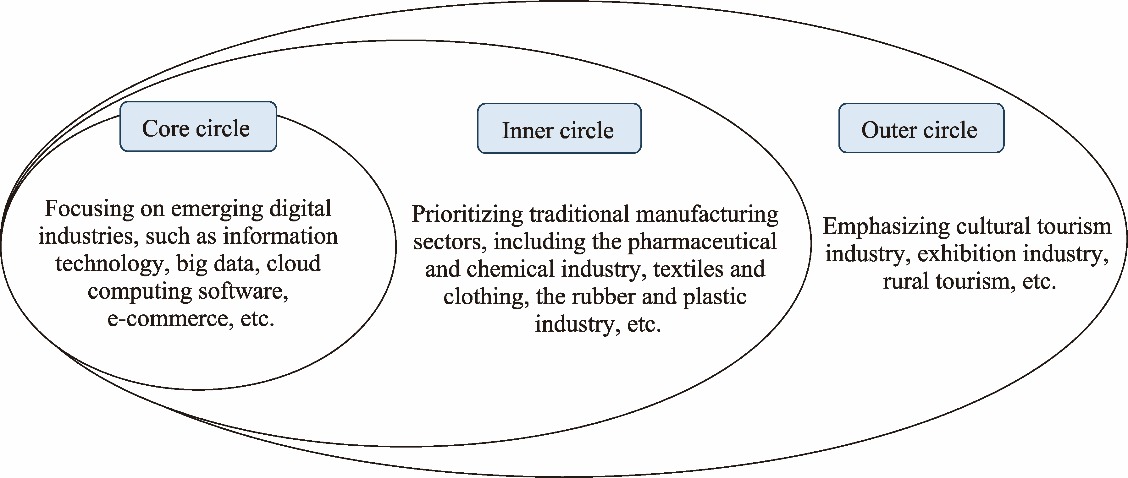
Coordinative development across various systems, particularly the economic, social, cultural, and human resources subsystems, is a key aspect of urban sustainability and has a direct impact on the quality of urbanization. The Hangzhou Metropolitan Circle, comprising Hangzhou City, Huzhou City, Jiaxing City, and Shaoxing City, was the first metropolitan circle approved by the National Development and Reform Commission (NDRC) as a demonstration of economic transformation in China. To evaluate the coupling coordination degree of the four cities and analyze the coordinative development in three systems (including digital economy, regional innovation, and talent employment), we collected panel data during 2015-2022 from these four cities. The development level of the three systems was evaluated by the standard deviation method and comprehensive development index. The results are as follows: (1) the level of coupling coordinated development of the three systems in the Hangzhou Metropolitan Circle was relatively low; (2) the coupling coordination degree of the four cities in the Hangzhou Metropolitan Circle showed significant regional differences, among which Hangzhou City was in the leading position, and Huzhou, Jiaxing, and Shaoxing cities made steady but slow progress in the coupling development of the three systems; and (3) the development of digital economy and talent employment needs to be strengthened. This study contributes to the coordinative development of Hangzhou Metropolitan Circle by innovatively focusing on the coupling coordination relationship among digital economy, regional innovation, and talent employment, which also meets the industrial layout of Hangzhou Metropolitan Circle. In this way, the optimal allocation and sustainable development of digital economy, regional innovation, and talent employment in the Hangzhou Metropolitan Circle can be achieved.
QIU Luyi , Sharina OSMAN , HUA Yidi . Coupling coordinated development among digital economy, regional innovation, and talent employment: A case study in the Hangzhou Metropolitan Circle, China[J]. Regional Sustainability, 2024 , 5(1) : 100115 . DOI: 10.1016/j.regsus.2024.100115
| [1] | Banalieva, E.R., Dhanaraj, C., 2019. Internalization theory for the digital economy. J. Int. Bus. Stud. 50(8), 1372-1387. |
| [2] | Billings, S.B., Johnson, E.B., 2012. The location quotient as an estimator of industrial concentration. Reg. Sci. Urban Econ. 42(4), 642-647. |
| [3] | Carlino, G.A., Chatterjee, S., Hunt, R.M., 2007. Urban density and the rate of invention. J. Urban Econ. 61(3), 389-419. |
| [4] | Chen, Z.H., 2015. Spatial econometric analysis of the impact of industrial agglomeration on regional innovation. East China Economic Management. 29(11), 59-65, 87 (in Chinese). |
| [5] | Chen, Z.J., Sun, Y.N., 2022. Digital economy, R&D innovation and regional integration: a study based on three Chinese urban agglomerations. International Journal of Economics, Finance and Management Sciences. 10(3), 83-91. |
| [6] | Dong, F., Wang, Y., Zheng, L., et al., 2020. Can industrial agglomeration promote pollution agglomeration? Evidence from China. J. Clean Prod. 246, 118960, doi: 10.1016/j.jclepro.2019.118960. |
| [7] | Dong, K.J., Yang, M.X., 2018. Analysis of innovation system and innovation ecosystem. Science and Technology Management Research. (14), 1-9 (in Chinese). |
| [8] | Dong, L.Y., Shang, J., Ali, R., et al., 2021. The coupling coordinated relationship between new-type urbanization, eco-environment and its driving mechanism: A case of Guanzhong, China. Front. Environ. Sci. (9), doi: 10.3389/fenvs.2021.638891. |
| [9] | Duarte, L.O., Reis, D.A., Fleury, A.L., et al., 2021. Innovation ecosystem framework directed to Sustainable Development Goal # 17 partnerships implementation. Sustain. Dev. 29(5), 1018-1036. |
| [10] | Fang, C.L., Yu, D.L., 2017. Urban agglomeration: An evolving concept of an emerging phenomenon. Landsc. Urban Plan. 162, 126-136. |
| [11] | Fang, W.W., 2007. Mechanism analysis of spatial agglomeration of information industry. Journal of Nanjing University of Science and Technology. (5), 5-7 (in Chinese). |
| [12] | Fernandes, G., O’Sullivan, D., 2022. Project management practices in major university-industry R&D collaboration programs - a case study. J. Technol. Transf. 48(1), 361-391. |
| [13] | Galster, G.C., Killen, S.P., 1995. The geography of metropolitan opportunity: A reconnaissance and conceptual framework. Hous. Policy Debate. 6(1), 7-43. |
| [14] | Grigorescu, A., Pelinescu, E., Ion, A., et al., 2021. Human capital in digital economy: An empirical analysis of Central and Eastern European countries from the European Union. Sustainability. 13(4), 2020, doi: 10.3390/su13042020. |
| [15] | Guo, X.X., Tao, H., 2022. Digital economy empowering vocational education adaptability. Journal of Guizhou Normal University. (1), 65-74 (in Chinese). |
| [16] | Hangzhou Municipal Bureau of Statistics, 2017. Hangzhou Statistical Yearbook. Beijing: China Statistics Press (in Chinese). |
| [17] | Hangzhou Municipal Bureau of Statistics, 2023. Hangzhou Statistical Yearbook. Beijing: China Statistics Press (in Chinese). |
| [18] | Hou, L.G., Zhang, X., Zhao, C.R., 2020. Study on coordination of urbanization, economy and environment in Chengdu metropolitan area. Hubei Agricultural Sciences. 59(19), 91-98 (in Chinese). |
| [19] | Huzhou Municipal Bureau of Statistics, 2018. Zhejiang Statistical Yearbook. Beijing: China Statistics Press (in Chinese). |
| [20] | Huzhou Municipal Bureau of Statistics, 2023. Zhejiang Statistical Yearbook. Beijing: China Statistics Press (in Chinese). |
| [21] | Jiaxing Municipal Bureau of Statistics, 2018. Jiaxing Statistical Yearbook. Beijing: China Statistics Press (in Chinese). |
| [22] | Jiaxing Municipal Bureau of Statistics, 2023. Jiaxing Statistical Yearbook. Beijing: China Statistics Press (in Chinese). |
| [23] | Kogan, L., Papanikolaou, D., Seru, A., et al., 2017. Technological innovation, resource allocation, and growth. Q. J. Econ. 132(2), 665-712. |
| [24] | Kong, D.Y., Chen, Y.C., 2019. Rural industrial integration, human capital and farmer income increase under the rural revitalization strategy - taking Zhejiang as an example. China Agricultural Resources and Zoning. (10), 22-24 (in Chinese). |
| [25] | Li, C., Razzaq, A., ?ztürk, ?., et al., 2023. Natural resources, financial technologies, and digitalization: The role of institutional quality and human capital in selected OECD economies. Resources Policy. 81, 103362, doi: 10.1016/j.resourpol.2023.103362. |
| [26] | Li, J.L., Chen, L.T., Ying, C., et al., 2021b. Digital economy, technological innovation, and green economic efficiency—Empirical evidence from 277 cities in China. Manag. Decis. Econ. 43(3), 616-629. |
| [27] | Li, W., Yong, W., Xie, S., et al., 2021a. Coupling coordination analysis and spatiotemporal heterogeneity between urbanization and ecosystem health in Chongqing municipality, China. Sci. Total Environ. 791, 148311, doi: 10.1016/j.scitotenv.2021.148311. |
| [28] | Liu, J., Li, D., 2019. International comparative of industry-education integration in vocational education: Taking China, Germany, and the United Kingdom as examples. Research on Higher Engineering Education. 4(4), 159-164. |
| [29] | Liu, X.P., Zhang, X.L., 2021. Industrial agglomeration, technological innovation and carbon productivity: Evidence from China. Resour. Conserv. Recycl. 166, 105330, doi: 10.1016/j.resconrec.2020.105330. |
| [30] | Liu, Y., Yang, Y.L., Li, H.H., et al., 2022. Digital economy development, industrial structure upgrading and green total factor productivity: Empirical evidence from China’s cities. Int. J. Environ. Res. Public Health. 19(4), 2414, doi: 10.3390/ijerph19042414. |
| [31] | Ni, J.L., Zheng, X.D., Zheng, Y.M., et al., 2023. Coupling coordination development of the Ecological-Economic System in Hangzhou, China. Sustainability. 15(24), 16570, doi: 10.3390/su152416570. |
| [32] | Pan, W., Xie, T., Wang, Z.W., et al., 2022. Digital economy: An innovation driver for total factor productivity. J. Bus. Res. 139, 303-311. |
| [33] | Pang, Q., Li, M.Z., Li, H., 2019. Research on the spatial coupling and coordinated development of financial agglomeration, regional innovation and ecological efficiency in the Yangtze River Economic Belt. Industrial Technology and Economics. (2), 68-76 (in Chinese). |
| [34] | Pauli, T., Fielt, E., Matzner, M., 2021. Digital industrial platforms. Bus. Inf. Syst. Eng. 63(2), 181-190. |
| [35] | Sahana, M., Hong, H., Sajjad, H., 2018. Analyzing urban spatial patterns and trend of urban growth using urban sprawl matrix: A study on Kolkata urban agglomeration, India. Sci. Total Environ. 628- 629, 1557-1566. |
| [36] | Shaoxing Municipal Bureau of Statistics, 2018. Shaoxing Statistical Yearbook. Beijing: China Statistics Press (in Chinese). |
| [37] | Shaoxing Municipal Bureau of Statistics, 2023. Shaoxing Statistical Yearbook. Beijing: China Statistics Press (in Chinese). |
| [38] | Shen, X., 2019. Hangzhou Metropolitan Circle development report-Information economy and smart city development. Beijing: Social Sciences Literature Press, 175-184. |
| [39] | Shen, Y.S., Yan, J.X., 2015. Research on the coordination of industrial structure and urban spatial pattern in Beijing Tianjin Hebei Metropolitan Circle - Based on the location entropy gray correlation degree and Urban Spatial Gravity Model. Industrial Economic Review. (6), 23-34 (in Chinese). |
| [40] | Tian, Z.X., Li, Y., Niu, X.G., et al., 2023. The impact of digital economy on regional technological innovation capability: An analysis based on China’s provincial panel data. PLoS One. 18(7), e0288065, doi: 10.1371/journal.pone.0288065. |
| [41] | Tong, J.X., Cao, Y.M., 2019. Coordination mechanism and spatial differences of modern service industry and urbanization in the Yangtze River Delta Urban Agglomeration. Shanghai Economy. (1), 51-64 (in Chinese). |
| [42] | Wang, M.T., 1999. Dispersion and mean square error decision-making method for weight determination in multi-index comprehensive evaluation. Chinese Soft Science. 8, 100-107 (in Chinese). |
| [43] | Wu, S.H., Xu, Z.X., 2024. Thoughts on the integrated development of Hangzhou metropolitan area. Cooperative Economy and Technology. (1), 27-29 (in Chinese). |
| [44] | Zaborovskaia, O., Nadezhina, O., Avduevskaya, E., 2020. The impact of digitalization on the formation of human capital at the regional level. Journal of Open Innovation: Technology, Market, and Complexity. 6(4), 184, doi: 10.3390/joitmc6040184. |
| [45] | Zhao, R., Han, X., 2019. On coordinated development of higher education, innovation ability and economic growth—A case study of Henan province. Heilongjiang Researches on Higher Education. (2), 23-29 (in Chinese). |
| [46] | Zhejiang Provincial Bureau of Statistics, 2023. Zhejiang Statistical Yearbook. Beijing: China Statistics Press (in Chinese). |
| [47] | Zhu, C.M., Zhang, X.L., Zhou, M.M., et al., 2020. Impacts of urbanization and landscape pattern on habitat quality using OLS and GWR models in Hangzhou, China. Ecol. Indic. 117, 106654, doi: 10.1016/j.ecolind.2020.106654. |
| [48] | Zhu, W., 2017. Influencing factors of spatial agglomeration of information economy and economic growth: An Empirical Analysis Based on panel data of Zhejiang Province. Economic Survey. (6), 13-18 (in Chinese). |
| [49] | Zhu, W.J., Chen, J.J., 2022. The spatial analysis of digital economy and urban development: A case study in Hangzhou, China. Cities. 123, 103563, doi: 10.1016/j.cities.2022.103563. |
/
| 〈 |
|
〉 |
 REGSUS Wechat
 新公网安备 65010402001202号