

How Himalayan communities are changing cultivation practices in the context of climate change
Received date: 2023-02-17
Revised date: 2023-06-13
Accepted date: 2023-11-05
Online published: 2024-01-09
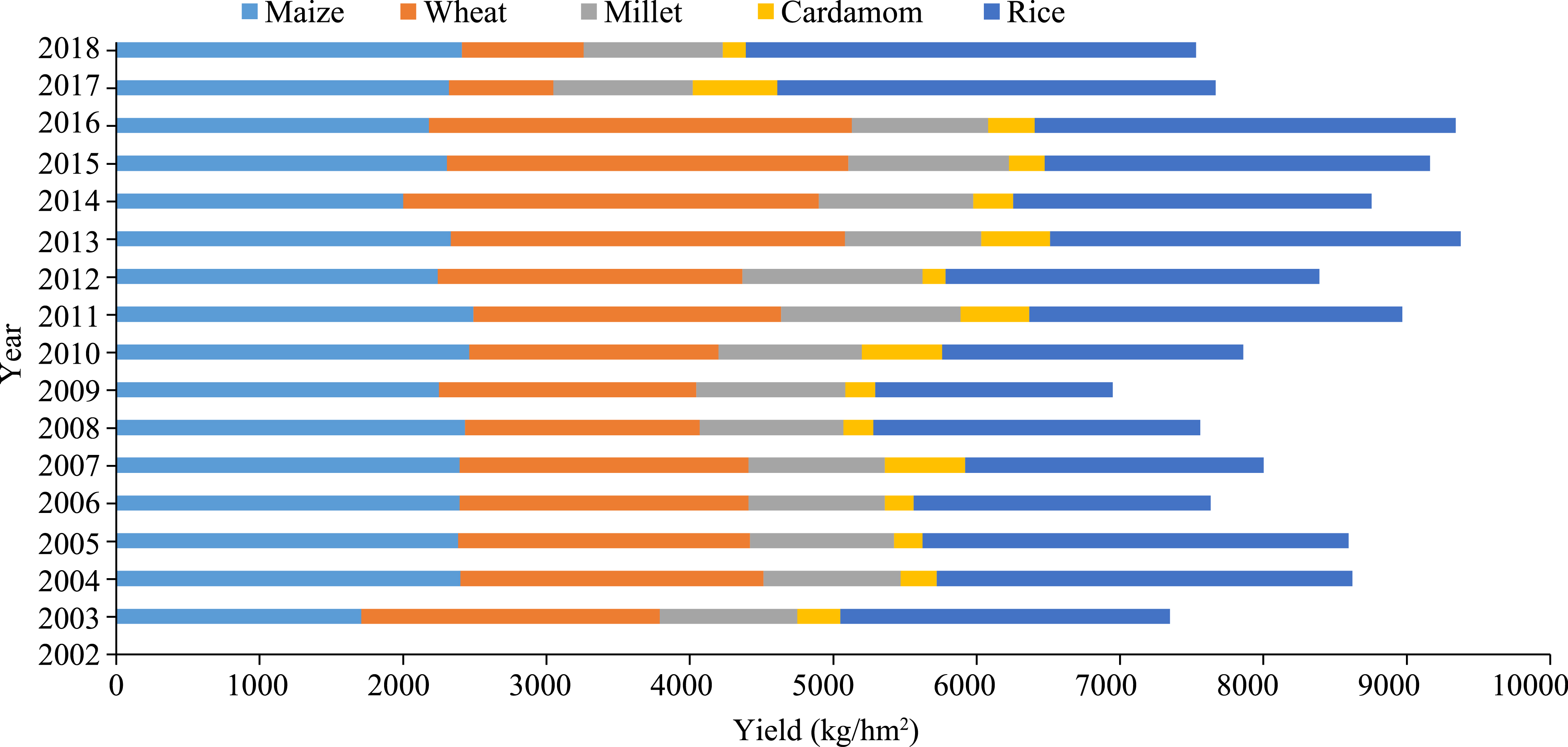
Climate change can have significant impacts on crop yields and food security. This study assessed the linkages between climate change and crop yields to obtain a better understanding on the drivers of food security. The study was conducted in Pasagaun village of Lamjung District in Nepal, where household surveys and focus group discussions (FGDs) were used to collect data including crop cultivation, irrigation facilities, and adaptation strategies. Moreover, climate data (temperature and precipitation) from 1992 to 2020 were collected from the Khudi Bazar meteorological station and crop yield data were obtained from the Agri-Business Promotion and Statistics Division. Trend analysis of temperature and precipitation was conducted using Mann-Kendall trend test and Sen’s slope method, and the results showed an increase in the average temperature of approximately 0.02°C/a and a decrease in the annual precipitation of 9.84 mm/a. The cultivation of traditional varieties of rice and foxtail millet (Kaguno) has vanished. Although, there was no significant impact of the maximum temperature on the yield of rice and maize, the regression analysis revealed that there are negative relationships between rice yield and annual minimum temperature (r= -0.44), between millet yield and annual precipitation (r= -0.30), and between maize yield and annual minimum temperature (r= -0.31), as well as positive relationship between rice yield and annual precipitation (r=0.16). Moreover, average rice yield and millet yield have decreased by 27.0% and 57.0% in 2000-2020, respectively. Despite other reasons for the decrease in crop yield such as the lack of irrigation facilities, out-migration of farmer, and increased pest infestation, respondents have adopted adaptation strategies (for example, shifts in cultivation time and changes in crop types) to minimize the impacts of climate change. More investigation and community-based farming education are needed to understand and alleviate the harmful impacts of climate change on crop yield, as effective adaptation coping strategies are still insufficient. This study provides insights into the adaptation strategies that are necessary to keep food security in the face of climate change.
Key words: Climate change; Crop yield; Adaptation strategies; Farming practices; Food security; Nepal
Ashma SUBEDI , Nani RAUT , Smriti GURUNG . How Himalayan communities are changing cultivation practices in the context of climate change[J]. Regional Sustainability, 2023 , 4(4) : 378 -389 . DOI: 10.1016/j.regsus.2023.11.001
| [1] | Adhikari, A.P., Mathema, A.B., 2023. Examining trends in temperature and precipitation mean/extremes over Gandaki Province, Nepal. J. Water Clim. Chang. 14(7), 2342-2361. |
| [2] | Adhikari, S., 2018. Drought impact and adaptation strategies in the mid-hill farming system of western Nepal. Environments. 5(9), 1-12. |
| [3] | Arunrat, N., Sereenonchai, S., Chaowiwat, W., et al., 2022. Climate change impact on major crop yield and water footprint under CMIP 6 climate projections in repeated drought and flood areas in Thailand. Sci. Total Environ. 807(2), doi: 10.1016/j.scitotenv.2021.150741. |
| [4] | Baidya, S.K., Shrestha, M.L., Sheikh, M.M., 2008. Trends in daily climatic extremes of temperature and precipitation in Nepal. Journal of Hydrology and Meteorology. 5(1), 38-51. |
| [5] | Bashyal, R., Dhakal, S., 2015. Climate Change Impacts and Adaptation Practices in Water Resources: A Case of Salyantar. [2022-03-15]. https://www.amazon.com/Climate-Impacts-Adaptation-Practices-Resources/dp/3659744166. |
| [6] | Bhandari, M.P., 2018. Climate change impacts on food security, a brief comparative case study of Bangladesh, India, Nepal and Pakistan. Acta Scientific Agriculture. 2(8), 136-140. |
| [7] | CBS (Central Bureau of Statistics), 2004. Central Bureau of Statistics of Nepal. Nepal Living Standards Survey 2003/2004. [2022-03-15]. https://microdata.cbs.gov.np/index.php/catalog/9. |
| [8] | Chalise, S., Maraseni, T.N., Maroulis, J., 2015. Adapting to climate variability: The views of peasant farmers in Nepal. Int. J. Global Warm. 7(3), 380-39. |
| [9] | Dahal, B.M., Raut, N., Gurung, S., et al., 2018. Changing trends in cultivation practices and adoption of climate adaptive farming in Eastern Nepal. Sustainable Agriculture Research. 7(3), doi: 10.5539/sar.v7n3p52. |
| [10] | Dahal, H., Karki, M., Jackson, T., et al., 2020. New state structure and agriculture governance: a case of service delivery to local farmers in the eastern gangetic plains of Nepal. Agronomy. 10(12), doi: 10.3390/agronomy10121874. |
| [11] | Dahal, K.R., Dahal, P., Adhikari, R.K., et al., 2023. Climate change impacts and adaptation in a hill farming system of the Himalayan region: Climatic trends, farmers’ perceptions and practices. Climate. 11(1), doi: 10.3390/cli11010011. |
| [12] | FAO (Food and Agriculture Organization of the United Nations). 2009. Geography, Climate and Population. In Aquastat. [2022-05-01]. http://www.fao.org/nr/water/aquastat/countries_regions/NPL/NPL-CP_eng.pdf. |
| [13] | Gurung, G., Pradhananga, D., Karmacharya, J., et al., 2010. Impacts of Climate Change: Voices of the People Based on Field Observations, Information, and Interactions with the Communities of Nepal. Pandol Marga: Practical Action Nepal Office. |
| [14] | Gurung, R., Sthapit, S.R., Gauchan, D., et al., 2016. Baseline Survey Report: II. Ghanpokhara, Lamjung. Integrating Traditional Crop Genetic Diversity into Technology: Using a Biodiversity Portfolio Approach to Buffer Against Unpredictable Environmental Change in the Nepal Himalayas. [2022-04-26]. https://cgspace.cgiar.org/bitstream/handle/10568/81039/LCP_Baseline_Survey_Report_Lamjung.pdf?sequence=1&isAllowed=y. |
| [15] | Hamed, K.H., 2008. Trend detection in hydrologic data: The Mann-Kendall trend test under the scaling hypothesis. J. Hydrol. 329(3-4), 350-363. |
| [16] | Hussain, A., Rasul, G., Mahapatra, B., et al., 2016. Household food security in the face of climate change in the Hindu-Kush Himalayan region. Food Secur. 8(5), 921-937. |
| [17] | Immerzeel, W., 2007. Historical trends and future predictions of climate variability in the Brahmaputra basin. Int. J. Climatol. 28, 243-254. |
| [18] | IPCC (Intergovernmental Panel on Climate Change), 2014. Climate change 2014 impacts, adaptation, and vulnerability Part B: Regional aspects: Working group II contribution to the fifth assessment report of the intergovernmental panel on climate change. [2022-01-05]. https://doi.org/10.1017/CBO9781107415386. |
| [19] | Khatri, N.R., 2013. Climate-change refugees in Nepal: The need for climate-smart capacity building. In: Leal Filho, W., (ed.). Climate Change and Disaster Risk Management. Climate Change Management. Berlin: Springer, 351-357. |
| [20] | Kwholasothar Rural Municipality, 2018. Gandaki Province, Government of Nepal. [2022-04-26]. https://gandaki.gov.np/#. |
| [21] | Lama, S., Devkota, B., 2009. Vulnerability of mountain communities to climate change and adaptation strategies. Agric. Environ. 10, 76-83. |
| [22] | Liu, W.Z., Yin, T.Y., Zhao, Y.F., et al., 2021. Effects of high temperature on rice grain development and quality formation based on proteomics comparative analysis under field warming. Front. Plant Sci. 12, doi: 10.3389/fpls.2021.746180. |
| [23] | Maharjan, K.L., Joshi, N.P., 2013. Effect of climate variables on yield of major food-crops in Nepal: A time-series analysis. In: Maharjan, K.L., Joshi, N.P., (eds.). Climate Change, Agriculture and Rural Livelihoods in Developing Countries.Berlin: Springer, 127-137. |
| [24] | Maharjan, K.L., Joshi, N.P., Piya, L., 2018. Sources of Climate Change, Its Impact, and Mitigation Issues in Nepal. New Delhi: Rawat Publications, 57-83. |
| [25] | Malla, G., 2009. Climate change and its impact on Nepalese agriculture. J. Agric. Environ. 9, 62-71. |
| [26] | Marahatta, S., Dongol, B., Gurung, G., 2009. Temporal and Spatial Variability of Climate Change over Nepal (1976-2005). Practical Action, Kathmandu. [2022-03-01]. https://www.scirp.org/(S(351jmbntvnsjt1aadkozje))/reference/referencespapers.aspx?referenceid=1119842. |
| [27] | Mendes, M.P., Rodriguez-Galiano, V., Aragones, D., 2022. Evaluating the BFAST method to detect and characterise changing trends in water time series: A case study on the impact of droughts on the Mediterranean climate. Sci. Total Environ. 846, 157428, doi: 10.1016/j.scitotenv.2022.157428. |
| [28] | MoFE (Ministry of Forests and Environment),2019. Climate Change Scenarios for Nepal Adaptation Plan (NAP). Ministry of Forests and Environment, Kathmandu. [2022-03-16]. https://www.climatenepal.org.np/resources/climate-change-scenarios-nepal. |
| [29] | Ogunsola, O.A., Adeniyi, O.D., Adedokun, V.A., 2021. Soil management and conservation: An approach to mitigate and ameliorate soil contamination. In: Marcelo, L.L., Sonia, S., (eds.). Soil Contamination-Threats and Sustainable Solutions. London: IntechOpen, 1-7. |
| [30] | Ostertagova, E., Ostertag, O., 2013. Methodology and application of One-way ANOVA. Am. J. Mech. Eng. 1(7), 256-261. |
| [31] | Palikhey, E., Sthapit, S.R., Gautam, S., et al., 2016. Baseline Survey Report: III. Haku, Jumla. Integrating Traditional Crop Genetic Diversity into Technology: Using a Biodiversity Portfolio Approach to Buffer Against Unpredictable Environmental Change in the Nepal Himalayas: LI-BIRD/NARC/Biodiversity International. [2022-04-26]. https://www.researchgate.net/publication/333866601_Baseline_Report_Hanku_Jumla_Integrating_Traditional_Crop_Genetic_Diversity_into_Technology_Using_a_Biodiversity_Portfolio_Approach_to_Buffer_against_Unpredictable_Environmental_Change_in_Nepal_Himalay. |
| [32] | Pant, K., 2013. Climate change and food security in Nepal. Journal of Agriculture and Environment. 13, 9-19. |
| [33] | Parajuli, A., Upadhya, D., 2016. Periodical deviation in climate and its impact on agriculture in high hill of Nepal, Jumla. Indian J. Econ. Dev. 12(1a), 427, doi:10.5958/2322-0430.2016.00100.1. |
| [34] | Pokharel, B., Wang, S.-Y.S., Meyer, J., et al., 2019. The east-west division of changing precipitation in Nepal. Int. J. Climatol. 40(7), 3348-3359. |
| [35] | Poudel, S., Shaw, R., 2016. The relationships between climate variability and crop yield in a mountainous environment: A case study in Lamjung District, Nepal. Climate. 4(1), 13, doi: 10.3390/cli4010013. |
| [36] | Rahman, A., Kang, S., Nagabhatla, N., et al., 2017. Impacts of temperature and rainfall variation on rice productivity in major ecosystems of Bangladesh. Agriculture & Food Security. 6(1), 1-11. |
| [37] | Regmi, B., Paudyal, A., 2009. Climate Change and Agrobiodiversity in Nepal: Opportunities to Include Agrobiodiversity Maintenance to Support Nepal’s National Adaptation Programme of Action (NAPA). FAO: Roma, 1-15 |
| [38] | Rijal, S.P., 2014. Impact of climate change on large cardamom-based livelihoods in Panchthar District, Nepal. The Third Pole: Journal of Geography Education. 13, 33-38. |
| [39] | Sen, P.K., 1968. Estimates of the regression coefficient based on Kendall’s Tau. J. Am. Stat. Assoc. 63(324), 1379-1389. |
| [40] | Sharma, E., Chettri, N., Eriksson, M., et al., 2009. Climate Change Impacts and Vulnerability in the Eastern Himalayas. [2022-02-17]. https://www.cbd.int/doc/pa/tools/Climate%20change%20impacts%20and%20vulnerabilities%20in%20the%20Eastern%20Himalayas.pdf. |
| [41] | Sharma, G., Partap, U., Dahal, D.R., et al., 2016. Declining large-cardamom production systems in the Sikkim Himalayas: Climate change impacts, agroeconomic potential, and revival strategies. Mt. Res. Dev. 36(3), 286-298. |
| [42] | Shrestha, A.B., Wake, C.P., Mayewski, P.A., et al., 1999. Maximum temperature trends in the Himalaya and its vicinity: An analysis based on temperature records from Nepal for the period 1971-94. J. Clim. 12(9), 2775-2786. |
| [43] | Shrestha, M., 2014. The dynamics of mountain agriculture and land change in Lamjung District, Nepal. Global Environmental Research. 18, 151-160. |
| [44] | S?nke, K., Eckstein, D., Dorsch, L., et al., 2020. Global Climate Risk Index 2020. [2022-02-17]. https://germanwatch.org/en/download/7170.pdf. |
| [45] | Sujakhu, N.M., Ranjitkar, S., He, J., et al., 2019. Assessing the livelihood vulnerability of rural indigenous households to climate changes in Central Nepal, Himalaya. Sustainability. 11(10), doi: 10.3390/su11102977Thapa-parajuli. |
| [46] | Thapa-parajuli, R., Devkota, N., 2016. Impact of climate change on wheat production in Nepal impact of climate change on wheat production in Nepal. Asian Journal of Agricultural Extension, Economics & Sociology. 9(2), 1-14. |
| [47] | UNFCCC (United Nations Framework Convention on Climate Change), 2004. United Nations Framework Convention on Climate Change: The First Ten Years. In UNFCCC. [2022-05-21]. https://unfccc.int/resource/docs/publications/first_ten_years_en.pdf. |
| [48] | Upadhayaya, R.P., Baral, M.P., 2020. Trends of climate change in some selected districts of Western Nepal. Janapriya Journal of Interdisciplinary Studies. 9(1), 148-158. |
| [49] | Wang, S.Y., Yoon, J.H., Gillies, R.R., et al., 2013. What caused the winter drought in western Nepal during recent years? J. Clim. 26(21), 8241-8256. |
| [50] | WFP (World Food Programme), 2013. Nepal Food Security Situation. [2022-08-08]. https://reliefweb.int/sites/reliefweb.int/files/resources/wfp260241.pdf. |
| [51] | WWF (World Wildlife Fund), 2021. Hariyo Ban Program, Phase-II, Volume III: Program Legacy Documentation. WWF Nepal, Hariyo Ban Program, Kathmandu, Nepal. [2022-02-02]. https://pdf.usaid.gov/pdf_docs/PA00XWM6.pdf. |
| [52] | Xiao, D., Zhang, Y., Bai, H., et al., 2021. Trends and climate response in the phenology of crops in Northeast China. Front. Earth Sci. 9, 1-13. |
| [53] | Xu, J., Grumbine, R.E., Shrestha, A., et al., 2009. The melting Himalayas: Cascading effects of climate change on water, biodiversity, and livelihoods. Conserv. Biol. 23(3), 520-530. |
| [54] | Yadav, R.K., Adhikari, A.R., Gautam, S., et al., 2018. Diversity sourcing of foxtail millet through diversity assessment and on-farm evaluation. Cogent Food Agr. 4(1), doi: 10.1080/23311932.2018.1482607. |
| [55] | Yao, P., Qian, L., Wang, Z.L., et al., 2022. Assessing drought, flood, and high temperature disasters during sugarcane growth stages in Southern China. Agriculture-Basel. 12(12), doi: 10.3390/agriculture12122117. |
| [56] | Zhao, M.Q., Boll, J., 2022. Adaptation of water resources management under climate change. Front. Water. 4, doi: 10.3389/frwa.2022.983228. |
/
| 〈 |
|
〉 |
 REGSUS Wechat
 新公网安备 65010402001202号